“Attention Must Be Paid”: The Vanishing BYU Racial Slur Saga [Updated]

Ethics Alarms mentioned this nauseating but significant story briefly last week, here. Obviously it warrants more consideration, depressing though the conclusions might be.

At an August 26 volleyball match, match on Aug. 26, Duke volleyball player Rachel Richardson’s claimed that she and her African American team mates targeted with repeated racial slurs from a crowd of more than 5,500 people the the Brigham Young University arena in Provo, Utah.  Richardson’s  godmother, Lesa Pamplin, was not at the match but still told the media that someone yelled “nigger” every single time Rachel was serving. Her father, Marvin Richardson, told The New York Times that the slur was repeatedly yelled from the stands at his daughter.

Well, they said it happened, so it must be true.

Moving with unseemly speed, BYU authorities fingered a fan pointed out by Richardson as the racist culprit and announced that he would be banned from Cougars’ sporting events evermore. Duke’s athletics director Nina King quickly said that her players “should always have the opportunity to compete in an inclusive, anti-racist environment which promotes equality and fair play.” University of South Carolina coach Dawn Staley, racing to grandstand, canceled all her team’s games against BYU, since its fans are obviously racists.

“I’m disgusted that this behavior is happening and deeply saddened if others didn’t step up to stop it,” Utah’s Republican Governor Spencer Cox tweeted on August 27 without know what happened. “As a society we have to do more to create an atmosphere where racist assholes like this never feel comfortable attacking others. ESPN resident race-baiter Stephen Smith was in high dudgeon. “I’m saying BYU- you did it!” Smith said on the air. “By allowing this to happen and not addressing expeditiously, not addressing it with a level of quickness and speed that you should’ve addressed this with.”

They banned the alleged racist before the game was over—how much faster could BYU have been?

Mike Freeman, the race and inequality editor for the sports section at USA Today, wrote a column on August 27 in which he called Richardson a “hero” and demanded an investigation. “What needs to happen next is a full investigation by BYU. If the school simply tries to move on with nothing but a statement that simply isn’t acceptable,” he wrote. “They need to interview players and coaches and the question consistently needs to be asked: why wasn’t the game stopped?”

Oopsie! They had the investigation, and found no evidence whatsoever that anyone was shouting racial slurs in the stands. Video showed that the fan BYU banned wasn’t shouting anything when Richardson was serving. Gee, the school said, we’re sorry for calling you a racist! Come back and cheer for us any time!

Continue reading

Ethics Observations On Gallup’s U.S. “Moral Values” Poll

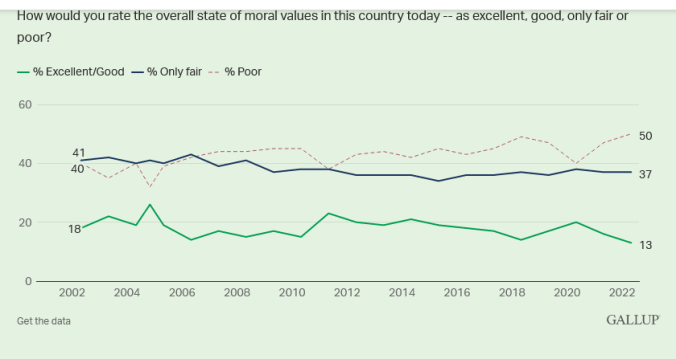
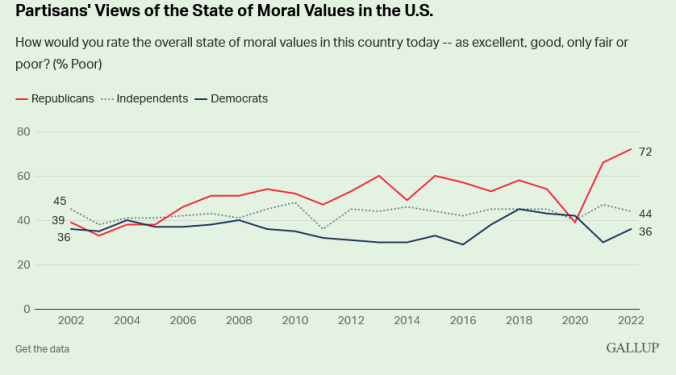
Gallup released a depressing poll last week that it headlined, “Record-High 50% of Americans Rate U.S. Moral Values as ‘Poor.'” Like many Gallup polls, but perhaps more than most, this one suffered badly from a failure a define terms and to ensure that respondents were basing their judgments on the same understanding of “values.” Using the term “moral” rather than “ethical” to define values is a crippling error: it automatically directs attention to religion. This, in turn, probably explains this chart…

…in which twice as many Republicans as Democrats rate the state of “moral values” as “poor.” About twice as many Republicans and Democrats are religious: the result was preordained. Morality involves behavioral codes, notably the Ten Commandments. Republicans are more likely to believe that such codes should guide conduct, although the whole point of moral codes is that one doesn’t have to think: just follow the code, and you’ll be “good.” Democrats have increasingly embraced the idea of subjective values and personal codes, “pursuing one’s truth.” Their idea of poor values are values that seem contrary to their objectives.

The poll does not rank values, or even require respondents to identify what values they think are being violated or ignored. Thus the figures given for various measurements in the poll are by definition apples, oranges and eggplants mash-ups. For example, a core ethical value is fairness, but progressives increasingly believe what is fair is for everyone to achieve the same level of success, security, comfort and power regardless of effort, ability, or contributions to society. Conservatives believe  fairness means that every individual should be allowed to achieve according to his or her aspirations and best efforts given the resources, talents and opportunities distributed by the vicissitudes of life and luck, and keep and use the rewards of those efforts, if any. Asking whether a group believes that life in the U.S. is fair when the group holds diametrically opposed definitions of the word is useless.

Similarly, an increasing component of the American Left believes that the U.S. Constitution embodies the wrong values. They believe it would be more “moral” to censor speech so as not to “harm” vulnerable populations; to keep “dangerous” ideas and “misinformation” advocated by Bad People from being heard or read. They believe that a right to self-defense is “immoral” because the tools of self-defense can be used to kill. They also believe, as we have seen in recent weeks, that it is “moral” to allow the mass killing of the unborn, because otherwise women are hindered in their opportunities and life choices by “unfair” biology. Most conservatives view those positions as opposition to American values.

Continue reading

How Long Will Women, Parents And Feminists Tolerate This? [Photo Added]

I don’t understand the persistence of such a blatantly unethical situation at all. It is the apotheosis of “It isn’t what it is.” Any group, movement, elected official or individual who approves of such an obvious injustice should be branded as untrustworthy, whether it be due to intellectual deficiencies, dishonesty, delusion or cowardice.

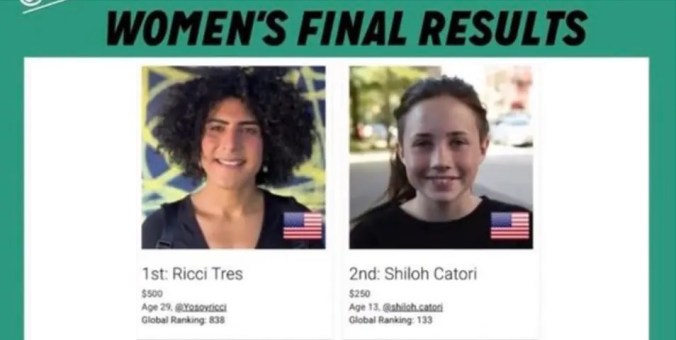
Ricci Tres, a 29-year-old transgender woman, defeated 13-year-old Shiloh Catori, to win the $500 top prize in a women’s division of New York City street skateboarding competition. The real girl got $250. Four of the six finalists were under the age of 17, with the youngest being 10-year-old Juri Iikura, who came in fifth. Tres was the oldest contestant. Tres had previously failed to qualify for the Women’s Street USA Skateboarding National Championships in a bid to qualify for  the Olympics, but was rejected because of an excess of testosterone, according to The Daily Mail. Obviously, Tres is the victim of transphobia.

So she decided to beat some little girls and pick up an easy 500 bucks. It should cover shaving costs. Continue reading

Ethics Hero: FINA (The International Swimming Federation)

Now do cycling, weightlifting, wrestling and running.

The world governing body for swimming voted to bar transgender women from the highest levels of women’s international competition, bringing expertise, authority and common sense to a debate that had been distorted by the Mad Left’s inexplicable commitment to radical transexual ideology.

FINA administers international competitions in water sports, and now definitively prohibits transgender women from competing unless they began medical treatments to suppress production of testosterone before going through one of the early stages of puberty, or by age 12, whichever occurred later. This is now one of the strictest rules against transgender participation in international sports, and with any luck and some courage elsewhere, it will have the necessary effect on other sports as well. Going through male puberty gives transgender women a massive physical advantage over most athletes born female, as the pool exploits of University of Pennsylvania’s unethical swimming champion Lia Thomas made obvious. Continue reading

Capital Punishment Ethics Dunce: Maricopa County Superior Court Judge Stephen Hopkins

Bad decision, bad opinion, bad judge.

As regular readers here know, I strongly favor capital punishment, but only when there is no doubt whatsoever about the facts and the guilt of the convicted defendant, when the crime is so cruel, horrific and premeditated that normal murders seem tame in comparison, and when the procedural due process is followed to the letter.

Continue reading

Rep. Cawthorne And The Cross-Dressing Future Congressman Principle Question

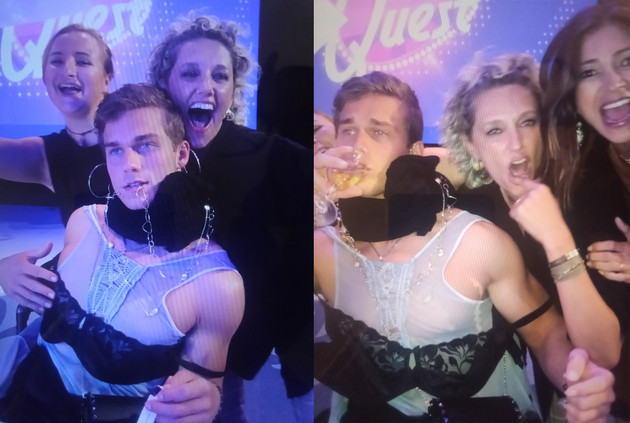
Yes, this is a funny controversy, but not entirely trivial. And you knew Ethics Alarms would be on it like hound on a hock of ham, because examining the Naked Teacher Principle [NTP]and its real or proposed extensions, sisters, cousins and aunts, have been a periodic obsession of both Ethics Alarms and its predecessor, The Ethics Scoreboard. Add to that the fact that that Madison Cawthorn (R-NC.), is both a Christian values-spouting politician and a mega-jerk, and the photo above, showing him cavorting in lingerie, cannot be ignored (or, once seen, unseen).

The Principle states that a secondary school teacher or administrator (or other role model for children) who allows pictures of himself or herself to be widely publicized, as on the web, showing the teacher naked or engaging in sexually provocative poses, cannot complain when he or she is dismissed by the school as a result.

It is important to remember that even the Naked Teacher Principle does not hold that teachers necessarily should be dismissed if old photos surface of them online that show more of them than parents and schools want students to see, but that it is their own carelessness that created their career crisis, and that the decision to dismiss them is ethically defensible. Most recent posts on the topic involve whether the NTP can be applied to other professions.The last time it was discussed, in 2012, involved a nurse who made money on the side by posing provocatively on a sexually themed website. The conclusion here was was that there was no “Naked Nurse Principle,” and that her firing was unjust.  The previous NTP-related post involved, almost a year before that one,  rebutting the argument that there are similar principles regarding police and firefighters. Some of the more interesting versions that have been explored on Ethics Alarms include The Female Bodybuilder Firefighter Principle, The Drag Queen Principal Principle, The Online Porn Star Teacher Principle, Naked Naval War College Professor Principle, and more.

So now we must ask, “Is there a Cross-Dressing Future Congressman Principle”? Continue reading

Baseball Hall Of Fame Ethics: This 2016 Post Just Became Ripe And Moot At The Same Time

The sportswriters who decide who is admitted to the Major League Baseball Hall of Fame voted in David Ortiz yesterday. The Red Sox and Boston icon (Carl Yastrzemski once said that while Ted Williams was the greatest Boston baseball player, Ortiz was the most important, and he was right) sailed into the Hall in his first year of eligibility, an honor few players have ever been accorded.

It was no surprise. In addition to having unquestionable statistical qualifications, “Big Papi” is also personally popular. That matters, a lot; the writers this year rejected Boston pitching ace Curt Schilling who also has impeccable Hall qualifications, because they don’t like him. Schilling is opinionated, combative, religious, and worst of all, politically conservative. Can’t have that. On the plus side, the writers also rejected steroid cheats Barry Bonds, Alex Rodriguez and Manny Ramirez, as well as almost certain steroid cheats Roger Clemens, Sammy Sosa and Gary Sheffield.

In 2016, anticipating and dreading yesterday’s news, I wrote a post titled, “The Wrenching Problem Of David Ortiz, The Human Slippery Slope.”

Here it is again.

Ethics conflicts force us to choose when multiple ethical principles and values point to diametrically opposed resolutions.  Often, a solution can be found where the unethical aspects of the resolution can be mitigated, but not this one. It is a tale of an ethics conflict without a satisfactory resolution.

I didn’t want to write this post. I considered waiting five years to write it, when the issue will be unavoidable and a decision mandatory. Today, however, is the day on which all of Boston, New England, and most of baseball will be honoring Red Sox designated hitter David Ortiz, who will be playing his finale regular season game after a 20 years career.  His 2016 season is quite possibly the best year any professional baseball player has had as his final one; it is definitely the best season any batter has had at the age of 40 or more. Ortiz is an icon and a hero in Boston, for good reason. Ortiz was instrumental in breaking his team’s infamous 86-year long “curse” that saw it come close to winning the World Series again and again, only to fail in various dramatic or humiliating ways. He was a leader and an offensive centerpiece of three World Champion teams in 2004, 2007, and 2013. Most notably, his record as a clutch hitter, both in the regular season and the post season is unmatched. You can bring yourself up to speed on Ortiz’s career and his importance to the Red Sox, which means his importance to the city and its culture, for nowhere in America takes baseball as seriously as Beantown, here.

That’s only half the story for Ortiz. Much of his impact on the team, the town and the game has come from his remarkable personality, a unique mixture of intensity, charm, intelligence, generosity, pride and charisma. After the 2013 terrorist bombing of the Boston Marathon, which shook the city as much as any event since the Boston Massacre, Ortiz made himself the symbol of Boston’s anger and defiance with an emotional speech at Fenway Park. Then he put an exclamation point on his defiance by leading the Red Sox, a last place team the year before, to another World Series title. Continue reading

Comment Of The Day: “On Transgender Competitors Being Permitted In Women’s Sports: Is It Possible To Be More Ethically And Logically Muddled Than This?”

In this Comment of the Day, the first of two this morning, Extradimensional Cephalopod provides useful perspective on the logical and ethical flaws inherent in the trans athletes fiasco, as well as the weak arguments presented by advocates of biological males competing in girls’ and women’s sports. [That’s transgender female powerlifter Janae Kroc above, before (when she was Matthew Kroczaleski, and after. He/she calls himself/herself “gender fluid,” so when feeling feminine, Janae competes against women. She does…well.]

Here is EC’s COTD, on the post, “On Transgender Competitors Being Permitted In Women’s Sports: Is It Possible To Be More Ethically And Logically Muddled Than This?”

***

The nature of most sports is a form of the liability of conflict: uncertain motivational obstacles. People want to be uncertain about the outcome of a sporting event, such that much of what decides the outcome is the motivation, the character, and the efforts of the competitors. That’s why weight classes in wrestling and boxing exist. If one competitor is larger and more physically powerful than the others, and that makes a predictable difference, that moves the event into the realm of scarcity: known physical obstacles, and out of the realm of sports.

If we want to spend the money to decouple gender and ability in sports, well and good. As long as they’re tied together, though, ability must be the priority for arranging match-ups, or else it stops being sport. (Testosterone treatments are a separate factor that would probably need to have its own class, because they’re artificial treatments that cause muscle growth.)

Due to budgetary constraints, only a subset of the most physically capable (cisgender) students are usually able to compete in academic sports, which rules out most students. (Sometimes there are also the equivalent of the Paralympics, to allow people with physical impairments to compete in sports with other athletes of similar physical ability.) Everyone who doesn’t make the team does other things, and sometimes they do amateur sports. People aren’t entitled to be on the school team, though. Continue reading

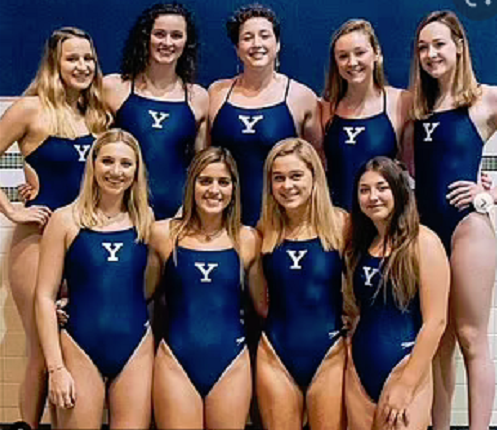
A “Two Wrongs Don’t Make A Right” Episode For The Ages: Trans Female Swimmer Lia Thomas Is Finally Beaten…by a Trans Male Swimmer…Competing As A Female

What ethical principles are we supposed to glean from this crazy story?

Lia Thomas, a biologically male swimmer who has transitioned to female, has been unfairly crushing all female collegiate competition while being allowed to compete as a transgender athlete. Ethics Alarms has covered the story in more than one post. Lia herself is unapologetic, and her Machiavellian coach is reportedly thrilled. Thomas’s teammates and opponents are not so thrilled, but so far have lacked the courage to take any meaningful action to preserve the integrity of their sport, fearing to end up like J.K. Rowling but without all the money.

So was ex-man Thomas unbeatable as a current woman? No! Yale female swim team star Iszac Henig defeated her in the women’s 100-meter freestyle with a time of 49.57 seconds. In fact, Thomas finished fifth with a time of 52.84 seconds. (How did THAT happen? Sounds like she “took a dive” to me, no pun intended…) In the 400-freestyle relay, Henig completed her leg in 50.45 seconds versus Thomas’ 51.94.

There is a catch, however. Henig is also a trans competitor, except that she is in the process of transitioning from female to male. In order to illustrate this with a dramatic gesture, the 20-year-old pulled down the top of his swimsuit to reveal the absence of breasts, which she-soon-to-be-he has had removed. A UPenn parent remarked, “I wasn’t prepared for that. Everything is messed up. I can’t wrap my head around this.”

Continue reading

‘Making An Example’ Ethics: The Condemnation Of Eddie Slovik

Eddie Slovik

Last year, when I noted this story in the December 23 warm-up, I was asked if there would be more on the topic. Here is more. It deserves it.

During World War II, U.S. Army Pvt. Eddie Slovik was tried for desertion. On this date in 1944 he was found guilty in his court martial and condemned to death by firing squad. It was the first such sentence against a U.S. Army soldier since the Civil War, and Slovik was the only soldier executed for desertion in World War II. In the intervening years between then and now, his death has become a point of ethical controversy, never resolved, and generally debated before the public from an emotional rather than an ethical, legal or even a military perspective.

I was first told the story of Eddie Slovik by my father, a decorated army veteran and officer during the war. A fervent admirer of General Eisenhower, he still disagreed with Ike’s much criticized decision to allow Slovik’s execution by firing squad to go forward. Dad was not supportive of the command principle of using a particularly blatant example of a crime to send a message to others considering similar conduct, and having had several Eddie Sloviks to contend with under his command, he did not like the resolution of the Slovik dilemma.

I argued the point with him many times over the years. “The question isn’t whether it was fair for Slovik to have been shot,” I told him. “It was. The question is whether many more deserters should have been shot as well.”

Private Eddie Slovik was a draftee, and not a good bet to be a good soldier. He had been classified 4-F because he had spend time in prison for a felony (grand theft auto), but was deemed draftable as the Allied war effort required quantity even more than quality as the conflict dragged on. He was trained to be a rifleman, though Slovik claimed that he hated guns.

In August of 1944, the Army shipped Slovik to France to fight with the 28th Infantry Division, which had suffered massive casualties. When he experienced being under heavy fire for the first time, Slovik concluded that he would not make it in combat. Though the current trend is to say that he and a friend “got lost,” it seems more likely that they were hiding before they turned themselves in to the Canadian military police. The Canadians returned the two to the Americans after about a month and a half.

Slovik asked the company commander if “getting lost” again would be considered desertion. Despite being warned that it would be, he went AWOL, then the next day turned himself in at a nearby field kitchen. He handed the cook this statement:

Continue reading