A Horror Story From The Law vs. Ethics Files: The Mario Hernandez Saga [UPDATED and BACKDATED!]

Mr. Hernandez? Mr. Unger would like a word with you...

Mr. Hernandez? Mr. Unger would like a word with you…

This is complicated.

Occasionally a trusted source sends me to a link or a news item that turns out to be old, sometimes many years old. I assume it is current (I need to learn to check the dates), write the post, and then find out that what I wrote about took place in 1978. I usually trash the post. There have been a few like this. Now this story came to me from a trusted source, and linked to a current story, or so I thought. The post, on a site called “America Now,” is dated August 25, 2016. But WordPress pointed out, right at the bottom, that I had in fact written about Mario Hernandez’s citizenship problems two years ago. What? For a second I thought there were TWO Marios (Mario brothers?), who had the same problem, but no, they are the same guy.

The story  I was given today, based on this New York Times story from May of 2014, led to the post below. There is an ending to the story, which was explicated by me in the post of two years ago. However my two posts were on two different ethics issues, and today’s though inspired by a stale story, is still ethically useful. Pretend Mario plight isn’t two years old: that doesn’t alter the principles involved, or my analysis. I’ll tell you what happened at the end of the post..

***

Continue reading →

Unethical Tweet Of The Month: Novelist Ann Rice

Can you see your hypocrisy when you look in the mirror, Ann?

Can you see your hypocrisy when you look in the mirror, Ann?

“The sex scandal at Fox matters; it’s at the heart of the GOP contempt for women as citizens and human beings.”

—-“Interview With The Vampire” author Ann Rice, on Twitter.

This is signature significance in so many ways. To write this in a public forum, one has to be completely corrupted by partyism, tunnel-vision, bias and the certainty that you are operating in an environment populated with millions of similarly disabled individuals. It also helps to be either dishonest or ignorant, or both.

Let’s try to count all the ways Rice’s tweet is unethical:

1. Sexual harassment scandals occur in all kinds of organizations, including otherwise virtuous non-profits and models of progressive thinking. The University of California at Berkley–the infamously right wing institution— has one going on right now. Yale has been covering up a sexual harassment scandal involving a world-famous ethicist.  These are just  examples of sexual harassment that make it to the headlines. I work in the field: believe me, there is no monopoly by Republicans or conservatives in this area. For Rice to insinuate otherwise is nothing more than disinformation born of her own biases.

In the alternative, she knows this is absurd, and is lying.

2. The statement embodies guilt by association at its worst. How about this: “The Brian Williams scandal at NBC matters; it’s at the heart of the Democratic Party’s contempt for the public as citizens and human beings” ? There’s no ethical difference: both statements are unfair and dishonest. I’ll wager that the percentage of Democrats who work for NBC is significantly greater than the proportion of Republicans who work at Fox. The political parties have nothing whatsoever to do with either situation.

3. Ailes’ engagement in harassing conduct is difficult to deny, especially after so many past employees have surfaced to bolster the accusations made in the recent lawsuit. Whether there is a wider problem beyond Ailes is completely unproven. Personally, I don’t doubt it: when leaders of organizations model such conduct, it typically corrupts the entire culture. However, it is far too soon to make the kind of leap Rice is making, which not only assumes company-wide harassment but somehow attributes it to another organization, the Republican Party.

4. Most of all, and to save the  best and funniest for last, has Rice never heard of Bill Clinton? Continue reading →

Health And Survival Rationing Ethics

cointoss

Beginning in 2012, Dr. Lee Daugherty Biddison, a critical care physician at Johns Hopkins and some colleagues have held public forums around Maryland to solicit the public’s opinions about how life-saving medical assistance should be distributed when there are too many desperately ill patients and not enough resources. The exercise was part of the preparation  for Biddenson’s participation in preparing official recommendations for state agencies that  might end up  as national guidelines regarding when doctors should remove one patient from a ventilator to save another who might have a better chance of surviving, or whether the young should have priority over the old.

Ethically, this is pure ends justifying the means stuff. The Golden Rule is useless—How would you like to be treated? I’d want to be left on the ventilator, of course!–and Kantian ethics break down, since Immanuel forbade using human life to achieve even the best objectives…like saving a human life. Such trade-offs of life for life (or lives) is the realm of utilitarianism, and an especially brutal variety….so brutal that I doubt that it is ethics at all.

When Dr. Biddenson justifies his public forums by saying that he wants to include current societal values in his life-for-a-life calculations, she is really seeking current biases, because that’s all they are. On the Titanic, it was women and children first, not because it made societal sense to allow some of the most productive and vibrant minds alive to drown simply because they had a Y chromosome, but because that’s just the way it was. Old women and sick children got on lifeboats;  young men, like emerging mystery writer Jacque Futrelle (and brilliant young artist Leonardo DiCaprio), went down with the ship. That’s not utilitarianism. That’s sentimentalism.

The New York Times article mostly demonstrates that human beings are incapable of making ethical guidelines, because Kant was right: when you start trading one life for another, it’s inherently unethical, even if you have no choice but to do it. Does it make societal sense to take away Stephen Hawking’s ventilator to help a drug-addicted, habitual criminal survive? Well, should violating drug laws sentence a kid to death? TILT! There are no ethical answers, just biased decisions. Continue reading →

New Media Ethics Rule For The Presidential Campaign…

RedSmears

This kind of smear (from Salon)…

Washington man stabs kissing interracial couple, cites Donald Trump when arrested

…has got to stop.

It doesn’t matter which candidate some despicable, hateful wacko “cites.” It’s not news, it means nothing, and it proves nothing positively or negatively about the individual so mentioned, praised, or referenced. Any news source that highlights it to suggest otherwise is playing despicable cognitive dissonance games, and is devoid of fairness and honesty.

Of course, this is Salon. But it is not alone. Continue reading →

Ethics Observations On The Naked Trump Statues

Naked Trump

Last week, five identical statues of a grossly caricatured nude Donald Trump  appeared overnight on street corners in San Francisco, Los Angeles, Cleveland, Seattle, and New York City.  The Washington Post reported that the anarchist collective INDECLINE made and placed the statues. It called the  project “The Emperor Has No Balls.” Indeed, the otherwise anatomically correct statues showed the Trump effigy missing those particular features, though not bright yellow pubic hair. If you really want to see these assaults on your consciousness and sanity, go here.

I advise against it.

Ethics Observations: Continue reading →

The Pitzer College “POC Only” Roommate Wanted Ad [UPDATED]

"Now THAT's not racism. Why do you honkies have so much trouble understanding this?"

“Now THAT’s not racism. Why do you murderous honkies have so much trouble understanding this?”

A roommate-wanted notice posted on Facebook by a Pitzer College student has turned into yet another racial controversy. The student, along with two Pomona College students,  were seeking a fourth to join them in an off-campus house. The notice included “POC only” –person of color only—and this got them immediately called out as racists by some other students.

The ad is not racist. The text reflects a bias, as in “preference,” but that isn’t necessarily racism. Everyone has freedom of association in this country, or should. Human beings are more comfortable with those whom they perceive as being more like them. There is nothing wrong with that, but even if there is, it is human nature. There is nothing to be done about it, and there shouldn’t be anything done about it other than to help each other understand that tribalism is divisive and  a pre-programmed bias that we should fight, because getting past it makes us better neighbors, members of society and human beings.

Still, I don’t want to live with someone who doesn’t want to live with me, but who is going to accept me into a living situation based on a feeling of obligation. A house seeking someone else to share the rent isn’t a public accommodation, and there is no ethical principle demanding that the roommates can’t or shouldn’t specify the kind of individual they think would best complete the group. What if the other three are all white, and are seeking someone different from them to make the house more diverse? Is it equally offensive if the ad sought an athlete, or someone overweight (who wouldn’t make the three hefty roomies feel unattractive), or a good student, or an actor, or someone with a good sense of humor? Why? Such requirements are not a per se indication of anything but personal preferences, and personal preferences aren’t racism.

Is the “POC only” addendum unethical? Technically, it fails Kant’s “what if everybody does it?” test,  for if everybody did it, white students would have nowhere to live. There you have an example of where Kant’s Rule of Universality is worth musing about but often isn’t applicable. Some conduct is ethical despite Kant because the idea that it would become universal is too ridiculous. I want to live with a baseball fan. I don’t want to live with someone who is going to be listening to punk rock. If three roommates can look for a female fourth, or a gay fourth, or a Spanish-speaking fourth—and they can without nicking any ethics principles at all—then they can insist on racial or ethnic qualifications too.

Is it better ethics to be accepting of all equally? Sure it is. But not exhibiting exemplary ethics isn’t unethical. Again, it’s just human.

There is more to the story however. When some students commented on Facebook that the notice was racist, the replies from the students posting it and others expanded the controversy.

The Claremont Independent, a student paper that covers all five of the Claremont colleges (as well as two graduate schools), of which Pitzer is a member, published some of the comments, and they show the anti-white animus and double standards now roiling race relations in the U.S. Continue reading →


Doesn’t Islam Endorse Sportsmanship? Even In The Olympics?

At the Rio de Janeiro Olympics today, Egyptian Olympic judo fighter Islam El Shehaby refused to shake the hand of his Israeli opponent Or Sasson.

After Sasson defeated El Shehaby he put out his hand, which is customary in judo. Competitors are expected to either shake hands or bow at the beginning and end of matches. El Shehaby, however, insulted his opponent by rejecting the gesture and backing away, shaking his head. The referee called him to returnto the mat to bow, and he gave a perfunctory nod. Then he walked off.

Ah, that glorious Olympic spirit! Continue reading →

Ethics Alert For Clueless Dog Owners: The Walk Is For The Dog

Hey! Here's an idea! BITE HER!

Hey! Here’s an idea! BITE HER!

I promised myself I would write this the next time I saw a young woman in my neighborhood, fit, with earbuds, jogging along briskly as her dog desperately tried to keep up while eying enviously my dog, who is allowed to sniff the plants, mark his territory (aka “the world”), enjoy life, and be a dog instead of a pull-toy.

The freedom to do this  is why dogs get excited about walks.They also like the companionship of their masters, at least when said master is paying some attention to them. They like being talked to, and looked at. I know this will come as a shock to my neighbor, but they do not like being dragged on a leash and forced to trot unstopping, while their self-absorbed owner listens to Adele.

I know dogs aren’t the most edifying conversationalists, but really, if you can’t spare them your full attention for a few short walks a day, don’t get a dog. What my neighbor does is animal cruelty  disguised as a fitness regimen that benefits dog and master.

The look in her dog’s eyes as it passed, panting, collar tugging, broke my heart. The pained expression communicated to my dog, “I’ll love to stay a minute and say hello, but GHHHAHHHG…” and off he went. No pausing, peeing, or playing for him. His owner can’t spare the time.

She’s an asshole.

Next time, I’m going to block her way, make her take out her buds, and tell her off.

Comment of the Day: “Ethics Dunces : Michigan State University Student Feminists”

fairness

Here’s the always provocative Extradimensional Cephalopod, discussing the core ethics value of fairness in his Comment of the Day on the post, Ethics Dunces: Michigan State University Student Feminists:

…Anyone who says that a situation in life is not fair is committing what Nasssim Nicholas Taleb called in his book The Black Swam the “ludic fallacy.” That is, treating real life as though it were a game, with a bounded range of outcomes. The way I’m using the term “ludic fallacy”, it also includes assuming that everyone agreed to rules coming in.

Where do you start defining if a race is fair? Do you start with everyone following the rules? Do you start with everyone having the same amount of free time to practice? Do you start with everyone having the same environment to practice in? Being born with the same physiology? Having the same opportunity costs in their life? Having the same psychological predilection for diligence? Where do we stop?

If you wanted to make things perfectly fair, you’d make everyone perfectly the same, or you would account for every difference and statistically measure their relative skills. But what are we measuring? Their bodies? Their brains? Their will? At some point it becomes a simple scientific fact who is more skilled and fit on average, which defeats the point of the game! The game is supposed to be the process by which we find out who would win, and the fun is in not being able to tell beforehand.

No, we need to stop at the beginning of the game. Everyone agreed to the rules going in; they knew the possible outcomes, and they accepted them. If the rules are followed, then it’s “fair.”

Continue reading →

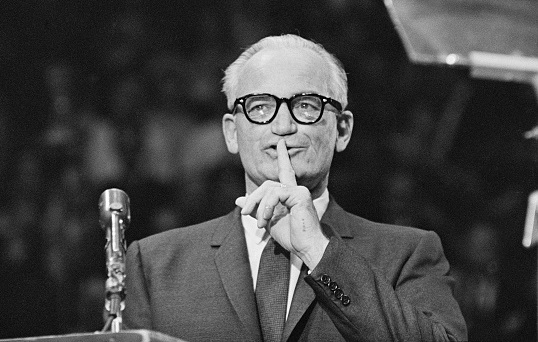
Is “The Goldwater Rule” Necessary?

Barry Goldwater

From an  edict handed down last week by the head of the American Psychiatric Association:

“Since 1973, the American Psychiatric Association and its members have abided by a principle commonly known as “the Goldwater Rule,” which prohibits psychiatrists from offering opinions on someone they have not personally evaluated. The rule is so named because of its association with an incident that took place during the 1964 presidential election. During that election, Fact magazine published a survey in which they queried some 12,356 psychiatrists on whether candidate Sen. Barry Goldwater, the GOP nominee, was psychologically fit to be president. A total of 2,417 of those queried responded, with 1,189 saying that Goldwater was unfit to assume the presidency.

While there was no formal policy in place at the time that survey was published, the ethical implications of the Goldwater survey, in which some responding doctors even issued specific diagnoses without ever having examined him personally, became immediately clear. This large, very public ethical misstep by a significant number of psychiatrists violated the spirit of the ethical code that we live by as physicians, and could very well have eroded public confidence in psychiatry… I can understand the desire to get inside the mind of a Presidential candidate. I can also understand how a patient might feel if they saw their doctor offering an uninformed medical opinion on someone they have never examined. A patient who sees that might lose confidence in their doctor, and would likely feel stigmatized by language painting a candidate with a mental disorder (real or perceived) as “unfit” or “unworthy” to assume the Presidency.

Simply put, breaking the Goldwater Rule is irresponsible, potentially stigmatizing, and definitely unethical.”

Naturally, as he is significantly responsible for much that is going haywire in the culture—CNN experts using words like “dick” on the air, a Fox News star and a Wall Street Journal editor calling each other names on Twitter, the New York Times announcing that it no longer is even pretending to follow its own ethics code—this can be partially placed at the feet of Donald Trump, though Ann Althouse’s suspicions that it is really designed to protect Hillary Clinton cannot be discarded.

I agree that professional groups that use their collective weight and credibility to assume greater influence in political matters than their biases and relevant expertise warrant are abusing their positions. I agree that psychiatrists pronouncing public officials mentally unfit for office without the same kind of examination that they would demand with a patient is a dubious practice, ripe for abuse. Still, I wonder if the situation with Trump doesn’t pose a different problem. Continue reading →