Ethics And “The Rifleman”

If you want to ground your child in basic values and ethics, buying the new DVDs (available next month) with all 168 half-hour episodes of “The Rifleman,” the classic Western TV series, is a good way to start. I’ve been watching episodes recently (they are currently showing on both AMC and Starz), and am struck by how virtually every one has a strong ethics lesson to teach, and teaches it well without interfering with the drama. Most of the TV westerns from the genre’s Golden Age (which had already ended before the demise of “Bonanza,” the last of the great ones) had strong ethical values embedded in their plots, but few made ethics as thematic as the show starring Chuck Connors as a single father, living on the prairie in the 1880s, who used his Winchester rifle the way other cowboys used a pistol, but faster and with more accuracy.  Because Lucas McCain was trying to survive while teaching his young son (played by original Mousekateer Johnny Crawford) how to be a good man and citizen, he was always striving to be a role model while solving the difficult and often dangerous problems that came his way. Unlike many Western heroes, McCain didn’t always get it right, sometimes letting his emotions get the better of him or being unfair or impetuous, and had to undergo an ethical course correction by the end of an episode.

A repeated theme in the show was redemption and trust, as McCain often became the champion of a fallen woman or reformed criminal, or had to rely on an ally with a less than sterling past.  Villains in “The Rifleman” sometimes saw the error of their ways at the last second, committing a noble act before dying or going to jail. And sometimes they didn’t, and got shot with the Winchester. I’m sure that “The Rifleman,” with its gun-happy opening sequence (it presents the rifle as the star of the show as much as Connors) will seem like an unlikely source of ethics to the gun-queasy parents out there, and that is a shame. There is much to learn from “The Rifleman.”

You can watch some episodes of the show herehere and here. The catchy theme music is here; I was surprised to discover that it had lyrics, which by the standards of the generally terrible lyrics of westerns that had songs that were actually sung on a show, aren’t too bad. The best of its endless verses:

                           
THERE IS A MORAL TO HIS EXPLOITS                         

AND HE’S TAUGHT IT TO HIS SON

SPEAK SOFTLY TO YOUR ENEMY

BUT LET HIM SEE YOUR GUN!

Chorus:             

THEY CALL HIM THE RIFLEMAN
THE STRONG, COURAGEOUS RIFLEMAN
A GREAT BIG MOUNTAIN OF A MAN!


___________________________________

Sources: Wikipedia, The Rifleman, Chuck Connors,
From Oklahoma, A Remarkable Ethics Lesson

hartmanparkinglot_610x458

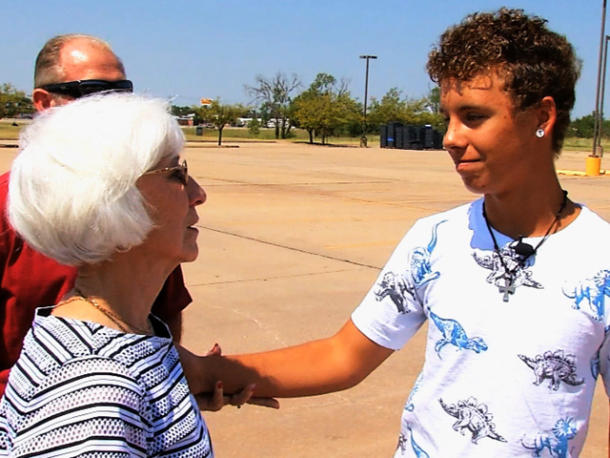
Young Christian Lunsford was disgusted when he saw the TV report about the mugging of seventy-eight-year-old Tona Herndon of Bethany, Oklahoma, robbed while visiting the gravesite of her husband of 60 years, who had died just two weeks earlier. It wasn’t merely that the mugger took a purse and $700 from a vulnerable and grieving woman, but that the culprit was Christian’s father. He had been quickly arrested, and his mug shot, shown on TV, was all-too-familiar to his fifteen-year-old son. Christian’s parents divorced when he was two, and his contact with his father had been minimal as the elder Lunsford kept ending up in jail. The teen had recently heard from his dad, however, when he sent Christian $250 to pay for his participation in a school band trip.

The latest crime, however, moved Christian to do something exemplary. He contacted Tona Herndon and asked her to meet him in a church parking lot. When she did, he mugged her too, as a tribute to his father.

No, that’s not what happened: I was just messing with you. Continue reading

Actor Patrick Stewart (“Captain Picard”) Is A Father’s Day Ethics Hero

The video is self-explanatory.

_________________________

Pointer: Alexander Cheezem


The $500,000 Dead Baby: Signature Sign Of An Unethical Industry

Why certainly, we'll be happy to paint a target on your baby's back, no questions asked---just keep up with the premiums!"

“Why certainly, we’ll be happy to paint a target on your baby’s back, no questions asked—just keep up with the premiums!”

Three insurance companies allowed a Manassas, Virginia father with a suspicious history of violent family deaths to take out life insurance on his 15-month-old son in the astounding amount of more than $500,000. Now the boy, Prince McLeod Ram, is dead, allegedly drowned by the beneficiary of those policies, his dad, Joaquin Rams. He’s under arrest; the companies are unlikely to have to pay out a cent.

I suppose that makes this a good business deal for them.

For the dead kid, not so much. Continue reading

Comment of the Day: “Clark Gable, Loretta Young, and the Betrayal of Judy Lewis”

-judy-lewis

Ethics Alarms has had an influx of new readers lately (Thanks, “O’Reilly Factor”!) and many have been visiting and commenting on older posts that I hadn’t thought about for a long time. “Evangeline” found one of the saddest and strangest, my post in December of 2011 about the death of Judy Lewis, who was the love child of Hollywood legends Loretta Young and Clark Gable. Gable, the “King of Hollywood,” never acknowledged her as his daughter, and Young, who like Gable was married and afraid of harming her reputation, pretended to adopt the girl, never revealing to her that she was her real mother, and the top leading man in movies was her father. (Judy was a dead ringer for him, too, as you can see in the photo above.) You should read the original post, here.

Evangeline apparently knows her Golden Age of Hollywood history, and makes a case that I was too hard on “Rhett Butler.” I’ll be back at the end for a rebuttal. Here is her Comment of the Day on the post, “Clark Gable, Loretta Young, and the Betrayal of Judy Lewis.” Continue reading

Ethics Mess In Kansas: The Lesbians and the Sperm Donor

The parents in happier days

The parents in happier days

Auto mechanic William Marotta must rue the day he responded to a Craigslist ad placed by Angela Bauer and her life partner Jennifer Schreiner. They were seeking a sperm donor, for the obvious reasons, and he had sperm to donate. The trio then signed a contract in which all agreed that Marotta would have no rights to any child his sperm spawned, nor future responsibilities regarding the child’s care. Schreiner was artificially inseminated and conceived, making her the child’s mother, as Bauer stepped into the role of the child’s father. Exit Marotta forever, with thanks.

Or so he thought. Continue reading

The Last Birthday Gift

blown out candles on a birthday cakeThis is my birthday. It’s also the third anniversary of my father’s death, as the two dates collided for all time when I found him dead, as if asleep, in his favorite chair when I went to my parents condo to meet him for a late birthday dinner, December 1, 2009.

I feel no more in the mood to celebrate my birth this day than I did that one, and seriously doubt if I ever will again. I miss my father terribly, every day really, and yet I recall that moment when I realized he was gone with mixed emotions. I knew that the old soldier, 89, fighting cancer, a heart condition and old war wounds, was facing a sharp down-turn in his quality of life; I knew that this was the way he always said he wanted to go out—quickly, without drama, humiliation or excessive expense—and I knew that among the members of his immediate family, I was the one whom he would have wanted to find his abandoned body. I never felt closer to my father, who, like so many of his gender and generation, had trouble expressing affection and intimacy directly, than I did in those last moments before the EMT’s arrived, as I stroked his thin, gray hair and said good-bye.

I have also come to believe that he gave me a great gift three years ago, probably unconsciously, but with my father, you never know.  He detested and rejected all forms of score-keeping, including regrets, accolades, praise and bucket lists. He was proud of many things in his life, especially his military service and his family, but he never felt superior to another human being based on what had happened in the past. My father believed that what mattered in life was going forward—doing one’s duty, helping others, setting a good example, and making every minute of your life count by trying to leave the world, even if it is only your small corner of it, better than it was before you got there. And when you’re done, you’re done. There is nothing to be sad about, or to be afraid of, or to regret; no recriminations for what didn’t happen, what couldn’t be completed, or mistakes made along the way. Just do your best, as you have learned to do it, for as long as you can. It’s not a competition, and you shouldn’t judge yourself by anyone’s standard but your own.

My father’s death reminded me that there is nothing special about being born. Everybody is born. It is how we use whatever time we have, when we use it well, that is truly worth celebrating, and even then, past achievements never justify resting on our laurels as long as we are still capable of doing some good, and have time left to do it.

On the day he died, my father spent loving hours with my mother in her hospital room, gave some needed advice and encouragement to my sister, wished his son a happy birthday, and made him laugh one last time. Good work, right to the end. If the timing of his finale changed for all time the meaning of my birthday for me, it also made vivid the life lessons that were the essence of Jack A. Marshall, Sr. Care about others. Be responsible.  Be fair. Do the best you can for as long as you can. Keep trying to be better. Never give up. Don’t be afraid. If you do all of that, you don’t need celebrations to prove your life has meaning. It just does.

It is true that “Happy Birthday” will never sound right to me again. Still, my father’s life and his way of leaving it gave me ideals good and true to celebrate on every December 1,  the wisdom to cherish whatever birthdays I have remaining, and the sense to never waste precious time regretting what is past and beyond changing. In many ways, his last birthday gift to me was the best one of all.

Ethics Dunce: Sports Grid Blogger Dan Fogarty

Civility is doomed. Civilization is doomed. Propriety is doomed.

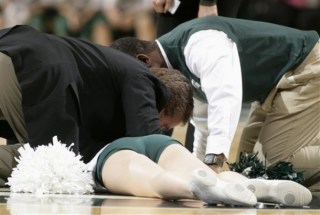
What's the concerned father of the injured cheerleader thinking about? Why, what any cool dad would think about---how good her butt looks!

And Taylor Young, a cheerleader for the Michigan State Spartans, may well be doomed, as it is impossible to tell how badly her character, values and common sense have been warped by being brought up in a household containing her father, Charles. After Young took a hard fall during the halftime show in a game against Florida State, requiring her to receive medical attention (she was OK), her father posted this astounding Facebook comment, which, naturally, has gone viral:

“I’m glad to see your booty isn’t gettin big ….. no one likes a chick with a big butt ….. love you.”

Idiotic? Check. Sexist? Check. Insulting to women? Check. Embarrassing to his daughter? Double check. Demonstrating a stunning lack of understanding of the internet? Check. Displaying a disturbing tendency to sexualize his own daughter?

Check, and Yuck.

But to Dan Fogarty, writing on Sports Grid, this offensive post proves that Young is a “cool Dad,” and Young goes on to cite other “experts” who believe this is “quite possibly the funniest ‘Dad Moment’ in Facebook history.”

Really? Is this really the current state of the culture? A father makes salacious comments about his daughter’s “booty,” suggests that “chicks” without similar booty quality are unloved and unlovable, and that’s cool?

If Fogarty is in step with the culture and I’m not, 1) then American society is coarsening faster than I thought, and 2) which way to Mars?

My condolences to Taylor Young for the boorish conduct of her father, and if she sees nothing wrong with it either, she has my intense condolences—because she has been severely damaged.

As, perhaps, have we all, if Fogarty is right.

Ethics Bulletin: Payback Is Not Always Unethical

"Sure, honey, take all the photos you want. And if your girlfriend wants to see the birth of our daughter, she's welcome too!"

Washington Post advice columnist Carolyn Hax, as I have noted before, has an almost pitch-perfect ethical sense, and negotiates difficult relationship dilemmas with consistent skill and wisdom. She is too nice sometimes, however, and her recent advice to an expectant mother is a striking example.

The woman wrote Hax about how to handle the request of her AWOL husband, who left her mid-pregnancy to move in with his mistress, to witness the birth of his daughter. He also wants his family to be present. The mother-to-be said that she fully intends to allow her child to have a good relationship with her father, but she does not want either her weasel husband or his family, which hid his affair from her, around when the baby comes. “I don’t want any of them there,” Expectant Mom writes. “Many of them knew about the girlfriend but kept it from me, and I don’t want my husband to have the satisfaction of comforting me when I’m in pain. Do I have the right to tell them this, in some collected, nonconfrontational way?” Continue reading

Clearing the Ethics Palette of Despair, Finding Hope

The accumulation of depressing stories and news items is making me despair again.

Our leaders will not exercise courageous leadership, and Americans seem unable to accept any sacrifices at a time when sacrifice is essential. I watch the pathetic Greeks riot because their country has gone broke allowing them to be irresolute and irresponsible, and I find myself feeling ashamed of my Greek heritage and wondering if the citizens of the land of my birth will behave any better.

When I search for Ethics Heroes to balance the many, many candidates for Ethics Dunces, I find myself increasingly drawn  to the obituaries of World War II heroes who are dying by the hundreds every day. Yet those are dead heroes, and we desperately need living ones.

Meanwhile, the continuing economic crisis plants seeds of ethical contempt, fertilized by national leadership that shows itself willing to cut corners and warp the truth in the name of expediency. The bombing of Libya is not a hostile action. Sure. The strategic oil reserves are being released because of a national emergency, not as politically-motivated manipulation of gas prices. Tell me another.

Legislators too cowardly to pass needed tax increases are instead willing to expose the nation’s values to rot, pushing initiatives to legalize recreational drugs and on-line gambling to acquire ill-begotten government revenue from those least able to afford it,  just as state governments took over the numbers racket. What is next? I’m afraid to guess. Ethical standards are more important than ever in a crisis, but they are also at their most vulnerable. When the going gets tough, I say, the tough get unethical. And that is what we are seeing now in our society.

Patrice Roe, a dear friend, a wise woman and an occasional reader here sent me this story, about a father who gave his life to rescue his Down Syndrome son under remarkable circumstances. Today it was just what I needed to read, to clear my ethics palette of some terrible tasting tales that generated too many toxic thoughts. It reminded me that out beyond the greasy ethics smog of Washington, D.C. there are people who do the right thing when it matters, more than we know.

I feel much better having read it, and perhaps you will too. You can find it here.