Ethics Observations On FBI Director Comey’s Statement Regarding The Clinton Investigation

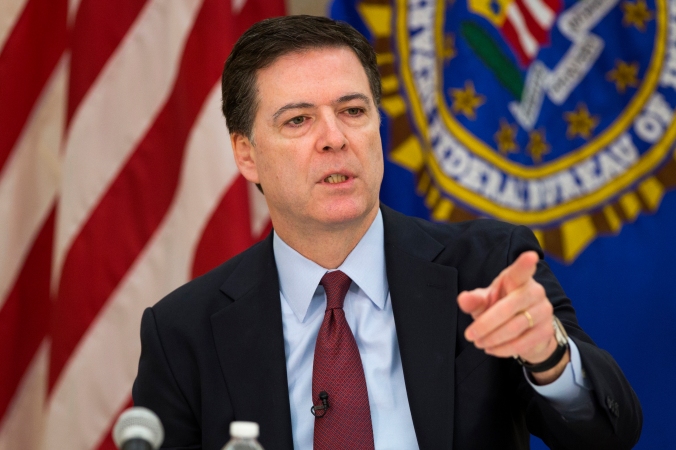
James Comey

The transcript of FBI Director James Comey’s full remarks on the Clinton e-mail probe follow. I will highlight important sections in bold, and in some cases, bold and red. My  observations will follow.

Good morning. I’m here to give you an update on the FBI’s investigation of Secretary Clinton’s use of a personal e-mail system during her time as Secretary of State.

After a tremendous amount of work over the last year, the FBI is completing its investigation and referring the case to the Department of Justice for a prosecutive decision. What I would like to do today is tell you three things: what we did; what we found; and what we are recommending to the Department of Justice.

This will be an unusual statement in at least a couple ways. First, I am going to include more detail about our process than I ordinarily would, because I think the American people deserve those details in a case of intense public interest. Second, I have not coordinated or reviewed this statement in any way with the Department of Justice or any other part of the government. They do not know what I am about to say.

I want to start by thanking the FBI employees who did remarkable work in this case. Once you have a better sense of how much we have done, you will understand why I am so grateful and proud of their efforts.

So, first, what we have done:

The investigation began as a referral from the Intelligence Community Inspector General in connection with Secretary Clinton’s use of a personal e-mail server during her time as Secretary of State. The referral focused on whether classified information was transmitted on that personal system.

Our investigation looked at whether there is evidence classified information was improperly stored or transmitted on that personal system, in violation of a federal statute making it a felony to mishandle classified information either intentionally or in a grossly negligent way, or a second statute making it a misdemeanor to knowingly remove classified information from appropriate systems or storage facilities.

Consistent with our counterintelligence responsibilities, we have also investigated to determine whether there is evidence of computer intrusion in connection with the personal e-mail server by any foreign power, or other hostile actors.

I have so far used the singular term, “e-mail server,” in describing the referral that began our investigation. It turns out to have been more complicated than that. Secretary Clinton used several different servers and administrators of those servers during her four years at the State Department, and used numerous mobile devices to view and send e-mail on that personal domain. As new servers and equipment were employed, older servers were taken out of service, stored, and decommissioned in various ways. Piecing all of that back together — to gain as full an understanding as possible of the ways in which personal e-mail was used for government work — has been a painstaking undertaking, requiring thousands of hours of effort.

For example, when one of Secretary Clinton’s original personal servers was decommissioned in 2013, the e-mail software was removed. Doing that didn’t remove the e-mail content, but it was like removing the frame from a huge finished jigsaw puzzle and dumping the pieces on the floor. The effect was that millions of e-mail fragments end up unsorted in the server’s unused — or “slack”— space. We searched through all of it to see what was there, and what parts of the puzzle could be put back together.

FBI investigators have also read all of the approximately 30,000 e-mails provided by Secretary Clinton to the State Department in December 2014. Where an e-mail was assessed as possibly containing classified information, the FBI referred the e-mail to any U.S. government agency that was a likely “owner” of information in the e-mail, so that agency could make a determination as to whether the e-mail contained classified information at the time it was sent or received, or whether there was reason to classify the e-mail now, even if its content was not classified at the time it was sent (that is the process sometimes referred to as “up-classifying”).

From the group of 30,000 e-mails returned to the State Department, 110 e-mails in 52 e-mail chains have been determined by the owning agency to contain classified information at the time they were sent or received. Eight of those chains contained information that was Top Secret at the time they were sent; 36 chains contained Secret information at the time; and eight contained Confidential information, which is the lowest level of classification. Separate from those, about 2,000 additional e-mails were “up-classified” to make them Confidential; the information in those had not been classified at the time the e-mails were sent.


Continue reading

Essay: On Loretta Lynch And Fighting Cynicism And Distrust Regarding The FBI Investigation Of Hillary Clinton

America_Falling_Apar

Warning:

This is long.

I think it’s important

In the wake of Attorney General Lynch’s acknowledgment of wrongdoing in meeting, however briefly and innocently, with Bill Clinton, some  reader comments here are redolent of the destructive distrust of government and leadership engendered by this administration and others, particularly Bill’s. Yet this attitude feeds on itself, and is to an extent a self-fulfilling prophecy. If leaders think that people expect corruption, they are less likely to shy away from it. Cynicism leads to acceptance. Of course, this is one explanation of why the tarmac meeting took place—pure arrogance and a belief that with the news media’s complicity, now virtually any degree of government dishonesty and corruption will be either effectively hidden from the public, or accepted by it.

This is untrue, still. Indeed, this episode is proof that it is untrue, though the news media did make (disgusting and ignorant) efforts to shrug off the clear appearance of impropriety represented by Lynch having a meeting with Clinton the Impeached under these circumstances. Why do I labor trying to write these essays explaining the legal and ethical context of such events if readers are so poisoned by bitterness and distrust that they can’t or won’t process them, and just default to “it doesn’t make any difference, all is shit, all is lost”?  If I believed that, I wouldn’t be spending time—work  time, uncompensated time—writing this stuff. I can earn peanuts directing professional theatrical productions: it makes people happy, gives actors work, and is a lot more fun, believe me.

Paranoia, suspicion, despair, and conspiratorial views of government, which are all these comments represent, are just forms of bias. Bias makes us stupid, and in this case, bias makes us dysfunctional as a people and fearful and miserable as individuals. Continue reading

Comment of the Day: “Ethics Hero: Mother Jones Pundit Kevin Drum”

http://www.youtube.com/watch?v=gxSn-UQmjfs

There are, I think, three regular commenters on Ethics Alarms who extend all the way back to Ethics Scoreboard days, or pre-2012. One of them is Tim Levier, who unlike the other two, I have actually met while I was in his state of Colorado. Tim posted the following on my Facebook page, and I invited him to cross-post here. In his post, he addresses the “do something!” lament that appears to be thoroughly rotting the brains of our leaders in both parties as they hustle to pander to the emotional responses to the Orlando tragedy. Tim wrote a younger friend about what somethings he would do, and not all of them are relevant to guns. They all, however, are relevant to building a society in which fewer people might choose to start shooting strangers.

Here is Tim’s Comment of the Day on the post, “Ethics Hero: Mother Jones Pundit Kevin Drum.

I’m 35 and was recently talking with someone slightly younger. He had the standard call for ideas to check the “do something” box. After I did some jumping jacks to show that I did something, I buckled down and wrote some ideas.

Now, I’m usually accustomed to reading some constitutional murky stuff, so I veered a different direction. Below is my list as I wrote it to him, perhaps there’s something in it that speaks to people. My 4 ideas for improvement (not solutions, because solutions don’t exist.):

Idea #1

I’ll tell you that the #1 thing I would like to see in this country (give me some slack here, I believe everything is connected), given the state of health care…

I’d like to see a 3 tier system of medical insurance & payments. (Tier 3 will be the part that relates back.)

Continue reading

Unethical Tweet Of The Month: Hillary Clinton

hedge funds

Among her almost infinite flaws, Hillary Clinton is stunningly lacking in self awareness, and her statements often—astoundingly often—point to her own misconduct and ethical bankruptcy without her comprehending the self-indictment. She has tweeted, more than once, this sentiment, for example:

“To every survivor of sexual assault…You have the right to be heard. You have the right to be believed. We’re with you.”

…though Hillary was emphatically not “with” the women who credibly accused her husband of sexual assault, and still do. She will make statements to one group that are the exact opposite of what she recently said to another group, without batting an eye. Hillary actually committed the meta-lie of saying she never has lied, which is manifestly unbelievable. Then there was this Titanic-style gaffe…

“There should be no bank too big to fail and no individual too big to jail.”

…coming from someone who is, many legal experts believe, not already under indictment purely because she is “too big to jail.” (and then there is hubby Bill, who engaged in flat-out illegal election conduct in Massachusetts that you or I would have been arrested for, and didn’t even get a rap on the wrists.) Neither Clinton has any integrity at all, or shame either. It’s really quite stunning.

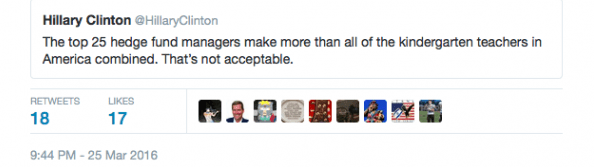
Last week, Hillary tweeted this howler:

Hillary Tweet 1

This is an example of a politician intentionally playing to class divisions, ignorance and bias, and worse, encouraging them. It is exactly like saying that it is “unacceptable” that Jimmy Fallon, who only hosts a silly late night show, makes more money than any cancer surgeon, special needs teacher or EMT alive. In some ways it is worse, because most people understand what those jobs are, and may  sort of comprehend the economic principles at work: if Jimmy Fallon drops dead, there is no replacement who will bring to the job exactly what Jimmy Fallon did. He is a unique commodity, and EMT’s are not. The statement is just an emotional attack on the fact that people value laughing over things that are objectively more practical, and entertainment salaries reflect that. Continue reading

Tech And Terrorism Ethics: Apple Is Right. The Government Is Wrong.

FBI-APPLE

If, in some future nightmare scenario come true, the FBI needs to break the encryption on a private i-phone to find the secret code to defuse the Doomsday Machine  President Donald Trump set up after his mind finally snapped and he thought he was the Stay-Puft Marshmallow Man, I assume that Apple won’t stand on principle and will do what needs to be done to save the world. The current dilemma, however, is not that dire.

Although President Obama announced last year that he had decided not to pursue legislation requiring tech companies to give law enforcement access to users’ encrypted data, he proved once again that if you don’t like Obama’s promises, just wait a minute.  For last week, the FBI persuaded a judge to order Apple to create software that would help federal investigators crack into the iPhone 5C that terrorist Syed Rizwan Farook was using before he and his wife slaughtered guests at his company Christmas party in San Bernardino last December. Apple has vowed to defy the order.

Good. Continue reading

From The “Ethics Isn’t Easy” Files: The FBI, Child Porn, And “Playpen”

key-computerIn order to probe “the dark web” and to apprehend those partaking of the pleasures of child pornography, the FBI emulated the illegal conduct of hackers, using a warrant to surreptitiously place malware on all computers that logged into a site called Playpen. When a user connected, the malware forced his computer to reveal its  Internet protocol address. Next a subpoena to the ISP  yielded his real name and address, and a another warrant allowed a subsequent search of the user’s home. Incriminating evidence, indictments and trials followed.

The problem of tracking computer related crime is far ahead of the law, and in the vacuum, ethical principles are being nicked, mashed, or ignored. Ahmed Ghappour, a professor at the University of California’s Hastings College of the Law, says, “It’s imperative that Congress step in to regulate exactly who and how law enforcement may hack.” If hacking is illegal, and wrong as an uncontested intrusion on privacy, when is it ethical, and thus legal, for law enforcement to do it? Continue reading

Ethics Quote Of The Week: Hillary Clinton

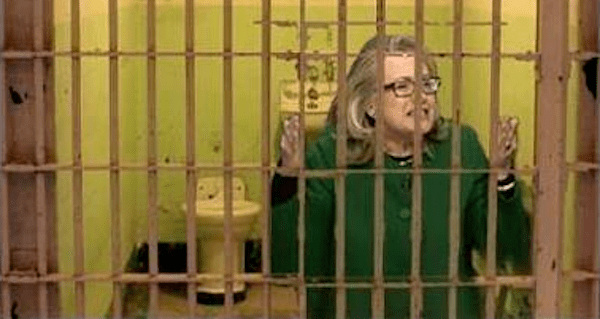
Hillary-Clinton-behind-Bars

“There should be no bank too big to fail and no individual too big to jail.”

Hillary Clinton, in last night’s NBC Presidential debate.

Like Hillary’s infamous declaration that all accusations of sexual assault must be believed, this statement shows a troubling disconnect between Clinton’s own complex and corrupt life and her rhetoric. 15o FBI agents are investigating what may be very serious violations of national security laws by Clinton, with penalties including prison. Shall we presume that Hillary is issuing a preemptive, honorable insistence that if Obama’s ultra-politicized Justice Department is tempted to try to oppose an FBI conclusion that an indictment is warranted by the evidence, it should treat her like anybody else?

Most Encouraging Statement Suggesting That There May Be Justice After All: Former U.S. Attorney General Joe DiGenova

Hope-Dove-Flying

Former U.S. Attorney Joe DiGenova had this to say on Laura Ingraham’s radio show, speaking  about the FBI’s investigation into Hillary’s intentional mishandling of confidential State Department e-mails—you know, those “stupid e-mails” that nobody cares about:

“They have reached a critical mass in their investigation of the Secretary and all of her senior staff. And, it’s going to come to a head, I would suggest, in the next 60 days…It’s going to be a very complex matter for the Department of Justice, but they’re not going to be able to walk away from it. They are now at over 1,200 classified emails. And, that’s just for the ones we know about from the State Department. That does not include the ones that the FBI is, in fact, recovering from her hard drives. …I believe that the evidence that the FBI is compiling will be so compelling that, unless [Attorney General Loretta Lynch] agrees to the charges, there will be a massive revolt inside the FBI, which she will not be able to survive as an Attorney General.  It will be like Watergate. It will be unbelievable.”

Sounds almost too good to be true, doesn’t it?  Yet DiGenova is far from a being a loon, a partisan hitman, or one to spin wild theories. He also should know a bit about how the internal workings of the various competing agencies under Justice work. [Full disclosure: I’ve met Joe, and chatted with him a bit, though this was quite a while back. Did you know he is a trained singer? A good one, too.]

I cannot begin to describe how marvelous it will be for the integrity of our government and justice system if Joe’s analysis is proven correct. I don’t even have to consider how much I would enjoy the screams of indignation of the Clinton Corrupted. This scenario is what the Clintons, the Democrats, the DNC, Clintons’ disgraceful mews media defenders and Hillary’s see-no-evil supporters sooooo richly deserve that if it ever comes to pass, Handel’s Hallelujah Chorus might just spontaneously echo from the cosmos, or at least John Kiley’s organ version that he played that immortal night, the best of my life, when Carlton Fisk hit that Game #6 winning home run off the Fenway foulpole, so many years ago.

Let us hope.

__________________

Pointer and Source: Don Surber


Ethics Observations On The Washington Post’s Fatal Police Shootings Study

policeshootings

The Washington Post just released its own study of 2015 police shootings, including statistics that that the FBI, which admitted to the Post that it has not done a thorough job of tracking the data, has missed. Writes the Post:

The Washington Post is compiling a database of every fatal shooting in the United States by a police officer in the line of duty in 2015. The Post is tracking more than a dozen details about each killing — including the race of the deceased, the circumstances of the shooting, and whether the person was armed — by culling local news reports and monitoring independent databases such as Killed by Police and Fatal Encounters. In some cases, The Post conducted additional reporting. The Post is documenting only shootings in which a police officer, while on duty, shot and killed a civilian — circumstances that most closely parallel the 2014 killing of Michael Brown in Ferguson, Mo. The Post is not tracking deaths of people in custody, fatal shootings by off-duty officers or deaths in which police gunfire did not kill the individual.

The FBI and the Centers for Disease Control and Prevention log fatal shootings by police, but officials acknowledge that their data is incomplete.The Post’s database will be updated regularly as new fatal shootings are reported and as new facts emerge about individual cases. The Post is seeking assistance in making the database as comprehensive as possible. To provide information about fatal police shootings in 2015, send us an e-mail at policeshootingsfeedback@washpost.com. The Post is also interested in obtaining photos of the deceased and original videos of fatal encounters with police.

Elsewhere, the Post makes it clear that “incomplete” hardly begins to describe the FBI’s negligence:

The landscape of police shootings is surprisingly thinly explored. The FBI is charged with keeping statistics on such shootings, but a Post analysis of FBI data showed that fewer than half of the nation’s 18,000 police departments report their incidents to the agency.The Post documented well more than twice as many fatal shootings this year as the average annual tally reported by the FBI over the past decade. The FBI and the federal Bureau of Justice Statistics now acknowledge that their data collection has been deeply flawed. FBI Director James B. Comey called his agency’s database “unacceptable.” Both agencies have launched efforts to create new systems for documenting fatalities.

Observations: Continue reading

FACT: The New York Times’ Front Page Anti-Gun Editorial Was Misleading And Deceitful, And Here’s Why

silencers and guns

I already posted on the ethics deficits in the New York Times front page editorial (First time since the 1920s! AHHHHHHH!!!) that was gaining such embarrassing hosannas from liberals and anti-gun zealots over the weekend. To sum up that post, the Times wrongly connected its hype to a terrorist incident irrelevant to its argument, simply to gain emotional traction; made an impossible and largely symbolic demand, focused on a class of guns that has minimal impact on national gun deaths; and, like most calls for “gun control” of late, including the President’s, was aimed at gaining incremental public acceptance of gun confiscation and banning, while pretending otherwise.

That post did not point out, however, that the Times intentionally neglected to inform its readers and those it hoped to persuade (or mislead, panic, or stampede) of the above essential news that is not only “fit to print,” but that must be printed if a newspaper is going to claim that “the attention and anger of Americans should also be directed at the elected leaders whose job is to keep us safe but who place a higher premium on the money and political power of an industry dedicated to profiting from the unfettered spread of ever more powerful firearms.”

The fact is that per-capita murders in the U.S. are at their lowest level since FBI records began (in 1960), and they are trending downwards. There is no “crisis,” at least no gun crisis. Terrorism is another story.

The Times makes the point that “motives do not matter to the dead” (a failed attempt to justify piggy-backing the grandstanding editorial on a terrorist attack that no plausible gun regulations would have stopped), but it is just as true that lethal weapons “do not matter to the dead.” If it is, as the Times piously says in accusing them of callousness and corruption, the job of elected leaders “to keep us safe,” our elected leaders, by the evidence of the statistic, are doing an excellent job. Continue reading