Spain Demonstrates Why We Have The First Amendment, And Why The US Must Protect It

Spain’s Parliament, in its wisdom, has declared dwarf bullfighting illegal. Not because the bulls are treated cruelly, mind you: oh no, that part is fine. It’s the small bullfighters the legislators find intolerable. (That’s a group of them rehearsing above.)

Comic bullfighting shows in which individuals with achondroplasia, a form of dwarfism, fight with juvenile bulls are now illegal. A new law bans “shows or leisure activities” employing a disability “to provoke public mockery, ridicule or derision.” As a result, the performers who earned their living putting on such shows are now forbidden from plying their craft, and citizens willing to pay to watch them can no longer do so. This is also embarrassing: the same law directs that “people with disabilities will participate in public shows and recreational activities, including bullfighting, without discrimination.”

Spain’s law arises from a failure to distinguish “Ick” from ethics, the same problem that has led some states to try to ban drag shows. There is no question that the First Amendment in the Bill of Rights would absolutely prohibit a law such as the Spanish dwarf bullfighting ban, and we should be grateful for that. The ethical principles embodied in freedom of expression include autonomy as well as intrinsic fairness and the Golden Rule validity of allowing others to have the same right to make their living as they choose without others deciding that because they wouldn’t make the same choices, those choices shouldn’t be available to anyone.

Continue reading

Ethics Dunce: Surgeon General Dr. Vivek Murthy [Link Fixed]

There is no way not to take yesterday’s public warning from the nation’s top health official as ominous, indeed sinister. U.S. Surgeon General Vivek Murthy expounded on the risks of social media to children and teens, citing possible “harm to the mental health and well-being of children and adolescents.” The remarkable 19-page advisory, begins by acknowledging that the effects of social media on adolescent mental health are not well understood, and even that social media can be beneficial to “some users.” It then goes on to argue ,“There are ample indicators that social media can also have a profound risk of harm to the mental health and well-being of children and adolescents.”

And thus the U.S. Surgeon General lays the groundwork for government censorship, despite admitting that there is insufficient hard data to support his conclusions. Parental supervision is not enough for this government, as we have already seen in multiple settings. After all, “it takes a village,” the village that one side of the current culture wars is trying to define includes treating words and expression as “harm” from which people must be kept “safe.” Predictably, the near-completely compliant national news media is behind such government appropriation of parental authority, in this as well as other matters.

Continue reading

Comment Of The Day: Unethical Quote Of The Week: Former Head Of Twitter’s Office of Trust and Safety Yoel Roth

In this Comment of the Day, made yesterday by veteran EA commenter Glenn Logan, he alerts us to an arguably even scarier statement at the Twitter censorship hearings yesterday, pointing to Jonathan Turley’s horrified (the professor is always horrified in a restrained fashion, unlike me) reaction to both the statement and the Democratic approval of it. The entire day of testimony justifies the appearance of Geena above, and she was only warning about a single man gradually turning into a giant fly. We are watching our nation mutating into a repressive, totalitarian society that restrains and punishes independent thought.

How many of your friends would vote for the likes of  Rep. Melanie Ann Stansbury (D., NM), whose response to the creepy statement Glenn writes about was “Exactly”? Or with former Twitter CEO Parag Agrawal’s statement that he pledged to regulate the platform’s content as “reflective of things that we believe lead to a healthier public conversation” and would  “focus less on thinking about free speech” because “speech is easy on the internet. Most people can speak. Where our role is particularly emphasized is who can be heard”?

For all his weirdness, hypocrisy and Trumpish trolling, Elon Musk performed one of the most important acts in defense of democracy and America’s future in recent memory.

Here is Glenn’s Comment of the Day on the post, “Unethical Quote Of The Week: Former Head Of Twitter’s Office of Trust and Safety Yoel Roth.”

***

Jack wrote: Roth literally said that Twitter believed you have to destroy free speech in order to save it—and he didn’t even realize how Orwellian that is.

Indeed, but what really freaks me out (and only slightly hyperbolically) was the testimony of his fellow Twit, former Twitter executive Anika Coliler Navaroli at a House Oversight Committee hearing yesterday, which is analyzed by Jonathan Turley on his blog:

Navaroli said in response to a question from a Democratic member:

“Instead of asking just free speech versus safety to say free speech for whom and public safety for whom. So whose free expression are we protecting at the expense of whose safety and whose safety are we willing to allow to go the winds so that people can speak freely.”

Continue reading

I Just Signed An Open Letter. This is Why:

Last week, professors, lecturers and academics across the country began signing the “Stanford Academic Freedom Declaration.” It is an open letter that calls on universities to restore free speech, academic freedom and institutional neutrality. The open letter asks universities and professors to adopt and implement the “Chicago Trifecta” — the Chicago Principles on unilateral free speech, the Kalven report that requires institutional neutrality on political and social topics, and the Shils report, making “academic contribution the sole basis for hiring and promotion.”  It is picking up metaphorical steam: several hundred new signatures have been entered since I first saw the document last night. One of them is mine: I qualify as a former adjunct professor of legal ethics.

Stanford economist and co-author John Cochrane is the first name on the list and presumably launched the letter. He told College Fix:

The larger hope is to bring back academic freedom on campus and in the academic enterprise more generally. Only with robust academic freedom, the ability to investigate ideas and bring out uncomfortable facts, does scholarship bring about new and reliable knowledge, especially on crucial issues to our society.

Who knows if this will have any impact or persuasive power? I am dubious about the use of such protest tools, but at least this one causes no harm even if it like the lonely tree falling in a forest. Trying to ensure that the letter has no effect is, of course, the mainstream media, which so far, at least, hasn’t deemed the effort newsworthy for a week. In the meantime, several news sources have devoted space to the fact that in China, a massive flock of sheep has been walking in a circle for 12 days straight. Priorities!

I’m grateful for the opportunity to do something proactive about this problem, which I view as an existential threat to American culture and society. Boycotting the recent class reunions of my college and law school was mandatory for me but also the equivalent of Grandpa Simpson shouting at clouds. My  Harvard reunion book essay explaining my position did attract a few kudos in the mail, all of which opined that there were many other class members who felt as I do but were afraid to make their views public.

Wow. Harvard apparently has graduated a lot of weenies. But I knew that.

I’ll be circulating the letter to my friends and associates who can sign it. It’s awfully open, which mean that if someone wanted to muck it up with fake names, gag names and other graffiti, they could. Right now, I’m the last name on the list, number 1,241. It will take about a hundred times that to make a ripple, I know.

It’s worth a shot.

Halloween Ethics And The Right To Bad Taste

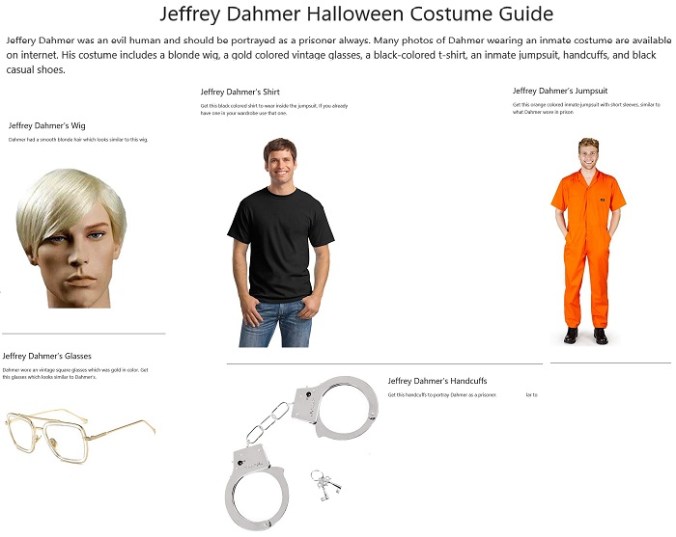
We watch a lot of horror movies, but the inexplicably popular Netflix series “Monster: The Jeffrey Dahmer Story” was too much for us, and the Marshalls bailed on the thing before the first episode was over. However, the show has spawned, among other troubling responses, the marketing of various Dahmer Halloween costumes.

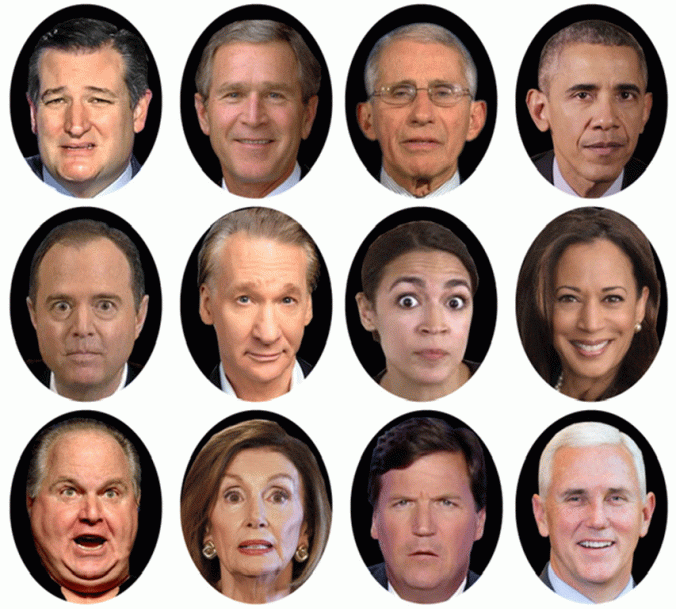
Ew. That’s creepy, but then, Halloween is supposed to be creepy. What exactly is the taste distinction (oops, setting up a bad Jeffrey Dahmer joke there!) between portraying a real life monster like Dahmer, John Wayne Gacy, the BTK killer or Ed Gein (the model for Norman Bates, among others) and movie murderers like Leatherface, Jason Voorhies, Michael Myers, the “Scream” slasher, and the Dahmer-like Hannibal Lector? I’ve seen Hitler and Osama bin Laden costumes; I once considered trick-or-treating as Jack the Ripper. If there’s a rule, I’ve never seen it explained. Is it that real scary people from history are taboo? Is there a statute of limitations? Jack the Ripper ripped almost a 140 years ago. That can’t be it: here are some living political figures (well, Rush is dead) whose faces are available online:

Adan Schiff? Nancy Pelosi? Dr. Fauci? I think I’d rather be Jeffey Dahmer, thanks, but that’s just me.

Continue reading

Censoring Expressive Speech By Bowing To Threats Is Unethical…Yes, Even When The Speech is John Hinckley’s

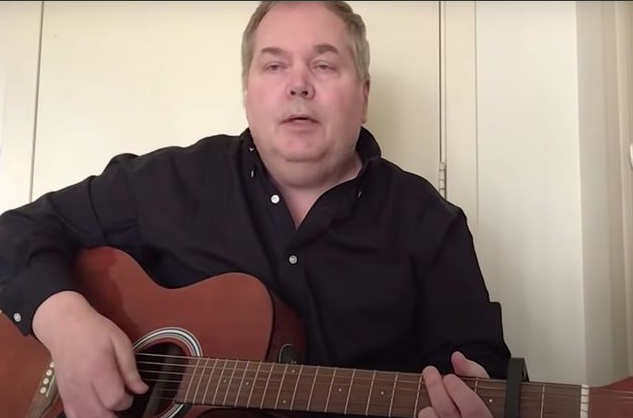
 Market Hotel agreed to host a concert on July 8th featuring the musical stylings of attempted Reagan assassin John Hinckley, Jr., who has been released  into the world on the theory that he was never technically guilty of a crime because he was insane at the time.  Hinckley called the show the beginning of his “Redemption Tour,” during which he will play his songs (are those bad rip-offs of Dylan dedicated to Jodie Foster on the program?) to promote, he says, rehabilitation for formerly incarcerated criminals and the mentally ill. Continue reading

Unethical—Or Maybe Head-Exploding—Quote Of The Month: New York Times Media Writer Ben Smith

“But the paper needs to figure out how to resolve these issues more clearly: Is The Times the leading newspaper for like-minded, left-leaning Americans? Or is it trying to hold what seems to be a disappearing center in a deeply divided country? Is it Elizabeth Warren or Joe Biden?”

—-Ben Smith, the New York Times’ media writer, regarding the “moral ” dilemma [ Postcard From Peru: Why the Morality Plays Inside The Times Won’t Stop” ] revealed by the controversy over the Times forcing out its top science writer for saying “nigger” in Peru instead of “n-word”.

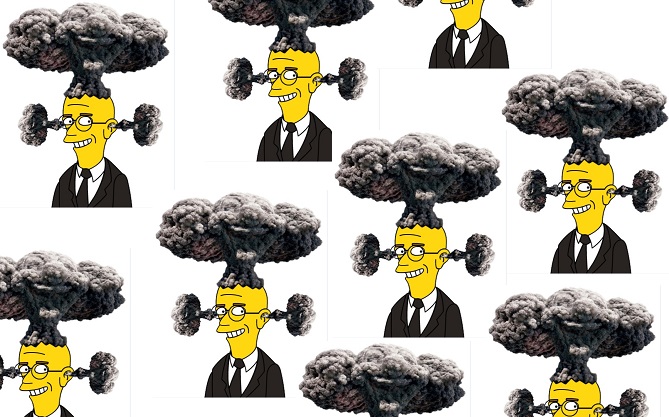
Hold the center? HOLD THE CENTER?? HOLD THE CENTER????? Oh, God, I can’t…oh no ..ARGHHHH!

Head jack boom many

What a mess! I’m so, so sorry.

And that’s just one paragraph! Since my head has already been shattered beyond hope, here’s another one:

This intense attention, combined with a thriving digital subscription business that makes the company more beholden to the views of left-leaning subscribers, may yet push it into a narrower and more left-wing political lane as a kind of American version of The Guardian — the opposite of its stated, broader strategy.

Is Smith gaslighting us? Is the Times really that lacking in self-awareness? This outrageous piece was featured on the front page! “Gee, I wonder if we’re too biased…”

The New York Times drove one of its veteran journalists out of the paper for speaking the specific word he was discussing in the context of a student question about racist and sexist language, because some woke high school students said they were offended, and the Times’ staff censors of color demanded their pound of flesh. The Times editor then made the ridiculous and untrue statement that ‘intent’ didn’t matter, which was correctly condemned by a Times op-ed writer in a column that was censored by the paper.

Continue reading

“Intent” Ethics: The “Grape Soda” Caper

Grape Soda

Little noticed when it was reported a month ago, but of special interest now that the New York Times is on record that the use of a racist slur is to be regarded as a racist act regardless of the intent of the speaker, is the decision by The New York Racing commission to ban a prominent trainer from competition for giving a horse a name that isn’t racist but apparently intending it to be a racist slur. Yes, it’s a reverse Donald McNeil! What do you say, Bret Stephens?

As Alice said in Wonderland, “Curiouser and curiouser!” The banned trainer is Eric Guillot, whose horses have earned more than $13 million in purses and have won 259 races. “Racism is completely unacceptable in all forms,” David O’Rourke, the association’s president and chief executive, said in a statement. “NYRA rejects Eric Guillot’s toxic words and divisive behavior in the strongest terms. Our racing community is diverse, and we stand for inclusion.” What were the “toxic words”?

“Grape soda.”

Yes, grape soda. I confess, I’ve used the words “grape soda.” I like grape soda; always have. But Guillot, see, named a horse “Grape Soda” after tweeting on New Year’s Day that he was giving a 3-year-old colt a “unique name in honor of a TVG analyst.” The tweet had a Black fist emoji. Apparently “grape soda,” in addition to meaning, you know, grape soda, has been used somewhere I’ve never been as a racial epithet. So bad an epithet is it that the New York Times wouldn’t dare print it in its headline: “NYRA Bars Horse Trainer For Using Racist Name.” I couldn’t find out what the “racist name” was until six paragraphs into the article. The Times didn’t even call it the “GS-word,” though it says it “can” be a racist term, presumably based on context and intent. But now, as a Times columnist discussed in a banned op-ed, the Times says intent and context doesn’t matter. If that’s true, then “Grape Soda” must be presumed to have the same meaning in the case of the horse as it is presumed to mean anywhere else, like when I say to my wife, “Hey, while you’re at 7-11, pick me up a grape soda please!” But that does not seem to be the case in this story, and the Times itself doesn’t challenge the logic that “Grape Soda” as a name for a horse is racist simply because it was dedicated to the only black horse-racing analyst. They think. Or someone thinks.

Confused? Me too, and I have some questions:

Continue reading

Why Freedom Of Speech In America Is Threatened: Too Many Cowards

Coward

Oh no, not this issue again so soon.

Another prominent professional has been fired for breaching political correctness rules and annoying the totalitarian Left’s censors. His crime: speaking the taboo word “nigger” while referencing it in a discussion of racial slurs. Then, as we have seen over and over again, the exiled victim of this assault on free speech apologized. “Thank you sir, may I have another?” And, as we have also seen, it did no good.

The New York Times fired its #1 science and health reporter Donald McNeil Jr., after The Daily Beast reported that he had used racist language while on a 2019 trip with students to Peru. He did not use “racist language,” however, and there is no evidence at all that he displayed racist attitudes or opinions. What he did is to speak a word that speech censors have decided is itself forbidden, even if it is necessary in order to discuss the issue of racism, censorship or linguistics. This is, I note again, punishing or even criticizing such conduct is unethical, idiotic, juvenile, and sinister. Nonetheless, it is rapidly becoming the norm, and it is becoming the norm because so many individuals of power and influence lack the integrity and fortitude to oppose an indefensible position loudly and unequivocally.

(See the previous post. It is very relevant here.)

McNeil, formerly the Times’ top reporter on COVID-19,was fired because six students or their parents claimed he had made racist and sexist remarks throughout the trip. An investigation inicated that none of his remarks were sexist or racist, but that he had used words employed by sexists or racists to talk about sexism or racism, rather than using the approved poopy/ pee-pee/woo-woo baby talk codes (n-word, b-word, c-word) demanded by language censors. Initially, the Times’ editor tried to be fair and to uphold what the Times is supposed to respect—the Bill of Rights—but eventually capitulated to his woke and anti-free speech staff, as he has before.

So here are the cowards in this nauseating drama:

Coward: Dean Baquet. The Times Executive Editor initially said McNeil should be “given another chance” (Chance to do what? Conform his speech to oppressive conformity with progressive dictates?).”I authorized an investigation and concluded his remarks were offensive and that he showed extremely poor judgment, but it did not appear to me that his intentions were hateful or malicious,” he said. But anti-white racist and liar (but Pulitzer Prize-winning racist and liar!) Pulitzer Prize-winner Nikole Hannah-Jones threatened to call the parents and students on the trip to determine what McNeil had said and in what context (all of which would be hearsay, and thus unreliable except to an ideological hack like Hannah-Jones). Then a group of over a hundred staffers, mostly “of color” or female, signed a letter demanding serious sanctions.

“Our community is outraged and in pain,” the signees wrote. “Despite The Times’s seeming commitment to diversity and inclusion, we have given a prominent platform—a critical beat covering a pandemic disproportionately affecting people of color—to someone who chose to use language that is offensive and unacceptable by any newsroom’s standards. He did so while acting as a representative for The Times, in front of high school students.”

Baquet, publisher A.G. Sulzberger, and Chief Executive Meredith Kopit Levien responded that they welcomed the letter, saying, “We appreciate the spirit in which it was offered and we largely agree with the message,” they wrote in masterpeice of weasel-wording. Then Baquet reversed himself and fired McNeil, saying, “We do not tolerate racist language regardless of intent.” Really? So if a news story involves a racist or sexist statement, the Times can’t write about it and use the langauge that makes the episode a story? If the Supreme Court holds that “nigger” or other words are constitutionally protected (as indeed they are), the nation’s ‘paper of record’ won’t be able to quote the opinion?

Baquet had an opportunity to take a crucial stand for freedom of expression and against the criminalizing of language and the retreat to the primitive logic of taboos. He proved himself to be more interested in Leftist agendas and his job than the principles of democracy.

Coward: Donald McNeil Jr. He could have articulately objected to the warped logic of the Times mob, and explained, as he was equipped to do, why we must never cripple expression by banning words, legally or culturally, and why this episode is a perfect example why. Instead, he wimpered an illogical and craven apology, telling the staff in part,
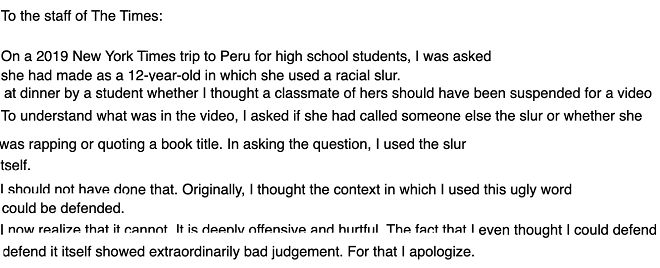
McNeil grovel

Well hello Galileo! He went on to say, “I am sorry. I let you all down.” He let a newspaper down by using a word in a discussion with students in Peru to examine the use of the word. He let a newspaper down by being clear and describing the matter under discussion… because at the New York Times, progressive agendas trump the truth.

Well, I guess we knew that.

Since he was going to sacked anyway, was obligated as an American to go down fighting for free speech and against the censorship of expression. Nah. That might interfere with getting his next job with an ideological indoctrinating institution or publication.

Coward: Ann Althouse. This is disappointing. She says the right things in her post on this fiasco:

In the old days, a big deal was made of the “use/mention” distinction. It doesn’t seem to matter anymore. Even McNeil, defendinghimself, asserts that he “used” the word.
I understand wanting to say that “intent” shouldn’t be decisive, because it presents evidentiary problems. What went on in a person’s head? Did he somehow mean well? But the “use/mention” distinction doesn’t require a trip into someone’s mind. If you have the outward statement, you can know whether the speaker/writer used the word as his own word or was referring to the word as a word. 
You don’t need to know whether I think Dean Baquet is a coward to distinguish the statement “Dean Baquet is a coward” from “I can imagine someone saying ‘Dean Baquet is a coward.'”

But there’s something oddly missing from her post. As one commenter coyly asks (and to her credit, Ann allowed it to be posted): “What word are you talking about?”

In this case, Althouse is a hypocrite as well as a coward. I can expect her to be on the sidelines with the mob when they haul me off to in the tumbrils because I write the word “nigger” when the topic is using the word “nigger.” Such reticence—I guess she’s worried her University of Wisconsin law school pals will shun her–does not help the cause of freedom of expression, which Ann knows damn well is under attack


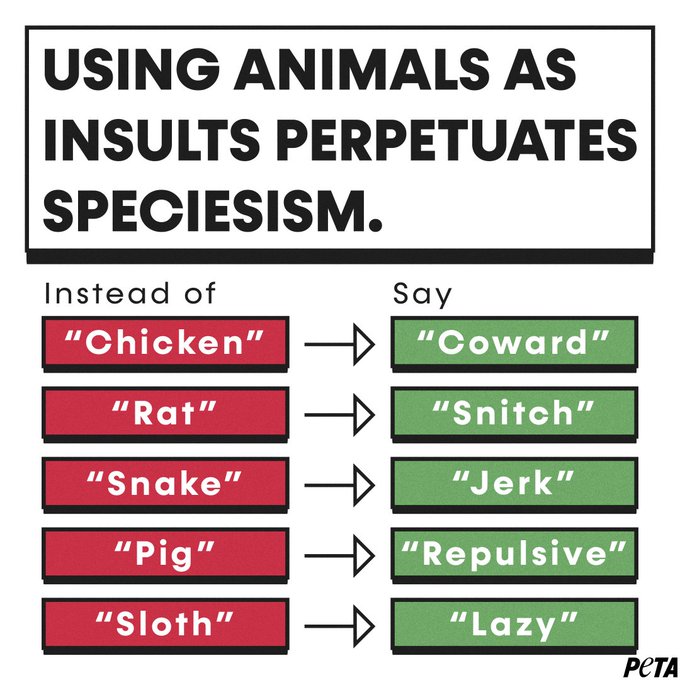
Yet PETA’s Campaign To Limit Speech Is No More Unethical Than Other Attacks On Freedom Of Expression, Just More Self-Evidently Stupid…

Speciesism

It doesn’t matter what words, phrases or expressions politically-motivated censors try to eliminate from the language, be it gender pronouns, “retard,” fuck,” “nigger” (or “niggardly”), “bitch,” “Karen,” or “master; ” “a chink in the armor,” “sexual preferences,” “Illegal aliens,” or “anchor babies.” The intent is to limit the ideas that can be expressed, and, eventually, thought. The principle is pure Orwellian linguistic: what the brain can’t express, it can’t imagine. The technique is unethical; worse, it’s a weapon against democracy and freedom of thought.

PETA, the U.S. organization that most egregiously misuses the word “ethical” in its name (with CREW, Citizens for Responsibility and Ethics in Washington is a close second) would like to erase the boundaries between human beings and animals in law and culture. Thus it must have seemed like a natural progression to them to come up with “speciesism,” a form of alleged bigotry in which humans view themselves as superior to animals, just because they are. Hence the new directives above. PETA wants dictionaries to excise from the language derogatory metaphors involving certain animals. “Animal-related slurs used to debase humans reinforce inaccurate and harmful characterizations of animals,” PETA says.

“Oh, shut up and get a life, you silly people,” Ethics Alarms says. Animal metaphors and comparisons contribute to the richness of language and literature, and unlike negative characterizations of human individuals and groups, nobody’s feeling are hurt, because, see, one of the reasons humans are superior is that they can read and understand complex language.

Continue reading