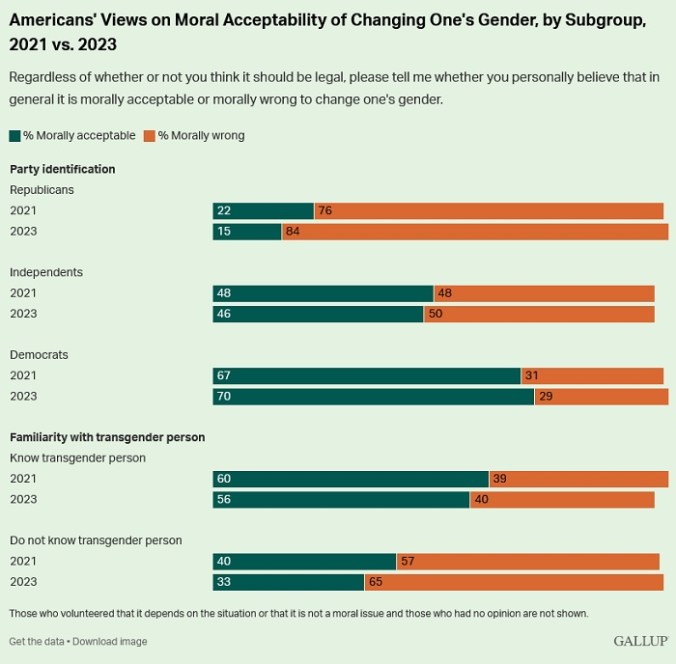
More Gallup: On The Transgender Fad, The Public Is Ethically, But Predictably, Confused, Mostly Because It Is Ignorant

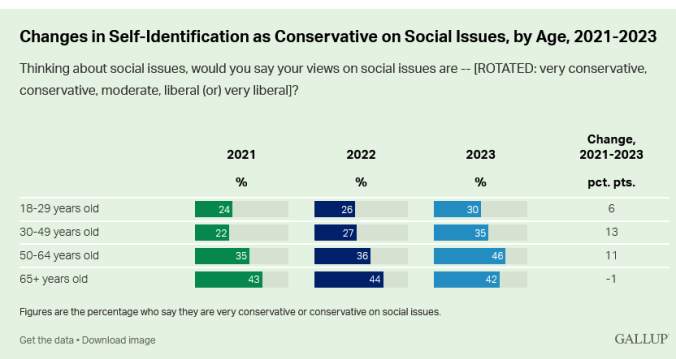
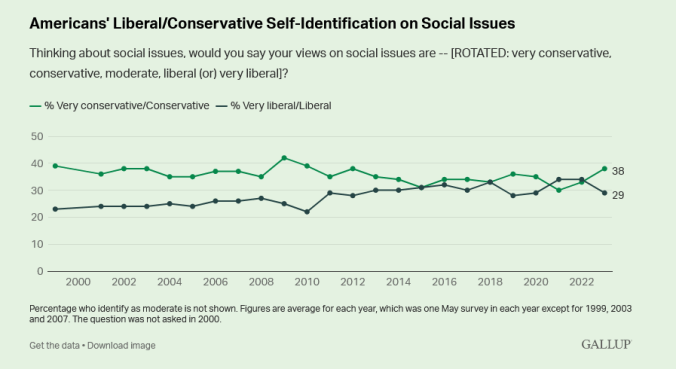
Gallup’s’ latest survey results are affirmatively strange, but then the topic is strange: American attitudes towards transgender issues. I believe the survey intersects with the one EA discussed yesterday, indicating that conservative self-identification was ticking up. It would have been stunning it it didn’t tick up, considering that the political and social Left has thrown all caution and moderation to the four winds and is openly advocating the most extreme and viscerally (as well as ethically) disgusting policies and beliefs imaginable, from 9 month abortions to legalizing theft. The unexpected Woke World obsession with transsexual “transitioning” is another example, though most Americans haven’t thought about it very carefully or thoroughly yet as Gallup’s polling makes clear.

The above survey, for example, is bizarre. I don’t see what morality has to do with an adult individual’s decision regarding transsexual surgery, non-surgical treatment, or “identification,” unless one is a Christian Scientist who opposes medical intervention, or someone who still subscribes to ancient religious taboos on all non-conforming sexuality and relationships. Obviously most American aren’t in either group. Those polled, and apparently those doing the polling, were seemingly using “moral” as a synonym for “ethical,” because most American are no longer taught what ethics is. They don’t know what “moral” means either.
Continue reading

OH NOOOO! Gallup Says Facism Is On The Rise In The US!!

Well, that may be a bit over-stated, though not in the parlance of the Democratic Party and its propaganda agents in the news media. What Gallup really found, in its annual survey of U.S. values and beliefs, is that social conservatism is on the rise, and has reached its highest level in a decade, since 2012. Gee…what…a…surprise…

Gallup, being, as much as it tries to fight it, also infected with partisan bias, doubletalks its explanation for charts like these:

Continue reading

Gallup Finds “Media Confidence Ratings at Record Lows”…Well, Good!

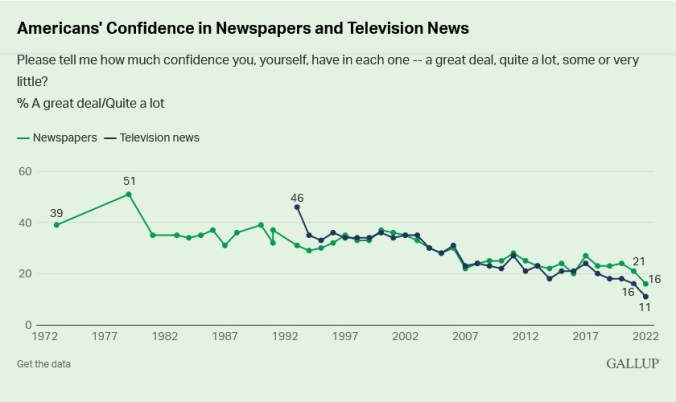
Why “good”? It’s obviously not good that the trustworthiness of journalism has declined so precipitously. What is good, since the news media has proven itself to be so biased, irresponsible, dishonest and untrustworthy, is that the public is waking up and no longer trusts it. That minimizes the damage. It does not solve, however, the existential danger to our democracy of having a propaganda system instead of objective and reliable reporting.

Sure, this is a poll, and polls themselves are biased and unreliable. Gallup and Pew, however, are the most reliable of the pollsters, and this one at least seems right. 11% trust in TV news is essentially no trust at all: that number represents the moron component that shows up in every poll. (The 16% trust level in newspapers is irrationally high.) Continue reading

When Polling Is Unethical

Gallup is both one of the oldest polling organizations and among the closest to objective, making it doubly irresponsible when it injects nonsense and ignorance into policy debates. This is what it did with two recent polls, headlined thusly: “Steady 58% of Americans Do Not Want Roe v. Wade Overturned” and ‘Pro-Choice’ Identification Rises to Near Record High in U.S.”

The immediate response here is “So what?” Abortion, at least since the misbegotten Roe v. Wade SCOTUS ruling in 1973, is matter of Constitutional law and individual rights, and neither of these are determined by popular opinion.. Nor should they be. Yet the reflex refrain of demagogues and the habitually dishonest when they are out of legitimate arguments is “the public overwhelmingly supports/opposes [fill in the blank],” a contention that inevitably depends on polling.

The threshold question Gallup asked its respondents on the abortion issue was “With respect to the abortion issue, would you consider yourself to be pro-choice or pro-life?” Useless. Did Gallup define what “pro-choice” or “pro-life” meant? Nope. Do “pro-choice” Americans believe a potential mother should be able to “choose” to kill a viable fetus right up to the moment of birth? Do they believe that abortion involves the taking of a life at any point? Ever? Do they care? Who knows? I don’t think most of those who responded that they were “pro-choice” know. It’s garbage in, garbage out: the poll results are meaningless, but they will still be cited as if they are profound.

Continue reading

Ethics Alarms Expresses Its Gratitude To CNN For Providing Such A Superb Illustration Of “Fake News” As I Compile The Directory Of Same

The fake news category is “polls.”

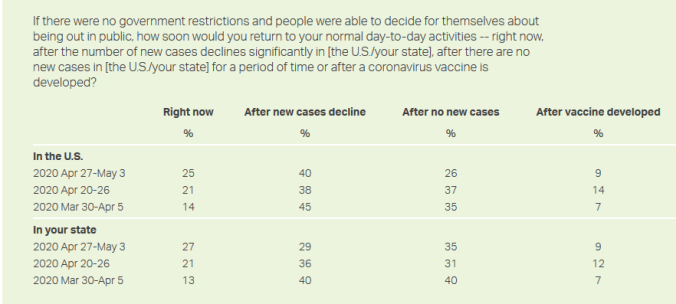
Gallup released the results of a survey in which various attitudes regarding the pandemic were explored. One question asked “How soon would you return to your normal day-to-day activities” if “there were no government restrictions,” giving respondants four options to choose among. The most popular answer was “after the number of new cases declines significantly,” getting 40% in the most recent results. The least popular answer was “after a coronavirus vaccine is developed,” with  9 %  choosing that.

Here is how CNN reported the results: Continue reading

The Knight-Gallup Freedom Of Speech Survey

A survey just released by the Knight Foundation and Gallup shows that More than 75% of the college students surveyed want “safe spaces” on  campuses that are free of “threatening actions, ideas, or conversations.” However, a majority of the same students support President Trump’s threat to withhold taxpayer dollars from universities that restrict speech.

Though 97% of college students believe that free speech is “an essential pillar of American democracy”, a  majority of students support policies to restrict of speech on campus. 78% of students support “safe spaces” where threatening ideas and conversations would be barred. 80%  favor the establishment of a “free-speech zone” where pre-approved protests and the distribution of literature are permitted. Continue reading

Saturday Ethics Warm-Up, May 2, 2020: Paid Liars, Paid Corrupters…

Beautiful day!

Outside.

1. Feel the restraints on free expression that inconveniences ideological agendas tightening? I do A couple of friends and commenters confirm that Zscaler, a service many companies use to monitor and block employee traffic on the web, blocks my ethics blog as containing “Pornography, Adult Content, Nudity, Hacking, Illegal, Racism, Hate or Violence, Phishing.”  Nice. So good for my reputation and business too.

2. It’s past time to conclude that no polls are trustworthy, and no one who cites polls as evidence regarding public opinion is trustworthy. All week long I’ve been reading progressive blogs  and sites telling us that the President’s support as measured by the polls is “collapsing.” Then today I see the latest Gallup survey claims that 49% of adults approve of the President’s performance, up from 43% two weeks ago. That would be the highest yet according to Gallup, if you trust any of these things now. I don’t, and you shouldn’t. Continue reading

Gallup’s 2020 Trust In Occupations Poll

I usually cover this interesting poll when it comes out in early January; somehow I missed it this year., and am getting it in right under the January wire. The results don’t change much from year to year, as you will see,  and this year was no different.

As the have for many years now, nurses, once again, top the list. Continue reading
Comment Of The Day: Public Confidence And Trust (2): Observations On Gallup’s Confidence In Institutions Poll

After Charles Green‘s recent  Comment of the Day on the post, Public Confidence And Trust (1): Observations On Gallup’s Trust In Occupations Poll, I was pretty sure that there would be an encore when I posted Part 2, an overview of the Gallup poll on public trust and confidence in American institutions. Charlie didn’t disappoint, so here is his Comment of the Day on the post, Public Confidence And Trust (2): Observations On Gallup’s Confidence In Institutions Poll:

…I agree with you that this stuff is as mission-critical as anything.

As you know, my life’s work is studying trust, and while I focus on interpersonal trust, you can’t ignore the systemic institutional issues either. In fact, they are connected.

In fact, I agree with your fundamental point that the cure for what ails our institutions must lie in personal behaviors, personal relationships, personal ethics.

Without taking anything away from that fundamental and massive agreement, let me suggest two tweaks to the issue as you have presented it.

The first is that this is NOT simply a US phenomenon. I recommend even more sobering reading from the Edelman Trust Barometer, a study that has been ongoing for over a decade. See the 2017 version here: https://www.edelman.com/global-results/

That survey covers about 18 western countries: fully half of them report the level of distrust in institutions – business, communications, NGOs, CEOs, etc. – not materially different from what we see in the US. Continue reading

Public Confidence And Trust (2): Observations On Gallup’s Confidence In Institutions Poll

In Part 1, we looked at the implications of Gallup’s 2017 polling on Americans’ beliefs in the trustworthiness and honesty of various occupations.  This post looks at institutions, and what Gallup’s research shows us when those polled answer the question, “Now I am going to read you a list of institutions in American society. Please tell me how much confidence you, yourself, have in each one — a great deal, quite a lot, some or very little?”

As with the occupations poll results, what is most interesting—or depressing— is how the public’s attitude has changed over time. Gallup has been taking this poll at the end of every year since 1993, and in some years, for some institutions, before that.

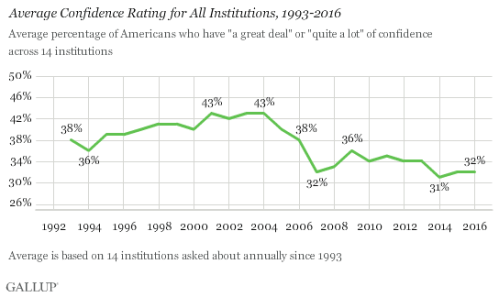
The most important finding is that Americans have less trust and confidence in our institutions than ever before, and have been in this state for three straight years. (See chart above.) The 32% average confidence level in all institutions measured was one point above 2016, which came in at a record low 31%, but that difference is not statistically significant. This is the third straight year that the number has been under 33%. That has never happened before.

I have written about this issue in the past (and discussed it with professional groups, like newly elected state legislators, in ethics seminars), with the same alarm. For a democracy to lack confidence and trust in its institutions portends disaster, and the danger cannot be understated. Of all forms of government, it is democracy that is most built on a foundation of public trust. This erosion in public trust—the average level of trust has fallen about 26% in just ten years—is collectively frightening. Look at the first line and the last in many of these charts: Continue reading