Donald Trump: A Pre-Election Ethics Alarms Character and Trustworthiness Review: 2005-2016 [UPDATED]

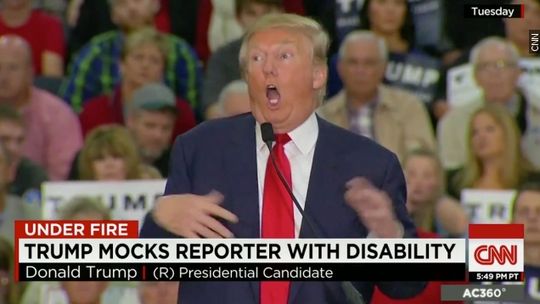
trump-mocks-disabled-reporter-cnn-usa-today

Donald Trump has no character or trustworthiness. Next question?

Oh, all right, in the interests of equity and fairness, I’ll submit The Donald to the same process as I did with Hillary Clinton, though in his case the verdict is res ipsa loquitur. Trump’s lack of ethics and his unfitness to fill the shoes of Washington, Lincoln, Teddy, FDR, or Millard Fillmore is, or should be, self-evident. Those for whom it isn’t self-evident are either ignorant, devoid of values themselves, or intentionally seeking to harm the United States.

I’ve been writing about the awfulness that is Donald Trump since 2005. He was noted for his dishonesty on my Ethics Scoreboard when I called foul on his marketing “various ‘get rich’ products, including tapes, seminars, and “Trump U,” an on-line delivery system for more of the same.” I wrote in part

There are thousands upon thousands of Americans who started with meager resources and made themselves rich through talent, hard work, creativity, inventiveness, and some luck. …Not Trump. The success of his pitch to the desperate wannabes and clueless is based on their erroneous assumption, nurtured by Trump but not explicitly supported by him, that he can teach them to do what they think he did…make himself rich through hard work and a business savvy. But what Trump is best qualified to teach is how to make yourself richer when you inherit an established business and have millions of dollars plunked into your waiting hands after your Dad has sent you to Wharton.

The fact that Trump doesn’t lie outright about his background but simply allows his marks to jump to the wrong conclusions puts his “get rich like me” marketing efforts in the category of deceit…but deceit is still dishonesty. Trump undoubtedly has useful wisdom to impart about building a successful career; it’s not as easy to stay rich as some people think. Ask most state lottery winners. Still, the most vivid lesson of Donald Trump’s successful campaign to sell himself as a self-made billionaire is the lesson that 19th Century con-man Joe Bessimer pronounced more than a century ago: There’s a sucker born every minute.

So we knew, or should have known, that this was a con artist at least back eleven years. In 2006, I posted on Trump’s misogyny and incivility, writing about the first outbreak of his feud with the equally vile Rosie O’Donnell, and their public name-calling…

Rosie set off the exchange by suggesting on ABC’s “The View” that Trump’s recent assumption of the role of moral exemplar by chastising and threatening to fire the reigning Miss USA for being a party-girl was more than a little ridiculous, given his own well-documented penchant for fast women and extra-marital affairs. Sometimes Rosie’s full of beans, and sometimes she gets it right; this time she was right, but spoiled it by concluding her commentary with some unflattering name-calling. Trump, no girly-man he, immediately said he would sue O’Donnell, and then launched into an extended riff on how unattractive and fat she was, including the charming phrase, “pig-face.” Classy as always, Donald…. Yes, anyone who admires either of these two annoying characters already has a problem, but there is no escaping the fact that both are celebrities, and as celebrities they contribute to establishing cultural norms of civility and conduct. This is especially true of Trump, who despite his low-life proclivities is a successful business executive. Resorting to personal attacks on an adversary’s weight or appearance is disrespectful, unfair, cruel and indefensible. Doing so on national media is like firing a shotgun into a crowd. There are a lot of fat or unattractive women out there, Mr. Trump, who are smart, generous, productive, loving, intelligent people… Golden Rule, anyone? How are we to convince our children not to ridicule the personal traits of others, when those they see as rich, famous and successful do the same openly, shamelessly, and even gleefully?

You can imagine my continued amazement that ten years after writing this rather obvious assessment, without Trump having undergone a complete transformation, and indeed with his conduct and public statements becoming worse rather than better, we are on the eve of a day that may live in infamy as the moment democracy  completely failed the United States of America, inflicting on it, and the world,  as unstable and unqualified a leader of a great power as history has ever witnessed. Continue reading
Hillary Clinton: A Pre-Election Ethics Alarms Character and Trustworthiness Review: 2009-2016

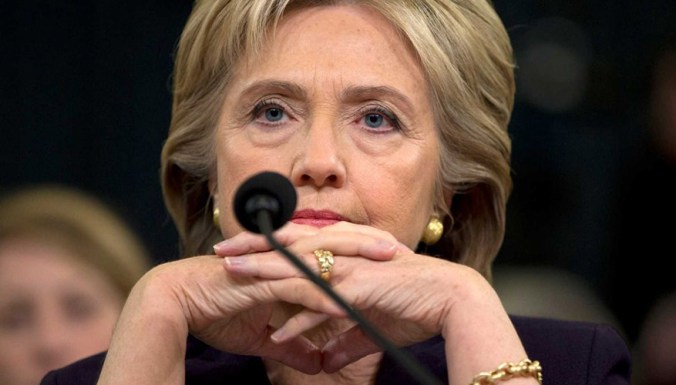
hillary-testifies

The first Ethics Alarms post about Hillary Clinton ironically enough, in 2009, awarded her an Ethics Hero. (She has two.) “I know, I know. Truth and the Clintons have never been friends,” it began. And, looking back, it was a pretty generous award: all she did was describe how an ethical decision is made, and claimed that was how she decided to accept Obama’s invitation to be Secretary of State.  It didn’t prove she actually made the decision the way she said she did, and now, with the benefit of seven years’ hindsight, I think it’s likely that she was lying about it, as usual. Still, it proves that Hillary may know how to act ethically. This distinguishes her from Donald Trump.

Before heading to the voting booth, I decided to review all of the Ethics Alarms posts about Clinton. It is, I think it’s fair to say, horrifying. You can find them all here. 

There are unethical quotes of the week and month, Ethics Dunce designations, Jumbos, where Clinton denied what was in clear view to all, and KABOOMS, where the sheer audacity of her dishonesty (or that of her corrupted allies and supporters) made my skull explode skyward. If you have a recalcitrant Hillary enabler and rationalizer in your life, you should dare him or her to read this mass indictment—not that it will change a mind already warped, of course, but because the means of denying and spinning what they read will be instructive, confirming the symptoms of incurable Clinton Corruption.In July of 2015, I responded to complaints—including one from an ethics professor— that I was not objective regarding Mrs. Clinton, that I was picking on her. The response was a manifesto, stating my standards and objectives: Continue reading

Sorry, Steve Bartman, But It’s Impossible To Leave You Alone

As the Chicago Cubs plowed their way to the World Series and a possible end to their 108 year failure to win a World Series, numerous sports writers, including some I thought were smart enough to know better, set out to prove their compassion, sensitivity and gooey caramel centers by arguing that the news media and fans should “leave Steve Bartman alone.” Bartman, for those of you who have lived in a bank vault since 2003, was the hapless young Chicago Cubs fan who unintentionally interfered with a foul ball that might have been catchable by Cubs outfielder Moises Alou in the decisive game of 2003 National League Championship Series. In a perfect display of the dangers of moral luck, Bartman’s mistake—it didn’t help that he was wearing earphones and watching the ball rather than the action on the field—began a chain of random events  that constituted a complete collapse by Chicago in that very same half-inning, sending the Miami Marlins and not the Cubs, who had seemed comfortably ahead, to the Series. Bartman, who issued a sincere and pitiful apology, was widely vilified and literally run out of town. He then became part of Cubs and baseball lore, one more chapter in the sad saga has been called “the Billy Goat Curse,” the uncanny inability of this team to win it all.

Over time, even Bartman’s tormenters came to see that holding him responsible for the team’s failure was cruel consequentialism at its worst. Alou, who had sicced the Furies on Bartman by angrily pointing at him after the incident from the field and later told everyone that with the interference, he would have caught the ball, even came out ten years later–five years!—to say that he wouldn’t have caught the ball, and Bartman wasn’t to blame. (I wrote about that epic example of barn-door locking here.) Now, NBC’s Craig Calcattera and many others are beating a new drum: nobody should write about or talk about Stave any more, because it’s so unfair. Continue reading

Along With All The Other Critical Issues Ignored In This Presidential Campaign, What Completely Neglected Crime Robs American Consumers Of An Estimated $25 billion A Year?

fish2

Why it’s fish fraud, of course!

Ethics Alarms covered the problem way back in 2011, in a post called “Getting Scrod in Boston: The Ravages of Seafood Fraud. I just checked: almost nobody has read it, and those who have almost certainly have 1) forgotten about it and 2) been ripped off buying seafood since.

Now the guys at “Stuff You Should Know” have done an excellent  podcast about the issue. It really is infuriating that with all the regulations we pay for, and all the attention the government focuses on fads, politically correct crusades (how many Americans are affected by limitations on which public rest rooms can be openly used by transgender citizens?) , and out-and-out trivia, something like this goes not only unaddressed by officials, but ignored as well. The news media, meanwhile, would rather use its limited daily space to tell us how Stephen Colbert just skewered Donald Trump last night than to warn us about our pockets being picked.

Well, not me: I almost never buy seafood unless it’s raw oysters, whole shrimp or crab,  and if I’m in New England, Ipswich clams and lobster, all hard to fake. Continue reading

Ethics Dunce: Kanye West

kanye-west-meadows-2016

I need a new designation for people like Kanye West, and am open to suggestions. Noting that in any specific episode that West is an ethics dunce is entirely superfluous and stating what was undeniable and generally known long ago. This is a man who accused George W. Bush of wanting to see black citizens suffer in the wake of Hurricane Katrina, and did so on national TV. This is a man who interrupted a fellow entertainer’s acceptance speech for an industry award to announce to the world that she didn’t deserve it. This is a man who has inflicted the names “North” and “Saint” on his helpless children. He, like Donald Trump (whom I would vote for as President over Kanye West, so don’t say I’m #NeverTrump), belongs to that rare but growing class of celebrities for whom  civil descriptions are inadequate. Only labels like “asshole” come close to describing them. In the West’s extreme case, even that is an insult to assholes.

West gave us another view of his near total ethics vacuum when he abruptly ended his October 2 performance at the Meadows Festival in Queens, New York City. He had just learned that his wife, Kim Kardashian, was robbed at gunpoint in her Paris hotel room. West, who was headlining the festival, went onstage (late, as usual) at a little after 8:45 p.m. He was scheduled to perform until 10 p.m., but walked off the stage at 9:40, halfway through the song “Heartless,” announcing, “I’m sorry, family emergency, I have to stop the show.” Continue reading

Ethics Hypothetical: Rules, Compassion, Integrity, Fairness, And A Looming Race Card

clock2

[The hypothetical is inspired by two recent events I witnessed in the past week.]

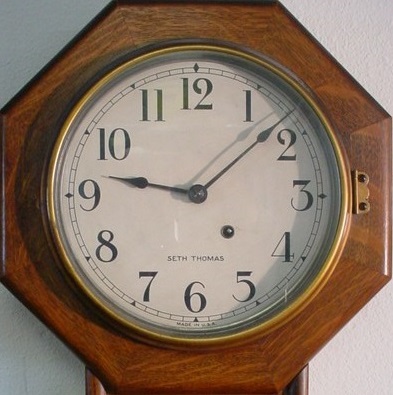
Preface: The state requires new bar admittees to take a one-day course covering the basics of practicing law in the jurisdiction—how the courts work, special procedural rules, unique aspects of local practice, horror stories, the works. They must complete the course or they can’t be certified, and the court-ordered series of lectures and presentations is held only once a month.

A company runs the mandatory curriculum under contract to the state, and is required to confirm in writing to the courts that its requirement have been fulfilled. One key requirement is that every attendee must be present for every minute of the presentations, except for brief emergencies, like using the rest rooms. The course administrators carefully monitor attendance. The published description of the course directs that once the course begins, theoretically at 9 am sharp, no late-comers will be admitted.

As you might imagine, missing the session can be quite a hardship, as participants often live and work in other jurisdictions.

The Event: It is 9:08 am on the day of the program, and the introductory video that begins the orientation is almost finished. It consists of interviews with members of the bar about the benefits of practicing in the state, the importance of ethical practice, etc: to say it is not substantive is an understatement. Literally nothing that is said and shown in the video is anything but boilerplate.

A young man, sweating profusely, bursts in the door, looking unhappy and desperate. “I’m sorry I’m sorry!” he babbles. He says that he had to drive up from a neighboring state and had an accident. “Can I still get in?” he pleads.

The male staffer responsible for the session chats briefly with an associate. The program was late starting, and this late arrival will miss nothing if he goes in now. “All right,” the honcho says as the young man heaves a sigh of relief. “I shouldn’t do this, but you haven’t missed anything.” As he goes into the auditorium, one can here the opening remarks of the first speaker, a judge. It is now 9:12 am, and another young man bursts through the door on a dead run. “My crazy cabbie’s been driving me all over the city for an hour!” he shouts. “I flew in last night from Arizona! Please, please, don’t make me do this again…I barely was able to afford this trip.” The administrator is wondering if he had seen the previous guy go into the auditorium. He’s heard this judge’s spiel many times: all that has been missed, to be honest, are a few (lame) jokes. “All right, all right, get in there quick!” he tells the new supplicant. “I’ll finish your paperwork during the break!” The kid looks like he’s going to cry, he’s so relieved.

I’m there, watching this (I’m on the program) and say to the administrator, “I bet this happens every time.” He says, “It does. I know that nobody misses anything that isn’t in the printed materials until 9:15, so it’s a hard stop after that.”

And another late arrival bursts through the door. It’s a bit after 9:14. The staffer has just told me that the final final deadline is 9:15, and it’s not that yet. This poor guy is bleeding through his pants,  has a big bruise on his face, and is saying something about a bicycle accident. By the time he gets himself settled—he is told that there is no time to clean up—it’s past 9:16. He starts toward the auditorium door as the other staffer says, “OK, that’s IT,” and starts to take the registration materials and lists away….just a very stressed young African-American woman enters, in plenty of time to see the bicycle rider, who is white, enter the auditorium. I can hear the judge through the open door. He’s still telling jokes, longer this time than usual.

Issues and Observations

1. The young woman was not admitted, and told that she had to come back another month. She too was from out of state. She also had a legitimate-sounding excuse.

  • Was that fair to her?
  • Should it have mattered that the program had not yet reached a serious stage?
  • She was told that 15 minutes was the absolute, unwaivable deadline. That was true, but it was not the deadline the company was contracted and pledged to enforce. That deadline was 9:00 am.

2. Should the explanations used by the latecomers play any part in the decision to allow them in? Why? Continue reading

The Ethical Dilemma Of The Successful, Failing, Local Small Business

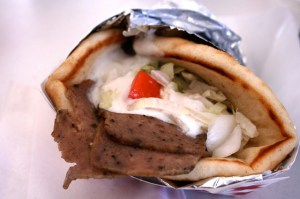
Now THIS is a gyros sandwich!

Now THIS is a gyros sandwich!

The little restaurant opened the same year my wife and I moved into the neighborhood. It specialized in yummy Greek fare like gyros, souvlaki, and Greek salads, but also made terrific hamburgers, subs and pizzas, and quickly became our reflex fall-back when we were too tired to make dinner or wanted a treat for lunch. The place was a family operation: the tiny, spunky middle aged woman who seemed to run the place—taking the orders, filling bags, taking the payment—had a Greek accent that reminded me of my grandmother and all of my relatives from her generation; her husband, silent, imposing, who was the chef; and over time, the two children, both of whom worked there when they weren’t in school.

The food was consistently delicious, fresh and authentic, but it was also satisfying to see an old-fashioned family business growing and thriving. A restaurant consultant would probably have said it was too old-fashioned, for the menu never changed, the faded prints of the Parthenon and the Aegean coast were the only decorations in the place, and it dealt only in cash. Still, the little Greek lady greeted you with a knowing smile when you walked in the door, and you knew you were going to be treated like a neighbor.

Then suddenly, the family was gone. The couple decided to sell the place and retire, and a long-time employee who had worked in various jobs over the years took the restaurant over. I knew him, of course, and we talked often. He’s a nice guy, determined, ambitious, hard working. He threw himself into the job of making the business boom. Now the restaurant accepts credit cards and delivers, is open on Sundays, has daily specials, and sports a newly-painted and (somewhat) less austere decor. He also jacked up the price on everything.

The new owner’s formula for success worked almost immediately. The restaurant, he told me, has almost doubled its business. The problem is, as my family gradually discovered, is that the entirely non-Greek staff, including the owner,  has no idea what their food is supposed to taste like. You know you’re in trouble when the entire staff mispronounces everything on the menu, (It’s GIR -Os, hard G, not, ugh, “JY-row,” like the name of the goose inventor in Donald Duck comics), but it’s worse than that. The feta cheese in the Greek salads, which are suddenly mostly iceberg lettuce, is scant and low quality. The once-marvelous cheese steak subs are bland; the onion rings are charred, and every now and then a carry-out order includes something inedible, like the freezer-burned veal parmigiana I had a few months ago. The owner was apologetic, but his candid “I thought that meat looked funny when I microwaved it” didn’t inspire confidence. Continue reading

Ethics Quiz: Ad Hominem Or Not?

I frequently find myself correcting commenters who accuse me of ad hominem attack when I diagnose their problem, based on their arguments as jerkism or mental deficiency. (I recently found one legal blogger who actually states that if a commenter uses the term incorrectly, the comment will be rejected). Ad hominem is an argument fallacy that holds that if a messenger is flawed, his or her argument can’t be valid. It’s a cheap debate tactic, and unethical. If I conclude, however, that your argument is so idiotic that it could only be devised by an  idiot and thus designate you as one in so many words (because you have a right to know), that’s not ad hominem.

African-American pastor Mark Burns is a rafter-shaking speaker and an unusual and useful advocate for Donald Trump. He has been on cable news segments frequently, and even spoke at the GOP Convention. Being black, he is obviously roundly detested by those who regard Trump as a bigot, indeed by those who just dislike Trump generally. This almost certainly includes journalists on CNN, a Hillary stronghold.

A member of the black fraternity Kappa Alpha Psi alerted CNN that  Burns had claimed to have been a member,  but there was no record to support it. This set CNN on a quest to check all of Burns’ credentials and biography items, and it found that he had other dubious claims. Confronted on the air by (also African-American) CNN reporter Victor Blackwell with these discrepancies, Burns stuttered, humina-huminaed, protested, lied (his web site bio had been “manipulated” in some way, he said—the Weiner Excuse: “I’ve been hacked!”), and finally stormed out of the interview, which is to say, he ran.

Mark Burns is a Trump ally and supporter of note because he is a black pastor. He is still a black pastor. He makes a case for why blacks should support Doonald Trump. That case does not in any way rely on his military record or where he went to school, or, for that matter, how well he responds to having his honesty and integrity challenged on TV.

Your Ethics Alarms Ethics Quiz of the Day is...

“Was CNN’s attack on Pastor Burns fair and responsible, or..

Was it an unethical ad hominem attack designed to discredit a Donald Trump ally?”

Continue reading

A Plague Of Misleading Headlines

Fake headline

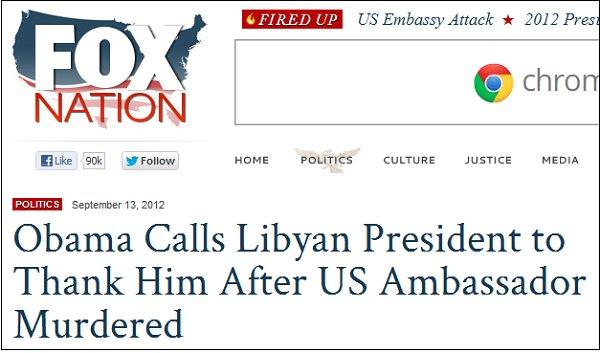
The mad quest for clicks appears to be leading websites that should know better to sink to misleading or outright dishonest headlines on the web. For someone like me, who has to scan these looking for possible ethics issues, it is an increasingly annoying phenomenon. Readers need to speak up. The practice is unethical, and moreover, suggests that the source itself isn’t trustworthy.

Here are three current examples;

1. The Daily Beast: “Idiocracy’ Director Mike Judge: Fox Killed Our Anti-Trump Camacho Ads”

Boy, isn’t it just like that conservative, Trump-promoting Faux News to help The Donald by using its power, influence, lawyers, something to stop the makers of “Idiocracy,” that comic classic, from being used to save the country from American Hitler?

That’s sure how the Daily Beast wanted its largely Democratic readership to react to its headline over the story about a fizzled effort to use the the film’s character  of ex-porn star future U.S. President Dwayne Elizondo Mountain Drew Herbert Camacho, played by Terry Crews, in a series of comic spots ridiculing Trump’s candidacy. The story, however, never quotes Judge as saying Fox—that would be the movie side of Twentieth Century Fox, not Fox News, which had no say in the matter: the company produced the film and owns the right to it and all of its characters—killed the project.  All Judge says is that the idea of doing a series of such ads didn’t come to fruition, for a whole list of reasons which might have included Fox’s distaste for the project.. Of  Fox, he says this..

“I think also Fox… yeah, they… even though they’ve probably forgotten they still own it…”

The writer then suggests that company owner Rupert Murdoch might not like the idea, and thus prompted, Judge replies,

“Yeah. That’s the other thing. I think there was a roadblock there, too…I just heard that [the proposed ads] were put on the shelf, so it looks like they’re not going to happen.”

Based on this, the author, typical Daily Beast hack Marlow Stern, writes, “It looks like Fox refused—and the ads are now dead.” Stern never says that Fox refused; it is the “reporter” who says it. Meanwhile, when the Daily Beast writes about “Fox,” it is referring to Fox News 99.9% of the time, and knows that’s what its readers will think when they read “Fox.”

The headline is intentionally misleading, and a lie.

(Incidentally, the movie is a great concept that under-delivers on its premise and potential, and should be a lot funnier than it is) Continue reading

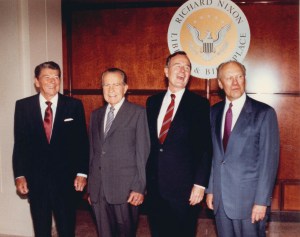
Ethics Heroes: The Nixon Foundation And The Richard Nixon Presidential Library

Pop Quiz: Who is missing from this picture from the dedication of the Nixon Library in 1990, and why?

Pop Quiz: Who is missing from this picture from the dedication of the Nixon Library in 1990, and why?

I can’t stand the Kennedy Library in Boston, with all its triumphal, sentimental hagiography of both Jack and Bobby. A presidential library will naturally try to put the best spin on the accomplishments, failures, and character deficits of its subject, but it has an obligation to history too. I once was determined to visit all of the libraries, but after the first few I decided that these structures were more like the pyramids than fair and enlightening representations of the men they honored.

The worst in this respect, as you might guess, was the infamous Richard Nixon Presidential Library in Yorba Linda, California, which opened 26 years ago.The Watergate exhibit, approved by Nixon himself, painted Nixon as an innocent and heroic victim brought down by the media  and his sinister foes. This was certainly Nixon’s view, but it has no relationship to reality. So convinced was Congress that the Richard Nixon Presidential Library would display the same lack of ethics as its namesake that it passed a law in 1974 requiring his presidential records to be stored with the National Archives and out of the library’s control, where they might be altered or “lost.”

Nixon’s library entered the official presidential library system under the auspices of the National Archives in 2007, and to finally make it more than the presidential library equivalent of  Fantasyland, the Nixon Foundation ordered the old Watergate exhibit to be overhauled. Continue reading