“The Walking Dead”…as always, providing abundant ethical dilemmas to chew on…
If you can stand the periodic spectacle of shambling, rotting flesh and heads being lopped off or split down the middle, AMC’s “The Walking Dead” still provides the most daring and interesting ethics storylines available on television.
The latest episode, titled “Indifference,” raised two gutsy issues that are unpopular in today’s culture to the point of taboo. It was revealed that Carol, previously the simpering and tragic mother of the now dead, zombified and executed little girl Sophia, has morphed into a stone-cold pragmatic survivalist who advocates killing on instinct when the threat is sufficiently severe. In addition to teaching methods of mayhem to the children entrusted to her instruction in the grim, abandoned penitentiary where our heroes have fortified themselves against the roaming zombie hoards, Carol summarily executed two members of the community who were fatally ill with a pernicious virus on the grounds that they threatened the safety of the rest. For this, Rick, the sheriff-turned farmer alleged leader of the non-zombies, orders her out of the prison.
Strange. In a world without doctors, medicine and hospitals, where the objective is simply to survive long enough for some remote miracle to rescue humanity, a runaway virus is as much of a threat as a maniac with a hatchet. Rick and the rest have long ago accepted the necessity of killing members of their group who are bitten by zombies, since they are certain to “turn”after death and start indiscriminately eating people. True, the preferred method is to withhold execution until the second after the living become undead after becoming unliving, but this is a distinction without a difference. Carol is quite right that a breathing, doomed, virus-carrier is as much of a threat to the group—perhaps more—as a newly-minted brain-muncher. Why is her strong action in defense of the group, a defensible utilitarian act, reason for exile? Continue reading →
What would Ted Williams have done? We know the answer to THAT question…
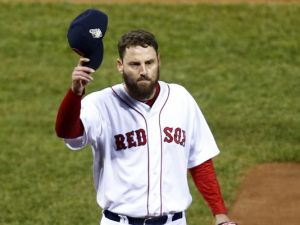
The Boston Red Sox won the World Series last night, making me happy. Something else happened too.
Some background is in order. The great Ted Williams used to give Boston baseball fans the biggest hat tip in baseball as they cheered him after a home run. This was when he was first known as “the Kid’ and indeed was one, as his Hall of Fame trajectory was obvious from the moment he stepped on a major league field in 1939 at the tender age of 19. Gradually but rapidly, a vicious local press and some ugly incidents in response to a few jackasses in the stands caused the Kid to sour on the admission-paying mortals who booed him when he struck out, and he decided to ignore their cheers, refusing to extend the traditional courtesy of a hat tip to the fans as he rounded the bases after a home run—which, since he was Ted Williams, happened frequently. Williams spent his whole career in the city of Boston playing before those fans who offended him in his twenties, but right up to and after his final home run, which he hit, famously, in his last at bat, the Red Sox fans got no hat tip from Ted. He rounded the bases the final time as they cheered themselves hoarse, and never looked up or acknowledged their praise. Screw ’em.
That was Red Sox pitcher John Lackey’s attitude toward the current generation of Fenway fans, for similar reasons. He had been signed to a rich, long-term contract in 2010 to be a Red Sox mound ace, but arrived in Boston with his arm deteriorating and his abilities diminished. 2010 was a disappointing season for Lackey and 2011 was worse, as he pitched in pain for a team that was short of hurlers. The 2011 Red Sox became infamous for their late-season collapse and underachieving starting pitchers, and no one on that team was jeered on the field or savaged in the call-in sports shows like John Lackey. He missed the entire next Red Sox season recovering from arm surgery after the 2011 collapse, and thus missed the 2012 debacle that was even worse. In 2013, however, Lackey returned with a renewed right arm, a fit body and a fierce determination to finally live up to the big contract. He did, too. He pitched well all season, and became a key factor in the Boston charge to the World Series, as they rose from last place in their division in 2012 to first.
In 2013, Lackey received nothing but cheers from the surprised and grateful Boston fans. Nevertheless, he adamantly maintained the Kid’s attitude—“Screw ’em”—all season long. As he walked into to the Red Sox dugout after being relieved in another fine pitching performance and the Boston fans saluted him, Lackey refused to reciprocate with the traditional hat tip, all season long and through the play-offs. The fans were fickle hypocrites, and their loyalty conditional. They booed him when he was valiantly pitching hurt and embarrassed in 2011, and he wasn’t going to forget it. They were going to get snubbed like they deserved, and that was the way it was going to be.
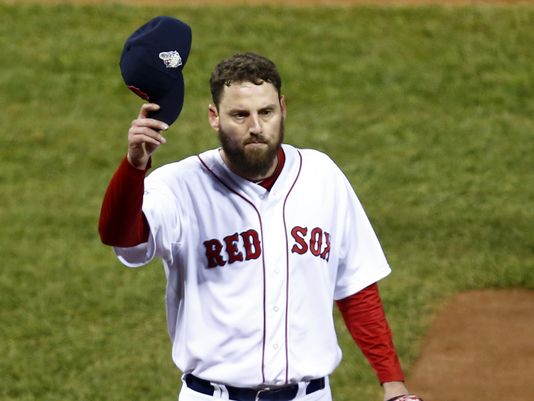
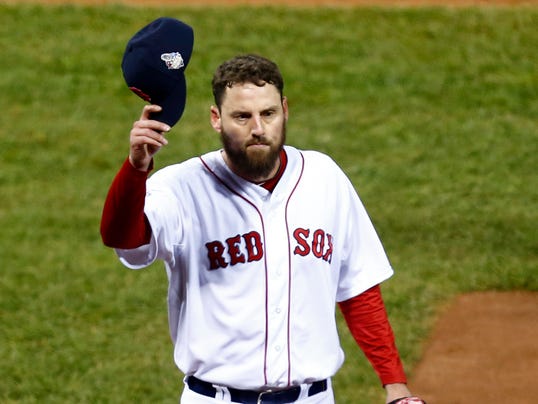
Last night the Boston Red Sox won their third World Series in the last ten years. It was the first time the home team fans had been able to witness the deciding game since 1918 (as the Fox announcers informed the presumably senile audience over and over and over again), and John Lackey was the pitching star for the home town team. The night was a love fest for Boston baseball fans, as they cheered every move of their frequently star-crossed and quirky team, and no Red Sox player was cheered more loudly than John Lackey, as he walked off the field for the final time in 2013 in the 7th inning, with his team safely ahead by five runs. They stood and applauded and chanted his name, as he moved deliberately to the Boston dugout, head down, grim, just like Ted on that gray day in 1960 when he hit homer number 521.
It was a small thing, the smallest really, only a gesture and for most players, most of the time, an automatic one…except that it symbolized the ethical virtues of grace, forgiveness, gratitude, humility and fairness. This memorable, wonderful night for the Boston Red Sox and the grand old city it represents—my home town– was no time to let bitterness and resentment prevail. Unlike Ted Williams (who wouldn’t make his peace with Boston fans until years later, when he returned as an opposition manager), John Lackey found the strength and decency to let it go.
It was, as I said, a small thing. But it took character, and it was the right thing to do.
Maryland Attorney General Doug Gansler (D) is running to be his party’s nominee for Governor, which, since Maryland is one of the Bluest of states, means that success equals the statehouse, or should. But the intense spotlight that such a quest creates can be hot and unflattering, and Gansler’s character and integrity is now being called into question…especially after this photo from last summer surfaced on Instagram, showing Maryland’s top law enforcement official in the middle of a wild teen beach party at a beach house by the Delaware shore. He’s the guy in the white shirt and the cell phone:
There you have it: the exact moment when Attorney General Doug Gansler, Candidate for Governor Gansler and Father of a Teenage Son Who Graduated From High School And Wants To Party With His Friends Like In “Animal House” Gansler officially collided. Many, especially many Democrats, especially many Bill Clinton fans, and definitely aspiring toyboy lawyer Brian Zulberti, would argue that only one of them is really there: Father Doug. The others, being absent, are immune from criticism. This position is popular, convenient, lazy, ethically corrosive and wrong. There is only one Doug Gansler, yes, but he is bound by three standards of conduct. When you are bound by three standards of conduct, you have to abide by the highest one.
Again, this situation focuses our attention on integrity, a core aspect of character, and crucial to ethics. Does an individual have genuine principles that he oe she lives by, or a constantly shifting set of values that are assumed and then discarded according to situation, convenient, strategy and whim? When an ethical problem arises, do others know how the individual will respond? Are his words consistent with his actions? Trust means that others can rely on an individual’s conduct, and you can’t rely on the conduct of someone whose values and priorities with the wind, locale, attention and personal desires.
Then there is the issue of judgment. Judgement is like intelligence and common sense: an individual either has it, or he doesn’t. And such traits as responsibility, accountability, honesty, prudence, dignity, loyalty and courage come into play. I know those who embrace the private individual/professional dichotomy are stuck with the argument that the absence of one or more of these in a private setting has no predictive value regarding public or professional conduct, but it is a hopelessly untenable position, pure denial, and ethics poison. Continue reading →
Whay ever happened to this guy? Boy, we sure could use someone like him about now…
As we all know by now, President Obama is refusing the negotiate over raising the debt limit, which, since the House of Representatives refuses to agree to raise the limit without some kind of concessions in spending by Democrats, is raising the specter of a catastrophic default.
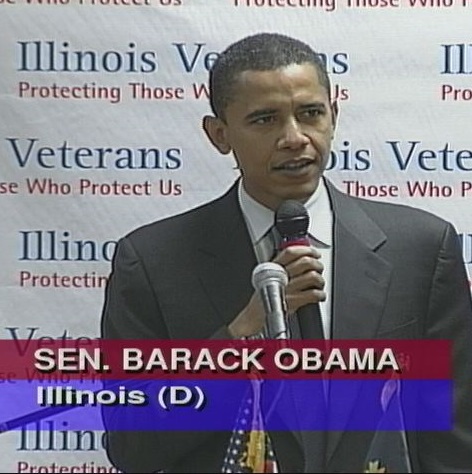
Conservatives have been citing as an example of the President’s hypocrisy the fact that he voted against raising the debt limit in 2006, when Bush was President and the debt owed was just about half what it is today, posing far less of a threat to the nation’s fiscal future. At that time, Senator Obama said this:
“The fact that we are here today to debate raising America’s debt limit is a sign of leadership failure. It is a sign that the U.S. government can’t pay its own bills. It is a sign that we now depend on ongoing financial assistance from foreign countries to finance our Government’s reckless fiscal policies. . . . Continue reading →
Hey! Get that foot off of your own desk! Who do you think you are, President of the…oh. Right.”
RECONSIDERED:I have been persuaded by the comment thread that followed this post that my initial position regarding Andy Levy’s objections to Stephen Colbert’s use of his critique from “Red-Eye” was mistaken: Colbert was indeed unfair to Levy, and it was unfair as well for me to hold Levy accountable for some of his conservative colleagues’ serious versions of the argument he properly labelled as absurd. Read the comments of James Flood and Ampersand below for the rebuttal that carried the day. As always, I am grateful for the passionate and well-argued perception of Ethics Alarms readers.
If you need more proof of how toxic and infantile the partisan wars are these days, you need search no farther than the manufactured controversy over President Obama’s disrespectful treatment of his own desk. When I first started seeing posts on major websites complaining about the photo of the President putting his foot on his desk in the Oval Office, I decided the controversy was too idiotic to waste time with. But, as is their tendency and their talent, conservatives escalated this one with exquisite gall, and now I have to take note.
Washington Post Fact-checker Glenn Kessler finally couldn’t stand it anymore regarding Secretary of State John Kerry’s favorite lie, only trailing me by about nine years. As he was participating as a stooge in President Obama’s improvised vaudeville act regarding his “red line” and Syrian chemical weapons (but then, as Americans, so are we all), Kerry said this in an interview on MSNBC, where he knows any transparent and self-serving lie by a Democrat will be accepted as revealed truth:
“You know, Senator Chuck Hagel, when he was senator, Senator Chuck Hagel, now secretary of defense, and when I was a senator, we opposed the president’s decision to go into Iraq, but we know full well how that evidence was used to persuade all of us that authority ought to be given.”
Now I, for one, am thankful when Kerry, who is not Irish (his heritage is primarily Jewish) * and was elected Senator in Massachusetts using campaign posters with green shamrocks on them, reminds us all why he never became President. This was yet another re-phrasing of the deception he kept hammering during his 2004 campaign—you remember, the one with John Edwards as his running mate, because Kerry is also a magnificent judge of character?—he didn’t support President Bush’s invasion of Iraq.
Of course, he did, and emphatically too. Kessler, who is inclined to go easy on Democrats for the same kinds of deceptions he slams Republicans for (I measure the discrepancy at just short of two “Pinocchios”) decided to give Kerry a full blast with both barrels: Continue reading →
“It is extremely dangerous to encourage people to see themselves as exceptional, whatever the motivation. There are big countries and small countries, rich and poor, those with long democratic traditions and those still finding their way to democracy. Their policies differ, too. We are all different, but when we ask for the Lord’s blessings, we must not forget that God created us equal.”
—-Former KGB officer and Russian leader Vladamir Putin, lecturing President Obama and the U.S. public on right, wrong, and human potential,in a New York Times op-ed that neatly exploits the stumbling White House diplomacy efforts regarding Syria. And yes, it made my head explode.
Oh-oh…this was bad one…
John McCain’s tweet in response to Putin’s cheeky op-ed was on target: “Putin’s NYT op-ed is an insult to the intelligence of every American.” [Aside:Of course, so was President Obama’s speech. As always these events give us a chance to gauge which journalists warrant ever regarding seriously again. On one side there are the likes of the Daily Beast’s toadying Michael Tomasky, who pronounced the President’s speech “great.” On the other is the Washington Post’s generally left-leaning Dana Milbank, who decided to be honest, pointing out how the President’s speech arising out of his contradictory and incoherent statement about Syria was…contradictory and incoherent: “The president, in the space of his 16-minute address, was often at odds with himself. He spent the first 12 minutes arguing for the merits of striking Syria — and then delivered the news that he was putting military action on hold. He promised that it would be “a limited strike” without troops on the ground or a long air campaign, yet he argued that it was the sort of blow that “no other nation can deliver.” He argued that “we should not be the world’s policeman” while also saying that because of our “belief in freedom and dignity for all people,” we cannot “look the other way.” He asserted that what Bashar al-Assad did is “a danger to our security” while also saying that “the Assad regime does not have the ability to seriously threaten our military.”In other words, “great.”] It was more than an insult, however. Putin’s screed was ethics poison: dishonest, manipulative, and malign. Continue reading →
I really don’t know what to make of this, but I think it means something,and whatever it is, it’s important to remember and learn from it. Now if I could only figure out what it is.
Here is what Ed Asner, the elderly “Mary Tyler Moore Show” and “Up” actor—he was also a bad guy in one of my favorite John Wayne Westerns, “El Dorado”—said in response to an interviewer’s question about why the Hollywood anti-war left was staying out of Obama’s self-made Syria controversy, in such marked contrast to its vocal opposition to the Iraq invasion (Where have you gone Janeane Garafolo, our nation turns its lonely eyes to you…OOOOO! ).
Spake Ed:
“A lot of people don’t want to feel anti-black by being opposed to Obama.”
Now, Asner has long been a vocal member of the Hollywood liberal activist community. Presumably, he still is well-connected and knows something about the culture and political pulse in Tinseltown. So I want to know: What can we glean from this ridiculous statement? What does it mean? Continue reading →
I live in the Washington, D.C. area, and at this moment even the beginning of the NFL season, usually the one thing everyone here (except me) usually cares about, is being over-shadowed by the drama of the looming Congressional vote on Syria. What was assumed—why, I cannot imagine–to be a likely rubber stamp with only an insufficient number of Republicans providing opposition because, as we all have been told repeatedly, they will oppose the President on anything, has materialized as strong bi-partisan opposition. The Washington Post estimated last night that the votes in the House are currently running 3-1 against the symbolic-and-deadly-but-promised-to-be-non-committal missile strikes on pre-announced targets. This is the most encouraging development in the government since President Obama was elected, I am tempted to say. It shows that this is not a nation of lemmings, and that the separation of powers has its virtues after all. Nonetheless, interesting ethical arguments are arising in favor of votes both no and yes.
The no arguments are varied, and reach the same conclusion from different positions, some more ethical than others. The pacifist Left and the isolationist Right, both irresponsible and dedicated to ideology over reality, are on the same path here, and would be on that same path even if the President’s argument for missile strikes was strong. Others, including me, but also those who supported more extensive military action in the Bush administration, fault the plan because of its dubious results, its contradictory logic, and the feckless and troubling way the President brought us to where we are.
I just heard an interview with a Republican House member who announced that he reversed his initial support for the missile strike after hearing Obama’s remarks in Sweden. After hearing Obama appear to deny that he drew the red line—a rhetorical point that was too cute by half and clumsily stated—this Congressman decided that he couldn’t believe anything Obama said or promised regarding Syria, including his assurances that nothing would lead to “boots on the ground.” (I would argue that his assurances that nothing would lead to boots on the ground is, if not dishonest, frighteningly irresponsible.)
The yes arguments are more perplexing. Naturally, there are those who, against all logic, simply adopt the contradictory and militarily nonsensical arguments John Kerry was asked to present to the Senate (apparently because President Obama knows that he appointed an inarticulate—but loyal!!!—dim-bulb, Chuck Hagel, as Secretary of Defense—but that is another, though related, issue). Liberal columnist Eugene Robinson, who has won an Affirmative Action Pulitzer Prize and who has proven that he will cheer whatever his fellow-African American in the White House does, even if he makes a decree like the South American rebel-leader-turned-dictator in Woody Allen’s “Bananas”...
“From this day on, the official language of San Marcos will be Swedish…In addition to that, all citizens will be required to change their underwear every half-hour. Underwear will be worn on the outside so we can check. Furthermore, all children under 16 years old are now… 16 years old!”
made this “argument”…
“The issue can’t be who wins that country’s civil war. It has to be whether the regime of Bashar al-Assad should be punished for using chemical weapons — and, if the answer is yes, whether there is any effective means of punishment other than a U.S. military strike…Let me clarify: I believe that a U.S. strike of the kind being discussed, involving cruise missiles and perhaps other air-power assets, can make it more likely that Assad loses. But I also believe that — absent a major commitment of American forces, which is out of the question — we cannot determine who wins.”
Gee, thanks for clarifying, Eugene!
Other, more coherent voices argue for endorsing Obama’s plan do sent a few missiles—not any that might hit Assad or his weapons, mind you– because they argue, even if the plan is weak, misguided, dangerous or certifiably bats, the President and, by extension, the United States will be dangerously weakened if a call to arms is rejected. This is essentially the argument of rational conservative James Taranto. Here is former Bush speechwriter Michael Gerson, this morning:
“…During the Syrian crisis, the Obama administration has generally waged a war of words and then used those words casually and clumsily. President Obama declared that Assad “must go” when his departure seemed inevitable — without a strategy, or even the intention, to achieve this goal when it became difficult. He drew a chemical-weapons “red line” that became a well-trodden thoroughfare. The Obama administration revealed details of an imminent military operation, which was promptly repudiated by the parliament of our closest ally, then abruptly postponed. The administration seemed to indicate that United Nations support for a military strike was needed — before declaring it unnecessary. It seemed to indicate that a congressional endorsement was superfluous — just before staking everything on securing it. Obama is inviting members of Congress to share responsibility for a Syrian policy that has achieved little to justify their confidence. In fact, he has undermined political support for the legislative outcome he seeks. For more than five years, Obama has argued that America is overcommitted in the Middle East and should refocus on domestic priorities. Now he asks other politicians to incur risks by endorsing an approach he has clearly resisted at every stage…”
Wait…this is how Gerson argues that Congress should vote yes? Indeed it is…
“Legislators are not arguing between preferred policy options, as they would on issues such as health care or welfare. They are deciding if they will send the chief executive into the world with his hands tied behind his back. This would be more than the repudiation of the current president; it would be the dangerous weakening of the presidency….even if this military action were wrong or pointless, it would have to be sufficiently dangerous to justify the gelding of the executive branch on a global stage. A limited military strike may be symbolic. But for Congress to block that strike would be more than symbolic. It would undermine a tangible element of American influence: the perception that the commander in chief is fully in command.”
This is a good time to stop and offer today’s Ethics Alarms Ethics Quiz, based on the reasoning of Gerson and others:
Are members of Congress ethically obligated, by loyalty and responsibility for the image and credibility of the U.S. abroad and to avoid weakening the institution of the presidency, to support the missile strikes on Syria, even if they and their constituents believe that to do so is wrong and misguided?
You see, Harold, this is your integrity on bias. Yes, I know it looks yummy…
Back in the run-up to the Iraq invasion, I exchanged some e-mails with Harold Meyerson, the left-est of the Post’s op-ed liberals. He had been condemning the Bush administration’s decision to go to war against Iraq—we were technically still at war with Iraq, since no peace terms had ever been agreed upon from the previous war, and Saddam was blatantly violating the terms of a cease-fire, but never mind—saying, among other things, that this was the first time in American history that the nation had embarked on a “war of choice” rather than necessity. This was a popular, and ignorant, “talking point” used by the anti-war critics at the time, and I was thoroughly sick of it being shouted in CNN debates without any objective participant protesting that it was a lie. I pointed out to the columnist that this was historical fantasy clothed as fact, and that he owed his readers better.
Most U.S. wars have been “wars of choice,” I wrote, and presumably Meyerson knew this. Arguably only the War of 1812, World War II and Afghanistan didn’t fit that description. The Revolution wasn’t a “war of choice”? Of course it was….most of the country would have been happy to stay subjects of the Crown. The Mexican War was not merely a “war of choice” but a war of “let’s trump up a reason to take away all this land belonging to Mexico” war. Lincoln certainly didn’t have to oppose the secession of the Southern states and start the Civil War; indeed, the best Constitutional analysis is that he was acting beyond his authority to do so.The Spanish-American War? World War 1? Korea? Vietnam? Granada? Desert Storm? What country was Meyerson talking about?
To my surprise, Meyerson replied, politely and, I thought, a bit sheepishly. Yes, he said, of course you are right, but this war is more of a war of choice than those were. Translation: “I oppose this war, and the party of this President, so I’ll say whatever is necessary to get people to agree with me, and I’ll convince myself in the process.” I’ve never taken a Meyerson column seriously since. His reasoning process, like so many on the ends of either side of the political spectrum, is to frame reality in the way that most comfortably supports his ideological objective, and then to allow that warped reality to become part of his own world view. I think this kind of thought process by confirmation bias should disqualify any infected media pundits from commentary, as much as habitual dishonesty, dementia or insanity.
Today, Meyerson once again shows how his biases rot his reasoning and integrity. Continue reading →