The Julie Principle

The combination of Memorial Day reflections on my late father’s character and a letter to relentlessly ethical advice columnist Carolyn Hax leads me to expound on what we will henceforth call the “Julie Principle.”

Hax’s non-religious correspondent wanted to know what she should do about a good but annoyingly Evangelical friend, who would not cease inviting her to attend church, despite knowing that such an activity held no appeal whatsoever. Hax’s answer, which you can read here, touched on many approaches to the problem. To my dad, the answer was simple. Continue reading

Nice Of The Heritage Foundation To Confirm All Those Accusations Of Bias, Don’t You Think?

Yup. It's the Heritage Foundation, all right.

Yup. It’s the Heritage Foundation, all right.

It didn’t take long for the the leadership of an ultra-ideological ex-Senator to make the Heritage Foundation to jump the shark, did it?

News Item:

“Jason Richwine, the co-author of a controversial immigration study released this week by the Heritage Foundation, tells Post Politics that he has resigned his position with the organization….The study written by Richwine and Robert Rector argued that the immigration reform bill would cost $6.3 trillion, but it was widely panned by conservative groups pushing for immigration reform as not accounting for the economic benefits of immigrants.

“Complicating matters were a series of revelations about Richwine, including that he had written a doctoral thesis at Harvard University arguing that the United States should focus its immigration efforts on those with high IQs and that he had written for a Web site that describes itself as “nationalist.”

Here is who else needs to resign: Jim DeMint. Continue reading

The GOP Out-Newtowns The Democrats…Impressive! Also, BLECHHH!

"Anything you can do I can do better...!" An appropriate accompaniment, and, ironically enough, from "Annie Get Your Gun"!

“Anything you can do I can do better…!” An appropriate accompaniment, and, ironically enough, from “Annie Get Your Gun”!

Further proving my conviction that there is no ethical difference between the two political parties at all (they are both habitually dishonest, corrupt, incompetent, hypocritical and Machiavellian), the Republicans opposing immigration reform are in the process of proving they can play the Newtown game too, only more shamelessly. This is why neither party can ever maintain the moral high ground in any issue, ever. While one party is using unethical arguments and tactics, it is just a matter of time before the other party, despite all its protests when it is the target of  them, will employ exactly the same measures—and argue that it’s not, of course.

Blechhh.

The Newtown game, if you didn’t get the reference, is when apolitical  party cynically seizes on a human tragedy and draws a specious and tendentious connection between it and a desired policy initiative. Gun control was never about stopping elementary school massacres, since what occurred at Sandy Hook Elementary was unprecedented, but suddenly the old, old debates about semi-automatic weapons and background checks were cynically recast as test of whether lawmakers cared about kids or not. Which is more important, an archaic Bill of Rights provision about militias, or saving toddlers from being mowed down in cold blood? Why, if only one child is saved, isn’t it worth limiting our right to arm ourselves? Have you no heart? Gun supporters, Republicans, conservatives and fair minded citizens  capable of thought were properly offended at these tactics, while, naturally, the integrity-free mainstream media adopted the same “save the children” mantra.

None of this stopped the Republicans who continue to oppose unavoidable measures necessary to clean up the mess left by decades of bi-partisan negligence regarding illegal immigration from using the latest high-profile tragedy—the Boston Marathon bombing—as a tool to derail the  push for immigration reform.  Continue reading

A Party Of Portmans, Of Cynics, Of Losers, Or No Party At All

GOP-ButtonThe just released GOP post mortem on the 2012 election is either wishy-washy, cynical, ambiguous or confused, depending on your level of charity. Personally, I would call it useless, as any internal assessment is likely to be when an organization knows that it will be dissected by unfriendly critics and used against them by outright enemies. It is also depressing.

In its essence, the report is about “messaging,” a.k.a marketing, a.k.a. “making people like what you’re peddling by not really letting them know the truth about it.” Undeniably, the Democrats have been better at this in recent years, as passing Obamacare without ever explaining what was in it either to the public or the legislators voting for it, running in 2008 as the tonic for all of George W. Bush’s supposed assaults on human and Constitutional rights and then pretty much adopting all of them and a couple more, like drone strikes, and perhaps most of all, making “transparency” a centerpiece of the 2008 campaign and then delivering a governing style that is anything but. “Messaging” to political parties means “lying” to the so-called “low information voter,” and no doubt about it, the Democrats were better at lying—not necessarily more prolific at it, now, but better—than Republicans in 2012

They must be so proud.

Thus the post mortem lurches between vague appeals to messaging and disturbing assertions that principle and integrity are just too darn risky in 2013 America. For example, the report notes that Republicans were tarred as the party of the rich–hardly a new label, based on those 1920’s political cartoons I have on file, but apparently more Americans don’t like rich people, and would rather be poor people who take the rich people’s money, or something…the report isn’t quite clear on why being rich in America is now somehow a bad thing. The report, therefore, seems to suggest a range of alternatives: Continue reading

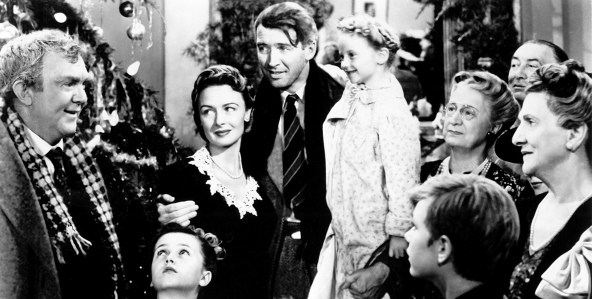
The Complete “It’s A Wonderful Life” Ethics Guide [UPDATED]

 Frank Capra’s 1946 masterpiece “It’s A Wonderful Life” is one of the great ethics movies of all time, perhaps the ethics movie of all time. In 2011 I prepared a guide through its complex ethics thicket. The post was divided into three separate posts, and I eventually combined them s0 readers can have the pleasure, if one can call it that, of watching the film like I do: having ethics arguments the whole way through. And now, here is your guide. Additions are welcome and encouraged.

1. “If It’s About Ethics, God Must Be Involved”

The movie begins in heaven, represented by twinkling stars. There is no way around this, as divine intervention is at the core of the fantasy. Heaven and angels were big in Hollywood in the Forties. Nevertheless, the framing of the tale advances the anti-ethical idea, central to many religions, that good behavior on earth will be rewarded in the hereafter, bolstering the theory that without God and eternal rewards, doing good is pointless.

We are introduced to George Bailey, who, we are told, is in trouble and has prayed for help. He’s going to get it, too, or at least the heavenly authorities will make the effort. They are assigning an Angel 2nd Class, Clarence Oddbody, to the job. He is, we learn later, something of a second rate angel as well as a 2nd Class one, so it is interesting that whether or not George is in fact saved will be entrusted to less than heaven’s best. Some lack of commitment, there—then again, George says he’s “not a praying man.” This will teach him—sub-par service!

2. Extra Credit for Moral Luck Continue reading

Ethics Dunce: The ACLU

I suppose they just can’t help themselves, sometimes.

So handsome…and so foolish to mess up with partisan politics.

I support the American Civil Liberties Union because of its mission, and because it is on the correct side of issues more often than not. Still, it is stocked with left-wing ideologues, and too often is blatantly political, which damages its reputation, perceived integrity and effectiveness. Every American should be a supporter of a non-profit organization that stands for individual rights and freedoms as defined by the Constitution. Once such a group aligns itself clearly with one side of the political spectrum, however, this is impossible. At very least, the organization should refrain from partisan political attacks, which raises questions of conflict of interest, fairness, and independent judgment. The ACLU is too important to sully with political bias, but since it is run by people full of it, such taint is inevitable.*

Thus we have the embarrassing “report” by ACLU Liberty Watch. I can’t tell what the affiliation with the ACLU is; I assume that the ACLU approves and oversees an entity that leads with its name. This report attacks Mitt Romney’s running mate, Rep. Paul Ryan, as being “anti-civil liberties,” using the most dubious and extreme rationales to do so. My instant reaction: How can I trust an organization that proudly publishes such slanted trash with such obvious partisan intent to be a dispassionate watchdog on my civil liberties?

The answer: I can’t. Neither can you. Continue reading

Supreme Court Headline Ethics: Our News Media, Misleading Rather Than Informing

The Supreme Court handed down its decision in Arizona v. United States today. This was the eagerly awaited case that addresses the issue of what the states can do to stem the tide of illegal immigration without encroaching on Federal authority, when Federal authority appears unwilling to enforce the nation’s immigration laws.

The decision was complex. Three provisions of the law were found to be preempted by Federal law and thus struck down, but they were provisions that have seldom been discussed in teh news media during the year-long controversy over the Arizona measure. The fourth provision covered in the opinion, the core of the law and the aspect of it that Democrats and illegal immigration advocates called “racial profiling,” was upheld, but with a caveat: if it was enforced in a fashion that violated Constitutional rights or raised preemption issues, it could be overturned later.

Meanwhile, after being smeared by the Obama Administration’s allies as politically-driven and without integrity, the split among the Justices defied the slander of its critics. Chief Justice Roberts joined the liberal wing of the Court to overturn the three provisions of the law.  Arch conservative and Bush appointee Justice Alito concurred with the banning of one of the three provisions. Hispanic Justice Sotomayor voted to uphold the papers-checking provision that the man who appointed her, President Obama, falsely described as allowing police to “harass” Hispanic citizens who were “eating ice cream” with their kids.

In short, like most Supreme Court decisions, the final opinions defied one-line analysis. This means that honest, ethical, objective and competent news sources shouldn’t and wouldn’t try to summarize the substance of the decision in a headline that was sure to mislead a reader who didn’t take the time to read the rest of the story (or, in truth, the actual opinions themselves, since the journalists who write stories about court cases generally do a terrible job). Yet here is sampling, gleaned from a Google search, of what the various publications, news networks and websites offered as headings. Judge for yourself how objective and fair they are: Continue reading

Ethics Quiz: The Strange Case of the Illegal Lawyer

“Hey Fred! Here comes your attorney!”

Sergio Garcia was brought across the Mexican border into California, at the age of 17 months, by his illegally immigrating parents. Thanks to the muddled and inconsistent enforcement of its immigration laws, Garcia graduated from Chico State University, a Florida law school and passed the California State Bar exam in July 2009., all while being in the country illegally. Now a special committee of the California Bar has recommended that he be licensed to practice in the state, but the California Supreme Court has reservations, and wants to read briefs on the issue. That issue is also the Ethics Alarms Quiz this weekend, and I must admit, it is a question I never thought would rise to status of a debate:

Should an illegal immigrant be allowed to practice law? Continue reading

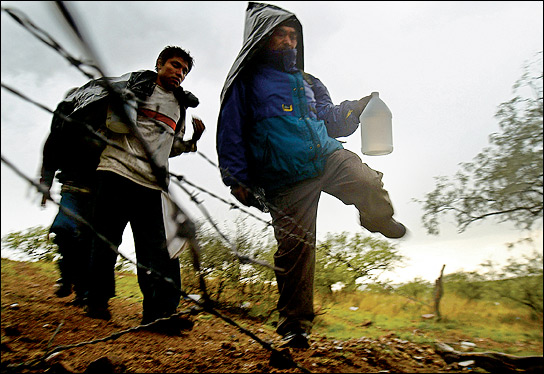
Illegal Immigration Insanity

I wonder what HE thinks is the sensible way to handle illegal immigration. It can't be much crazier than almost everyone else's opinion.

Yesterday the U.S. Supreme Court heard arguments on the legality of Arizona’s anti-immigration legislation, and in today’s Washington Post, columnist Dana Milbank, one of the Post’s house liberals who has the integrity to be up-front about it, presented us with a related column that reminded me how ideology can become indistinguishable from insanity.

Illegal immigration is perhaps the best (or worst) illustration of this phenomenon, a problem that requires essential and obvious measures to address, one of which—finding a route to allow current illegal immigrants to achieve legal status—is opposed “on principle” by the Right though there is  no feasible alternative, and the other—taking effective measures to block entry by future illegals and to eliminate the benefits of breaking immigration laws through tougher enforcement—is opposed by the Left on humanitarian grounds, though it is irresponsible, expensive, and dangerous. In the middle of this absurd impasse is the government, which refuses to aggressively enforce the laws on the books, either because of unholy alliances with business interests that want cheap and exploitive labor (the Republicans) or because of a cynical strategy to court a large and growing demographic group to ensure future political power (the Democrats).

In short, Nuts, Nuts, Corrupt and Corrupt. Continue reading

“It’s A Wonderful Life” Ethics, Part 3

Here is the final installment of the Ethics Alarms overview of the ethical issues raised in Frank Capra’s classic. Some of the comments on Parts 1 and 2 have suggested that my analysis is unduly critical. Nothing could be further from the truth. I love the movie, and have already said that I find it ethically inspiring. Noting that characters act unethically in a movie about ethics is no more criticism than pointing out that people in horror movies never just leave when things start getting weird (as I would). I know that their actions drive the plot and are necessary. This is, however, how an ethicist watches a movie with as many ethical choices as “It’s A Wonderful Life.” I can’t help it.

Now back to George, Mary, and Bedford Falls:

11. Uncle Billy screws up as we knew he would

11.  Christmas Eve arrives in Bedford Falls, and Uncle Billy manages to forget that he left the week’s deposits in the newspaper he gave to Mr. Potter. Thus more than $8,000 is missing on the same day that the bank examiner is in town. Why is Uncle Billy still working for the Savings and Loan? He’s working there because George, like his father, is putting family loyalty over fiduciary responsibility.  Potter, of course, is a thief; by keeping the lost money to trap George, he’s committing a felony, and an unnecessary one. As a board member on the Savings and Loan, Billy’s carelessness and George’s negligence in entrusting him with the bank’s funds would support charges of misfeasance. Mr. Potter, had he played fair, might have triumphed over George legitimately, and no Christmas miracle or guardian angel could have saved him. But this is the inherent weakness and fatal flaw of the habitually unethical: since they don’t shrink from using unethical devices, they often ignore ethical ways to achieve the same objectives that would be more effective.

12. George folds under pressure Continue reading