Comment of the Day: “The Priorities of U.S. Higher Education Defy Understanding”

When the topic on Ethics Alarms is education, Michael frequently scores a Comment of the Day, and he did it again following the post on the University of Maryland spending a fortune on its president’s residence. Here is his effort to help us understand the conduct discussed in The Priorities of U.S. Higher Education Defy Understanding. And I’ll have a closing comment at the end.

“I have asked these questions about what is driving up college costs. Here is what I have found: Continue reading →

The Priorities of U.S. Higher Education Defy Understanding

The next president of the University of Maryland, apparently. Wait---that was the previous post!

The out-of-control costs of higher education are one of many systemic problems that plague America, and it is one that I confess baffles me completely. I do not understand why tuition is so high and continues to climb. I do not understand why universities pay professors huge salaries for minimal teaching duties, and I don’t see what expensive buildings and beautiful surroundings have to do with education. I don’t understand why students pay outrageous sums to be educated then take trivial and absurd courses, like the now-cancelled Columbia University undergraduate course that was to consist of hanging out with the Occupy Wall Street gang to endear oneself with course’s OWS-loving professor.

Most of all, I do not understand the persistence of the myth that a college education can, does, or should qualify a graduate for good job, when it appears that a large percentage of students, if not a majority, leave the campus unable to write, think, or name the men on Mount Rushmore. Decades ago, as an administrator at major law school, I was shocked to discover that the school held remedial reading and wring courses for some first year students, one of them a graduate of Yale.  Do you think the problem has improved since then? A college education in the U.S. is a poor and declining product that is over-priced and over-hyped, and I don’t understand why people are willing to go into debt to purchase it, and why the manufacturers haven’t cut costs, improved the product, and lowered the price.

Well, maybe I do understand. Like so many other problems, the reason for this one may be no more mysterious than the fact that those in charge are irresponsible, incompetent, and unaccountable.

This week brought the news that crews will begin demolishing the president’s house at the University of Maryland, and begin construction of a new 14,000-square-foot mansion that will cost the school at least  $7.2 million. The palatial new digs for Maryland U’s president is being built in the midst of the university’s pleas for donors to contribute funds to rescue Maryland students who may be forced to drop out because of their family’s financial plights.
Meanwhile, the current president, Wallace D. Loh, has said that he will cut eight varsity sports teams in June to save an estimated $29 million over the next eight years. Do you understand this? Continue reading →

A Lesson From Georgia: Schools Too Stupid To Be Ethical Are Also Too Stupid To Be Trusted To Teach

Handy Tip: Don't trust this man to educate your children.

Rick Jones, proprietor of Curmudgeon Central,  launched his Curmie Award last year, “honoring” educational professionals who embarrass their profession. Rick discovered a  Curmie-worthy story that he blogs on here, from the Beaver Ridge Elementary School in Norcross, GA. A teacher gave her third-grade class a Monty Pythonesque math test in which all the questions revolved around slavery:

  • “Each tree had 56 oranges. If eight slaves pick them equally, then how much would each slave pick?”
  • “If Frederick got two beatings per day, how many beatings did he get in one week?”
  •  “Frederick had 6 baskets full of cotton. If each basket held 5 pounds, how many pounds did he have all together?”

Moron.

Naturally the school got an earful from parents, and naturally the school, which had no possible justification for such wretched judgement on its teacher’s part, apologized and backtracked. It’s not enough. Why are such incompetent idiots hired to teach anything more sentient than a poodle? How can a parent trust a school that allows teachers like this in the front door? If your child is taught by a moron—and technical definitions aside, that is not an unfair or uncivil description of a teacher who thinks it’s reasonable to give the question, “If Frederick got two beatings per day, how many beatings did he get in one week?” to a third-grader, your child’s likelihood of growing up moronic is vastly increased.

And yet, as Richard Dreyfus’s character says to Quint the shark-hunter as they compare scars in “Jaws,” “I got that beat.”In fact, Rick, I got that beat in Georgia. Continue reading →

Ethics Quiz, Killer Pizza Edition: Can School “No-Tolerance” Be Dumber Than THIS?

I grant you: THIS is a scary pizza. What Nick Taylor had, however, was not.

Nicholas Taylor is 10-years-old and attends David Youree Elementary School in Smyrna, Tenn., 30 miles southeast of Nashville. He is currently serving a week-long sentence at “the quiet table” during lunch time and has had to endure gun safety lectures. What was his terrible offense?

He “threatened” other students at his lunch table with a piece of pizza that was shaped vaguely like a gun because of the bites that had been taken out of it. Yes, some pathetic, parent and culture-warped weenie of a fellow student complained to a teacher that Nick was making “threatening gestures” with his partially-eaten pizza-gun.  Taylor denied it. That meant he was lying. More punishment.

Your Ethics Quiz Question—and you better not get this one wrong!—is : Can political correctness “no-tolerance” idiocy in the schools get any worse than punishing a child for the shape of his pizza slice? Continue reading →

The Loudon County Courthouse Christmas Display Fiasco: Anatomy of an Ethics Train Wreck

Believe it or not, this is a train wreck.

In Loudon County, Virginia, the county board didn’t want to let Christmas displays on the courthouse lawn go down without a fight. Once upon a time a community could put up Santa and his sleigh without a militant anti-religion or non-Christian group threatening law suits, but no longer, especially in a community so close to Attorney Central, Washington, D.C.  Other communities have gotten away with pan-religious displays—a pretty silly solution, I think, since Christmas is a Christian and secular holiday but has exactly nothing to do with Islam, Buddhism or the others—but again, once atheists organized and pressed the issue that the state supporting all religion was tantamount to promoting a religion, “inclusive” displays must be open to groups actively hostile to the religious displayers. Can we guess what will happen in such an environment? Yes? Well, the Loudon County board couldn’t.

A sensible board-appointed citizen group, the Courthouse Grounds and Facilities Committee, recommended in December 2009 that the county ban courthouse displays. The board rejected the committee’s request.  In July 2010,  the committee again requested a ban be put in place on courthouse lawn displays. The board, in its infinite wisdom, decided that anyone could put up displays on the lawn with ten spots open on a first-come, first-serve basis, pending county approval.

Yes, this was bound to turn out well, pull the community together, and promote the good feelings of the holiday season! Thus we reached Stage One in our ethics train wreck: official incompetence. The board’s actions lit the fuse of a cultural bomb, and only a Christmas miracle could have kept it from detonating.

So the displays were duly allotted thusly:

You can see two nativity scenes, the predictable Flying Spaghetti Monster display ridiculing all religion, the atheist display, and other benign additions. Hmmmm...but what, pray tell, is the “Santa cross?” Oh, just this… Continue reading →

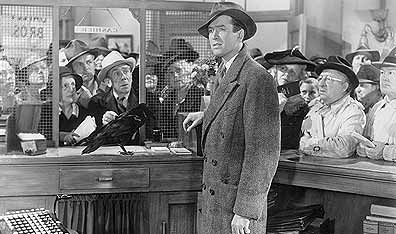
“It’s A Wonderful Life” Ethics, Part 2 (of 3)

When we last saw George Bailey, he was defending his father’s dubious loan practices. In this, Part 2 of the three installments of  “It’s A Wonderful Life” Ethics, we take the saga up the fateful Christmas Eve when George Bailey meets his guardian angel.

6. George’s Fork in the Road

George Bailey’s decision to give up his plans to go to college to save the Savings and Loan is clearly not motivated by his personal dedication to the institution; he doesn’t like the place. He says so over and over again. He admires his father’s motivations for starting it. Had Potter not sparked his resentment with his nasty comments about George’s late father, George would have been out the door. But his passionate speech in rebuttal of Potter’s words put him on the spot: after those sentiments, turning down the Board’s appointment of him to be the new operating manager of the S&L would have made George a hypocrite in his own eyes, and rendered his passion  laughable. If George had integrity, then he had to accept the appointment.

It is one of the most interesting ethical moments in the film, because it represents a realistically complex ethical decision. George does what he does for selfish reasons as well as altruistic ones, and irrational reasons as well as considered ones. He wants to respect himself; he fears what might happen to his family and the community if Potter becomes the only financial power in town, and knows he will feel guilty if the consequences are bad. He feels like not staying will be taking Potter’s side over his father’s—completely irrational, since his father had given his blessing to George’s college plans, and wasn’t alive to be harmed by whatever he chose to do anyway. A large proportion of George’s decision seems to be motivated by non-ethical considerations, for he doesn’t like Potter—even hates him, perhaps—and wants to stick it to the old tycoon by foiling his victory. There are few ethical decisions in real life that are made purely on the basis of ethics, and Capra makes George’s decision wonderfully impure. Continue reading →

“It’s A Wonderful Life” Ethics, Part I (of 3)

“It’s A Wonderful Life” made its now traditional holiday season appearance on network television, and naturally, I watched it. The movie is one of the great ethics movies of all time, as well as being one of the great American movies of all time, perhaps director Frank Capra’s masterpiece. One of the markers of a classic film is how one can find new things in it upon every viewing, and that is certainly true of “It’s A Wonderful Life.” I was struck this time around by how many ethics issues are raised in the screenplay, some, no doubt, unintentionally.

1. “If It’s About Ethics, God Must Be Involved”

The movie begins in heaven, represented by twinkling stars. There is no way around this, as divine intervention isat the core of the fantasy; heaven and angels were big in Hollywood in the Forties. Nevertheless, the framing of the tale advances the anti-ethical idea, central to many religions, that good behavior on earth will be rewarded in the hereafter, bolstering the theory that without God and eternal rewards, doing good is pointless.

We are introduced to George Bailey, who, we are told, is in trouble and has prayed for help. He’s going to get it, too, or at least the heavenly authorities will make the effort. They are assigning an Angel 2nd Class, Clarence Oddbody, to the job. He is, we learn later, something of a second rate angel as well as a 2nd Class one, so it is interesting that whether or not George is in fact saved will be entrusted to less than heaven’s best. Some lack of commitment, there—then again, George says he’s “not a praying man.” This will teach him—sub-par service! Continue reading →

Comments of the Day: “Incompetent Elected Official of the Week” : Rhode Island legislator Lisa Baldelli-Hunt”

Several powerful and moving responses were posted in response to yesterday’s “Incompetent Elected Official of the Week” article about  Rhode Island legislator Lisa Baldelli-Hunt’s crusade to make it impossible for registered sex offenders to live in her state.  I was unable to choose between the three that follow, one by the mother of a registered sex offender, another by Sherika, who includes a letter written on behalf of the families of registered sex offenders, and the third by Shelly Stow, who offers a letter she wrote to the legislator (and that was bounced back to her). I find myself wondering if Baldelli-Hunt has spoken to or listened to any residents of her district with stories and opinions like theirs, whether she has considered these perspectives, or, as her own comments suggest,  just doesn’t care about fairness and collateral damage when it involves the people she regards as “the worst of the worst.”

Here are the Comments of the Day on Incompetent Elected Official of the Week: Rhode Island State Rep. Lisa Baldelli-Hunt: Continue reading →

Incompetent Elected Official of the Week: Rhode Island State Rep. Lisa Baldelli-Hunt

Funny, she doesn't LOOK vicious...

The Penn State scandal will have one good effect: it will embolden victims of sexual  molestation to confront those who harmed them. Unfortunately, it will also embolden political grand-standers  to propose draconian and unconstitutional measures that will encourage fear, bigotry, hate and persecution.  Rhode Island’s Lisa Baldelli-Hunt, D-Woonsocket, is ready for her close-up.

Baldelli-Hunt proposed a law this year that would allow local police to place signs on public sidewalks or streets in front of the homes of sex offenders, designating them as threats. This shows a nice 17th Century strain, placing her in the ranks of town elders of the past that encouraged various forms of branding former offenders to ensure their perpetual mistreatment.  To give her credit, though, she also can claim international inspiration from the past, and may want to consider requiring registered sex offenders to wear, say, brightly colored star-shaped badges.

The Anti-Golden Rule logic of such a proposal is stunning: how would you like a sign proclaiming the worst thing you ever did in your life in front of your home? How would Baldelli-Hunt like a sign in front of her house that says, “Outspoken endorser of persecution and hate”?

An elected official who has no concept of ethics is not only unqualified for office and incompetent, but dangerous, because there are always a lot of ethically-challenged people to lead. Baldelli-Hunt is squarely in the “the ends justify the means” camp with every brutal dictator, vigilante killer, and mad scientist fictional and real, from Dr. Frankenstein to Josef Mengele. “I have some concerns regarding sex offenders because, quite frankly, they don’t walk around with signs telling people they are sex offenders,” Baldelli-Hunt told reporters. “I’m not interested in their rights or protecting them. I have no concern for them because they are the worst of the worst.”

Baldelli doesn’t walk around with signs telling people she is a vicious fool, either, but her words do the job:

1. She doesn’t know who “they” are or what “they” did. The vast majority of former sex offenders have paid their debt to society and are not dangers to anyone. She is, therefore, selling and facilitating bigotry.

2. Every registered sex offender did not commit an offense of equal seriousness. An 18-year-old boy who has consensual sex with a 15 year-old girl is not “the worst of the worst,” or any kind of worst at all.

3. Elected officials in a community are obligated to care about every citizen’s rights, not just the citizens they like and admire. Officials like Baldelli-Hunt brought America witch trials, lynchings and segregation.

She, in fact, is this worst of the worst.

Consider this her sign.

 

I Wonder…What Would It Take To Get Fired From the SEC?

Keep up the way you’re going, guys. You’ll drive me to “Occupy D.C.” yet.

Do you think The Donald would be willing to run the SEC? At least he knows how to fire someone.

Eight Security and Exchange Commission employees were demoted, docked pay, suspended or otherwise disciplined for their role in the agency’s rank incompetence that allowed Bernard Madoff to steal billions of dollars and destroy lives and charities despite the timely warning of a persistent whistleblower, and more red flags than a bullfight. Yet despite mismanagement of epic and disgraceful proportions, the SEC couldn’t bring itself to fire anyone.

This is the state of accountability in today’s America. Run a corporation into the ground, lose the jobs of thousands, and take a mega-million dollar parting gift. Accept a bribe while you are serving as a State Senator, and not only keep your job, but get acquitted by a jury on the theory that you are too stupid to understand that what you were doing was a crime. Now the SEC’s response to an almost unimaginable breach of diligence in investment oversight by its staff doesn’t involve getting rid of a single one of the individuals responsible—even the individual deemed the most culpable, whose termination was recommended by the agency’s lawyers.

Why, you ask? Continue reading →