Ferguson Ethics Train Wreck Update: The Mayor of Atlanta Tells “Meet The Press” That “Justice” Means Prosecuting Officer Wilson

kasim-reed

There should be no question about it any more. The nearly unanimous position, stated or unstated, by elected Democratic and African American officials is that Officer Wilson, the Ferguson police officer who shot the unarmed, 18-year-old Michael Brown, should be charged with murder. That position represents a triumph of group identification, political expediency and bias over the rule of law and, yes, in defiance of that cynically wielded term “justice,” and it needs to be rejected and condemned at the highest levels of our society. Who is going to have the courage to do it?

Certainly not the news media. This morning on the David Gregory-less “Meet the Press,” the stand-in for the fired host interviewed Democratic Missouri Governor Jay Nixon, who talked exclusively in code about “justice” and “transparency.” Nixon, you will recall, has already stated his view that Wilson should be prosecuted, so his mouthing platitudes now about “transparency” ring like the sly plotting of the villains in old Westerns. You know the type: the cattle baron who owns the town and the sheriff devises a way to remove an obstreperous opponent who won’t toe the line by framing him and convicting him of murder. “Make it look niiice and fair, right by the book!” he snickers to his henchman. That was Nixon today.

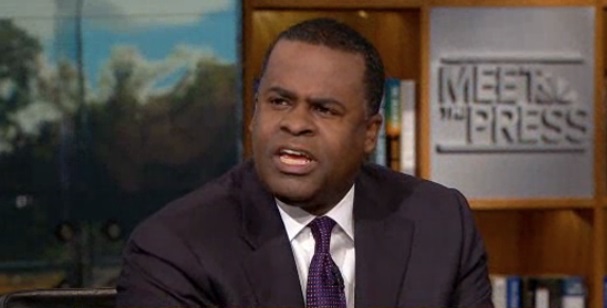
Then the questioning turned to NBC round-table guest Kasim Reed, the African-American Mayor of Atlanta, who was asked about how to ensure a just result in the case. His answer was frank, if jaw-dropping: everyone, including jurors and officials, should see the incident “through the eyes” of Brown’s parents, “whose son was shot six times in front of four witnesses and left lying in the street for hours.” Continue reading

Virginia’s McDonnells, Masters Of Rationalization

Former_Governor_Indicted

The only question regarding the multiple count federal corruption indictment of Virginia’s most recent ex-Governor Bob McDonnell (R) and his wife is whether or not the relevant laws are so porous that they can’t be convicted on the evidence. Did they use McDonnell’s high office for personal enrichment? Yes. Did they go to great lengths to disguise the fact? Yes. Did the Governor betray the public trust? Yes. Were the gifts, loans and cash, totaling at least $165,000, received from a dietary supplements company CEO essentially bribes? Of course they were. This is another excellent example of why the admonition that the accused are innocent until proven guilty is often technical rather than true. Based on irrefutable facts, the Virginia’s former First Couple is guilty as hell—of dishonesty, greed, corruption, obstruction of justice, bribery, betrayal of trust, the appearance of impropriety and outrageously unethical conduct. They just may not have broken any of the laws regulating those actions.

The legal case will ultimately rest on whether there was a specific, provable quid pro quo, which is to say, were the gifts and loans from Jonnie Williams Sr., former CEO of Star Scientific, expressly made in exchange for the governor’s assistance in helping his company in the state? Williams, who has made a deal, will testify that this was his understanding; why else would he allow himself to be used as a piggy bank by McDonnell and his wife? But in politics, as we all know, the myth is otherwise. Big companies give lawmakers big campaign contributions out of the goodness of their hearts and patriotic fervor, and it’s just a coincidence that those same lawmakers subsequently support laws that make those same companies millions, or block laws that would get in their way. It’s a coincidence! The Feds are going to have to show that what McDonnell did was significantly more sleazy than what virtually the entire population of Congress does by reflex, and also a clear violation of law. Continue reading

Ethics Quiz: Awarding An Accused Rapist The Heisman Trophy

jameis2Heisman Trophy winner Jameis Winston was cool, collected and funny delivering the “Top Ten” on David Letterman last night, but to me, the hijinks seemed out of sync with reality, fairness and justice somehow.

The 19 year-old-Florida State University star quarterback became the youngest Heisman Trophy winner ever when he was named college football’s most outstanding player Saturday night in New York. He is also the youngest accused rapist to be awarded the Heisman.

That award  symbolizes football’s ongoing ethics problem. The pro game’s brutal, uber-macho and “the ends justify the means” culture that has players maiming each other as the crowd cheers and multiple felons on the field in most games has reached into the lower reaches of football, with both colleges and high schools breeding arrogant, entitled jerks who get special treatment through their pampered academic careers and too often emerge from from the football machine as polished sociopaths. The Penn State horror story was a symptom of this. Is Winston’s award another?

It hasn’t been featured in many of the exultant stories about the Heisman winner, but a year ago, on December 7, he was accused of rape by an FSU co-ed. Last week the prosecutors—just in time for the Heisman!—declared that they had not found enough evidence to convict him, which means that they did not have enough evidence to ethically prosecute him. The accuser’s attorney, Patricia Carroll, immediately condemned the decision and the  investigation that led to it, detailing multiple irregularities in the the handling of evidence and testimony. Writes Slate’s legal reporter Emily Bazelon: Continue reading

Comment of the Day: “Ethics Dunce: Columbia, South Carolina Police Chief Ruben Santiago”

A few quick points, before I present Chris Marschner’s excellent Comment of the Day:

  • You know you’re posting too much when a you’ve completely forgotten an essay less than a month old, like this one.
  • Why didn’t someone tell me that I left the “l” out of “Columbia”?
  • I’m going to have to start working on my proof-reading again, clearly. There were a couple more typos in this post.
  • Chris just started commenting, and this is the third carefully written, well-reasoned substantive piece he has produced. I am grateful; such debuts raise everyone’s game.
  • I liked this post, and not many people read it or commented on it. I am increasingly worried about the trend in law enforcement and in government generally, especially the schools, to brush off free speech as an inconvenience. I’m grateful to Chris for raising the issue again.

Here is his Comment of the Day on the post, “Ethics Dunce: Columbia, South Carolina Police Chief Ruben Santiago”: Continue reading

Ethics Dunce: Columbia, South Carolina Police Chief Ruben Santiago

The face of police power abuse in Columbia, S.C.

The face of police power abuse in Columbia, S.C.

If our culture did a minimally competent job communicating the essential right of free speech in the United States, people like Ruben Santiago wouldn’t think as the do—as they do being best described as ignorantly, censoriously, arrogantly and stupidly. Both the Left and the Right are to blame for the message not getting out to the public, and, consequently, members of the public who acquire governmental authority: the government can’t threaten you or harm you for mere speech…the Left through its attempts at political correctness, mind control and indoctrination in the schools, the Right in its efforts to use laws to curb expression involving sex and violence in the arts and entertainment.

In Columbia,Police Chief Ruben Santiago took to the Columbia Police Department Facebook page to announce that his officers had seized  $40,000 in marijuana from an apartment after a successful drug investigation. Citizen Brandon Whitmer, on his own page, took note of the arrest and opined, “maybe (police) should arrest the people shooting people in 5 points instead of worrying about a stoner that’s not bothering anyone. It’ll be legal here one day anyway.” Santiago replied ominously to Whitmer, saying, “(W)e have arrested all of the violent offenders in Five points. Thank you for sharing your views and giving us reasonable suspicion to believe you might be a criminal, we will work on finding you.”

Somebody  in the department with a working knowledge of the Constitution quickly got that post deleted, but Santiago defended it in a double-down post, writing, Continue reading

Emmy Ethics: Honoring Elmo, Or Honoring A Child Molester?

kevin-clash1

I am assuming, based on the fact that this story was featured on the conservative muckraking website Brietbart, that some people think it is inappropriate to award three Daytime Emmys for children’s programming to Kevin Clash, the Muppets puppeteer whose career as fuzzy red monster Elmo on Sesame Street ended with a series of child molestation accusations.

If I am right, these people are dead wrong. Clash is an artist, and a talented one. Whether or not the allegations of his having illicit contact with under-aged boys are true, and none have been tested in court, his skill in manipulating and voicing the cutest and most vulnerable of the Muppets is beyond debate. The Emmy has never been nor claimed to be a character award. An Emmy recognizes excellence in television, in this case children’s programming, and it doesn’t make a smidgeon of difference if an artist is a child molester, a bank robber, a cannibal, a Nazi or a Billy Ray Cyrus fan—if he or she delivered the best artistic product, the honor is deserved.

___________________________________

Spark, Facts and Graphic: Breitbart

Ethics Quiz: The Case of the Maybe Killer Lawyer

Tough one! Are you ready?

Convicted killer and lawyer too?

Convicted killer and lawyer too?

Richard Buchli, a Missouri lawyer who was convicted of beating his law partner to death, was getting a new trial after it was revealed that the prosecution had illegally withheld exculpatory evidence from the defense. There was some strong evidence supporting his conviction, such as the fact that the partner’s blood was splattered on Buchli’s clothes in a manner consistent with a beating death. (Buchli argued that he got bloody trying to revive his partner.) The court, however, frustrated with the prosecution continuing to drag out discovery and failing to deliver all the evidence to Buchli’s legal team, threw out the conviction completely and barred all the evidence in the case, effectively making Buchli, who had been in prison since 2002, a free man.

Now Buchli, who was disbarred in 2005 (killing your law partner is considered unethical), wants his law license back. Your Ethics Alarms Ethics Quiz Question:

Should he get it? Continue reading

Ethics Quote of the Day: Sesame Street

“Sesame Workshop’s mission is to harness the educational power of media to help all children the world over reach their highest potential. Kevin Clash has helped us achieve that mission for 28 years, and none of us, especially Kevin, want anything to divert our attention from our focus on serving as a leading educational organization. Unfortunately, the controversy surrounding Kevin’s personal life has become a distraction that none of us want, and he has concluded that he can no longer be effective in his job and has resigned from Sesame Street. This is a sad day for Sesame Street.”

—— The producers of “Sesame Street,” announcing Kevin Clash’s resignation and the end of his close association with Elmo. A second man just accused Clash of molesting him when he was underage, and Clash’s original accuser, Sheldon Stephens, recently recanted his recantation of  his allegations.

“Goodbye, my friend.”

This ending was pre-ordained from the beginning of the scandal, and Clash’s guilt or innocence was and is irrelevant. Sesame Street’s duty is to Elmo and his fans, not Kevin Clash. “Innocent until proven guilty” also has no application. Clash, if nothing else, is guilty of not being innocent enough to be the voice of the most innocent Muppet on Sesame Street.

Ethics Quiz: Elmo’s Problem

And now, Muppet ethics.

Sorry, Elmo.

Kevin Clash is the voice and operator of beloved Elmo, the cute lttle red monster  on “Sesame Street.”  A young man has accused Clash of molesting him when he was a teen.  Clah denies the allegations, claining that the relationship was between consenting adults. The Children’s Television Workshop says its investigation did not substantaite the accusation; nonetheless, Clash is being disciplined for says the show, is being disciplined for “inappropriate use of company email,” and is unlikely to have his hand in Elmo any time soon, if ever again. The alleged victim is probably not through with Clash, and this could get ugly.

Your Ethics Quiz challenge, should you choose to accept it, is this:

Assuming nothing illegal is proven regarding Clash’s sexual relationship with the accuser, and it remains a “he said/he said” dispute, should Clash remain the voice and puppeteer behind “Sesame Street’s” most innocent character? Continue reading

One For The “Innocent Until Proven Guilty” Crowd

Stop scaring my dog!

A commenter recently pulled out the hoary and almost always misused “innocent until proven guilty” line, which reliably makes me scream, frightening the dog and the neighbors. Thus I was happy to see this September 28 ruling by the Louisiana Supreme Court, which found that Philip Pilie, a 2007 University of Georgia School of Law  who passed the bar examination in 2009, lacked the character and fitness to be admitted to practice in the state, despite the fact that he was not convicted of the crime that resulted in his disqualification.

Why? Because he did it, that’s why. Pilie contacted what he thought was a 15-year-old girl online and arranged to have sex. She was, unfortunately for Pilie, really a big, hairy, middle-aged man looking for predators who like to have sex with under-age girls. Pilie  was arrested at the planned rendezvous and charged with two  felonies,  computer-aided solicitation of a minor and attempted indecent behavior with a minor.

Pilie negotiated a deal with the district attorney to avoid prosecution. He completed a pre-trial diversion program including counseling, and all charges  were dropped. Pilie took and passed the bar exam, but was informed  in March 2009 that he lacked the character and fitness for admission to practice, because he trolled on computers for young girls to have sex with, by his own admission. His appeal to Louisiana’s highest court failed, twice.

In the latest decision, the court said that Pilie’s lack of a criminal conviction made no difference in its reasoning. “Had petitioner been a practicing attorney at the time of his misconduct, it is very likely he would have been permanently disbarred,” it wrote. “Given this fact, we can conceive of no circumstance under which we would ever admit petitioner to the practice of law.” Pilie was permanently barred from ever again seeking admission, without ever being “convicted in a court of law.” Continue reading