Evening Ethics Leftovers, 11/8/2018: Acosta, Beto, Tucker, And Claire

Good evening…

1.  The Jim Acosta Affair. I suppose my analysis of this hypocritical flap will surprise no one. No White House reporter who behaved as Jim Acosta did at the press conference yesterday would have been defended by his employers or other journalists. Dan Rather (with Nixon) and Sam Donaldson (with Reagan) were rude and confrontational (Funny how the only examples of journalists being disrespectful to Presidents involve Republicans–nah, there’s no mainstream media bias!), but nothing like Acosta was and has been. Imagine a journalist defying President Obama like that! It wouldn’t happen, but as with so much else, the rules are somehow different for President Trump.  This news media’s reporters have decided, consistent with the attitude of progressives and the “resistance,” to withhold even minimum respect and deference to the Presidency as long as Donald Trump occupies the office.

Acosta was not asking questions, but arguing his position with the President. That’s not his job, or his privilege. When the President told him repeatedly “That’s enough,” Acosta did not stop. That, all by itself, justified pulling Acosta’s credentials. The White House was foolish to concentrate on Acosta pushing the intern away. He had crossed the line before that; indeed, he had crossed the line of what the White House should require from a journalist many times before.

If Acosta apologizes to the intern and the President, and promises not to abuse his opportunity to ask questions at press briefings and press conferences, to exhibit a minimal level of respect, then the White House should give him another chance.

Commentators calling Acosta’s punishment a First Amendment violation should be ridiculed for the hypocrites they are. Ann Althouse points out that journalists were up in arms when  Trump’s campaign manager Corey Lewandowski was charged with battery for grabbing Michelle Fields, a reporter. The level of contact in the two cases is similar. “Either both instances of battery matter or neither does. Pick one,” says Ann. But there’s a problem that Ann somehow doesn’t see. She writes, “I found myself thinking that Trump and Acosta are both in control and choosing to do this theater of mutual hate.” Acosta and Trump are not equals, however. Acosta is obligated to give due respect to the President of the United States, but the converse does not apply. Continue reading

The Flight Connection Dilemma, Or “It’s Hell Being An Ethicist”

Increasingly, I find myself wondering whether everyone who travels on business regularly encounters the vast range of irritations, outrages and generally unpleasant experiences I do, or if it’s just me. This time, on an over-night trip to Boston, I had important medicine confiscated by the TSA, got trapped in a hotel elevator, ran out of the house without my computer, injured my mouth when a sharp piece of food pierced a gum, and, of course, my flight was delayed. This time the delay would cause a genuine hardship: I had an important and time-sensitive task to complete involving the welfare, indeed safety, of two family members, and it meant that I had to be home no later than 6:40 pm.

When we finally landed at Reagan National, which is less than a 20 minute cab ride from my home if the lights and traffic break well, there was still a slim chance that I could make my deadline, IF the plane emptied quickly. The flight attendants said that there were several passenger who probably had tight connections, and asked them to raise their hands so everyone could stay seated to help them bolt the plane and try to make their flights.

Being human, my mind filled with rationalizations for raising my hand. I did have a tight connection, sort of. The urgency of my need to leave the plane wasn’t necessarily less than any of my fellow passengers. In fact, it was objectively important. And really, what would be the harm if I raised my hand? What might that cost one of the passengers trying to make a connection, 5 seconds? Ten? And how did I know everyone raising their hands really had a plane to catch?

But crap. I’m an ethicist. Raising my hand would be a lie, and there were no substantial or legitimate justifications for it. So I kept my hand down. I missed my crucial appointment, and it is going to cause me and two family members a lot of unpleasantness. Nonetheless, it was the right thing to do.

Right?

Comment Of The Day: “Ethics Quiz: The Good Hoax?” (1)

It’s 2:04 am…3:04, really but Daylight Savings Time has fallen…and I can’t sleep. I decided that it must be a guilty conscience for falling so far behind in posting Comments of the Day, so here is one of the more recent ones, Ryan Harkins on the question of whether deliberately fooling academic journals to show how vulnerable they are to  bogus research is ethically defensible. Another COTD will be along on the same post, but this one is by Ryan, on Ethics Quiz: The Good Hoax?:

Other professionals read the articles, and surveys of results are typical to show that there is a body of evidence supporting a particular conclusion. If a bunch of bunk is being passed off as good science, that feeds into further papers and can eventually influence public policy. This is especially true in softer sciences, where results are much murkier than than in the hard sciences, but even the hard sciences suffer from the problem.

The question is, how do you show that there is a problem in the peer review process, and that articles are being discarded because they don’t toe a party line, and articles are being accepted not on their merits but because they do toe the party line? You can’t write a good paper and show bias by having it rejected, because the rejection is supposed to be proof that the paper is bad. But you can deliberately write a bad paper, and if it is accepted, you can call foul because you can show you deliberately put together a bunch of garbage.

Is this ethical? I think it would certainly be ethical if the system were intentionally built so that some people were tasked with creating bogus papers to keep peer-reviewers on their toes. It is sort of like secret shoppers in the service industry. But we don’t currently have this built into the system. Is playing vigilante in this effort unethical, then? Continue reading

Is Continuing Legal Education A “Farce”?

Continuing legal education, or as it is fondly called, CLE, began being a staple of bar membership in most states by the 1980s. The theory is that the law is always changing and new developments in case law and practice resources are essential for lawyers to know about, so in order to keep practicing in good standing, lawyers should be required to take a set number of training hours to keep up with current techniques and information. The practice is also designed to emphasize the law’s position as a self-regulating profession with exemplary dedication to excellence.

AND the new system allows the bar associations to require the purchase of a product the associations themselves develop, provide, and most important of all,  charge for.

Most lawyers, it is fair to say, loathe mandatory CLE requirements. They resent the time and expense, and generally feel that having to take the courses is an insult.

Yesterday a Virginia lawyer named Paul Sherman—he might even have attended some of my courses!–laid out on Twitter his brief that CLE course are a “farce that do nothing to protect the public and impose big social costs.: Right wing blogger and law prof Glenn Reynolds endorsed the screed, calling CLE a scam. I teach about 45 CLE seminars a year on legal ethics, and I’ve spoken on the subject to the CLE providers association, so this obviously piqued my interest.

Here is Sherman’s argument (and by the way, Twitter is a ridiculous platform for extended commentary):

Since I’ve just finished my last Continuing Legal Education class of the year, allow me to say that these requirements are a farce that do nothing to protect the public and impose big social costs. For those of you who aren’t lawyers (who know this already), allow me to explain.

To continue practicing law in the Commonwealth of Virginia, I am required each year to take 12 hours of continuing legal education (4 of which must be live) by Oct. 31. Collectively, Virginia lawyers lose more than 290,000 work hours to CLE every year. Almost every lawyer I know satisfies these requirements in the same way: by buying whatever CLE courses are cheapest, regardless of subject. This is not at all surprising, because competent lawyers already stay on top of developments in their practice areas.E.g., I exclusively practice constitutional law, but this year I took CLE courses in international taxation, asset protection planning, independent contractor compliance, etc. None of these have anything to do with my practice, and the VA Bar does not care!

Consider also the direct and indirect monetary costs. Let’s say CLE packages cost $100. According to the National Consumer Law Center, in 2015-2016, the average attorney in Virginia charged $358/hr. That means the cost of these requirements is almost $4,400 per attorney. The total cost for all Virginia lawyers is about $106 million. Yet, of that, only $2.4 million ends up in the pockets of CLE providers. The rest is just value that has been destroyed. Even if we assume (with extreme generosity) that lawyers would voluntarily pay for 6 hours of relevant CLE each year, you’re still losing $50 million in value per year (which is almost exactly Virginia spends on indigent defense annually). In short, we would all be better off if Virginia ended this farce, abolished mandatory CLE, and instead required every Virginia lawyer to send an extra $100 to the Bar and/or to set $100 on fire.

This seems to have touched a nerve, so let’s make this an actual thing. Contact your state bar (mine is @VAStateBar) and tell them to end the shakedown. #EndMCLE!

Continue reading

Morning Ethics Warm-Up, 10/26/2018: ‘Bombs,’ Bicycles And Bullying

Good morning!

I need Jimmy today. (Bing’s on this one too…)

1. They’re NOT “bombs.” I urge everyone to call their friends on this. Until it is established that in fact the “suspicious packages” (the FBI’s current description) or the “potentially destructive devices” can blow up and that they were intended to blow up, referring to them (as the New York Times has done) as “pipe bombs” and the mysterious asshole who sent them as “the bomber” is misleading and, in many cases, deliberately inflammatory. Cut it out. Nor are the mailed whatevertheyares “attacks.” Nobody has been “attacked” until the intent to harm them has been established, and it hasn’t been.

This is driving me crazy, in case you can’t tell.

The news media obviously wants these to be bombs, wants the sender to be a deranged Trump fan, hell, they’d love it if the sender was Trump himself. So they can’t help themselves, apparently, in jumping the gun and dishonestly reporting what is still very much in doubt. Personally, I would love to have it determined that the perp is a “resistance” member pulling a false flag operation, just to teach the news media a lesson, not that they are capable of learning it.

2. Trump’s Tweets. CNN and MSNBC are melting down with faux fury over this morning’s Trump Tweet, which said,

Funny how lowly rated CNN, and others, can criticize me at will, even blaming me for the current spate of Bombs and ridiculously comparing this to September 11th and the Oklahoma City bombing, yet when I criticize them they go wild and scream, “it’s just not Presidential!”

Notes: Continue reading

Conclusion: If #MeToo Has No Integrity, Then It Is Doomed, And Deserves To Be

When the #MeToo movement emerged, the idea appeared to be that women (and men!) should speak out about sexual assault and sexual harassment, that powerful people should not feel entitled to take physical liberties with others, and that the culture needed to unequivocally and clearly condemn such conduct. Like most abstract concepts, it sounded good in theory, until—

—the question about what constituted sexual assault and harassment remained unanswered, because in so many cases it is a matter of perception and perspective.

—basic due process and the presumption of innocence were ignored, minimized, or jettisoned entirely, turning the accused into victims themselves

—Democrats sought to weaponized the movement politically, raising questions about motive, equal justice, and bias, and turning what should have been a bi-partisan movement into a cynical partisan one.

—The “women must be believed” mantra, discriminatory, unjust and ridiculous on its face, became part of the narrative and burst into open misandry and outrageous double standards.

Then the Harvey Weinstein Ethics Train Wreck collided head-on with the Brett Kavanaugh Ethics Train Wreck, and here we are among ethical and cultural carnage.

Good job, everybody!

Now here’s where we are: Continue reading

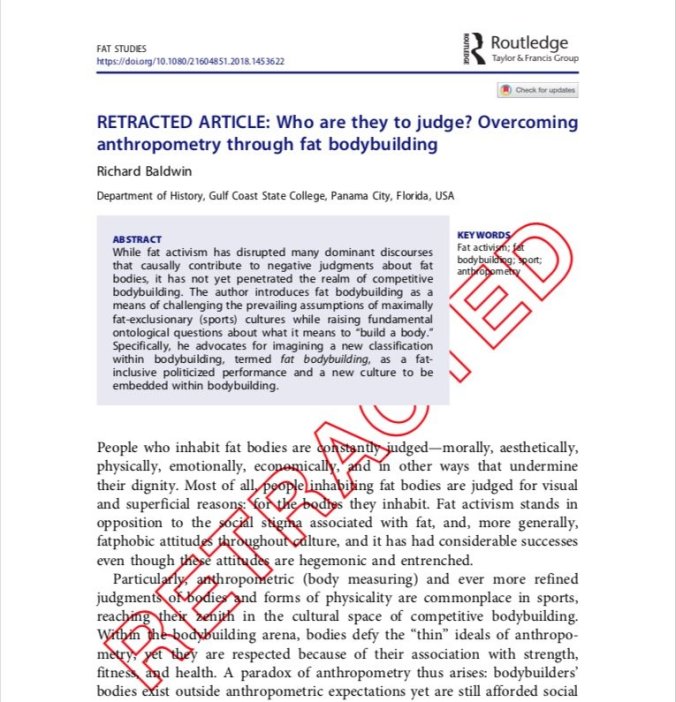
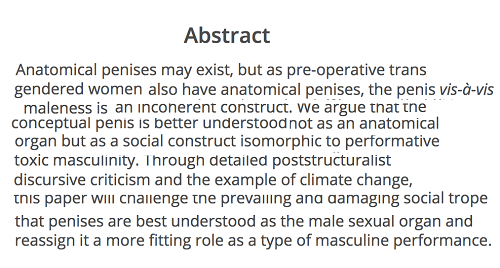
Ethics Quiz: The Good Hoax?

A scholarly journal called “Sex Roles” published what t thought were the results of  a two-year study involving “thematic analysis of table dialogue” to uncover the mystery of why heterosexual men like to eat at Hooters. A journal of feminist geography, whatever that is, featured research om “human reactions to rape culture and queer performativity” at dog parks in Portland, Oregon. Another paper was deemed worthy of publication in a journal of feminist social work:  titled “Our Struggle Is My Struggle,” it merged current feminist cant into passages lifted from Hitler’s “Mein Kampf.”

Last week, the three authors of these and many other hoax papers  revealed in an article for the online journal Areo explaining that their fakery was part of a project to expose the lack of integrity in academia. “Scholarship based less upon finding truth and more upon attending to social grievances has become firmly established, if not fully dominant, within these fields,” they wrote. James A. Lindsay, Helen Pluckrose and Peter Boghossian  (above) said that they wrote 20 fake scholarly papers and had several accepted and published in journals. The embarrassed publications rushed to retract the fake scholarship…

…while many scholars praised the hoaxers. for casting a harsh and revealing light on the “peer-reviewed research” scam.

Your Ethics Alarms Ethics Quiz Of The Day:

Was the hoax project ethical?

Continue reading

I Break My Own Rule And Publish A Social Media Meme…

Here it is:

The Ethics Incompleteness Principle holds that ethics rules don’t always work in anomalous situations. An Ethics Alarms rule is that internet memes are simple-minded agitprop, lazy ways for the uninformed and the critical thought-challenged to circulate pre-digested talking points and partisan distortions. I hate them.

But I was actually beginning work on a flow chart of the constantly changing arguments against the confirmation of Brett Kavanaugh, and this magically appeared. (Pointer: Instapundit)

It’s perfect, fair, and true.

Bravo.

Look! An Ethics Dunce Mob: 2,400+ Law Professors

My mind may be mush, but I can get 2400 colleagues to agree with me anyway!”

In the New York Times: The Senate Should Not Confirm Kavanaugh

One of the most disillusioning aspects of the epic 2016 Post Election Ethics Train Wreck, the worst and most damaging of them all, has been the serial disgrace of one profession after another as they abused their public trust, ethics codes, core values, and expertise. Psychiatrists, physicians, lawyers, journalists, academics, educators, judges, elected officials, pundits, journalists, law enforcement officials and more: so many have sided with partisan mobs when the nature and mission of what makes them valuable society demand that the professionals  remain neutral and objective. Law professors have been particularly fond of disgracing themselves since President Trump’s election, and almost all of them are Democrats,  so seeing over 2400 of them sign a statement that can stand as a warning to all against taking pronouncements from this particular group of  legal academics seriously is hardly a shock.  It’s still discouraging.

What is unethical, as well as dumb, about this stunt, for stunt it is? Let us count the ways.

1. It is grandstanding and virtue signaling designed to mislead the public, and seed further division, if that’s possible. Every one of these professors can have their own individual opinion about the Kavanaugh nomination, but it is no better, or more influential, nor should it be, than yours or mine. They seek to increase their influence by amassing thousands of personal and biased opinions into a single loud one masquerading as a professional opinion, which it is not.

2. The number 2400 is inherently misleading. This isn’t close to a majority of the law professors in the country. It’s not close to a majority of the Democrats and progressives in the profession. Most of the public, however, doesn’t have continuing relationships at law schools, haven’t worked for them, haven’t graduated from one, or taught at one, like, say, me. The petition is designed to deceive. There are more than 20,000 law professors in US Law schools. Now we know at least 10% appear to be unfit to teach law.

3. The letter is completely irrelevant. Nobody in the Senate cares what a group of liberal law professors want. No Senator is going to read this opinion and say, “Oh, no! I guess I better vote against Kavanaugh: a boatload of professors I’ve never heard of think I should!” Continue reading

Morning Ethics Warm-Up, 10/4/18: On Baseball, Mocking Ford, Apologies, and “Tax Schemes”

Good Morning!

[BOY its been hard keeping up on ethics blogging between air travel, a balky laptop, seminars, the new firm and, most of all, ushering the Red Sox to a World Championship. Yesterday was classic: I had multiple posts composed in my head, and literally was never able to find time to work on them. I’m sorry. I’ll figure it out…]

1 Baseball ethics: The exciting Cubs-Rockies Wild Card elimination game was set up by the Colorado 12-0 win over the Washington Nationals on the final day of the season. Thus the Rockies ended the season in a tie with the Dodgers on top of the NL West, requiring one of the two tie-breaking games on Monday. These were ratings bonanzas for baseball and the networks showing them, leading to conspiracy theories regarding that last Rockies victory.  Max Scherzer, arguably the best pitcher in the league, was supposed to start the game fr Washington, and if he had, its safe to say that the Rockies would not have won 12-0, if at all. Reportedly he wanted to start the game, but the Nationals decided late to start the immortal Eric Fedde. Were they trying to give the game to the Rockies? Did orders come down from MLB to tank?

The theory makes no sense, because the suits and networks are always rooting for the big media centers and their teams to make it to the World Series. The Dodgers, Red Sox, Yankees and Cubs mean big ratings, and the Rockies posed a threat to the Dodgers and ended up eliminating the Cubs. Nonetheless, a team like the Nats, out of the race, running out the string, should have the professional integrity to go all out to win when a game is important to its opponent.

2. I’m not going to demand an apology, but they still owe me an apology. The Hill is reporting that…

Congressional investigators have confirmed that a top FBI official met with Democratic Party lawyers to talk about allegations of Donald Trump-Russia collusion weeks before the 2016 election, and before the bureau secured a search warrant targeting Trump’s campaign.

Former FBI general counsel James Baker met during the 2016 season with at least one attorney from Perkins Coie, the Democratic National Committee’s private law firm.

That’s the firm used by the DNC and Hillary Clinton’s campaign to secretly pay research firm Fusion GPS and Christopher Steele, a former British intelligence operative, to compile a dossier of uncorroborated raw intelligence alleging Trump and Moscow were colluding to hijack the presidential election.

The dossier, though mostly unverified, was then used by the FBI as the main evidence seeking a Foreign Intelligence Surveillance Act (FISA) warrant targeting the Trump campaign in the final days of the campaign.

This is not exactly surprising, but it ticks me off for personal reasons. Several left-leaning commenters here who I respected and gave a lot of attention, abandoned Ethics Alarms in high dudgeon because I continued to question the growing evidence that the entire Russian collusion investigation was rigged, partisan, illegal, and an effort to bring down an elected President using a corrupt and politicized FBI and Justice Department. Here was one exit speech, and from a friend:

“But I can’t allow my own tiny voice to be associated with this nonsense any longer. Being the “left” voice is one thing; being way out on the fringe is quite another, and I don’t think it’s me that has moved. I see far too many shades in our times now of McCarthyism (not Gene), George Wallace-ism, and autocracy. I’m deeply concerned about the continued health and well-being of our democratic institutions. I suspect Rod Rosenstein will soon have no recourse but to resign, and I’m doing something similar. I don’t want to be party to this hysterical of a dialogue (in my humble opinion).”

Continue reading