About the “So-Called” Judge’s TRO

robart

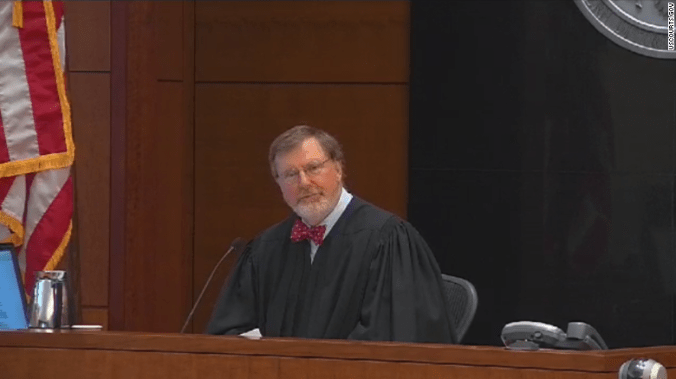
Ethics Alarms had a revealing comment on the post about the grandstanding and unethical ex-acting-Attorney General’s  breach of her duty to represent her client regarding the President’s Middle East immigration Executive Order. Following Judge Robart’s temporary restraining order (or TRO), the reader said, in essence, ‘See? She was right! The order was illegal, just like she said it was!’ The comment was idiotic on its face on many levels, yet it was also a fair summation of how partisan citizens have viewed the controversy. The various TROs validate the criticism of the Executive Order in their minds. They don’t, however. Judge Robart’s order particularly doesn’t. In fact, it is infuriatingly vague.

Now, a TRO doesn’t necessarily have to explain in detail what is wrong with a law, regulation or order. The purpose of this judicial act is to stall a measure that has the potential of causing a lot of disruption, unhappiness or expense from going into effect until there can be a decisive determination that it is legal, constitutional and within the power of the government entity that issued it. A judge issuing a TRO must conclude that the objection to the act is substantive, that the party applying for the TRO has a substantial chance of prevailing on the merits, and that the party has standing to object. The judge does not have to conclude that the party asking for the order is right, just that the party may be right.

However, reading Judge Judge Robart’s order, one can glean no clue as to why the TRO was justifiable, and why it is so sweeping. Although the judge writes in his conclusion that…

The work of the court is not to create policy or judge the Wisdom of any particular policy promoted by the other two branches. That is the work of the legislative and executive branches and of the citizens of this country who ultimately exercise democratic control over those branches. The work of the Judiciary, and this court, is limited to ensuring that the actions taken by the other two branches comport with our country’s laws, and more importantly, our Constitution. …

[T]he court is mindful of the considerable impact its order may have on the parties before it, the executive branch of our government, and the country’s citizens and residents. The court concludes that the circumstances brought before it today are such that it must intervene to fulfill its constitutional role in our tripart government.

…the order never states what is illegal or unconstitutional in his view.  This omission has led many analysts to conclude that there isn’t anything. He just doesn’t like the order. Much has been made of the fact that Robart was a Bush appointee, so the order isn’t “partisan.” Of course, the same people making this argument, in other settings, would maintain that a Bush appointment is just a bad judge. Many, many, many Republicans  and conservatives detest the President, and especially, one should remember, the Bush family. It is far from unlikely that bias against the President caused Judge Robart to employ poor judgment. Democrats cite the fact that Rorart is a conservative as part of a wonderfully convenient construct: if a conservative judge opposes them, the fact that he’s a conservative means he’s wrong, and if a conservative judge agrees with them, the fact that he’s a conservative means he’s right.
Some of the exchanges in the hearing that led to his order directly contradict his written statement that he is not questioning the wisdom of the order rather than challenging its legality.

Continue reading →

Ethics Observations On The President’s “So-Called Judge” Tweet

Donald J. Trump - ø@realDonaldTrump The opinion of this so-called judge, which essentially takes law-enforcement away from our country, is ridiculous and will be overturned! 1:12 PM - 4 Feb 2017 Donald Trump Tweet

Ugh.

In case you were lucky enough to miss it, after Judge James Robart temporarily blocked  President Trump‘s Executive order halting  immigration from seven Middle East nations teaming with terrorists, nationwide, the President responded on Twitter yesterday:

Tweet 1.:

When a country is no longer able to say who can, and who cannot , come in & out, especially for reasons of safety &.security – big trouble!

Tweet 2.:

Interesting that certain Middle-Eastern countries agree with the ban. They know if certain people are allowed in it’s death & destruction!

Tweet 3.:

The opinion of this so-called judge, which essentially takes law-enforcement away from our country, is ridiculous and will be overturned!

The last one inspired expressions of alarm and horror:

Senator Schumer: “POTUS’s attack on Judge Robart shows a disdain for an ind. judiciary that doesn’t bend to his wishes & lack of respect for the Constitution.”

Bernie Sanders: “Trump has to learn the very important truth stated by Washington AG Bob Ferguson: “No one is above the law, not even the president.”

Representative Jerry Nadler: ” No “so-called.” Judge Robart is a GWB appointee who was confirmed 99-0. We are watching closely your contempt for our Judicial Branch.”

Evan McMullin—remember, the Independent who ran to be President of Utah?—wrote,

“Disagreeing with a court decision is fine, but undermining the legitimacy of a judge and the Judiciary Branch is a threat to the Republic.”

(Somehow I just don’t think that a President who has for three months watched an entire political party seek to undermine the legitimacy of a duly elected POTUS–him–with protests, riots, recounts, an Electoral College rebellion, calls for impeachment, calls for military coups, Hitler comparisons, accusations of incest with his daughter,  insanity, and conspiracy theories involving Russia will take too seriously the argument that three words in a tweet is a “threat to the Republic.” I could be wrong…)

Naturally bloggers, pundits and social media users have reacted to the three words with even more intensity.

Ethics Observations: Continue reading →

Supreme Court Vacancy Ethics: A Competent Choice, An Unethical Announcement, And An Irresponsible Reaction

gorsuch

You know, if every day is going to set off multiple political ethics controversies, I’m not going to have time to write about lobster hats.

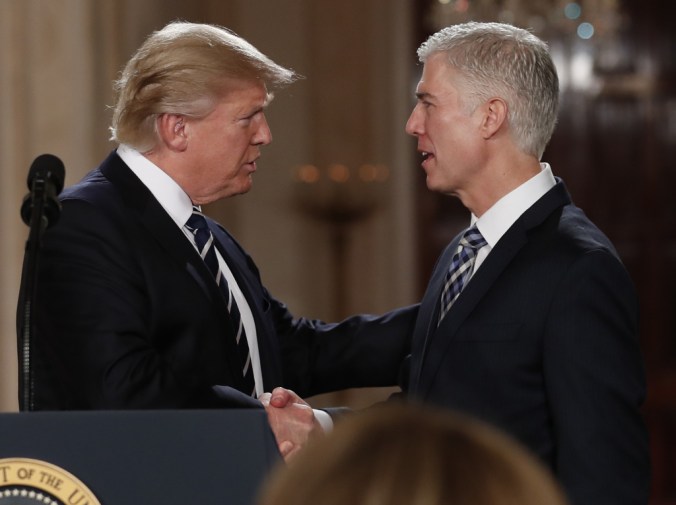
Last night, President Trump selected Colorado federal appeals court judge Neil Gorsuch as his Supreme Court nominee.

A. The Choice

Except for those who literally are determined to freak out and condemn anything President Trump does, this was a competent, responsible choice. He would be one of the best of the available choices for any Republican President, more qualified than Obama’s snubbed selection, Merrick Garland, to fill the same vacancy, and Garland was certainly qualified. It’s ridiculous that Gorsuch is one more Harvard grad on a Court that is exclusively Harvard and Yale, but that aside, he adds some diversity of outlook by being from the middle of the country rather than the coasts. He writes clearly, unlike, say, Justice Kennedy, and is not a pure political ideologue, like Ginsberg or Alito.

Before the Democrats’ rejection of Robert Bork shattered the tradition of allowing every President the privilege of having his SCOTUS nominations approved absent real questions about their competence or honesty, a nomination like this one would have garnered bipartisan praise. Trump made a responsible, competent, choice. Really. He did.

B. The Announcement Continue reading →

A Fake Judge Disqualifies Herself From Becoming A Real Judge

This is ridiculous.

Well, sure it's OK to impersonate a judge ON STAGE...

Well, sure it’s OK to impersonate a judge ON STAGE…

The Illinois Attorney Registration and Disciplinary Commission is asking for the immediate suspension of a judicial candidate Rhonda Crawford, who is running  for a judgeship covering parts of Chicago and its suburbs. The request asks the Illinois Supreme Court to block Crawford from becoming a judge if she wins the election, which is likely, since she is running unopposed. The reason she has been deemed unfit to be a judge is that she already pretended to be one, in essence impersonating a judge and ruling on cases in traffic court.

Crawford admitted last month that she wore a judicial robe and sat at the bench as part of a “shadowing process”  under the direction Judge Valarie Turner, who was reprimanded and  reassigned to administrative duties after pulling the stunt. Near the end of the afternoon court call, Judge Turner announced that “we’re going to switch judges” and gave her judicial robe to Crawford. Crawford didn’t correct the misstatement, and began acting as the judge. Judge Turner, who appears to have taken leave of her senses, told the prosecutor earlier in the day that Crawford was a judge, and Crawford did not correct the misstatement. When an officer in the courtroom congratulated Crawford on her judgeship, Crawford did not correct him, either. Judge Turner later told the presiding judge investigating the incident that she thought Crawford really was a judge, which is odd since she was employed as a law clerk and staff attorney, and real judges tend to have their own robes while not requiring second judges to stand behind them. Continue reading →

Judicial Ethics Quiz: The Cranky Judge

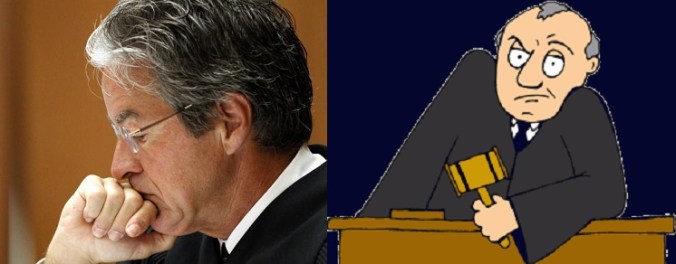
Judge Clarke (L) and artist's representation (R)

Judge Clarke (L) and artist’s representation (R)

A three-judge panel in California found misconduct in Judge Edmund Clarke, Jr’s treatment of one or more jurors in a jury pool for a murder trial.

Your challenge:  Guess which of the incidents was found to be an abuse of judicial power and authority.

A. Judge Clarke also told a potential juror who wrote that she had only $25 in her checking account that “every one of these lawyers spent more than that on lunch today.” He excused the juror, and after she left, Clarke told everyone in the courtroom how much the juror had in her account. When a second potential juror disclosed he had only $33 in his checking account, Clarke again announced the amount and said that his savings put the other juror “in the shade with that big account.”

B. Judge Clarke reduced another juror to tears reprimanding her after she appeared to change a form to indicate that she did not speak English, which he found incredible. She said  had lived in the United States for 25 years. Clarke said,

“Most people that have been in this country for 10 years have picked up enough English. [Twenty] or so, they’re moving right along. And 25 years is—so you better have a different reason why you want to be excused than that.” 

After she began weeping loudly because, she said later, she was ashamed because she didn’t speak English, he dismissed her from the panel.

C. Finally, Judge Clarke became annoyed at a juror who had written on her hardship form, “Having Severe Anxiety!!” next to her drawing of a frowny  face. “I work as a waitress and make minimum wages, plus I’m planning a wedding in two months and all of these things, especially this courthouse are aggravating my anxiety terribly. On the verge of a meltdown!” Clarke  excused her from jury duty,  but when she added that the clerk who was checking in potential jurors was “really disrespectful” to everyone, he  told the woman that she could stay in the hallway and tell him more at the end of the day. When the dismissed juror insisted that she had to leave, he said,

“No, you’re staying. You’re staying You’re staying on. I’ve been a judge for seven years. No one’s ever complained about my clerk. But I’ll be happy to hear your complaint at the end of the day. So go to the hall and stay and come in, act like an adult and you can face her and tell me everything she did wrong.”

The woman did as she was ordered and apologized to Clarke after waiting for an hour court to be adjourned. The judge  asked her how she would have felt if he came to the restaurant where she worked and criticized her in front of everyone, saying, 

“If you came here thinking that this was going to be Disneyland and you were getting an E Ticket and have good time, I’m afraid you have no sense of what is going on in this building. Now, seven years ago the first clerk that was assigned to me, she’s still here. The only clerk I’ve ever had. One juror, in all that time, out of thousands, has ever complained about her. That’s you. You can leave now knowing that’s what you accomplished.”

D. All of the above.

Take the poll, and then go to the answers after the jump.

Continue reading →

Wearing Black Lives Matter Pins In The Courtroom Matters To This Judge

Q: Which of these can a judge ban from a courtroom? A: All of them.

Q: Which of these can a judge ban from a courtroom? A: All of them.

Youngstown (Ohio) Municipal Court Judge Robert Milich ordered NAACP attorney Andrea Burton to remove the Black Lives Matters pin she was wearing. The attorney refused, and was declared in contempt of court.

Good.

She was.

Judge Milich  sentenced the grandstanding lawyer to five days in jail, though the sentence has been stayed while she appeals the decision, as   as long as she obeys Milich’s order not to wear items that make a political statement in court. When she loses her appeal, and she will, she will have to serve the five days in jail.

Milich is on firm ethical and constitutional ground, not that this episode won’t subject him to being called a racist. It is well-established that judges can ban political expressions in the courtroom, and in 1998, the Supreme Court let stand the rulings of a federal district court and the 1st Circuit Court of Appeals, in Berner v. Delahanty, that a the judge’s prohibition of political buttons was a reasonable method of “maintaining proper order and decorum” in a courtroom. In that case, the judge prohibited lawyer Seth Berner from wearing  a button saying “No on 1—Maine Won’t Discriminate,” a declaration against an upcoming state referendum.

As long as a judge doesn’t allow one form of political advocacy while banning others, there is no free speech issue. Judges have gotten themselves involved in controversy when they have allowed buttons, as in the 2006 Supreme Court case of Carey v Musladin, in which Court ruled  unanimously that murder trial spectators were free to wear buttons with a picture of the victim in front of the jury that convicted the defendant. The justices agreed with California prosecutors who said the buttons were a harmless expression of grief by family members at Mathew Musladin’s trial.

I really don’t like that decision. A wise judge will avoid the issue by prohibiting any advocacy in court of of any political, social or case-related opinion. Continue reading →

The Unethical Courtroom Exchange Of The Century!

believe-it-or-not-1024x442

This would have been rejected by “Boston Legal” as too ridiculous.

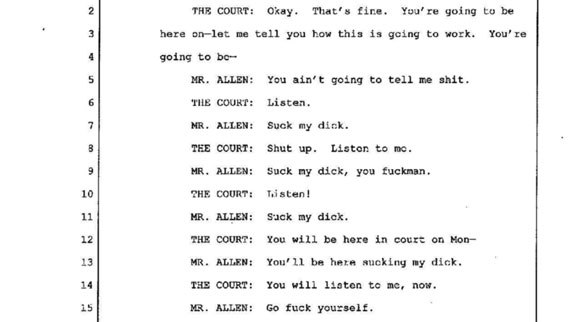
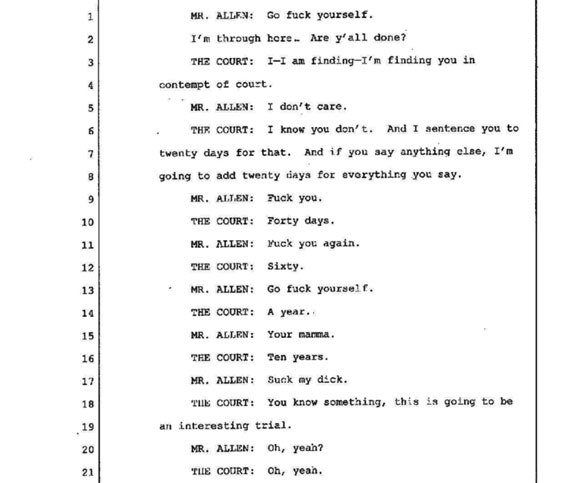
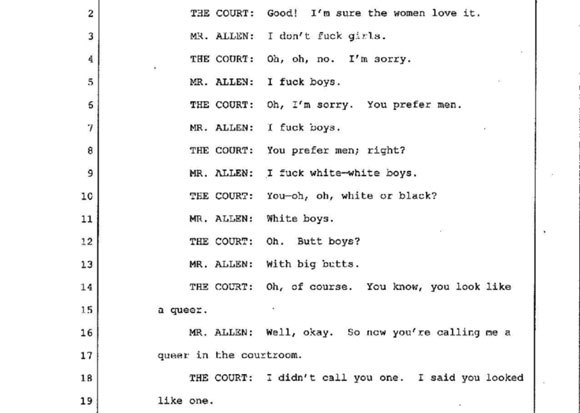
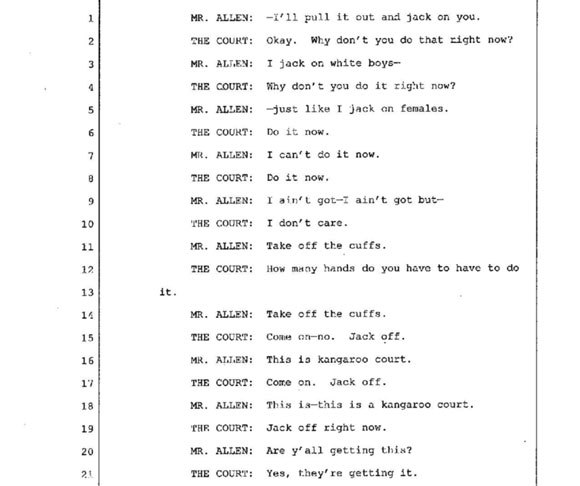
In a Rome, Georgia court room, as others looked on, Floyd County Superior Court Judge Bryant Durham allowed himself to be provoked by a defiant murder suspect named Denver Allen.

What resulted was a rare (thank goodness) example of a judge lowering himself, his position, the court and the justice system to the level of those with no respect for the law or society. Here is a portion of the transcript:


dialogue 1

dialohue 2dialogue 3dialogue 4


Stay classy, Judge Durham. Continue reading →

From The Ethics Alarms Double Standard Files: A Brock Turner Sentence For A Predator Teacher, And Everyone Shrugs

The predator teacher, who is much more deserving of a light sentence than Brock Turner, who should be killed, and the judge too, come to think of it...

The predator teacher, who is much more deserving of a light sentence than Brock Turner, who should be killed, and that judge too, come to think of it…

The lenient sentence Judge Aaron Persky handed to Stanford student Brock Turner for raping a drunken co-ed  enraged the social media and the public conscience, resulting in thousands of op-eds, protests from feminists and rape-culture activists, petitions, a recall effort, and most devastating of all, an Ethics Alarms post.

Last week, a 33-year old high school teacher named Lindsay Himmelspach pleaded guilty to repeatedly having sex with two minor students at the high school, and received the almost the identical sentence, from another California judge, as Turner. Himmelspach recieved three years probation and four months in jail.

I’m listening, but I hear no screams of outrage.

Huh.

The judge, Butte County Superior Court Judge James Reilley, administered the equivalent rap on the wrist that her Santa Clara colleague did on Turner because Himmelspach had no prior criminal record, she expressed remorse, and somehow he concluded that she’d never do such a thing again. (I’m sure it had nothing to do with the fact the she is hot, and the judge was thinking, “Those lucky bastards!”) Indeed, the judge didn’t even require the predator teacher to register as a sex offender, at least not yet. He’s keeping an open mind, and will decide after a separate hearing.

Hello?

Social media?

Continue reading →

A Slap On The Wrist For The Lawyer Who Demanded 65 Million Dollars For A Lost Pair Of Pants

And they weren't even Elvis' pants...

And they weren’t even Elvis’ pants…

There has been a lot of beating up on judges and lawyers lately, on this blog and elsewhere, so what better time to revisit the weird case of foormer administrative law judge and current attorney Roy Pearson, Jr? He was the D.C.  judge who carried on such a vendetta against a dry cleaner because they lost a pair of his pants that it became national news…which is to say, it was discussed on The View and the women made fools of themselves. Not as big fools as the judge made of himself, though.

Pearson claimed that in 2005, the dry cleaners gave him the wrong pair of pants and refused to pay him the $1,150 he demanded as compensation. His suit—his $67 million suit!— against the dry cleaners alleged that the business violated Washington, D.C.’s consumer protection law by failing to comply with its sign promising “satisfaction guaranteed,” which Pearson claimed was unconditional. You know, even if a customer was deranged.

In his testimony in this wacko lawsuit, Pearson argued that “satisfaction guaranteed” meant the dry cleaner was legally obligated to pay a customer who demanded $1,000 for a supposedly lost sweater even if the owners knew they had delivered the correct sweater to the customer.

By that logic, the owner would also have to let the customer have sex with his teenage daughter, if that’s what it took to “satisfy” him. Continue reading →

Res Ipsa Loquitur Ethics Quote Of The Day: Law Professor/Blogger/Irony Master Ann Althouse

free-bingo-design

The NYT article tells us that Sotomayor’s remarks were published in the Berkeley La Raza Law Journal and that she also said:

“Whether born from experience or inherent physiological or cultural differences,” she said, for jurists who are women and nonwhite, “our gender and national origins may and will make a difference in our judging.”…

… Judge Sotomayor questioned whether achieving impartiality “is possible in all, or even, in most, cases.” She added, “And I wonder whether by ignoring our differences as women or men of color we do a disservice both to the law and society.” She also approvingly quoted several law professors who said that “to judge is an exercise of power” and that “there is no objective stance but only a series of perspectives. Personal experiences affect the facts that judges choose to see,” she said.

So has Donald Trump refrained from doing a disservice both to the law and society?

—-Ann Althouse, making a slam-dunk point about the hypocrisy of the uproar over Donald Trump’s “racist”suggestion that a Hispanic-American judge might be biased against him.

Althouse and I are right, and almost everyone else is wrong. It’s obvious, and beyond rebuttal on the facts. Althouse has joined me as one who also deplores everything about Donald Trump but who is determined to call out intellectual dishonesty and unfairness in the attacks against him. She also posted this… Continue reading →