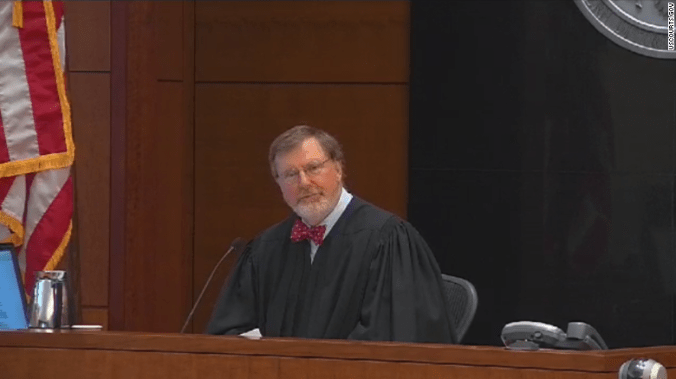
That’s the judge lying down. At least he wasn’t wearing his robe…
Arkansas circuit judge Wendell Griffen granted a temporary restraining order last week halting the Arkansas Department of Corrections from executing seven condemned prisoners within eleven days as it had planned, as Griffen barred the use of one of the ingredients in the lethal drug “cocktail.” A federal judge followed up quickly with anothee orderlikewise barring Arkansas from proceeding to execute anyone with a lethal injection. Mission accomplished, Judge Griffen decided to reward himself by attending an anti-death penalty rally in which he participated with elan, playing a condemned prisoner lying prone on a lawn chair as if it was a gurney.
What fun! And what an idiot! No ethics alarms went off, despite the fact that he was flagrantly displaying his bias against the death penalty immediately after interfering with the state’s law enforcement based on a fair and objective interpretation of the law.
State officials were outraged, and argued that Griffen’s conduct proved that he was not capable of impartiality in capital cases. Ya think?
Yesterday the Arkansas Supreme Court pulled Griffen from all pending death penalty and lethal injection protocol cases. It also referred him to the state’s Judicial Discipline and Disability Commission to determine whether he violated the Code of Judicial Conduct.
Signature significance, in the context of ethics, is when a single example of conduct or a single episode is sufficient to make a definitive judgment about the ethical values of an individual or an organization. It is something so striking and blatant that the usually valid statistical argument that one data point is meaningless doesn’t hold true. Ethics Alarms refers to signature significance frequently.
The Democratic Party’s behavior regarding the confirmation of Judge Gorsuch is signature significance. It won’t work. It will result in permanent harm to the Senate, harm that will initially most affect Democrats. It is hypocritical, irresponsible, and embarrassing, at least if the party is considering citizens who understand what is going on, admittedly a minority. It is unprofessional. It is dishonest. It is unpatriotic. The conduct is so obviously irresponsible that it is difficult to believe that Democratic leaders don’t realize it. Because it is all these things, the strategy is also very close to insane.
I just watched Senator Grassley’s address to the Judiciary Committee, ticking off l the reasons why the inflammatory Democratic rhetoric regarding Judge Gorsuch ranged from untrue to self-contradictory to ludicrous. He wasn’t exaggerating; it wasn’t a partisan speech. Grassley reminded the committee that Gorsuch had been unanimously confirmed when he was nominated to the 10th Circuit. The Senator correctly explained why the recent mantra that Gorsuch wasn’t “mainstream” was counter-factual, since he has voted with the majority on that court over 90% of the time.
Grassley dismissed as offensive and judicially ignorant (my words, not his; Chuck was appropriately mild in his word choices) the argument that Gorsuch lacked compassion and wouldn’t rule “for the little guy.” Competent and ethical judges—unlike, say, Justice Sotomayor—don’t change their decisions according to which litigant is “big,” “little,” rich, poor, black or white. Their job, duty and role is to clarify what the law is. It is only part of the current progressive delusions, most recently shown in the rulings against the Trump travel halt from terrorist-teeming Muslim nations, that judges should base their analysis on their personal and political biases, when those biases are the “right” ones.
Senator Grassley then moved to the complaint that Gorsuch “refused to answer questions.” “What this means is that the judge wouldn’t say in advance how he would rule on cases that hadn’t come before him yet,” the Senator said. Of course he is exactly right. No judicial nominee has been willing to answer such question since the Democrats politicized the confirmation process forever by voting down Reagan appointee Robert Bork, despite the judge being as qualified and brilliant a jurist as anyone nominated to sit on the Court. No judge should have answered such questions before that, either. Cases are decided on the law and the facts. A justice who has made up his or her mind before even reading the briefs or hearing oral arguments is not judging fairly or competently.
Finally, Grassley pointed out that no Supreme Court nominee has ever faced a filibuster or the threat of one. For Gorsuch to be filibustered by Democrats, despite being assessed by almost every legal expert and commentator as unusually distinguished and qualified (including the left-leaning American Bar Association, which has found conservative judges less than qualified in the past because they were…conservative), is indefensible on the merits. Continue reading →
A 13-Year-Old Girl Sobbed While Recording Her Immigrant Father Get Arrested By ICE Agentis the headline at Buzzfeed. Wait, teenage girls weeping is news now? Was she the only teen sobbing this week? How is this news, by any standard?
Of course, it’s headline worthy if the objective is to provoke an emotional reaction rather than to inform the public objectively. In fact, nothing about the story is newsworthy, except as pr0-illegal immigration, anti-law enforcement, anti-President Trump propaganda and hate-mongering. Illegal immigrant and scofflaw Romulo Avelica-Gonzalez had dropped his daughter off at a Los Angeles school, and six blocks from the school his car was surrounded by immigration enforcement agents who took him into custody, just as law enforcement takes law-breakers into custody every hour of every day of the week. Gonzalez had a 2014 deportation order against him issued by an immigration judge, and violated it every day he spent in the U.S., masquerading as a law-abiding citizen, since then. He also had a 2009 DUI conviction. This wasn’t even a close call.
I’m pretty sure the children of gang members, drug dealers, muggers and serial killers also sob when daddy is taken away, and while I feel sorry for the children, it doesn’t make me want to let their fathers go free, it doesn’t mean we should change the laws, and it isn’t news.
ICE said Avelica-Gonzalez is scheduled to be deported to Mexico, where he was supposed to have returned three years ago. This isn’t cruel, this isn’t unfair, this shouldn’t be a surprise.
Brenda Avelica, a different daughter from the one heard sobbing on the viral video of her father’s arrest—YES! It really happened! The girl SOBBED! Film at 11!— said that her father has been in the US for 20 years and has four children, two of them adults.
So?
“It’s really hard what we’re going through,” Avelica told reporters. “I never thought we’d actually go through something like this. It’s terrible to feel and see your family being broken apart.”
Let me fix that for her. It’s terrible to finally have the law catch up to you when you are guilty as hell. The James brothers said that, I think. Maybe it was Bonny and Clyde. Or Bernie Maddoff. ICE agents are not the bad guys here. The elected officials, activists, and journalists who want us to think that, however, are. Very bad. Continue reading →
The Supreme Court of Appeals of West Virginia suspended Judge Stephen Callaghan for two years and fined him $15,000 for a campaign flyer that it deemed dishonest. The court said that the flier depicted the incumbent judge, Gary Johnson, as “partying” with President Obama. Johnson had visited the White House for a federally required conference on fighting child trafficking, but he didn’t see Obama there, there was no party, and no function involving alcohol. The flier was mailed out five days before the May 2016 election, which Callaghan won. Callaghan won the election by 220 votes.
The flier was “in every sense, materially false” according to the decision. You can see it above. Photos of Obama and Johnson are shown next to each other. Obama is shown holding a beer and streamers are in the background. The caption reads, “Barack Obama & Gary Johnson Party at the White House.” The opposite side of the flier read,
“While Nicholas County lost hundreds of jobs to Barack Obama’s coal policies, Judge Gary Johnson accepted an invitation from Obama to come to the White House to support Obama’s legislative agenda. That same month, news outlets reported a 76% drop in coal mining employment. Can we trust Judge Gary Johnson to defend Nicholas County against job-killer Barack Obama?”
After Johnson objected to the flier ( and probably threatened to sic the Judicial Ethics Panel on him), Callaghan removed the flier from his Facebook pages and ran radio ads saying the flier’s “specific characterization of the White House visit may be inaccurate and misleading,” and “candidate Callaghan apologizes for any misunderstanding or inaccuracies.” Continue reading →
New Jersey, a state for which many would say ethics itself would be a novelty, has taken the lead in a truly revolutionary criminal justice experiment that resolves an ancient ethical dilemma in favor of mercy and compassion. Beginning on January 1 this year, New Jersey judges are expected to release all but the most dangerous and untrustworthy defendants pending their trials, often with certain conditions, rather than to require cash bail as a condition of avoiding jail.
In 2014, voters decided to amend New Jersey’s Constitution and virtually eliminate bail, responding to a national movement to reform a system that has always discriminated against poor defendants. Although bail requirements are usually modest for most offenses (a bail bondsman typically charges a defendant 10% to post the entire bond), many defendants are still unable to pay even small amounts. Then they wait in jail, often losing their jobs and causing hardship for their families. Continue reading →
Ethics Alarms had a revealing comment on the post about the grandstanding and unethical ex-acting-Attorney General’s breach of her duty to represent her client regarding the President’s Middle East immigration Executive Order. Following Judge Robart’s temporary restraining order (or TRO), the reader said, in essence, ‘See? She was right! The order was illegal, just like she said it was!’ The comment was idiotic on its face on many levels, yet it was also a fair summation of how partisan citizens have viewed the controversy. The various TROs validate the criticism of the Executive Order in their minds. They don’t, however. Judge Robart’s order particularly doesn’t. In fact, it is infuriatingly vague.
Now, a TRO doesn’t necessarily have to explain in detail what is wrong with a law, regulation or order. The purpose of this judicial act is to stall a measure that has the potential of causing a lot of disruption, unhappiness or expense from going into effect until there can be a decisive determination that it is legal, constitutional and within the power of the government entity that issued it. A judge issuing a TRO must conclude that the objection to the act is substantive, that the party applying for the TRO has a substantial chance of prevailing on the merits, and that the party has standing to object. The judge does not have to conclude that the party asking for the order is right, just that the party may be right.
However, reading Judge Judge Robart’s order, one can glean no clue as to why the TRO was justifiable, and why it is so sweeping. Although the judge writes in his conclusion that…
The work of the court is not to create policy or judge the Wisdom of any particular policy promoted by the other two branches. That is the work of the legislative and executive branches and of the citizens of this country who ultimately exercise democratic control over those branches. The work of the Judiciary, and this court, is limited to ensuring that the actions taken by the other two branches comport with our country’s laws, and more importantly, our Constitution. …
[T]he court is mindful of the considerable impact its order may have on the parties before it, the executive branch of our government, and the country’s citizens and residents. The court concludes that the circumstances brought before it today are such that it must intervene to fulfill its constitutional role in our tripart government.
…the order never states what is illegal or unconstitutional in his view. This omission has led many analysts to conclude that there isn’t anything. He just doesn’t like the order. Much has been made of the fact that Robart was a Bush appointee, so the order isn’t “partisan.” Of course, the same people making this argument, in other settings, would maintain that a Bush appointment is just a bad judge. Many, many, many Republicans and conservatives detest the President, and especially, one should remember, the Bush family. It is far from unlikely that bias against the President caused Judge Robart to employ poor judgment. Democrats cite the fact that Rorart is a conservative as part of a wonderfully convenient construct: if a conservative judge opposes them, the fact that he’s a conservative means he’s wrong, and if a conservative judge agrees with them, the fact that he’s a conservative means he’s right.
Some of the exchanges in the hearing that led to his order directly contradict his written statement that he is not questioning the wisdom of the order rather than challenging its legality.
In case you were lucky enough to miss it, after Judge James Robart temporarily blocked President Trump‘s Executive order halting immigration from seven Middle East nations teaming with terrorists, nationwide, the President responded on Twitter yesterday:
Tweet 1.:
When a country is no longer able to say who can, and who cannot , come in & out, especially for reasons of safety &.security – big trouble!
Tweet 2.:
Interesting that certain Middle-Eastern countries agree with the ban. They know if certain people are allowed in it’s death & destruction!
Tweet 3.:
The opinion of this so-called judge, which essentially takes law-enforcement away from our country, is ridiculous and will be overturned!
Senator Schumer: “POTUS’s attack on Judge Robart shows a disdain for an ind. judiciary that doesn’t bend to his wishes & lack of respect for the Constitution.”
Bernie Sanders: “Trump has to learn the very important truth stated by Washington AG Bob Ferguson: “No one is above the law, not even the president.”
Representative Jerry Nadler: ” No “so-called.” Judge Robart is a GWB appointee who was confirmed 99-0. We are watching closely your contempt for our Judicial Branch.”
Evan McMullin—remember, the Independent who ran to be President of Utah?—wrote,
“Disagreeing with a court decision is fine, but undermining the legitimacy of a judge and the Judiciary Branch is a threat to the Republic.”
(Somehow I just don’t think that a President who has for three months watched an entire political party seek to undermine the legitimacy of a duly elected POTUS–him–with protests, riots, recounts, an Electoral College rebellion, calls for impeachment, calls for military coups, Hitler comparisons, accusations of incest with his daughter, insanity, and conspiracy theories involving Russia will take too seriously the argument that three words in a tweet is a “threat to the Republic.” I could be wrong…)
Naturally bloggers, pundits and social media users have reacted to the three words with even more intensity.
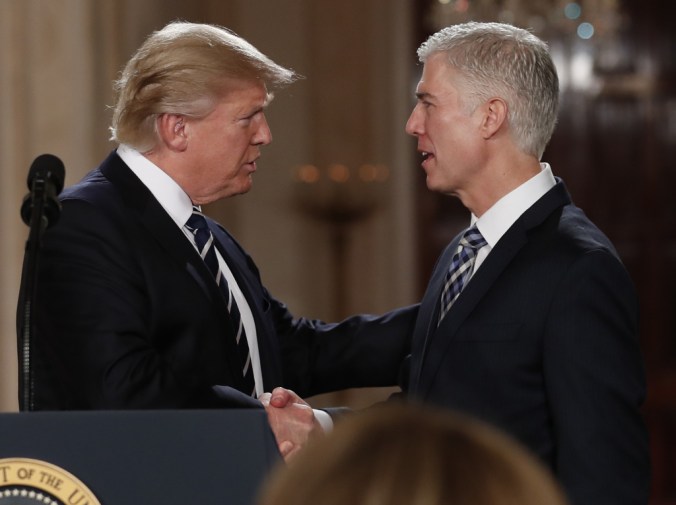
Except for those who literally are determined to freak out and condemn anything President Trump does, this was a competent, responsible choice. He would be one of the best of the available choices for any Republican President, more qualified than Obama’s snubbed selection, Merrick Garland, to fill the same vacancy, and Garland was certainly qualified. It’s ridiculous that Gorsuch is one more Harvard grad on a Court that is exclusively Harvard and Yale, but that aside, he adds some diversity of outlook by being from the middle of the country rather than the coasts. He writes clearly, unlike, say, Justice Kennedy, and is not a pure political ideologue, like Ginsberg or Alito.
Before the Democrats’ rejection of Robert Bork shattered the tradition of allowing every President the privilege of having his SCOTUS nominations approved absent real questions about their competence or honesty, a nomination like this one would have garnered bipartisan praise. Trump made a responsible, competent, choice. Really. He did.
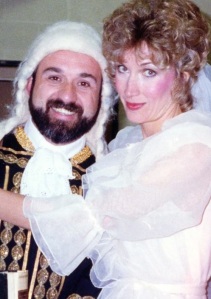
Well, sure it’s OK to impersonate a judge ON STAGE…
The Illinois Attorney Registration and Disciplinary Commission is asking for the immediate suspension of a judicial candidate Rhonda Crawford, who is running for a judgeship covering parts of Chicago and its suburbs. The request asks the Illinois Supreme Court to block Crawford from becoming a judge if she wins the election, which is likely, since she is running unopposed. The reason she has been deemed unfit to be a judge is that she already pretended to be one, in essence impersonating a judge and ruling on cases in traffic court.
Crawford admitted last month that she wore a judicial robe and sat at the bench as part of a “shadowing process” under the direction Judge Valarie Turner, who was reprimanded and reassigned to administrative duties after pulling the stunt. Near the end of the afternoon court call, Judge Turner announced that “we’re going to switch judges” and gave her judicial robe to Crawford. Crawford didn’t correct the misstatement, and began acting as the judge. Judge Turner, who appears to have taken leave of her senses, told the prosecutor earlier in the day that Crawford was a judge, and Crawford did not correct the misstatement. When an officer in the courtroom congratulated Crawford on her judgeship, Crawford did not correct him, either. Judge Turner later told the presiding judge investigating the incident that she thought Crawford really was a judge, which is odd since she was employed as a law clerk and staff attorney, and real judges tend to have their own robes while not requiring second judges to stand behind them. Continue reading →
A three-judge panel in California found misconduct in Judge Edmund Clarke, Jr’s treatment of one or more jurors in a jury pool for a murder trial.
Your challenge: Guess which of the incidents was found to be an abuse of judicial power and authority.
A. Judge Clarke also told a potential juror who wrote that she had only $25 in her checking account that “every one of these lawyers spent more than that on lunch today.” He excused the juror, and after she left, Clarke told everyone in the courtroom how much the juror had in her account. When a second potential juror disclosed he had only $33 in his checking account, Clarke again announced the amount and said that his savings put the other juror “in the shade with that big account.”
B. Judge Clarke reduced another juror to tears reprimanding her after she appeared to change a form to indicate that she did not speak English, which he found incredible. She said had lived in the United States for 25 years. Clarke said,
“Most people that have been in this country for 10 years have picked up enough English. [Twenty] or so, they’re moving right along. And 25 years is—so you better have a different reason why you want to be excused than that.”
After she began weeping loudly because, she said later, she was ashamed because she didn’t speak English, he dismissed her from the panel.
C. Finally, Judge Clarke became annoyed at a juror who had written on her hardship form, “Having Severe Anxiety!!” next to her drawing of a frowny face. “I work as a waitress and make minimum wages, plus I’m planning a wedding in two months and all of these things, especially this courthouse are aggravating my anxiety terribly. On the verge of a meltdown!” Clarke excused her from jury duty, but when she added that the clerk who was checking in potential jurors was “really disrespectful” to everyone, he told the woman that she could stay in the hallway and tell him more at the end of the day. When the dismissed juror insisted that she had to leave, he said,
“No, you’re staying. You’re staying You’re staying on. I’ve been a judge for seven years. No one’s ever complained about my clerk. But I’ll be happy to hear your complaint at the end of the day. So go to the hall and stay and come in, act like an adult and you can face her and tell me everything she did wrong.”
The woman did as she was ordered and apologized to Clarke after waiting for an hour court to be adjourned. The judge asked her how she would have felt if he came to the restaurant where she worked and criticized her in front of everyone, saying,
“If you came here thinking that this was going to be Disneyland and you were getting an E Ticket and have good time, I’m afraid you have no sense of what is going on in this building. Now, seven years ago the first clerk that was assigned to me, she’s still here. The only clerk I’ve ever had. One juror, in all that time, out of thousands, has ever complained about her. That’s you. You can leave now knowing that’s what you accomplished.”
D. All of the above.
Take the poll, and then go to the answers after the jump.





 Ethics Alarms