Justice Ginsberg Has Reached Her “What The Hell” Stage, But That Doesn’t Mean It Can Extend To Ethics

ginsberg-jabot

Justice Ginsberg has been speaking out lately in intemperate fashion, first about Donald Trump, then about Colin Kaepernick. In both cases she received immediate criticism and issued apologies. It’s clear, however, that the liberal feminist icon, now 84 and in ill health, has reached the point in life where she feels she doesn’t need to be especially vigilant about what she says, a bit like Estelle Getty’s character Sophia on “The Golden Girls.” After all, what can anyone do to her?

Now that would normally be the time where ethics are paramount: ethics are what you do when you know you can get away with it (among other handy definitions). Ginsberg is a member of the one court that has no official Code of Judicial Ethics,  but since it is the highest court in the land, its judges are obligated to be exemplars, not rebels.

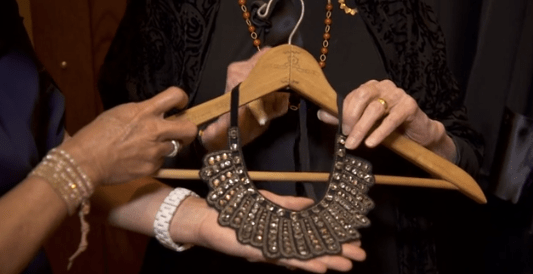
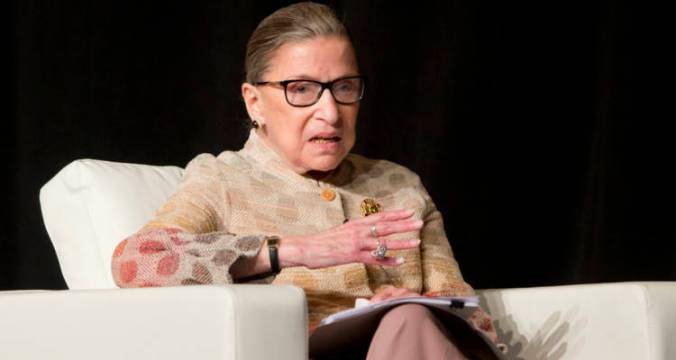
But what the hell. Justice Ginsberg affects ornate jabots when she is on the bench: they spruce up the unisex black judicial robes. In 2014, she revealed that some of them have special significance. She wears one Jabot, for example, when she is part of a majority which is about to deliver its opinion. She wears another when she is dissenting from the majority opinion. (That’s it above.)

Wednesday morning, following the election of Donald Trump, an event that she had earlier told an interviewer would cause her to move to New Zealand, Ginsburg sported the “dissent jabot” on the bench, though no opinions were being read. Reporters quickly picked up on the code, and took the choice as an expression of opposition to Trump’s election, which it almost certainly was. She has not disabused anyone of the assumption.
Cute, clever, unprovable, and unethical. It would have been a clear breach of decorum, independence and judicial dignity for Ginsberg to wear a Hillary button on her robes, or to sport any political statement. Judges typically oppose lawyers, clients and witnesses from bringing politics into court. For a judge to do it is asking for an official reprimand. For a Supreme Court Justice to do it, it doesn’t matter what the message is, shows a lack of respect for her own profession, as well as a lack of self-control.

The gesture is also unprofessional and a breach of the duty of all high government officials to publicly show respect and support for each other. For Ginsberg to “shout out” her dissent to a Presidential election (it doesn’t matter if it is code or not) in such a prominent public forum intentionally endorses divisiveness, at a time when divisiveness is a real threat to national stability.Naturally, her feminist, progressive and Democratic fans cheer this defiance, because they don’t know judicial ethics from corn flakes. Heck, after defending Hillary Clinton for so long, they don’t know any ethics from corn flakes. Justice Ginsberg knows, however. She just doesn’t care any more.

Ah, what the hell?

Continue reading

Judicial Ethics Quiz: The Cranky Judge

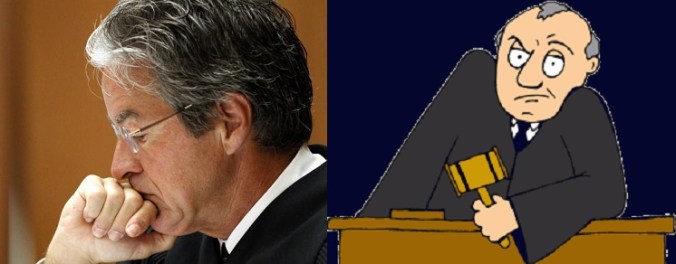
Judge Clarke (L) and artist's representation (R)

Judge Clarke (L) and artist’s representation (R)

A three-judge panel in California found misconduct in Judge Edmund Clarke, Jr’s treatment of one or more jurors in a jury pool for a murder trial.

Your challengeGuess which of the incidents was found to be an abuse of judicial power and authority.

A. Judge Clarke also told a potential juror who wrote that she had only $25 in her checking account that “every one of these lawyers spent more than that on lunch today.” He excused the juror, and after she left, Clarke told everyone in the courtroom how much the juror had in her account. When a second potential juror disclosed he had only $33 in his checking account, Clarke again announced the amount and said that his savings put the other juror “in the shade with that big account.”

B. Judge Clarke reduced another juror to tears reprimanding her after she appeared to change a form to indicate that she did not speak English, which he found incredible. She said  had lived in the United States for 25 years. Clarke said,

“Most people that have been in this country for 10 years have picked up enough English. [Twenty] or so, they’re moving right along. And 25 years is—so you better have a different reason why you want to be excused than that.” 

After she began weeping loudly because, she said later, she was ashamed because she didn’t speak English, he dismissed her from the panel.

C. Finally, Judge Clarke became annoyed at a juror who had written on her hardship form, “Having Severe Anxiety!!” next to her drawing of a frowny  face. “I work as a waitress and make minimum wages, plus I’m planning a wedding in two months and all of these things, especially this courthouse are aggravating my anxiety terribly. On the verge of a meltdown!” Clarke  excused her from jury duty,  but when she added that the clerk who was checking in potential jurors was “really disrespectful” to everyone, he  told the woman that she could stay in the hallway and tell him more at the end of the day. When the dismissed juror insisted that she had to leave, he said,

“No, you’re staying. You’re staying You’re staying on. I’ve been a judge for seven years. No one’s ever complained about my clerk. But I’ll be happy to hear your complaint at the end of the day. So go to the hall and stay and come in, act like an adult and you can face her and tell me everything she did wrong.”

The woman did as she was ordered and apologized to Clarke after waiting for an hour court to be adjourned. The judge  asked her how she would have felt if he came to the restaurant where she worked and criticized her in front of everyone, saying, 

“If you came here thinking that this was going to be Disneyland and you were getting an E Ticket and have good time, I’m afraid you have no sense of what is going on in this building. Now, seven years ago the first clerk that was assigned to me, she’s still here. The only clerk I’ve ever had. One juror, in all that time, out of thousands, has ever complained about her. That’s you. You can leave now knowing that’s what you accomplished.”

D. All of the above.

Take the poll, and then go to the answers after the jump.

Continue reading

Ethics Observations On The Financial Massacre Of The Aurora Massacre Plaintiffs

James Holmes’s 2012 attack on the Century Aurora 16 movie theater showing “The Dark Knight Rises” killed 12 people and wounded 70 others. Many of the survivors and relatives of those killed sued Cinemark, the theater’s owner, in state and federal court, arguing that lax security was the cause of the attack. Cinemark’s defense was that the shooting was unforeseeable. Two suits went forward, one in state court and one in federal court, with different plaintiffs. Cinemark prevailed in both. After the recent jury verdict for Cinemark in the state court case this summer, the company had sought nearly $700,000 from the victims under the “loser pays” Colorado law, which directs that the winning side in a civil case is entitled to recover its legal costs from the losing side. This is the predominant system in England and Europe. The litigation costs of Cinemark in the federal case are likely to be more than $700,000, maybe a lot more.

What’s going on here (the best question to begin any ethics inquiry)? Well…

1. The law suits were a terrible idea. This was the result, in part, of the increasingly popular ideological virus in our society that is slowly reprogramming previously functioning brains to believe that nobody should have to pay for their misfortunes, and that somebody with deeper pocket and more resources should always be obligated to pay instead. This is increasingly a staple of leftist thought: the government, insurance companies, corporations, people with more money, all of them should be potentially on the hook when misfortune strikes others, because that’s fair.

2. It’s not fair, though.  It is profoundly un-American and unethical.

If those parties have caused the damage, or had the power and responsibility to mitigate it, or promised to pay for it, then there are ethical arguments to support them paying some or all of the expenses. But if something terrible happens to you, those people should have no more obligation to be accountable for your harm than you should have responsibility for taking care of them. That’s not the message sent by the culture though. Lawyers love the message that if you are harmed, somebody else can be found to ease your pain. They love it, because they can share in the bounty if a lawsuit seeking damages prevails, and this attitude guarantees more lawsuits. Continue reading

Wearing Black Lives Matter Pins In The Courtroom Matters To This Judge

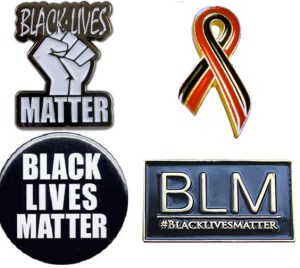
Q: Which of these can a judge ban from a courtroom? A: All of them.

Q: Which of these can a judge ban from a courtroom? A: All of them.

Youngstown (Ohio) Municipal Court Judge Robert Milich ordered NAACP attorney Andrea Burton to remove the Black Lives Matters pin she was wearing. The attorney refused, and was declared in contempt of court.

Good.

She was.

Judge Milich  sentenced the grandstanding lawyer to five days in jail, though the sentence has been stayed while she appeals the decision, as   as long as she obeys Milich’s order not to wear items that make a political statement in court. When she loses her appeal, and she will, she will have to serve the five days in jail.

Milich is on firm ethical and constitutional ground, not that this episode won’t subject him to being called a racist. It is well-established that judges can ban political expressions in the courtroom, and in 1998, the Supreme Court let stand the rulings of a federal district court and the 1st Circuit Court of Appeals, in Berner v. Delahanty, that a the judge’s prohibition of political buttons was a reasonable method of “maintaining proper order and decorum” in a courtroom. In that case, the judge prohibited lawyer Seth Berner from wearing  a button saying “No on 1—Maine Won’t Discriminate,” a declaration against an upcoming state referendum.

As long as a judge doesn’t allow one form of political advocacy while banning others, there is no free speech issue. Judges have gotten themselves involved in controversy when they have allowed buttons, as in the 2006 Supreme Court case of Carey v Musladin, in which Court ruled  unanimously that murder trial spectators were free to wear buttons with a picture of the victim in front of the jury that convicted the defendant. The justices agreed with California prosecutors who said the buttons were a harmless expression of grief by family members at Mathew Musladin’s trial.

I really don’t like that decision. A wise judge will avoid the issue by prohibiting any advocacy in court of of any political, social or case-related opinion. Continue reading

Ethics Quote—But Not Necessarily ETHICAL Quote!—Of The Month: Supreme Court Justice Ruth Bader Ginsburg

i-was-wrong

“On reflection, my recent remarks in response to press inquiries were ill-advised and I regret making them. Judges should avoid commenting on a candidate for public office. In the future I will be more circumspect.”

—- Justice Ruth Bader Ginsberg, officially apologizing for making remarks sharply critical of Donald Trump last week, including suggesting (in jest) that if her were elected President, she might “move to New Zealand.”

Observations:

1. Supreme Court justices almost never apologize, and I only say “almost” because I can’t do enough research right now to safely say “never.” They don’t apologize because the don’t have to: they are, ethically, a law unto themselves, and accountable to nobody unless impeached and convicted. (Justice Samuel Chase, was impeached by the U.S. House of Representatives on March 12, 1804, on charges of arbitrary and oppressive conduct of trials; it was a purely political attack. He was, correctly, acquitted by the U.S. Senate on March 1, 1805.)

2. An apology was appropriate, however. Justice Ginsberg proved herself smarter, better, more ethical and more principled than the embarrassing, crypto-facsist “these are not ordinary times” crowd, including the folks at Salon and other left-wing blogs, this guy, and too many of my dear friends on Facebook, whose expressed opinions really are beginning to make me wonder if they will solemnly send me to a Lobotomy Man when I oppose President Clinton’s declaration of open borders, ban on fossil fuels, race and gender quota in all hiring and admissions to (free) colleges, and confiscation of 50% of my property to help pay for national health care including late-term abortion on demand and tax-payer funded recreational drugs.

3. She apologized because any fool could see that her comments did undermine trust in the institution of the Supreme Court, and that her critics were right. Some of my more misguided colleague in the legal ethics field opined that it was silly to think that Justices don’t have political opinions and biases, just as it is silly to think journalists do not, so why shouldn’t she exercise her First Amendment rights? This  lame notion was decisively rebutted by a lawyer whose name I wish I could reveal, except that his comments were on a private list. He wrote in part… Continue reading

Donald Trump Candidacy Ethics Train Wreck Passenger List Update: Georgetown Law Prof. Paul Butler Scores A Perfect Rationalization #28

We're real sorry about this, but these are not ordinary times...

We’re really sorry about this, but these are not ordinary times…

The human ethics train wreck named Donald Trump is now in the process of exposing how thin the veneer of professionalism is for many alleged intellectuals, scholars and lawyers. On an e-mail list of most of the legal ethicists in the country, one of them posted this in reaction to Justice Ginsberg’s unethical and unjudicial shots at Donald Trump:

“I love RBG way too much to be critical of her in any way . Long may she live!”

This opne expression of willful denial, from not merely a lawyer, but an ethics specialist! It is the epitome of one of my father’s favorite quotes, “My mind’s made up, don’t confuse me with facts.” I responded to the list that it was the most depressing statement I had ever read from any of the list’s participants.

Paul Butler’s op-ed in the New York Times isn’t much better. The Georgetown Law Center professor defended Ginsberg’s indefensible comments by arguing that these times are special, and thus suspend the ethics principles that must govern judges if the judiciary is to engender any respect or trust at all. He writes:

“Normally Supreme Court justices should refrain from commenting on partisan politics. But these are not normal times. The question is whether a Supreme Court justice – in this case, the second woman on the court, a civil rights icon and pioneering feminist — has an obligation to remain silent when the country is at risk of being ruled by a man who has repeatedly demonstrated that he is a sexist and racist demagogue. The answer must be no.”

No, Professor, the answer must be “yes.” Continue reading

Ethics Dunce: Supreme Court Justice Ruth Bader Ginsburg

Justice Ginsberg, not giving a damn.

Justice Ginsberg, no longer giving a damn.

Add one more bit of evidence to the pro- side of the debate over whether there should be a limit to Supreme Court tenure. Justice Ruth Bader Ginsburg, 83 and a cancer survivor, has now apparently entered the “What the hell: I’m going to say what I feel like saying” period of her life. How nice for her. The problem is that there are some things an ethical Justice should not and cannot say.

In an Associated Press interview published last week, Ginsberg opined that a Trump Presidency was too awful to contemplate, saying that she presumed Hillary Clinton will be the next president, and that she didn’t ” want to think about that possibility” of Trump being elected instead. Talking to The New York Times, she said, “I can’t imagine what this place would be — I can’t imagine what the country would be — with Donald Trump as our president. For the country, it could be four years. For the court, it could be — I don’t even want to contemplate that.”  Then, in a CNN interview, she got specific:

 “He is a faker…He has no consistency about him. He says whatever comes into his head at the moment. He really has an ego. … How has he gotten away with not turning over his tax returns? The press seems to be very gentle with him on that.”
Law professor Daniel W. Drezner, who teaches at the Fletcher School of Law and Diplomacy at Tufts University,  minces no words over at the Washington Post, nor should he. Like me, he agrees with Madam Justice on the substance of her remarks about, yechh, Donald Trump. Nonetheless, he writes, Continue reading

From The Appearance of Impropriety Files: Justice Scalia’s Hunting Trip

ScaliaCheney

A partyist, ignorant hack named Andrea Paysinger, who is banned from further commentary by the Ethics Alarms “too dumb and biased to contribute” rule, just wrote a comment to the Clinton-Lynch post making the typical ratioanalization-rotted argument that “all the brouhaha over this is ridiculous, childish on the part of all the RIGHT WING jerks who SAW NOTHING WRONG with JUSTICE SCALIA taking gifts and spending vacations PAID FOR by those who actually had cases coming up before SCOTUS AND NOT ONE FUCKING TIME DID HE RECUSE HIMSELF.”

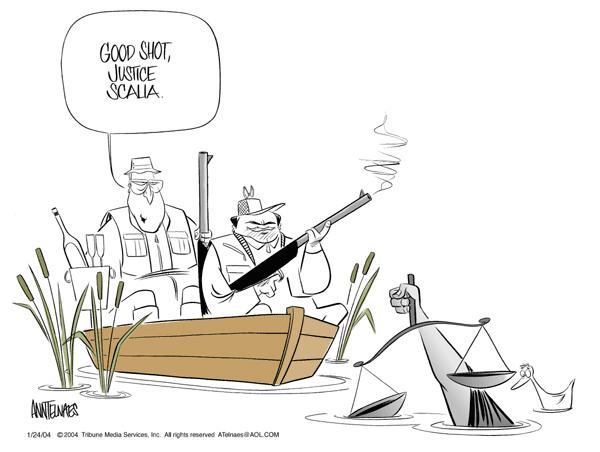
I just love it when people accuse me of being a partisan hypocrite without bothering to check what I have written. As it happens, I wrote a great deal about Scalia’s infamous hunting trip, which I unequivocally condemned as creating the appearance of impropriety. (It was, however, factually less troubling than the Clinton-Lynch meeting, as Scalia and Cheney were never alone during the trip in question.) So for people like Andrea (though not Andrea herself, who won’t be able to get back on this site if she recruits an army of Myrmidons), I will hereby post the two Scalia essays, which currently reside only on the Ethics Scoreboard, now an archive of my ethics commentary prior to 2010.

Unfortunately, the site’s search function stopped working when I had to change platforms recently. If you want to check out the Scoreboard now, just use Google: type “Ethics Scoreboard” and the subject or topic. If there was commentary, you’ll find it.

To give due credit, Andrea did identify real hypocrisy on the Lynch issue. Many of the Democrats exposing themselves as corrupted by partisan bias by now trying to defend Lynch also furiously attacked Scalia’s appearance of impropriety. They—your idols, Andrea— have no integrity. I do.

Here was what I wrote about Scalia’s clear appearance of impropriety in 2004.

Good Judge Hunting: Antonin Scalia and the Cheney Case

Supreme Court Justice Antonin Scalia recently went hunting with Vice President Cheney, even as the Supreme Court prepares to rule on whether the documents pertaining to Cheney’s meetings with energy company officials regarding future US energy policies must be made public. This has led to critics calling for Scalia’s recusal from the case, on the grounds that the social contact renders his objectivity in the matter suspect. Scalia, feisty as always, denies this, and maintains that he is fully capable of ruling objectively.

And I’m sure he is, but that’s beside the point. In the case of judicial independence, it is often appearances that count, and because this is an issue particularly charged with partisan passions, the Supreme Court must avoid any hint that cronyism or personal loyalties are playing a part in the outcome of the legal showdown. Scalia should remove himself from the case.

Justice Scalia has pointed out that personal friendships between the justices and Washington leaders are commonplace, and that mere friendships among professionals should not raise the specter of favoritism or bias. Indeed, had Scalia maintained exactly the same collegial relationship with Cheney, but avoided the hunting trip, there would be no issue. But the outing conjures images of male bonding and frank talk by the campfire (lobbying, perhaps?), and if Justice Scalia were to rule Cheney’s way (and Scalia’s past opinions would suggest that this is likely), the legitimacy of the ruling would be, in the eyes of many, tainted. But there is more.

According to the L.A. Times, Scalia was flown to the hunting reserve on the small jet that serves as Air Force Two. That could be interpreted as a gift to a judge from a pending litigant. The trip has value, and judges are not supposed to accept things of value under circumstances where it calls their objectivity into question. This alone would justify a recusal. And there’s a “strike three.”

The Times reports that the reserve where the duck hunting took place is owned by Wallace Carline, the head of Diamond Services Corp., an oil services firm that is on 41 acres of waterfront property in Amelia, La. The company provides oil dredging, pile driving, salvage work, fabrication, pipe-rolling capability and general oilfield construction. There is no indication that he has a direct stake in the case, but he is an energy executive. So we have a Supreme Court Justice ruling on whether materials should be released regarding the input of the energy industry into national energy policy in meetings held by the Vice-President, after he spends a hunting trip with the Vice-President, who has also provided charter jet transportation, at a hunting reserve where he is the guest of an energy executive.

Come on, Justice Scalia. Continue reading

The Unethical Courtroom Exchange Of The Century!

believe-it-or-not-1024x442

This would have been rejected by “Boston Legal” as too ridiculous.

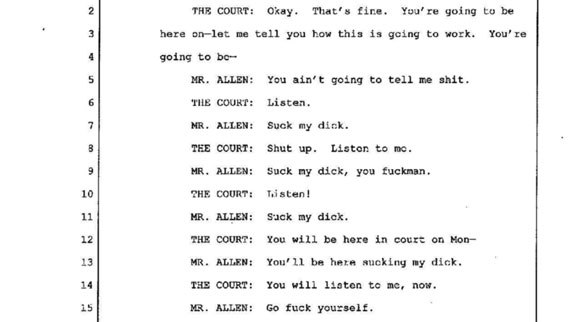
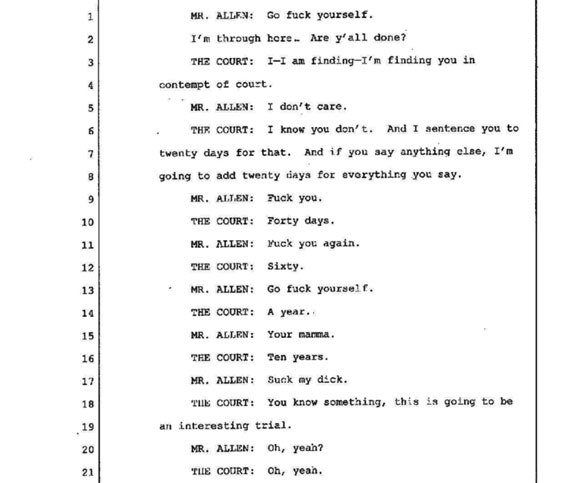
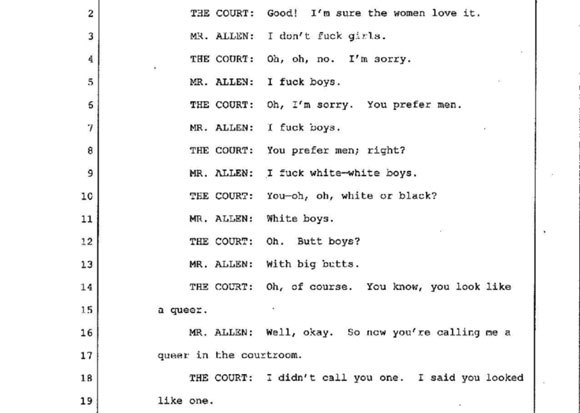
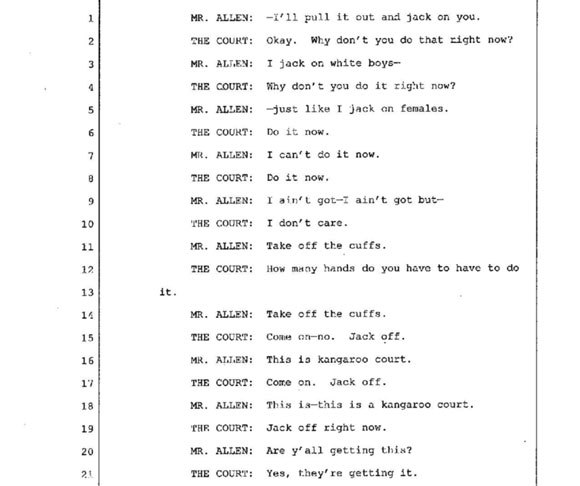
In a Rome, Georgia court room, as others looked on, Floyd County Superior Court Judge Bryant Durham allowed himself to be provoked by a defiant murder suspect named Denver Allen.

What resulted was a rare (thank goodness) example of a judge lowering himself, his position, the court and the justice system to the level of those with no respect for the law or society. Here is a portion of the transcript:


dialogue 1

dialohue 2dialogue 3dialogue 4


Stay classy, Judge Durham. Continue reading

Res Ipsa Loquitur Ethics Quote Of The Day: Law Professor/Blogger/Irony Master Ann Althouse

free-bingo-design

The NYT article tells us that Sotomayor’s remarks were published in the Berkeley La Raza Law Journal and that she also said:

“Whether born from experience or inherent physiological or cultural differences,” she said, for jurists who are women and nonwhite, “our gender and national origins may and will make a difference in our judging.”…

… Judge Sotomayor questioned whether achieving impartiality “is possible in all, or even, in most, cases.” She added, “And I wonder whether by ignoring our differences as women or men of color we do a disservice both to the law and society.” She also approvingly quoted several law professors who said that “to judge is an exercise of power” and that “there is no objective stance but only a series of perspectives. Personal experiences affect the facts that judges choose to see,” she said.

So has Donald Trump refrained from doing a disservice both to the law and society?

—-Ann Althouse, making a slam-dunk point about the hypocrisy of the uproar over Donald Trump’s “racist”suggestion that a Hispanic-American judge might be biased against him.

Althouse and I are right, and almost everyone else is wrong. It’s obvious, and beyond rebuttal on the facts. Althouse has joined me as one who also deplores everything about Donald Trump but who is determined to call out intellectual dishonesty and unfairness in the attacks against him. She also posted this… Continue reading