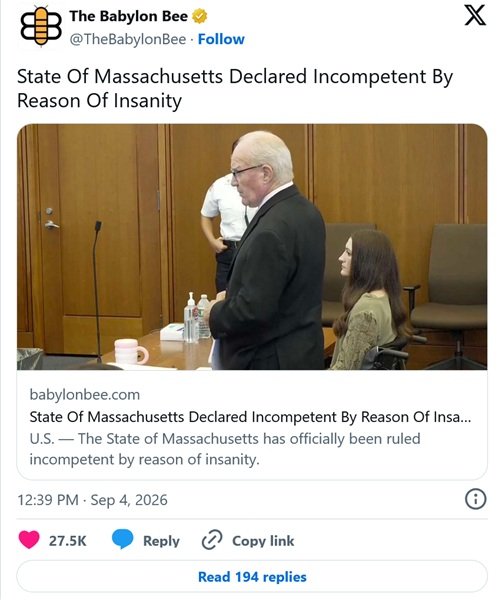
More Ethics Notes On The Lindsay Clancy Case…

Things are not as simple as the Babylon Bee would have us think. Ethics Alarms already posted two essays on this case, here and here. The latter, a Comment of the Day by Tim Levier, concluded by describing the protesters and demonstrators thusly:

The Protestors / Defenders / Supporters – Providing financial and material support to someone with whom they have no prior connection.

These people are deranged and one has to question where they came from and who has time to commit to such folly at a time when everyone and their mother is complaining about the cost of things. Why would anyone protest due process? She’s making her case in a court of law and the fair process will play out resulting in a judgment. This isn’t an area for “opinions” and to influence an outcome. Its meddlesome and the act of a narcissist that believes in one’s own “greatness” or “importance” over that of an impartial judicial institution.

Clancy’s trial, presumably the first of two (at least), ended in a mistrial yesterday due to a hung jury. A single juror, widely believed to be one of the three men on the 12 juror panel, was apparently refusing to budge from his unshakable belief that the woman who has confessed to murdering her three children is guilty of murder. I dunno, that seems like a defensible verdict to me, but I wasn’t in the courtroom during the trial.

But I digress. Here are recent ethics-related developments and observations:
Another Unethical Jury, Another Dead Canary In The Mine of Democracy

In Allegheny County Pennsylvania, the murder trial of Safon Gump ( I swear that’s his real name) ended in a mistrial last week because a juror smoked or vaped marijuana in the jury room during a lunch break and the judge was unable to determine who.

Here I must interject my obligatory “I told you so!” note regarding my long-time insistence that legalizing pot after indoctrinating the public with the false message that it was harmless would prove to be a cultural and societal disaster undermining health, children’s socialization, the family, the economy, the workplace and more. All is unfolding as I foresaw, and it wasn’t all that difficult a prediction to reach either.

The selection of 12 jurors and two alternates had been completed and the jury empaneled as the prosecution called its first two witnesses. The judge adjourned the trial for lunch, but when court staff arrived at the jury room to release the jurors, the smell of marijuana was unmistakable. Smoking and vaping are not allowed in the Allegheny County Courthouse, and worse, all of the jurors had answered the question on their questionnaires about whether they were taking any medications that could impact your ability to sit on the jury had checked “no.”

The judge called each juror into his chambers and asked if he or she had been toking. He even summoned an additional criminal defense attorney to sit in to ensure that the jurors’ Fifth Amendment right against self-incrimination would be protected. That was unnecessary, because it had been agreed that no charges would be filed against the pot-puffing juror: everybody just wanted to ensure the integrity of the trial. The defense attorney, however, sounds like a woke, drug-loving jerk. “You have all of these privacy issues you have to worry about,” he told reporters.“The last thing we want to do is embarrass someone.”

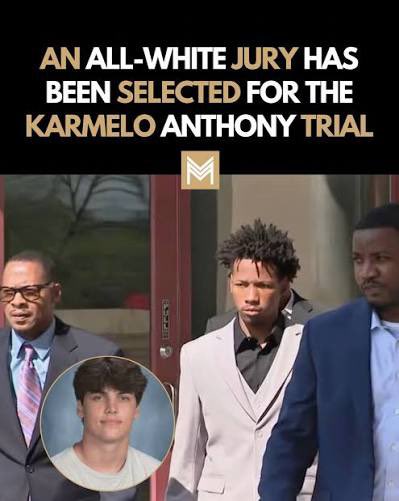
Oh Great: Another Car Has Been Added To The Karmelo Anthony Ethics Train Wreck

Ethics Alarms first mentioned the Karmelo Anthony case a year ago in the context of how completely screwed up woke Minnesota has become. Anthony, a teen who allegedly stabbed an unarmed white student to death at a school track meet, is the beneficiary of a GoFundMe effort that raised a large sum of money. Many conservative pundits wrote that this was a black backlash against a racist white woman who had attracted large donations to support her when a black man posted a video on social media that caught her in the act of calling him a “nigger.” I wrote in part,

“Anthony, who is black, is accused of stabbing 17-year-old Austin Metcalf, who was white, to death during a rain delay at their high school track meet. Anthony has not faced trial yet and claims that he in innocent by reason of self-defense. The online fundraising campaign on his behalf has raised over a half-million dollars. The clear difference between that and [the racist white woman’s] ill-gotten booty: Anthony hasn’t been found guilty of anything yet, and raising money for his defense is not, as some are claiming, the same as rewarding him for murdering a white kid. The accused teen’s family is the object of this fundraising campaign, and it is not inherently endorsing a black kid murdering a white kid to show sympathy for his family with a contribution.”

This ethics train wreck is still running. Anthony’s trial is finally getting started, and, naturally, the usual race-hustlers and victim-mongers are already claiming that the young man is another victim of racism by evil whites. Protesters were out in front of the courthouse chanting “Self-defense is not a crime!” They have no idea whether Karmelo has a legitimate self-defense case, but he’s black, so that’s all they need to know that he’s being framed by the racist justice system.

Comment of the Day: “From Uvalde, The Message Is “Don’t Criminalize Incompetence and Cowardice”

I loved this: not only did long-time commenter Red Pill Ethics return to the fold after almost three years, he did it with brio, registering a Comment of the Day! This gives me hope: I periodically take inventories of which regular commenters have fled the nest, leaving me with only five. All I have to do is take the Ethics Alarms wayback machine, also known as “the archives” and peruse the names under “Comments.” I am always thrilled when I discover that an AWOL commenter has been following the blog all along when something rouses them from their torpor. We have had several instances of this lately.

Here is Red Pill’s Comment of the Day on the post, “From Uvalde, The Message Is “Don’t Criminalize Incompetence and Cowardice”

***

From Uvalde, The Message Is “Don’t Criminalize Incompetence and Cowardice”

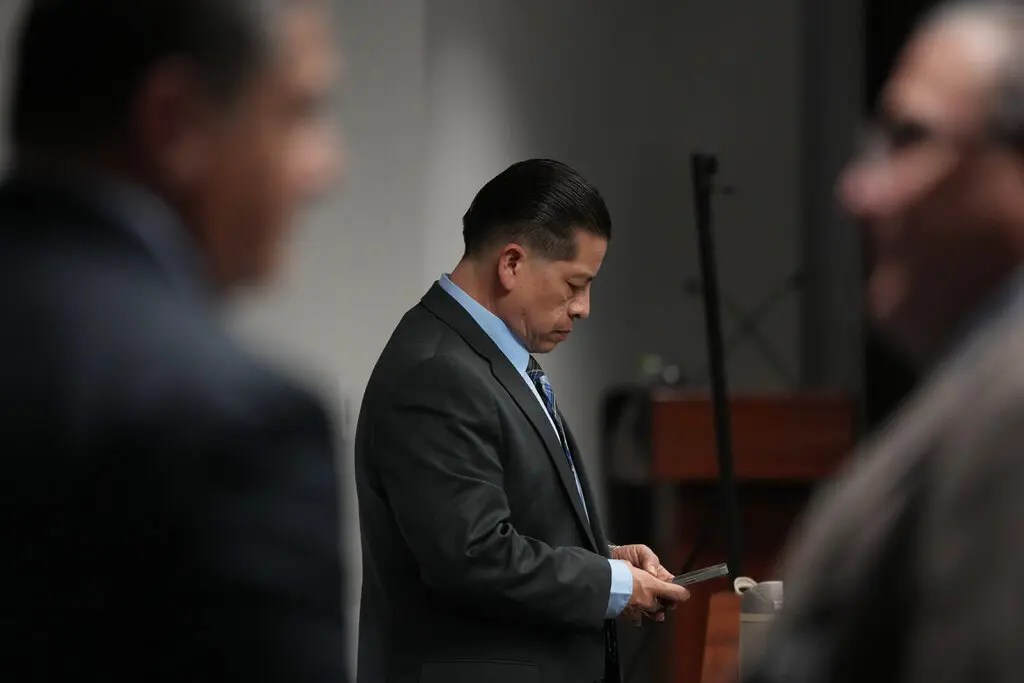
A deranged gunman massacred 21 people at Uvalde’s Robb Elementary three years ago. The murderer is dead and someone must be held accountable, so a former school police officer was tried for abandoning or endangering children. Adrian Gonzales (above, checking his phone like he probably did as the kids were being shot), the first officer to arrive at the school, faced 29 counts of abandoning or endangering children, 19 for the dead and 10 more for survivors. A jury found him not guilty yesterday. Soon the pretty clearly incompetent school former school police chief Pete Arredondo will face trial later on similar charges, and we should expect the same result.

One of Ethics Alarms’ encomiums is that when ethics fail, the law steps in and usually makes a mess of things. If people won’t do the right thing because it’s the right thing, making them do what the state says is the right thing because they’re afraid of being punished is a very poor substitute. Those following the law may not have any concept of what the right thing to do is.

The Uvalde prosecutions arise out of anger and frustration, and reasonably so. Emotions, however, are not reliable motives for law enforcement. The school’s police pretty clearly failed the children of Robb Elementary because Gonzales and Arredondo choked when an unexpected crisis required them to place themselves in harm’s way. As much as we find it disheartening, lack of courage in a crisis cannot be criminalized. These officers thought they had accepted a relatively low-stress job in a quiet community. They hadn’t dealt with a gun-wielding madman before. Sure, we’d like to know that a Dirty Harry is ready to let an active shooter “make his day,” but in the real world—and, I will say without more than my own assessment, increasingly a nation of weenies—that is probably not going to happen. Gonzales had received active shooter training and was also a co-instructor in such a course, but training, however, is one thing, and the a real gun-wielding killer is another.

Continue reading

Ethics Observations on the Trump “Hush Money” Trial

Last week Jonathan Turley issued a thorough indictment of the trial in Manhattan, which he described as “a clear example of the weaponization of the criminal justice system.” The George Washington University law professor has been saying this from the beginning about Alvin Bragg’s partisan prosecution, and it should be self-evident: a criminal case relying on the slimier-than-slime, convicted perjurer and disbarred lawyer Michael Cohen as an essential witness should never be pursued, and it is a violation of prosecutorial ethics to do so.

I was surfing between various news networks’ analyses of the case, and only the usually silly “Fox and Friends” crew stated the most important conclusion that the others carefully avoided. It’s a political prosecution, and the purpose is to get a conviction by any means possible, even one tainted and sure to be overturned, so the Democrats can run against Trump as a “convicted felon.” Justice has nothing to do with it, as Turley’s careful assessment makes clear.

The other purpose is to interfere with the certain Republican candidate’s ability to campaign, because he otherwise has the energy and ability to campaign, while his Democratic opposition does not. Yes, the Democrats are interfering with the 2024 election and attempting to rig it even as in other prosecutions and in campaign attacks, they claim Trump is an existential danger to democracy and that his claims that the 2020 election was “stolen” are “baseless.” The unethical conduct of the Democrats in prosecutions like the “hush money” trial is itself a rebuttal of that statement. If I had to define “hypocrisy,” I couldn’t come up with a better example than that.

The question this week was whether it is fair to try Donald Trump in New York City. That’s easy: no. All of the lawfare cases are calculated to go to trial in communities extremely hostile to Trump: New York, D.C., and Fulton County, Georgia, the solid Blue heart of a mostly conservative state. Given the stakes and the defendant, judges should move all of the cases, just as the trial of Derek Chuavin and the three other cops implicated in George Floyd’s death should have been moved out of the Twin Cities, if the objective had been a fair trial rather than to mollify Black Lives Matters.

Continue reading

Rueful Observations on a Former O.J. Juror’s 2016 Admission

O.J. Simpson’s death this week brought back lots of bad memories—I can’t think of a good one—and a lot of familiar spin and dubious exclamations. One disturbing moment it brought back into the spotlight was the moment above, when in 2016, the ESPN series “O.J.: Made in America” showed Carrie Bess, one of the Simpson jurors, stating that her jury voted to acquit O.J. not because the jury didn’t think he was guilty, but because they sought “payback” for the police beating of Rodney King.

The whole exchange after the interviewer asks, “Do you think there are members of the jury that voted to acquit OJ because of Rodney King?”

Bess: Yes.
Interviewer: You do?
Bess: Yes.
Interviewer: How many of you do you think felt that way?
Bess: Oh, probably 90% of them.
Interviewer: 90 %! Did you feel that way?
Bess: Yes.
Interviewer: That was payback.
Bess: Uh-huh.
Interviewer: Do you think that’s right?

And the ex-juror shrugs.

Nice.

Observations:

Continue reading

From Texas, A “Better Late Than Never” Horror Story

The Texas Monthly story is titled, “The Juror Who Found Herself Guilty.” Its tone is celebratory: a juror who made an unethical decision (though the writer attempts to mitigate it in many ways throughout his article) courageously decided to undo the wrong, and succeeded. Far from being impressed with the alleged ethics hero, Estella Ybarra, I found the story infuriating, and its conclusion that Ybarra should be admired untenable.

The story is in the familiar, long-form format familiar to readers of the New Yorker, Esquire, Vanity Fair and The Atlantic. We are given more details about the lives of all the participants in a drama than we need as well as thick context about every facet of the tale. It can be summarized easily, however, and relatively quickly.

In 1990, when Ybarra was 48 years old, she served on a jury charged with determining the guilt of a Mexican-American man accused of rape. She was the hold-out juror, Henry Fonda in “Twelve Angry Men”; everyone else was certain Carlos Jaile (above) had raped an eight-year-old girl. Ybarra was not: she felt the evidence was thin. There was no physical evidence, the defendant had an alibi, and the main proof of his guilt offered was a child’s eyewitness identification after the fact. But, we are told, Estella was still learning English despite being born in the U.S. (Whose fault is that?) and didn’t understand the justice system very well. (Or that?). As a result, she allowed herself to be bullied into voting ‘guilty’ by the men on the jury, even though she was not at all convinced Carols Jaile was.

She went home after Jaile was convicted and sentenced to life in prison, and wept, we are told. This is supposed to make her seem sympathetic. Later, Estella received a certificate in the mail stating that by serving as a juror and “accepting this difficult and vital responsibility of citizenship in a fair and conscientious manner, you have aided in perpetuating the right of trial by jury, that palladium of civil liberty and the only safe guarantee for the life, liberty and property of the citizen.” Ybarra threw the document into a drawer. She told the writer, Michael Hall, that she thought to herself, “We sent an innocent man away for the rest of his life.”

Continue reading

Unethical Quote Of The Month: The Sussmann Jury Forewoman

“I don’t think it should have been prosecuted. There are bigger things that affect the nation than a possible lie to the FBI.”

—-The forewoman in the just completed Sussman trial, which acquitted Clinton Campaign lawyer Michael Sussman of lying to the FBI when he presented bogus evidence of Trump campaign “collusion” with Russia and said he was doing so as “a private citizen” when in fact he was carrying out the strategy of Hillary Clinton and her campaign.

The  breaking story yesterday, covered at Ethics Alarms here, had less than 24 hours hours of innocence in which the responsible response (and mine) was “we should give the jury the benefit of the doubt; they were in the courtroom for the whole trial, we were not.” Now we know, thanks to this woman, that the jury members were under the influence of progressive-programed  confusion and bias, and were either incapable of fulfilling the duties of a jury, or prompted by the leadership of this proudly unethical fool, chose not to. Continue reading

Joke And Jury Ethics At The Kyle Rittenhouse Trial

chicken_ft-scaled

Weird, man.

In Kenosha, Wissonsin, where Kyle Rittenhouse is standing trial for murder after he shot and killed two protesters during the riots following the shooting of Jacob Blake, an alternate juror was dismissed for making a joke. The juror, a retired white man, said to a court police officer as the officer escorted him to his car, “Why did the Kenosha police shoot Jacob Blake seven times? Because they ran out of bullets!”

HAR! That’s being called a bad joke in the news media: actually, it’s a classic formula joke in the tradition of “Why does a fireman wear red suspenders?,” “Why did the chicken cross the road”? and “How do you know a politician is lying?” (because his/her lips are moving!). Nonetheless, the officer reported the joke to Judge Bruce Schroeder, who called on the juror to explain to him and the lawyers what the joke was and what he meant by it. The juror confirmed that he made a joke but wouldn’t repeat it. That got him kicked off the jury.

Observations:

Continue reading