In Brooklyn, Another Nightmare Prosecution

Prosecutors intentionally robbed Darrell Dula of a year out of his life. What should happen to them?

We continue Unethical Prosecutors Week with this jaw-dropping horror story from Brooklyn, New York.

In June 0f 2011, the accusations of a 22-year-old prostitute led to Damien Crooks and Jamali Brockett being arrested on charges of forcing the woman  into prostitution when she was a 13-year-old girl, and then raping, assaulting and sexually trafficking her for the next 8 years. She also accused  Jawara Brockett and Darrell Dula of raping her. They were also arrested and charged.

The day after she fingered Brockett and Dula, however, the 22-year-old prostitute confessed to detectives that she concocted the accusations against them.  “I once again asked [her] if she was raped,” a detective wrote in a police report after the interview. “She told me ‘no’…”   Then she signed a recantation.

Never mind. Even though they knew a conviction would be impossible after the alleged victim and accuser had recanted her own account, prosecutors continued to pursue the case. Continue reading

Trayvon Martin-George Zimmerman Ethics Train Wreck Update: The Special Prosecutor Buys a Ticket!

Don’t tell me Angela Corey is unethical too! Hey…I told you not to tell me!

Here, almost in its entirety, is noted legal ethicist Monroe Freedman’s post on the The Legal Ethics Forum, regarding Special Prosecutor Angela Corey’s outrageously unethical press conference. I was going to post on this myself, but I could not improve on Prof. Freedman, which should come as no surprise to anyone familiar with his career and contributions to legal ethics theory. His title was “Trayvon Martin, Angela Corey, and Prosecutors’ Ethics.”  When I read it, the only thing I could say was “Bingo!”  From here on, it is all Monroe:

“Special Prosecutor Angela Corey used her press conference to establish three things.

“First, her investigative team… “worked tirelessly” in a “never-ending search for the truth and a quest to always do the right thing for the right reason.”  We are “not only ministers of justice,” we are “seekers of the truth,” and we “stay true to that mission.” Continue reading

The Criminal Justice Ethics Breakdown: Unforgivable, Incomprehensible, and Horrifying

"Yeah, that's bad, but can you believe those gas prices?"

There is no longer any way for the defenders of the criminal justice system, or indeed American democracy and its ideals, to deny that thousands, and perhaps tens of thousands, of Americans languish in prison for crimes they did not commit. This fact is so terrible in its implications for the nation, the system, the public and the legal profession that I feel incapable of grasping it all, still, though this has been slowly dawning on me for a long time. Right now, it is all I can manage to escape denial, for the deprivation of so many innocent people of their liberty is my responsibility, as well as yours, and that of everyone else. Even in the midst of serious policy debates over so much else that is vital to our future, how can anyone argue that this isn’t the highest priority of all?

Yesterday, the Washington Post revealed that

“Justice Department officials have known for years that flawed forensic work might have led to the convictions of potentially innocent people, but prosecutors failed to notify defendants or their attorneys even in many cases they knew were troubled. Officials started reviewing the cases in the 1990s after reports that sloppy work by examiners at the FBI lab was producing unreliable forensic evidence in court trials. Instead of releasing those findings, they made them available only to the prosecutors in the affected cases, according to documents and interviews with dozens of officials. Continue reading

Unethical Quote of the Week, Trayvon Martin Ethics Train Wreck Division: Dr. Boyce Watkins

“Sybrina’s words have opened the door for millions of people to understand when George Zimmerman is let off the hook with either an acquittal or a plea bargain for a lesser charge.”

Syracuse University Professor Boyce Watkins, in a blog post complaining that the comments of Sybrina Fulton, Trayvon Martin’s mother stating that she thought the shooting of her son was “an accident” were devastating to the chances of convicting George Zimmerman of second degree murder.

Unmasked at last!

I must confess, I love this quote and the post that generated it. I love it because a race-baiting scholar who later defenders cannot credibly claim didn’t write what he meant, has confirmed what I have argued in multiple posts, in the course of also validating my assessment that Fulton’s comment was itself unethical, though not for the reasons Dr. Watkins objects to it.

In the rest of his post, Watkins confirms my assessment of Fulton’s irresponsible and despicable willingness to stir up hate toward Zimmerman. Continue reading

Clarifications, Retractions, Excuses and Lies: The Low Art of Pretending You Didn’t Mean What You Said

A figure in the public eye says something that appears sincere but that leads to negative conclusions about the speaker? Well. there are many options:

1. The speaker can stand by his or her words, and take the consequences.

2. The speaker can regret the words, express remorse, apologize, and ask forgiveness.

3. The speaker can accept the criticism and agree that he or she meant what he said, but state that, upon listening to the criticism, state that he or she no longer feels that way, and would not say the same thing today.

4. The speaker can try to say that the original statement wasn’t intended to mean what anyone hearing the words would naturally think they meant, making a plausible claim that the original statement was mis-worded.

5. The speaker can deny that he or she said the words, even, in some cases, though it was on tape.

6. The speaker can say that the words were taken “out of context,” as they sometimes are, as in Shirley Sherrod’s case, when subsequent comments at the same event changed the meaning of the quote, but were edited out.

7. The speaker can say he was joking, as Senator John Kerry tried to do after he suggested that if you don’t study hard and end up ignorant, you’ll be in the military fighting with all the other dummies, or as Professor Charles Ogletree has claimed regarding his statement that a video of President Obama hugging a radical law school professor when he was a student was hidden during the 2008 campaign.

8.The speaker can say that the statement is “no longer operative”, as Newt Gingrich did after a televised interview earlier this year. Continue reading

Trayvon Martin’s Mother Says That The Killing of Her Son Was An Accident. Well, That’s Certainly A Generous and Reasonable Thing For Her To—Wait, WHAT???

Great. Thanks for that statement, Sybrina. Now look what you've done to my head!

You think the Trayvon Martin-George Zimmerman Ethics Train Wreck is almost done? Ha! I would love for you to be right, but the signs are not promising:

  • Yesterday, the special prosecutor ended the suspense and announced that Zimmerman would be charged, putting a sock in the collective mouths of activists who claimed that the case was already closed. That was nice, but it also allowed Al Sharpton to claim that it was the demonstrations, the threats and the public outcry that forced that outcome. This is bad in three ways:

1.) It suggests that the U.S. justice system can be manipulated by mob rule;

2.) It tells the public that any citizen might be arrested, not because law enforcement believes it has a legitimate case, but because his rights have been balanced against other political and popular factors and found to be dispensable; and

3.) He may be right. Angela Corey, who made the decision to charge Zimmerman without a grand jury, strongly denied Sharpton’s point, and we should all hope she was being truthful.

  • But she almost certainly over-charged. Again, with a second degree murder charge, she is saying that there was no self-defense and that Zimmerman shot Trayvon out of spontaneous anger, animus or other cause that does not include any excuse or legally recognized mitigating factor. Here’s hope again: I hope she has sufficient evidence to support this. Otherwise, she has set everyone up for another round of mob fury and even violence, when Zimmerman is released by the judge who must rule on the “Stand Your Ground” law’s application to Zimmerman before trial, or when a jury finds that the evidence doesn’t support the charge beyond a reasonable doubt. Unethical: if Corey took this path  intentionally to take the city and state off the hook, guaranteeing that a judge would take the heat, and everyone could attack the judiciary for following the law, since that is the current fad. Unethical: if she overcharged to give the jury the unenviable job of freeing Zimmerman, since people are used to blaming Florida juries. (See: Anthony, Casey) Requiring less suspicion is the theory, advanced by some defense lawyers, that Corey is over-charging to put leverage on Zimmerman (he will be facing life imprisonment) and squeeze him to agree to a lesser charge, like manslaughter. Prosecutors are not supposed to charge citizens with crimes they know they can’t prove in trial; it is professional misconduct. I know, Jack McCoy used to do it all the time on Law and Order. So do too many prosecutors. It’s still unethical.
  • Zimmerman promptly turned himself in, which means that his blabber-mouth lawyers were even more unethical than I thought they were, suggesting that Zimmerman was on the run and out of state when, obviously, he wasn’t. George is well rid of these two.

If this wasn’t enough to prove that the Trayvon train wreck was still rolling, Sybrina Fulton, the dead teen’s mother, weighed in with this jaw-dropper: Continue reading

Next To Board The Trayvon Martin Ethics Train Wreck? Why, The Lawyers, Of Course!

George Zimmerman attorneys Craig Sonner and Hal Uhrig explaining that their client is innocent, and how they are dropping him like a hot potato because of all the suspicious things he's been doing.

Over at the Legal Ethics Forum, the superb blog on the many and fast-moving ethical issues in the legal field, the usually reserved and impeccably professional blog founder, attorney John Steele, had this message for George Zimmerman’s ex-lawyers:

“[S] hut up, guys. Shut the h*** up. It’s not about you. It’s supposed to be about the client.  And that’s even before we get to the ethics rules on confidentiality.”*

Really, that’s about all that needs to be said.

During Ken Starr’s investigation of the Monica Lewinsky affair, his ethics counsel, former Watergate prosecutor Sam Dash, resigned with a public statement that he believed Starr had crossed ethical lines. Sam was my ethics professor in law school, and a finer man and more ethical lawyer never walked the earth, but on that day his ethics alarms broke down. A lawyer may not harm his or her client during the representation, and that includes leaving it. Why lawyers think that the fact that a case is getting a lot of publicity should alter their ethical obligations is a mystery, but they often do. If you have a dispute with a client, if you’ve decided that a client is dishonest, manipulative or can’t be trusted, or if, as in Zimmerman’s case, he takes actions that make your job more difficult or doesn’t communicate with you enough to do a competent job, fine: Rule 1.16 of the Rules of Professional Conduct says you can quit. The rule also says, however, that “…a lawyer must take all reasonable steps to mitigate the consequences to the client.One of those reasonable steps is not to make your withdrawal a major news story. Continue reading

“Dear Legal Ethicist: I’m a Lawyer, and I Think My Real Estate Client Might Be Jack the Ripper. What Should I Do?”

Here is a perfect example of where legal ethics and ethics diverge.

The Supreme Judicial Court of Maine reprimanded veteran Maine lawyer Eric B. Cote for investigating the background of Rory Holland—leading a “one man crusade” was how the court put it— after Holland  was convicted of a double murder and sentenced to two life sentences. Cote was convinced that Holland was a serial killer, and that there were other victims. Cote set out to find out who they were.

What’s wrong with that, you ask? Well, Cote had represented the convicted murderer in a real estate transaction. The reasons he suspected Holland came from information he learned in the course of the representation, and under the ethics rules of every state, he cannot reveal such information for the benefit of others to the detriment of a current or former client. Continue reading

“The Good Wife” Ethics Addendum: Why Misrepresenting the Legal Profession’s Standards Does Real Harm

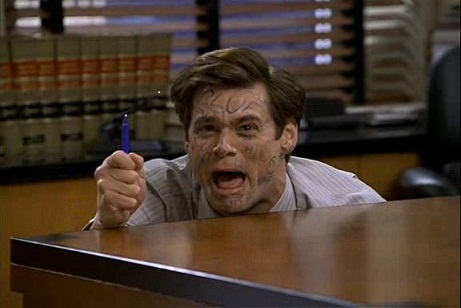
Sure, it was a comedy, but how many people believe that Jim Carrey's compulsively lying lawyer was not that far from the truth?

A comment from reader Penn on my post about “The Good Wife’s” recent misrepresentation of legal ethics standards got me thinking, and what it got me thinking was that I was too easy on the show.

Penn asked why I waste my time watching programs that raise my blood pressure, and there are two answers. The first is what I wrote back: it’s not a bad show; in the past it has been a very good one, even from the legal ethics perspective. I have used several scenarios from episodes in seminars.

The second answer, which I didn’t mention in my response to Penn, is the more important one, however. Good show or not, millions of Americans get their information about the legal profession from the portrayal of lawyers and law on TV and in movies. From these fictional sources, they think they know that most lawyers are liars, that they allow their clients to lie, that they put witnesses on the stand who they know will lie under oath. The public thinks that lawyers abuse the law, don’t earn their fees, don’t give a damn about their clients (unless they are sleeping with them), switch sides routinely and confuse juries to release serial killers on more victims. Continue reading

BREAKING NEWS: Whales Aren’t Slaves! PETA Shocked!

"Thank you! And for my next number, 'Nobody Knows The Trouble I've Seen!'"

PETA’s cretinous and offensive lawsuit equating Sea World’s whales with enslaved human beings—just the latest in the organization’s irresponsible “look at us!” tactics—was laughed out of court, as everybody but a breathless NPR interviewer knew it would be. This was yet another example of a lawsuit that any common sense-imbued layman would accurately call frivolous, but a bar association discipline committee would not. A lawyer can ethically take on a lawsuit he or she knows is stupid, foolish, silly, or a “hail Mary” shot, as long as there is a good faith belief that it might/could possibly/ gee, with a little luck and they don’t think about it too carefully prevail. And looking at some of the rulings that come down from various benches and verdicts that creep out of some jury boxes, that means almost no case is unethically frivolous in a legal sense. That doesn’t mean that it is responsible and right for lawyers to help plaintiffs like PETA bring such wasteful lawsuits, just that it isn’t a breach of professional ethics to do so. Continue reading