 My favorite baseball player retired a few days ago. Tim Wakefield, a knuckleball specialist who had pitched the last 17 years with my home town Boston Red Sox, finally decided to hang up his spikes at the age of 45. There were several remarkable aspects to his long and successful career (he won 200 games, something the vast majority of major league pitchers never do), not the least of which was throwing the knuckleball almost exclusively, an infamous and rare pitch that is almost as difficult to throw as it is to hit or catch. (Former catcher Bob Uecker famously quipped that the best way to catch a knuckleball was to wait until it stopped rolling, and pick it up.) The most remarkable, however, was the way Wakefield always exhibited exemplary character, on the field and off of it. Continue reading
loyalty
Ethics Quote of the Week: Chris Matthews
“Loyalty is the heart of Pat’s being. He is loyal to country, to church, to neighborhood to heritage. To Pat, the world can never be better than the one he grew up in as a young boy. Blessed Sacrament Church and Grade School, Gonzaga High School, Georgetown University. No country will ever be better than the United States of America of the early 1950s. It’s his deep loyalty to preserving that reality and all its cultural and ethnic aspects that has been his primal purpose and is what has gotten him into trouble. Not just now but over the years.”
—MSNBC talking head Chris Matthews, in his wistful on-air tribute to Pat Buchanan, who was fired from his long-time role as the left-wing network’s token hard-right conservative.
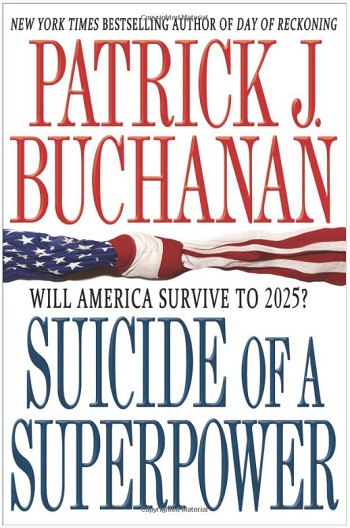
"Pat, I may disagree with what you say, but I will defend to the death your right to say it...on some other network."
Matthews’ quote helps explain why loyalty is the most corrupting of the ethical virtues. Loyalty is important and admirable, but when it is divorced from the other values, it can lead to rigidity, stubbornness, and corruption. When a person, organization or cause no longer embodies the qualities that justified the loyalty in the first place, loyalty can undermine ethical conduct as strongly as any vice.
The right is attempting to frame Buchanan’s dismissal as part of a conspiracy to silence conservative voices. I never understood why Pat was on MSNBC anyway, unless it was to have a particularly Jurassic conservative around to make MSNBC’s extreme liberal bias look reasonable by comparison. It was Buchanan’s latest book, “Suicide of a Superpower: Will America Survive 2025?,” that finally triggered his ouster. I haven’t read it, but I’ve heard Buchanan on this topic sufficiently already. He may not be a racist, xenophobe, homophobe and anti-Semite, but his confusion of the need to hold on to American cultural values, with which I agree, with the need to keep America as white, Christian, heterosexual and Anglo-Saxon as possible is hard to distinguish from racism, homophobia, xenophobia and anti-Semitism. If I were running a news network, I wouldn’t employ him. Continue reading
Albert Pujols: Yes, He’s Disloyal, Greedy, and Confused.
I'm sorry! This was supposed to be a picture of Albert Pujols, not King Midas. Well, six of one, half-dozen of the other...
Cardinal free agent first baseman Albert Pujols, generally regarded as the most talented baseball slugger alive, just jumped from his supposedly beloved St. Louis to the Los Angeles Angels because they offered him several more millions of dollars per year that he couldn’t possible spend if he tried than the Cardinals did. The attitude of most players, fans and sportswriters, not to mention the players’ union (naturally), is “Of course! Who wouldn’t?”
Who wouldn’t? A more ethical, less greedy, more thoughtful human being, that’s who.
The Angels won Pujols with an offer of $254 million dollars for ten years, making him the highest paid player on captivity. The Cardinals. on the other hand, whose fans had cheered him, embraced him and worshipped him, and which had established Pujols as one of the franchise’s icons fit to stand with Stan the Man Musial, Bob Gibson, Dizzy Dean and Lou Brock, had offered a measly $204 million for nine years, or about 23 million a year. The difference between the two offers is minimized, if not eliminated, by the cost of living disparity between the two locales: housing, for example, is about 250% more expensive in LA. Continue reading
“It’s A Wonderful Life” Ethics, Part 3
 Here is the final installment of the Ethics Alarms overview of the ethical issues raised in Frank Capra’s classic. Some of the comments on Parts 1 and 2 have suggested that my analysis is unduly critical. Nothing could be further from the truth. I love the movie, and have already said that I find it ethically inspiring. Noting that characters act unethically in a movie about ethics is no more criticism than pointing out that people in horror movies never just leave when things start getting weird (as I would). I know that their actions drive the plot and are necessary. This is, however, how an ethicist watches a movie with as many ethical choices as “It’s A Wonderful Life.” I can’t help it.
Now back to George, Mary, and Bedford Falls:
11. Uncle Billy screws up as we knew he would
11. Christmas Eve arrives in Bedford Falls, and Uncle Billy manages to forget that he left the week’s deposits in the newspaper he gave to Mr. Potter. Thus more than $8,000 is missing on the same day that the bank examiner is in town. Why is Uncle Billy still working for the Savings and Loan? He’s working there because George, like his father, is putting family loyalty over fiduciary responsibility. Potter, of course, is a thief; by keeping the lost money to trap George, he’s committing a felony, and an unnecessary one. As a board member on the Savings and Loan, Billy’s carelessness and George’s negligence in entrusting him with the bank’s funds would support charges of misfeasance. Mr. Potter, had he played fair, might have triumphed over George legitimately, and no Christmas miracle or guardian angel could have saved him. But this is the inherent weakness and fatal flaw of the habitually unethical: since they don’t shrink from using unethical devices, they often ignore ethical ways to achieve the same objectives that would be more effective.
12. George folds under pressure Continue reading
“It’s A Wonderful Life” Ethics, Part 2 (of 3)
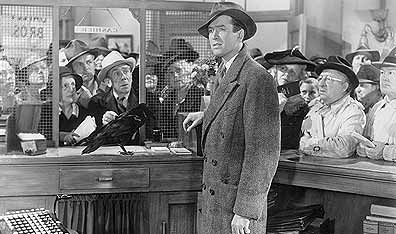 When we last saw George Bailey, he was defending his father’s dubious loan practices. In this, Part 2 of the three installments of “It’s A Wonderful Life” Ethics, we take the saga up the fateful Christmas Eve when George Bailey meets his guardian angel.
6. George’s Fork in the Road
George Bailey’s decision to give up his plans to go to college to save the Savings and Loan is clearly not motivated by his personal dedication to the institution; he doesn’t like the place. He says so over and over again. He admires his father’s motivations for starting it. Had Potter not sparked his resentment with his nasty comments about George’s late father, George would have been out the door. But his passionate speech in rebuttal of Potter’s words put him on the spot: after those sentiments, turning down the Board’s appointment of him to be the new operating manager of the S&L would have made George a hypocrite in his own eyes, and rendered his passion laughable. If George had integrity, then he had to accept the appointment.
It is one of the most interesting ethical moments in the film, because it represents a realistically complex ethical decision. George does what he does for selfish reasons as well as altruistic ones, and irrational reasons as well as considered ones. He wants to respect himself; he fears what might happen to his family and the community if Potter becomes the only financial power in town, and knows he will feel guilty if the consequences are bad. He feels like not staying will be taking Potter’s side over his father’s—completely irrational, since his father had given his blessing to George’s college plans, and wasn’t alive to be harmed by whatever he chose to do anyway. A large proportion of George’s decision seems to be motivated by non-ethical considerations, for he doesn’t like Potter—even hates him, perhaps—and wants to stick it to the old tycoon by foiling his victory. There are few ethical decisions in real life that are made purely on the basis of ethics, and Capra makes George’s decision wonderfully impure. Continue reading
“It’s A Wonderful Life” Ethics, Part I (of 3)
 “It’s A Wonderful Life” made its now traditional holiday season appearance on network television, and naturally, I watched it. The movie is one of the great ethics movies of all time, as well as being one of the great American movies of all time, perhaps director Frank Capra’s masterpiece. One of the markers of a classic film is how one can find new things in it upon every viewing, and that is certainly true of “It’s A Wonderful Life.” I was struck this time around by how many ethics issues are raised in the screenplay, some, no doubt, unintentionally.
1. “If It’s About Ethics, God Must Be Involved”
The movie begins in heaven, represented by twinkling stars. There is no way around this, as divine intervention isat the core of the fantasy; heaven and angels were big in Hollywood in the Forties. Nevertheless, the framing of the tale advances the anti-ethical idea, central to many religions, that good behavior on earth will be rewarded in the hereafter, bolstering the theory that without God and eternal rewards, doing good is pointless.
We are introduced to George Bailey, who, we are told, is in trouble and has prayed for help. He’s going to get it, too, or at least the heavenly authorities will make the effort. They are assigning an Angel 2nd Class, Clarence Oddbody, to the job. He is, we learn later, something of a second rate angel as well as a 2nd Class one, so it is interesting that whether or not George is in fact saved will be entrusted to less than heaven’s best. Some lack of commitment, there—then again, George says he’s “not a praying man.” This will teach him—sub-par service! Continue reading
Comment of the Day: “Ethics Dunces: Penn State Students”
“Different Angle,” a college student and victim of child abuse, has, appropriately enough, a different angle on the Paterno/Penn State/ Sandusky scandal, and it provides useful and provocative perspective. I’ll let him have his say, as it is extraordinarily well argued, and save my comments for the end. I think he is compassionate, generous, thorough, thoughtful, and wrong. But first, here is his Comment of the Day on “Ethics Dunces: Penn State Students.”
“As a current college student, prior victim of child molestation, and generally reasonable person, I feel inclined to give my two cents. Having read the grand jury report personally, I am shaken. Unless you are familiar with the shame and humiliation of a situation like this–even if you are familiar–the sheer quantity of these attacks… beyond words. Had any Penn State staff understood the thoughts running through this man’s mind, this comment would’ve started “As a current toddler…” Anyone who knows that the sexual abuse of children is occurring and acts so callously as to downplay it and sweep it under the rug has no place in modern society. That’s as nicely as I can put that.
“With as much emotion and sympathy as I harbor for the young men who’ve endured through this, it pains me to read the bickering and finger-pointing I’ve encountered in comment threads like this. And while it is normally in my nature to grab my trident for a healthy round of devil’s advocate with the popular and most often intelligent opinion, I cannot help but side with Joe Paterno in this matter. I’m about as far removed from sports as a sociable college male can get; I will not rally for a few chants of WE ARE… at the end of this post. If you’re going to scrutinize the choices he made in reference to the 2002 incident, be thorough enough to consider this: He wasn’t thinking about slandering Sandusky, he wasn’t concerned about his career or standing in the community. The decision of if/when/to whom this should be reported wasn’t calculated with pro’s and con’s. Continue reading
Now THIS Is Disloyalty…
Good ol' whatshisname. We'll never forget him.
…also ingratitude, venality, and crassness.
Baseball’s Kansas City Royals are putting the name of their ball park, now Kauffman Staudium, up for corporate bidding. Soon the stadium that stood as a monument to the late Kansas City community leader Ewing Kauffmann, who owned the Royals in their very first season (1969), built the state-of-the-art home for them that is still a source of civic pride, and turned the team into a model franchise and perennial pennant contender in record time, will be named “Kansas City Masterpiece Stadium” or something else that makes it a giant billboard. Meanwhile, little will be left to remind future baseball fans and Kansas City residents of the life and dedication of the man who was responsible for the city having a major league team at all. Continue reading
Unethical Quote of the Week: Penn State Football Coach Joe Paterno

Did you know that Jerry Sandusky's autobiography was titled, "Touched," Joe?
“The fact that someone we thought we knew might have harmed young people to this extent is deeply troubling. If this is true we were all fooled, along with scores of professionals trained in such things, and we grieve for the victims and their families. They are in our prayers…It was obvious that the witness was distraught over what he saw, but he at no time related to me the very specific actions contained in the grand jury report. Regardless, it was clear that the witness saw something inappropriate involving Mr. Sandusky. As coach Sandusky was retired from our coaching staff at that time, I referred the matter to university administrators…If true, the nature and amount of charges made are very shocking to me and all Penn Staters. While I did what I was supposed to with the one charge brought to my attention, like anyone else involved I can’t help but be deeply saddened these matters are alleged to have occurred.”
—–Penn State Football Coach Joe Paterno, commenting on the indictment on 40 charges of child sexual abuse brought against his long-time former defensive coordinator, Jerry Sandusky. It was Paterno who first brought allegations of Sandusky’s sexual molestation of young boys to the University’s attention, and two Penn State administrators have also been charged with covering up Sandusky’s alleged misconduct.
Paterno’s statement is ethically troubling on many levels, self-serving and disingenuous. Continue reading
Comment of the Day: “Penn State, the Child Molester and the Dark Side of Loyalty”
Newcomer Steven Ardler muses over a provocative question about the virtue loyalty in his Comment of the Day on“Penn State, the Child Molester and the Dark Side of Loyalty”:
“Out of curiosity: would you say that a better definition of Loyalty is needed? It seems to me that the dilemma can be partially resolved by claiming all Loyalty need be to “the good” rather than to a person/institution/nation (I put the term in quotations because I am conflicted as to its actual meaning).
“We choose people and institutions that we believe maximize the good and adhere to their policies and behaviors accordingly. When those people or institutions step away from the good, our “Loyalty” to them is revoked. In this case, nearly by definition, Loyalty will always be a virtue. Of course, a very simple counter to this idea will be the varying interpretations of “good.” Muslim suicide-bombers are, in their ethical consideration, maximizing good in the universe by doing Allah’s will (according to their interpretation of that will). A bishop in the Catholic church may *feel* as if he is maximizing good by not condemning his pederast brethren, as he serves what he thinks is the ultimate good – a god. A coach at Penn State may think that he is loyal to the good, by determining that the university accomplishes enough good to be worth preserving from scandal. All of these are very apparently flawed, but this type of reasoning would abound with a new definition of loyalty, nonetheless. I feel like a re-tuned definition of Loyalty *helps*, but certainly does not resolve the problem. Is there a way to define loyalty in which it is actually a virtue, and not just a description of a series of actions?”
 Ethics Alarms