Morning Ethics Warm-up: 8/16/17

GOOD MORNING!

1. I’m heading to Boston and Fenway Park in a few hours to meet with two of my high school classmates and together pay our respects to the 1967 Boston Red Sox, the spiritual beginning of Red Sox Nation, and a group of men, then barely more than boys, who had as profound an effect on my life and view of it as anything I have ever experienced.

It’s the 50th Anniversary of that amazing team and the heart-stopping pennant race it won against all odds, in a four team race that came down to the final game of the regular season. I mean heart-stopping literally: the team wasn’t called “The Cardiac Kids” for nothing. TWO of my father’s colleagues at the Boston Five Savings Bank died of heart attacks while attending Red Sox games, during one of the 9th inning desperation rallies for which the team was famous. The only reason I didn’t perish in like fashion is because I was just 16 years old.

Why was this team, and that summer 50 years ago, so important to me? I don’t have time or space to answer that question well, and you’d probably wonder what I was babbling on about anyway. A 2017 film by Major League Baseball called “The Impossible Dream” does a fair job of explaining it, but it’s too short to do the job right.

I had listened to, watched or attended every Boston Red Sox game for five years, as the team lost and lost. From those bad teams, followed weakly by the city in those days, in a crumbling old park that seemed destined to be abandoned and torn down, I learned that winning wasn’t everything, that loyalty wasn’t easy, that Hemingway was right, and that baseball was about courage, humility, perseverance, doing your job every day, sacrifice, and hope, as well as usually losing at the end. That summer of 1967 taught me that hope is worth the effort even though hope is usually dashed by the ice water of reality, that you should never give up, that miracles do happen, and that nothing is as wonderful as when a community is united in a single, inspirational goal, no matter what that goal might be…and that you should never be afraid to give everything you have in pursuit of a mission, even when it is likely that you will fail.

I learned difficult, discouraging lessons, too. When an errant pitch hit Red Sox right-fielder Tony Conigliaro in the face on August 18, 1967, it was the beginning of a lesson that revealed its tragic last chapter 23 years later. That one taught me that life is horribly, frightening unpredictable, and that we envy others at our peril. It taught me that we need to do what we can to accomplish as much good as we can as quickly as we can, because we may lose our chance forever at any moment.

Tony C, as he was and is known as, was a beautiful, charismatic, local kid, the idol of Boston’s huge Italian-American community,  in his fourth season with his home town team at the age of 22. He dated movie stars; he recorded pop songs; he had a natural flair of the dramatic, and was destined for the Hall of Fame. One pitch took it all away. Although he had two comebacks and played two full seasons facing major league fastballs with a hole in his retina and his field of vision, Tony was never the same. After his final attempt to keep playing failed at the age of 30, he became a broadcaster, and at 37 was seemingly on the way to stardom again in 1982 when he suffered a massive, inexplicable heart attack—Tony  did not smoke, and had no family history of heart problems– that left him brain damaged until his death in 1990.

As Henry Wiggin, the star pitcher protagonist of the novel, play and movie “Bang the Drum Slowly” observes as he  reflects on the death of his catcher and roommate, everyone is dying, and we have to remember to be good to each other. But it’s so hard. Ethics is hard. The ethics alarms ring faintly when we are about the task of living, or not at all…

At the end of the story, the narrator, the best friend of the catcher (but not really that close a friend) recalls how quickly everyone on the baseball team went back to their selfish ways after their teammate went home to die Even the narrator, who was the leader of the effort to make the catcher feel loved and appreciated in his last days, ruefully recalls his own failing. The catcher had asked him a favor, just to send him a World Series program (the team won the pennant after he had become too ill to play), and he had forgotten to mail it until it was too late. How hard would it have been, the narrator rebukes himself, to just put it in an envelope and mail it? Why are we like that, he wonders?

1967 was the beginning of my exploration of that mystery too.

So I am going to Boston for the 30 minute ceremony. I can’t even stay for the game; I have a seminar to teach tomorrow morning, and the last flight out of Logan is at 9 PM. There will probably be just a small contingent from the Cardiac Kids: most of them are dead now, or too infirm even to walk onto the field. But Yaz will be there, and Gentleman Jim Lonborg; Rico Petrocelli, Mike Andrews, and maybe even Hawk Harrelson  and Reggie Smith. I will be there to say thank-you, that’s all.

And to show that I remember. Continue reading

Welcome To Incompetent Leadership And Toxic Management: President Trump’s Jeff Sessions Attack

I detest bad leadership. I’ve studied leaders since I was 11, and studied management since I was 19. Incompetent leadership and inept management cripples business, the arts, sports, education, government, civilization, the world. I seldom see as horrible an example of both as in the case of President Trump’s verbal tirades against his own Attorney General,Jeff Sessions, first to Republican Senators at a White House dinner on this week,  and later in an interview with the New York Times. Sessions responded to his boss’s disgraceful behavior by saying that he intended to serve “as long as that is appropriate.”

The only reason it would be appropriate for anyone to work for a leader, executive, manager or supervisor who treats subordinates this was is patriotism. The nation has to be managed; the government has to function. Other than that, no one with honor, self-respect or a sense of responsibility should voluntarily subject themselves to the kind of abuse this President offers.  Reportedly the President insists on loyalty, but loyalty has to be minimally reciprocal. Criticizing a subordinate in public, as with the press, or in private, behind that subordinate’s back, is the equivalent of sin for any leader. It is cowardly. It’s unfair and disrespectful.  It is irresponsible, incompetent and stupid, stupid stupid. Continue reading

Reluctant Additional Ethics Notes On A Manufactured “Crisis”: The Comey Firing Freakout

1. When this ridiculous episode is recounted in history books, if it is, it will only be as an example of how the news media worked in tandem with Democrats to undermine the President of the United States, and deeply wounded American democracy and the public trust as a result. I suppose if it is recounted, it will either be as one of the many factors that led Americans to express disgust for both the news media and the Democratic party, forcing the first to shape up and the latter to re-invent itself, or, under the worst case scenario, to explain how the United States lost its Constitutional government.

2. A President of the United States fired an FBI director who deserved to be fired, and everything else is political warfare and public disinformation. A President firing someone he had the power to fire and that most Americans rightly believed should be fired cannot be a scandal, a crisis, or anything else worthy of the hysterical coverage this story has received. The coverage of the story is the antithesis of the journalism ethics tenet that journalists cover stories but do not create them.

3. President (and candidate) Trump is certainly at fault for handing his enemies sticks to beat him with. I put this is exactly the same category with a voluptuous woman walking into a bar full of drunken, rowdy men and doing a provocative dance to the jukebox as they hoot and drool. She should be safe, but she isn’t, and she should know that she isn’t. The drunken dogs should be trustworthy not to sexually assault her, but they aren’t,   When she ends up like Jodie Foster in “The Accused,” it is her sexual assailants who are guilty, but it is not blaming the victim to ask, “What the hell were you thinking?”

4. Of course, as has been proven at nauseating length here and elsewhere, President Trump does not think, at least in the professional sense of the word. It was stupid to throw out compliments to Vladimir Putin. It was stupid to make defensive-sounding comments about the Russian hacks because he didn’t want to admit that any factors led to his election other than his essential brilliance. One  indication that there are no sinister connections between Trump and Russia is that if there were, it would be mind-numbingly moronic for Trump to do anything but show hostility to the country and its leaders. It is only slightly less moronic for him to say these things when he has nothing to hide regarding “Russian ties.”

[An aside: a recent commenter on another thread repeated the oft-cited nonsense that Trump must be smart (like he says) because he has an IQ of 160. If Donald Trump scored 160 on an IQ test, then IQ tests should be thrown out and never used again. However, that claim is imaginary. (IQ tests don’t prove you are “smart,” either, but that’s a different issue.) A researcher once estimated Trump’s IQ based on his admission to Wharton and the gross average IQ of Wharton grads, which is itself a phony number. Then this  (incompetently) estimated figure was used by other hacks in some of those “Who was the smartest President?” articles, which estimate the IQs of the Presidents using the same kind of bad reasoning as the process that arrived at the figure for Trump (it was 156, not 160). In truth, nobody knows what Trump’s IQ is. Everybody knows, however, or should, that he does and says an astounding number of dumb things, many of which mostly have the effect of harming him, or his ability to do his job.] Continue reading

Baseball’s Childish Ethics: An Embarrassing Case Study

http://www.youtube.com/watch?v=oXIVg8ovjA4

It is often said that baseball is a child’s game, but that doesn’t excuse professional baseball players holding on to childish traditions regarding the “right way to play the game” that are not right, frequently dangerous, and mind-numbingly stupid to boot.

Last week, beginning a weekend series in Baltimore, the Boston Red Sox were enmeshed in a close game., losing 2-0, with time running out. With the Orioles batting and Manny Machado (Non-baseball fans: he is the very young, very large, very talented O’s third-baseman, a joy to watch and already a super-star) on first, Sox shortstop Xander Bogaerts fielded a slowly bouncing ground ball and flipped a weak throw to Dustin Pedroia (Non-baseball fans: he is the small, cocky, excellent Sox second baseman, the best fielder at his position in 2016, a former MVP, and the acknowledged leader of the team now that David Ortiz has retired). Pedroia caught the ball in a first baseman’s stretch, awkwardly, just in time to force out Machado: a double play was out of the question. Machado, however, came into the base hard, sliding late, and barreling right over the bag with his spikes raised. (It looks on the tape as if one foot was elevated  when it hit the base.) Machado’s momentum took him into Pedroia, knocking him down and spiking him, as well as injuring his knee and ankle. Machado appeared to try to catch the Sox player after he passed over the base.

There was no question that Machado was out, but the Red Sox manager argued that the slide was illegal: since last year, runners are not allowed to try to break up double plays by intentionally sliding at opposing fielders. Late slides, slides not intended to allow the runner to get to second base, and sliding past teh base to upend the second baseman or shortstop will be called as obstruction, and the batter is then called out to complete the double play. The umpires disagreed with Farrell, and that is still being debated; it’s not relevant here. Pedroia, meanwhile, was led off the field, obviously injured.

After the game, Red Sox TV analysts and former players Jim Rice (Sox Hall of Fame Sox slugger) and Steve Lyons (an opinionated jackass) chuckled about what was coming. Ancient baseball tradition required, they explained, that the Red Sox “protect their player” who was injured by a careless, inept, or intentionally illegal slide. This meant, they explained, that a Red Sox pitcher in the next game was obligated to hit Machado with a pitch in retaliation. “He knows it!” said Rice. “He’ll be expecting it.” Lyons nodded and laughed. (Full disclosure: I hated Steve Lyons as a player, and I loathe him as an analyst.)

This is indeed an “unwritten law” of baseball, and one of the most unethical. I have seen it countless times, and the result is often fights and injuries, as well as suspensions for the pitcher’s involved and outright beanball wars. The theory is that you can’t let a team “intimidate” you, so a message must be sent. The message is “tit for tat” or “Mob Ethics”: you hurt one of ours, we hurt one of yours. Sometimes the situation requires a pitch directed at other team’s star player, when that team’s scrub injures the pitcher’s team’s star. In this case, the target was an easy call, for Machado was both the miscreant and is also the Orioles best player. Continue reading

Unethical Quote Of The Month: President Trump

“I think he shouldn’t have settled; personally I think he shouldn’t have settled. Because you should have taken it all the way. I don’t think Bill did anything wrong. I think he’s a person I know well — he is a good person.”

President Trump to the New York Times , speaking of the sexual harassment allegations intensifying around star Fox News Bloviator Bill O’Reilly.

Now President Trump is acting like President Obama. The President of the United States abuses his power and position by ever commenting upon or registering an opinion about matters that do not involve the national welfare or his direct responsibilities. These include local law enforcement episodes (Trayvon Martin, the arrest of an African-American professor in Cambridge by a white cop), employment matters, private lawsuits, pending criminal trials, TV shows (Saturday Night Live), media coverage (don’t get me started), legal business decisions and sports controversies (Colin Kaepernick). Obama never learned this (among other leadership basics, a problem fagged as “flat learning curve” on Ethics Alarms), and, not surprisingly, Trump is going to be even worse. Continue reading

Ethics Quote Of The Day: Charlotte Hogg, Ex-Bank of England COO

“However, I recognise that being sorry is not enough. We, as public servants, should not merely meet but exceed the standards we expect of others. Failure to do so risks undermining the public’s trust in us, something we cannot let happen. Furthermore, my integrity has, I believe, never been questioned throughout my career. I cannot allow that to change now. I am therefore resigning from my position. I will, of course, work with you through any transition.”

—-The Bank of England’s chief operating officer and incoming Deputy Governor for Markets and Banking, Charlotte Hogg, in her letter of resignation over criticism regarding a possible conflict of interest and her failure to report it.

Charlotte Hogg, a senior Bank of England official who had been named a deputy governor, resigned this week after a Parliament committee found that she had failed to disclose a potential conflict of interest: her brother held a senior position at Barclay’s during her time at the central bank. Hogg insisted that she never breached her duties or passed along any confidential information to her brother, but she had helped draft an industry ethics code of conduct policy required a disclosure of such conflicts. This creates doubts about her integrity, judgment competence, as well as the appearance of impropriety.

The Parliamentary committee recently issued a report finding that Ms. Hogg’s professional competence “short of the very high standards” required to be deputy governor, adding that her failure to disclose her brother’s role was a “serious error of judgment.”

This is one of my favorite kinds of conflicts, because it may be only appearances at stake. What if, as is often the case (sadly), Hogg and her brother are estranged? What if she doesn’t speak to him? What if they hate each other? Never mind: the public, not knowing this,  will suspect that she might use her position to favor him or his bank, so disclosure is crucial to maintaining public trust. Not disclosing, in contrast, raises suspicions. Why didn’t she let everyone know about her brother? What was she hiding? Continue reading

Unethical Protest, Unethical Protesters, Just Desserts

protest-immigrant

Last week’s “A Day Without Immigrants” protest could be the example in the dictionary to illustrate “unethical protest,” or perhaps “stupid protest.”  The stunt of immigrants not coming to work to protest policies aimed at illegal immigrants and terrorists was a non sequitur, proving nothing, saying nothing. Nobody wants to stop immigration, nobody has an objection to legal immigrants, and the danger of the U.S. not having sufficient legal immigrants is precisely none. According to the Ethics Alarms Protest Check List, “A Day Without Immigrants”  was an epic, embarrassing, dud. If my immigrant employees used this jaw-droppingly dumb protest  to justify not coming to work, I would do exactly what Bradley Coatings, Incorporated  in Nolensville, Tennessee did.

I’d fire them all. Continue reading

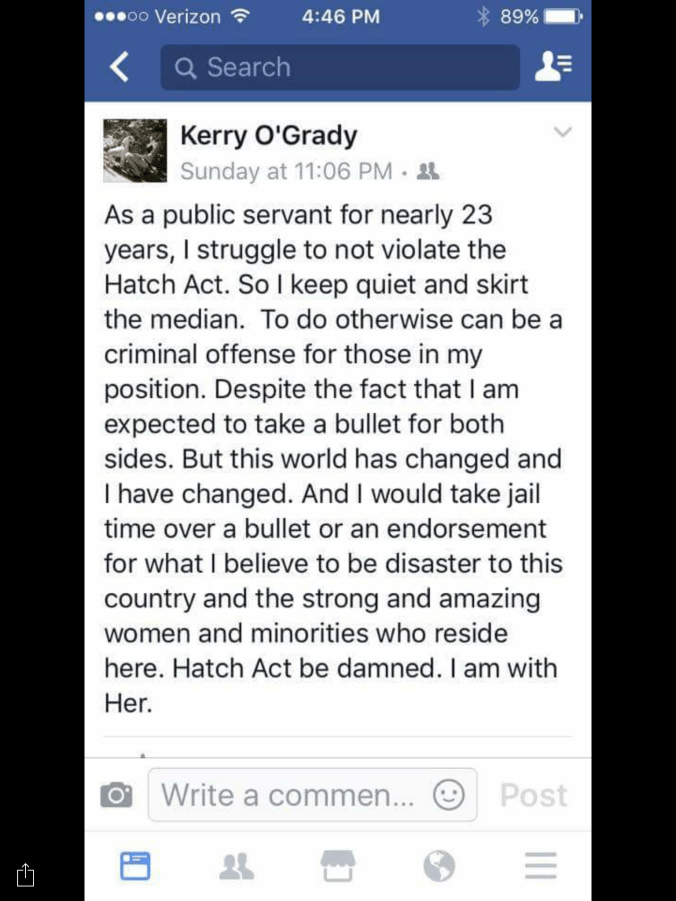
Ethics Dunce: Secret Service Agent Kerry O’Grady

Here is a Facebook post by O’Grady, the special agent in charge of the Secret Service’s Denver district, who oversees coordination with Washington-based advance teams for all Presidential trips to the area:

facebook-secret-service


This was in October, and was seen by her Facebook followers including current and former Secret Service agents. In addition to being a declaration of disloyalty, the social media post is  a Hatch Act violation, which among other things prohibits a federal employee from “posting a comment to a blog or a social media site that advocates for or against a partisan political party, candidate for partisan political office,or partisan political group,” and also from using  social media to “distribute, send or forward content that advocates for or against a partisan political party, candidate for partisan political office, or partisan political group.”

Never mind that, though. Continue reading

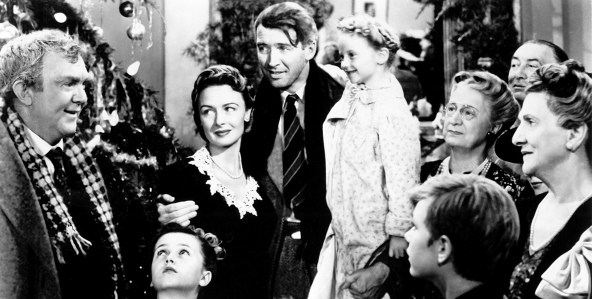
The Complete “It’s A Wonderful Life” Ethics Guide [UPDATED AGAIN! ]

 Once again, Ethics Alarms re-posts its ethics guide to Frank Capra’s 1946 masterpiece “It’s A Wonderful Life,”one of the great ethics movies of all time. It was written in 2011, and revised regularly since, including for this year’s version. I suspect we need it more in 2016 than usual.

It is fashionable now, and was even when the film was released, to mock its sentiment and optimism. On one crucial point Capra was correct, however, and it is worth watching the film regularly to recall it. Everyone’s life does touch many others, and everyone has played a part in the chaotic ordering of random occurrences for good. Think about the children who have been born because you somehow were involved in the chain of events that linked their parents. And if you can’t think of something in your life that has a positive impact on someone–although there has to have been one, and probably many—then do something now. It doesn’t take much; sometimes a smile and a kind word is enough. Remembering the lessons of “It’s a Wonderful Life” really can make life more wonderful, and not just for you.

Here we go:

1. “If It’s About Ethics, God Must Be Involved”

The movie begins in heaven, represented by twinkling stars. There is no way around this, as divine intervention is at the core of the fantasy. Heaven and angels were big in Hollywood in the Forties. Nevertheless, the framing of the tale advances the anti-ethical idea, central to many religions, that good behavior on earth will be rewarded in the hereafter, bolstering the theory that without God and eternal rewards, doing good is pointless.

We are introduced to George Bailey, who, we are told, is in trouble and has prayed for help. He’s going to get it, too, or at least the heavenly authorities will make the effort. They are assigning an Angel 2nd Class, Clarence Oddbody, to the job. He is, we learn later, something of a second rate angel as well as a 2nd Class one, so it is interesting that whether or not George is in fact saved will be entrusted to less than Heaven’s best. Some lack of commitment, there—then again, George says he’s “not a praying man.” This will teach him—sub-par service!

2. Extra Credit for Moral Luck

George’s first ethical act is saving his brother, Harry, from drowning, an early exhibition of courage, caring and sacrifice. The sacrifice part is that the childhood episode costs George the hearing in one ear. He doesn’t really deserve extra credit for this, as it was not a conscious trade of his hearing for Harry’s young life, but he gets it anyway, just as soldiers who are wounded in battle receive more admiration and accolades than those who are not. Yet this is only moral luck. A wounded hero is no more heroic than a unwounded one, and may be less competent as well as less lucky.

3.  The Confusing Drug Store Incident

George Bailey’s next ethical act is when he saves the life of another child by not delivering a bottle of pills that had been inadvertently poisoned by his boss, the druggist, Mr. Gower. This is nothing to get too excited over, really—if George had knowingly delivered poisoned pills, he would have been more guilty than the druggist, who was only careless. What do we call someone who intentionally delivers poison that he knows will be mistaken for medication? A murderer, that’s what.  We’re supposed to admire George for not committing murder.

Mr. Gower, at worst, would be guilty of negligent homicide. George saves him from that fate when he saves the child, but if he really wanted to show exemplary ethics, he should have reported the incident to authorities. Mr. Gower is not a trustworthy pharmacist—he was also the beneficiary of moral luck. He poisoned a child’s pills through inattentiveness. If his customers knew that, would they keep getting their drugs from him? Should they? A professional whose errors are potentially deadly must not dare the fates by working when his or her faculties are impaired by illness, sleeplessness or, in Gower’s case, grief and alcohol.

4. The Uncle Billy Problem

As George grows up, we see that he is loyal and respectful to his father. That’s admirable. What is not admirable is that George’s father, who has fiduciary duties as the head of a Building and Loan, has placed his brother Billy in a position of responsibility. As we soon learn, Billy is a souse, a fool and an incompetent. This is a breach of fiscal and business ethics by the elder Bailey, and one that George engages in as well, to his eventual sorrow. Continue reading

From The Ethics Alarms Mail Bag: A Reader Asks, “Is The Verizon Wireless “Can You Hear Me Now?” Guy Unethical For Going Over To Sprint?

Question: Is the former Verizon Wireless spokes-character  whose tag line was “Can you hear me now?” unethical to star in commercials for Verizon competitor Sprint?

Answer: No, because that character, “the Test Man,” wasn’t real.

The real actor who played him, Paul Marcarelli, was playing a character and reading a script. He was acting the role of someone who told the audience how good the Verizon Wireless network was. He didn’t have to believe what he said was true. His loyalty extended no farther than his contractual obligations. The actor wasn’t ethically obligated to use Verizon Wireless, like it, understand it or believe in it, any more than Dos Equis’s “most interesting man in the world” has to really be interesting. Once the first ad series was dropped, he was a free agent.

Verizon could have included some kind of non-compete provision in the contract, forbidding Marcarelli from doing ads for a competitor, at least for a while.  It definitely could have prevented him from playing the same character as he played in the Verizon commercials, because that character is owned by Verizon. However,  Marcarelli uses his real name, Paul, in those Sprint ads, so he can argue that he’s not playing the Verizon character, but himself, and he owns the rights to “Paul Marcarelli.”

However, I do think the Sprint ads are unethical, and so obviously dishonest that they reflect poorly on Sprint. Continue reading