
The Absurdly Warped Priorities of the Incompetent Boy Scouts of America

“Follow me into those bushes, boys! You won’t need your pants.”

The Boy Scouts of America, who recently re-affirmed its policy of refusing to accept homosexuals into its ranks because to do so would supposedly undermine the organization’s moral values, have been unconscionably lax in protecting its young participants from child molesters in its ranks.

From the Los Angeles Times:

“A Los Angeles Times review of more than 1,200 files dating from 1970 to 1991 found more than 125 cases across the country in which men allegedly continued to molest Scouts after the organization was first presented with detailed allegations of abusive behavior. Predators slipped back into the program by falsifying personal information or skirting the registration process. Others were able to jump from troop to troop around the country thanks to clerical errors, computer glitches or the Scouts’ failure to check the blacklist.In some cases, officials failed to document reports of abuse in the first place, letting offenders stay in the organization until new allegations surfaced. In others, officials documented abuse but merely suspended the accused leader or allowed him to continue working with boys while on “probation.” In at least 50 cases, the Boy Scouts expelled suspected abusers, only to discover later that they had reentered the program and were accused of molesting again.” Continue reading

Rushed Ethics

Feeling pressured?

The Economist points its readers’ attentions to two studies showing the ethical benefits of delay to decision-makers. It is an important topic, with profound ethical implications. Deadlines and the perception of urgency are both what I call pre-unethical conditions, situations that so frequently lead to unethical conduct that our ethics alarms should start ringing the second we start feeling the dread of time-pressure. The Economist article notes that…

“…[ in ] an obscure article in the Academy of Management Journal by Brian Gunia of Johns Hopkins University… Mr Gunia and his three co-authors demonstrated, in a series of experiments, that slowing down makes us more ethical. When confronted with a clear choice between right and wrong, people are five times more likely to do the right thing if they have time to think about it than if they are forced to make a snap decision. Organisations with a “fast pulse” (such as banks) are more likely to suffer from ethical problems than those that move more slowly….The authors suggest that companies should make greater use of “cooling-off periods” or introduce several levels of approval for important decisions.” Continue reading

Unethical Quote of the Week: Rep. Ron Paul

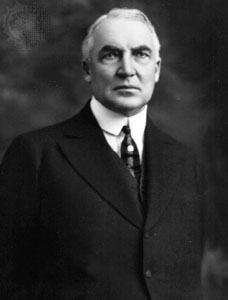
Warren G. Harding, the patron saint of "Nobody's perfect!" presidencies.

“I don’t think anybody in the world has been perfect on management, everybody that’s ever worked for them. So, yes…  it’s a flaw. But I think it’s a human flaw… I admit that I’m an imperfect person and didn’t monitor that as well.”

–GOP presidential candidate Ron Paul, responding to ABC’s Jake Tapper’s question about whether his accountability for racially inflammatory statements made in his name in newsletters published by him 20 years ago raise legitimate doubts about his management abilities.

Anyone who’s read this blog much knows what I think of the “nobody’s perfect” excuse for misconduct. To be precise in this case:

1. Nobody said you weren’t human, Ron. Humanity is a rather low bar for a presidential candidate, don’t you think?

2. There is a lot of territory between “perfect” and “letting people write racist and homophobic content under your name in a for-profit newsletter.” For example, the rest of the Republican field is as far from perfect as one could imagine, yet none of them have done that.

3. People who fail to fulfill core management functions when they oversee a project are imperfect, flawed and human, and also called “inattentive and incompetent leaders.” Imperfect, flawed and human individuals can be good and effective Presidents of the United States. Inattentive and incompetent leaders, however, cannot.

Paterno, Hoover, and Jones’s First Law

Would Uncle Walt have resisted the curse of Jones's First Law?

Jones’ First Law, one of many useful corollaries to Murphy’s Law (“Anything that can go wrong, will.”) is usually stated:

“Anyone who makes a significant contribution to any field of endeavor, and stays in that field long enough, becomes an obstruction to its progress – in direct proportion to the importance of his original contribution.”

This week was a good one for Jones (whoever he was; I can’t seem to find out) if not for the rest of us, because two classic examples of his principle were on display:  Penn State coach Joe Paterno, who managed to stay coach long enough to unravel his legacy and help lay the groundwork for an ethical, moral, legal, public relations, and financial catastrophe for the institution he had dedicated his life to, and J. Edgar Hoover, the subject of a newly-released Clint Eastwood directed film that shows how he too stayed long enough as the key figure of an institution he built—the FBI—to become an embarrassment to it. Continue reading

Comment of the Day:”Catawba Valley Community College vs. FIRE, Free Speech and Fairness”

"Being courageous, challenging authority and exercising your right to free speech is no way to go through life, son."

Michael supplies an answer to my question, “What is going on with colleges and universities?” to begin the recent post about yet another example of a college trying to strangle inconvenient free expression on campus. Here is his Comment of the Day on Catawba Valley Community College vs. FIRE, Free Speech and Fairness:

“Colleges used to be run by faculty. Senior faculty members would be promoted to department heads, then deans, then provosts, and finally presidents. Their whole career, they would teach and be in contact with students. The faculty used to have a strong voice, including the ability to remove a sitting president if they felt it was necessary. Continue reading

Why Doesn’t This Government Ethics Alarm Go Off…Or Does It Even Exist?

"Let's see...cheese on a Ritz, or Beef Wellington...Hell, let's spring for the Wellington--everyone OK with that?"

I just don’t understand it. I never have.

In a report released today, the Justice Department’s inspector general revealed that U.S. Justice Department agencies spent absurd amounts for lavish food at conferences, in one case serving $16 muffins, in another dishing out beef Wellington appetizers that cost $7.32 per serving, and in yet another, a March 2009 conference of the Office on Violence Against Women, serving Cracker Jacks, popcorn and candy bars at a single break to the tune of $32 per person. Yum!

The abuse isn’t unique to the Obama Administration, but it has gotten worse. The inspector general reviewed a sample of ten Justice Department conferences held between October 2007 and September 2009 at a cost of $4.4 million, a period that included the administrations of Republican George W. Bush and Democrat Barack Obama. The Justice Department spent $73.3 million on conferences in fiscal 2009, compared with $47.8 million a year earlier, according to the report. Continue reading

Do Nicer People Earn Less Money? Of Course They Do. And That’s the Way it Should be.

Leo Durocher figured out that "nice guys finish last" 60 years ago, and he never went to college. Now three academics, after extensive research, have "discovered" the same thing. Ah, scholarship!

A study by Cornell professor Beth A. Livingston,  Timothy A. Judge of the University of Notre Dame and Charlice Hurst of the University of Western Ontario study used survey data to examine “agreeableness” and found that disagreeable men made 18%, or $9,772 annually, more in salary than those who are more accommodating. The salary disparity was  less among women, with disagreeable females making 5% or $1,828, more than those who are easier to get along with. Does this shock you? It shouldn’t.

As is depressingly often the case, the academics who come up with such crack-brain studies—I read this one, and will want that wasted hour back when I’m on my death-bed so I can watch one last re-run of “Magnum, P.I.”—have so little experience with the working world and the reality of non-academic cultures that they don’t even comprehend their own research and draw absurd conclusions from it.

“The problem is, many managers often don’t realize they reward disagreeableness,” Livingston told the Wall Street Journal. “You can say this is what you value as a company, but your compensation system may not really reflect that, especially if you leave compensation decisions to individual managers.”

Oh brother. Continue reading

Group Bigotry: Is This The Way It’s Going To Be? AGAIN?

I'm a fan of women's curves, but I expected their learning curve to be better than this.

I already covered this topic when Christiane Amanpour held an unrestrained “males are inferior managers because all the blood rushes to their penises” session on ABC’s “This Week” a few Sundays ago, but since it is becoming clear that the outbreak of gender bigotry in the media is more widespread than ABC, a second alarm is warranted.

This week’s Time magazine has a column by Meredith Melnick entitled “Why Women Are Better at Everything.” Among its contents:

•    “Recently in the Wall Street Journal, MarketWatch columnist David Weidner noted that women ‘do almost everything better’ than men — from politics to corporate management to investing.”

•    “What’s the problem with men? ‘There’s been a lot of academic research suggesting that men think they know what they’re doing, even when they really don’t know what they’re doing,’ John Ameriks, the author of the Vanguard study, told the New York Times.”

•    “Women, who have only 10% of the testosterone that men have, seem inured to the phenomenon, according to Coates.”

•    “So, basically, the more women around, the better, as the Journal’s Wiedner said. His column referred to a recent book by Dan Abrams called Man Down: Proof Beyond a Reasonable Doubt That Women Are Better Cops, Drivers, Gamblers, Spies, World Leaders, Beer Tasters, Hedge Fund Managers, and Just About Everything Else.”

•    “…women are better soldiers because they complain about pain less. They’re less likely to be hit by lightning because they’re not stupid enough to stand outside in a storm. They remember words and faces better. They’re better spies because they’re better at getting people to talk candidly.”

•    “Of course, to most women none of this is much of a revelation.” Continue reading

Girl Talk and Bigotry Ethics: Celebrating One-Way Gender Bias on ABC

Christiane Amanpour just led a jaw-dropping roundtable discussion on her ABC Sunday morning talk show, “This Week with Christiane Amanpour,”as three female guest commentators ( Torie Clarke, the former assistant secretary of defense for public affairs in the Bush administration: Cecilia Attias, the former first lady of France and founder of Cecilia Attias Foundation for Women, and ABC’s Claire Shipman)
and Christiane discussed how the convergence of  Former IMF director Dominique Strauss-Kahn’s attempted rape charges and Rep. Anthony Weiner’s travails has created a possible tipping point, in which the nation will finally come to the realization of a fact that these women have known all along: women are just plain better than men when it comes to leadership, management, decision-making, and conflict resolution.

The sweeping generalities, stereotyping, and flat pronouncements of male inferiority were unrestrained. Continue reading

What Competent Leaders Do: A Checklist

While we are on the topic of leadership (in the wake of Harold Camping’s failure to act like a responsibility one), here are  highlights from “Inside CRM’s list of 101 Common Sense Rules for Leaders. 

The list is specifically targeted at managers, but the principles have broad application to all kind of leadership. If only Harold had given as much study to these as he did to his Bible. President Obama should give them some consideration, however. It’s not too late.


Meeting Deadlines

11. Only promise what you can realistically deliver. Don’t create deadlines that you know you can’t meet. By only promising what you know you can do, you’ll be able to finish on time.

12. Set clear goals. Once you know what you need to accomplish, it helps to know how and when you want to do it. Put your goals down on paper and make sure everyone on your team gets a copy.

13. Organize a team. … Pick a team that has the right skills to carry out the job.

14. Delegate tasks. Spread work among your employees in a way that doesn’t leave anyone overburdened while also allowing the project work smoothly.

16. Keep communication open. Keeping everyone in touch with the status of the project is key to making sure it’s completed on time.

17. Do it right the first time. Planning ahead will help prevent you from delivering a substandard product. Having to redo something for a client costs money, and, more than likely, future business opportunities Continue reading