Morning Ethics Warm-Up, 7/19/2018: The All-Denial Edition

Good Morning!

On this day in ethics, 1918: Washington catcher Eddie Ainsmith claimed that he should be deferred from the draft because he was a major league baseball player. Uh, nice try, Eddie, but no,  Secretary of War Newton D Baker ruled, as he tried to suppress uncontrollable eye-rolling..

1. “California, here I come!…here I come!…here I come!…” Oh. Never mind. The California Supreme Court took a measure off the ballot that would have allowed Californians to vote on whether the state should be divided into three smaller states, like this:

In its opinion, the Court argued that the changes demanded by the ballot measure exceeded California voters’ broad authority to enact laws by initiative, established in 1911. If enacted, the measure would have in effect abolished the state Constitution and all existing laws, which would have to be replaced by lawmakers  in the three new states. The measure would also alter the laws that define California’s boundaries, amending the state Constitution. That cannot be done by initiative, but instead requires approval by two-thirds of both houses of the Legislature to be placed on the ballot.

I know that the splitting up of California was a transparent effort to hijack the Senate by adding four more guaranteed Democrats. It was also doomed, since this plot would need to pass Congress and not be vetoed by the President. Still, wouldn’t something as obvious as violating the state Constitution arise before the wacko measure was placed on the ballot? How incompetent can you get? How much more incompetent can California get?

2. THIS will end well… Facebook claims that it will be removing false information from its pages when it threatens to cause violence, before it will cause violence. Sure, we all trust Facebook as an objective, trustworthy arbiter of speech, don’t we? Don’t we? Especially since they use the ever-reliable Snopes to check. During an interview with ReCode’s Kara Swisher, Mark Zuckerberg cited Holocaust denials as the kind of misinformation Facebook would allow to remain on the platform.  “At the end of the day, I don’t believe that our platform should take that down because I think there are things that different people get wrong,” Zuckerberg told Swisher. “I don’t think that they’re intentionally getting it wrong.”

He doesn’t? I’m not sure Holocaust denial is automatically eligible for Hanlon’s Razor; on the other hand, there are good faith idiots. Speaking of idiots, Zuckerman was surprised when his ignorant shrug sparked angry attacks like that of Jonathan Greenblatt, CEO of the Anti-Defamation League, who said, “Holocaust denial is a willful, deliberate and longstanding deception tactic by anti-Semites that is incontrovertibly hateful, hurtful, and threatening to Jews.Facebook has a moral and ethical obligation not to allow its dissemination.”  Continue reading

Morning Ethics Warm-Up, April 12, 2018: Mistakes, Senators, Survivors, The Pope And Cosby

Good morning!

(I’m in a good mood because this happened last night…)

1. Incompetent elected officials of the month…From Reason:

On Tuesday, the Senate Judiciary and Commerce, Science, and Transportation committees grilled Facebook CEO Mark Zuckerberg about the company’s insufficient efforts to protect users’ personal data…

Sen. Roy Blunt, (R–Mo.) … didn’t seem to understand that Facebook lacks a means of accessing information from other apps unless users specifically opt in…. Sen. Roger Wicker (R–Miss.) needed a lot of clarification on how Facebook Messenger interacts with cellular service. Zuckerberg had to carefully explain to Sen. Brian Schatz (D–Hawaii) that WhatsApp is encrypted, and Facebook can’t read, let alone monetize, the information people exchange using that service. Zuckerberg had to explain to multiple senators, including Sen. Dean Heller (R–Nev.), that Facebook doesn’t technically sell its data: The ad companies don’t get to see the raw information. Sen. Patrick Leahy (D–Vt.) brought along a poster on which his office had printed out images of various Facebook pages. Leahy asked whether these were Russian propaganda groups. “Senator, are you asking about those specifically?” Zuckerberg asked. He of course had no way of knowing what was going on with those specific pages, just from looking at pictures of them….Sen. Amy Klobuchar (D–Minn.) offered this metaphor: “the way I explain it to my constituents is that if someone breaks into my apartment with a crowbar and takes my stuff, it’s just like if the manager gave them the keys.” But …Facebook didn’t willfully assist in a crime. …Sen. Debbie Fischer (R–Neb.) didn’t understand, at a fundamental level, that if you’re using Facebook, you have agreed to let Facebook know a lot of information about you. Sen. Lindsey Graham (R–S.C.) asked whether Facebook had any major competitors. …


This is a theme of regulation, rules and laws in the cyber age: the officials responsible for regulating the uses and abuses of technology don’t use the technology involved, don’t understand it, aren’t willing to take the time to learn, and are apparently not even aware of how irresponsible and incompetent this is, how stupid and lazy it makes them look, and how it undermines the public trust.

2. But don’t worry…In his testimony, Zuckerberg said that Facebook was working on a way to ban “hate speech.” I can’t wait to see what the left-wing crypto-fascists who run the Big Tech giants consider “hate speech.”  Actually, we have some pretty good clues. Facebook silenced pro-Trump video-bloggers “Diamond and Silk,” deeming their political content “unsafe to the community.” Continue reading

Facebook’s “Ugly Memo” Is Completely Ethical.

Facebook employees were horrified last week by over a leaked 2016 memo from  Facebook VP Andrew “Boz” Bosworth defending the social network’s aggressive expansion plans. Naturally, since the news media is in a Hate Facebook mode, ever since it was discovered that the social networking giants didn’t just let Barack Obama and Hillary Clinton acquire personal, data from its users: Republicans got some of the “big data” too, the Bosworth memo, nicknamed “The Ugly,” was more fodder to declare Mark Zuckerberg’s baby evil.

It may be evil, but not on the basis of the memo. Here’s what Bosworth wrote:

The Ugly

We talk about the good and the bad of our work often. I want to talk about the ugly.

We connect people.

That can be good if they make it positive. Maybe someone finds love. Maybe it even saves the life of someone on the brink of suicide.

So we connect more people

That can be bad if they make it negative. Maybe it costs a life by exposing someone to bullies. Maybe someone dies in a terrorist attack coordinated on our tools.

And still we connect people.

The ugly truth is that we believe in connecting people so deeply that anything that allows us to connect more people more often is *de facto* good. It is perhaps the only area where the metrics do tell the true story as far as we are concerned. That isn’t something we are doing for ourselves. Or for our stock price (ha!). It is literally just what we do. We connect people. Period.

That’s why all the work we do in growth is justified. All the questionable contact importing practices. All the subtle language that helps people stay searchable by friends. All of the work we do to bring more communication in. The work we will likely have to do in China some day. All of it.

The natural state of the world is not connected. It is not unified. It is fragmented by borders, languages, and increasingly by different products. The best products don’t win. The ones everyone use win.

I know a lot of people don’t want to hear this. Most of us have the luxury of working in the warm glow of building products consumers love. But make no mistake, growth tactics are how we got here. If you joined the company because it is doing great work, that’s why we get to do that great work. We do have great products but we still wouldn’t be half our size without pushing the envelope on growth. Nothing makes Facebook as valuable as having your friends on it, and no product decisions have gotten as many friends on as the ones made in growth. Not photo tagging. Not news feed. Not messenger. Nothing.

In almost all of our work, we have to answer hard questions about what we believe. We have to justify the metrics and make sure they aren’t losing out on a bigger picture. But connecting people. That’s our imperative. Because that’s what we do. We connect people.

Anyone who thinks this is a horrible or unethical sentiment doesn’t understand the fallacy of consequentialism, doesn’t comprehend moral luck, and doesn’t understand ethics or the concept of liberty. The section in the memo that has the Left’s new moralists suffering from the vapours is this one:

“So we connect more people. That can be bad if they make it negative. Maybe it costs a life by exposing someone to bullies. Maybe someone dies in a terrorist attack coordinated on our tools.”

That’s not “ugly.” That is a statement of reality, though admittedly one that certain political groups can’t understand, or choose not to accept. The value of tools that expand human power and experience is not diminished because they can be, and predictably will be, misused by some people, sometimes tragically. The nation was built on a basic understanding and embrace of that concept. Recently, a powerful movement has arisen challenging the assertion that personal; liberty is a universal good, on the grounds that liberty can be abused..  Here are some of the parallel and equivalent statements that this group currently challenges, often in  angry and demonizing terms: Continue reading

Big Data Ethics: The Facebook-Cambridge Analytica Affair

This is supposedly the big ethics story of the past ten days. There are ethics elements involved, but the main ethics stories are how the facts are being spun to try to make this yet another example of sinister doings by the Trump campaign, and how incredibly incompetent and naive social media users are.

In 2016, the Trump presidential campaign paid about $6 million to a firm called Cambridge Analytica to put together a voter database with profiles to allow targeted messaging. Global Science Research was hired by the firm, and reportedly paid Facebook to post a personality quiz and an app that 270,000 Facebook users ultimately consented to. The app allowed the firm to harvest personal likes, attitudes and preferences from 50 million Americans through access to the consenting users Facebook friends. Originally we were told that Cambridge Analytica had used all of that data to target voters during the 2016 presidential election, but that claim seems increasingly dubious. The Trump campaign ended its relationship with the firm well before the election.

Facebook claims it was lied to, and has now banned the firm, which could be fairly classified as misdirection. Facebook, as it has done before on its own, permitted its platform to be used to gather psychological profiles on its users without full disclosure regarding what the data would be used for.  Now Facebook stock is plunging in the U.S., Facebook advertisers are leaving, some users are leaving too, and Congress wants hearings.

What’s going on here?

  • If, in fact, Facebook was deceived into allowing the quiz, that was unethical. Gathering data through such means is not illegal, however, and the ethics of Big Data gathering and analytics are murky at best. The legal profession, for example, has no clear regulation of it or guidance from bar associations.

Facebook did not inform users whose data had been harvested, and that could violate laws in Britain and some  states.

  • The tenor of much of the news reporting and punditry, however, has been  pure fear-mongering and hyperbole. That Cambridge Analytica was evil is presumed, I gather, from the fact that Steve Bannon was one of the founders. The New York Times in various articles described the data gathering as an invasion of “private information,” which is an inflammatory and misleading description, and described “misuse” of the information, as if such use isn’t routine in 21st Century commercial marketing. Here’s the Times, for example,

“The researcher hired by Cambridge Analytica, Alexandr Kogan, told Facebook and his app’s users that he was collecting information for academic purposes, not for a political data firm owned by a wealthy conservative. Facebook did nothing to verify how the information was being used.”

Ah…if it’s for a firm owned by a wealthy conservative, that makes the data gathering sinister, I guess.

  • It is unethical not to let people know why their preferences are being requested, and how they might be used, except that a strong argument could be raised that anyone who didn’t know they were creating a Big Data-base for Facebook is too naive to be allowed on the web without a leash.  Facebook isn’t free: providing data is one of the ways users pay for it. There has certainly been plenty of publicity about this, and it’s not just Facebook. Google, Amazon, Twitter: this is what these companies do.

If it were possible to feel sorry for Mark Zuckerberg (it isn’t) one could conclude that the massive backlash he is receiving is contrived and unfair.

  • The episode is also being called a “breach,” as if there was hacking, or information was stolen.

There was no “breach.” Continue reading

Morning Ethics Warm-Up, 1/16/18: “Murder at 1600 Pennsylvania Avenue,” The Institution Of The Presidency, And Thought Control

Good Morning, Ethics World!

1 “Murder at 1600 Pennsylvania Avenue” Yesterday, finding myself in desperate straits thanks to our recent decision that premium cable TV stations were not worth the money, I watched the film version of “Murder at 1600 Pennsylvania Avenue.” How time flies! The always excellent Diane Lane was still playing ingenues, instead of the unusually lovely mothers she plays now. Wesley Snipes still had a career.

And this: after a bloodily murdered young woman is discovered in a White House bathroom, the head of security explains to the police why it is crucial to shield the President from any speculation or hint of scandal, saying,

“You won’t question the President! The Presidency is an institution, not a person.  And that institution will be protected at all costs.”

Gee, how old IS that movie? I just checked: it’s 20 years old. The novel was written by one-time first daughter Margaret Truman, who once lived at at 1600 Pennsylvania Avenue with her Democratic President father. The quote wasn’t considered remarkable at the time: it didn’t even make it into the IMDB’s quotes page for the film. The quote is certainly striking today. All it took was 20 years, a shocking upset and a President who “breaches norms” to make the Democrats, Republicans, the news media and much of the public forget that is in our interests as a nation to protect and respect the institution, and that the person occupying it is secondary.

I knew there was a reason I liked that movie, other than Diane Lane.

There’s another interesting quote from the film too:

“I think President Teddy Roosevelt said it best: ‘If I must choose between righteousness and peace, I choose righteousness.'” 

Continue reading

Let’s Hear No More About Facebook “Values”

china-facebook-1024x576

The New York Times reports that Facebook has developed software that will enable partner Chinese companies to monitor popular stories and topics that Facebook users share across the social network. Facebook’s partner would have power to decide whether those posts should show up in users’ feeds and suppress posts from  in specific geographic areas. The censorship and information-suppressing software  was created to help Facebook get into China, a lucrative market where the social network has been blocked. CEO Mark Zuckerberg is, sources say, full supportive of this effort by Facebook to make the subjugation of Chinese liberty easier.

One of Facebook’s core mission statements is “Make the world more open and connected.” Like so many mission statements, it is public relations deception. If Facebook was devoted to this mission, it would not even consider breaching its intent, letter and spirit by spending time and money to develop censorship software.

Facebook’s real mission is making a fortune by expanding into new markets. Let us not debase the topic of this blog by defaulting to Rationalization # 25. The Coercion Myth: “I have no choice!”

Facebook has a choice, the ethical one. That choice is to tell China it has a choice: either accept Facebook without censorship, of do without it. Google and Twitter, neither exactly paragons of virtue, have been blocked there for refusing to yield to the government’s  censorship requirements. Boy, when a company isn’t even as ethical as Twitter..wow.

This is the company we are going to trust to decide what is “real news.”  Ridiculous.

Prominent Democratic Party supporter Zuckerberg, like the party itself, is insufficiently allergic to the methods and objectives of totalitarianism.

“Fake News” Ethics: Top Ten Culprits (And Facebook Isn’t One Of Them)

pope-trump

“Fake News” is now a big topic in the news media, as it tries to lead public attention away from legitimate scrutiny of its own bias and incompetence, Facebook, in particular, is the target of this outcry, because the false narrative (should Facebook also be helped responsible for policing false narratives?) that fake news drove Donald Trump’s shocking victory is more palatable than the accurate narrative that Trump was opposed by the only candidate so corrupt, dishonest and inept that he had a chance of winning.

Here’s an interesting study of how Facebook’s algorithms circulates news stories that are made up. The focus on this kind of fake news, however, creates a fake picture of the problem that over-emphasizes hoax stories, many of which, apparently, come from teens in Macedonia exploiting American online gullibility for profit. The problem is that Americans are so ignorant that when some of them read a story that says  the Pope endorsed Donald Trump, they believe it. (Popes don’t endorse presidential candidates, and if anyone conscious thinks about it for five minutes, they should be able to figure out why.) The problem is that 40% of Americans are so lazy that they get their news from social media (and another chunk gets its news from comedy shows.)

The Blame Facebook theory is that because Facebook is foolishly relied upon by inept and gullible citizens to get their information about the world, Facebook has to take on the impossible task of vetting news items.

Facebook, however, is neither trustworthy nor competent to do this. Facebook is biased. Facebook is overrun with social justice warriors whose idea of what Facebook should censor is anything that offends them. For example:

Mark Zuckerberg had to fend off employees during the U.S. presidential campaign who wanted to censor billionaire Donald Trump’s posts due to alleged hate speech. Controversial statements by Mr. Trump’s presidential campaign in December forced Mr. Zuckerberg to quash a mini-mutiny of staffers who threatened to quit if they could not delete the candidate’s posts. Sources close to the matter told The Wall Street Journal that some of the comments in question involved a plan to ban Muslim immigrants while the U.S. determines how to best combat the Islamic State group.

Biased selections regarding which news to print while censoring the statements of a Presidential candidate are at least as misleading as fake news.

Presumably Facebook won’t try vet the misleading, dishonest news stories, commentary, links and memes I see flooding Facebook every day, courtesy of my nice, friendly, smart, educated, completely left-biased and right-biased friends who throw absolute garbage out as truth and immediately receive dozens of “Likes” for doing so. These are a lot more visible and just as brain-muddling as any Macedonian fiction. Here’s one example from yesterday, and to the good friend who posted it, I love you dearly but you are gullible and irresponsible:

BREAKING: Trump Announces Plan To ELIMINATE Overtime Pay For 20,000,000 Americans

This is completely false, as one would learn, sort of, by reading the story. Republicans are going to review regulations established in the last 60 days and kill the ones they think are ill-advised, as the law allows Congress to do. One that might be in jeopardy is a recent  rule that requires companies to pay time-and-a-half overtime to employees who make under roughly $47,000. The article also eventually says that it is House Republicans who say they are targeting the rule. So, to summarize:

  • Trump announced no such plan.
  • Nothing is being eliminated, since nobody has received any extra pay to be eliminated.
  • The alleged regulation cancellation wouldn’t take away overtime pay, as the headline states, but the requirement of paying overtime plus 50%.
  • Killing the rule wouldn’t take away such overtime or ban it; employers would still be free to pay time and a half at their discretion.

In short, the headline is fake news, designed to attack Trump. This kind of fake news isn’t included in the linked study, and for good reason. If we fairly call misleading headlines fake news, Facebook would be charged with vetting the mainstream media constantly. What about real quotes, from supposedly reliable people, that falsely spread rumors or specious accusations? Jim Comey did not violate the Hatch Act, as Harry Reid claimed. Trump is not a Nazi, as Howard Dean just claimed. Those quotes are just as misleading than nonsense about the Pope endorsing Donald Trump, but they are real quotes, from well-respected people who are being irresponsible. Continue reading

Facebook Manipulation, Ben Rhodes And Hillary’s Tech Minion’s Missing Emails: Seeking A Path To Objective Analysis (PART 2 of 2)

suspicion

In Part I I examined the considerations involved in assessing whether the Ben Rhodes affair, which I also discussed here, is factual and justifies dire conclusions about our government.

Part Two will attempt to objectively assess the two other news stories that seem to compel progressives, in full confirmation bias mode, to deny, ignore, or trivialize, and conservatives, also driven by bias, to take as proof that conspiracies are afoot. Those stories both come down to suspicion and trust:

  • The claims from former Facebook employees that they were directed to suppress news stories of interest to conservative readers from the social network’s “trending” news section, while pushing stories with positive implications for progressive readers.
  • The State Department’s revelation that it can’t locate Bryan Pagliano’s emails from the time he served as Secretary of State Hillary Clinton’s senior information technology staffer during her tenure there.

First, the Facebook charges. From the Gizmodo “scoop”:

“Several former Facebook “news curators,” as they were known internally, also told Gizmodo that they were instructed to artificially “inject” selected stories into the trending news module, even if they weren’t popular enough to warrant inclusion—or in some cases weren’t trending at all. The former curators, all of whom worked as contractors, also said they were directed not to include news about Facebook itself in the trending module.

In other words, Facebook’s news section operates like a traditional newsroom, reflecting the biases of its workers and the institutional imperatives of the corporation. Imposing human editorial values onto the lists of topics an algorithm spits out is by no means a bad thing—but it is in stark contrast to the company’s claims that the trending module simply lists “topics that have recently become popular on Facebook.”

And, like a typical newsroom, Facebook’s bias is heavily weighted to the left. The Senate has announced that it is investigating news manipulation at Facebook, though I can’t see on what theory.

Facebook unequivocally denied the charges, saying in part,

“Facebook does not allow or advise our reviewers to systematically discriminate against sources of any ideological origin and we’ve designed our tools to make that technically not feasible. At the same time, our reviewers’ actions are logged and reviewed, and violating our guidelines is a fireable offense.”

Leaving aside confirmation bias and eschewing the six reactions to such stories I listed in Part I (I don’t believe it, AHA! I knew it!, So what?, ARGHHHH! We’re doomed!, Good, So how did the Mets do today?), we’re left with a “he said/they said” controversy that is either a stalemate, with the default judgment having to go to the side that actually has the guts to reveal its name, or a case of “Who do you trust?”

Does this seem like something Facebook would do? Well, let’s see, Facebook already admitted that it had performed unwilling experiments on random users to see if it could manipulate their moods. Facebook was credibly accused of restricting users from access to 30,322 emails and email attachments sent and received by Hillary Clinton during her tenure as Secretary of State.  Last month, a report found evidence of  Facebook censorship on pro-Trump and negative Hillary news, and a Facebook employee’s question about whether Facebook should actively take measures to impede Donald Trump was discussed here.  Facebook founder and CEO Mark Zuckerberg is a big Democratic donor. Facebook’s fellow social media giant Twitter has been censoring some high-profile conservative users lately.

Gee, are there any reasons not to trust these people? Continue reading

“What Responsibility Does Facebook Have To Help Prevent President Trump in 2017?”

Facebook qThis was one of the questions asked of Facebook employees in advance of a Mark Zuckerberg Q and A session in March; every week, the employees vote in an internal poll on what they want  Facebook CEO Zuckerberg to talk about. This week,  Zuckerberg openly criticized many of  Donald Trump’s various blatherings  during the keynote speech of the company’s annual F8 developer conference:

“I hear fearful voices calling for building walls and distancing people they label as ‘others.” I hear them calling for blocking free expression, for slowing immigration, for reducing trade, and in some cases, even for cutting access to the internet.”

This is his right, as much as any pundit, rock singer or blogger. Zuckerberg’s political positions on anything shouldn’t have any more influence than those of the guy next to you at the sports bar, because nothing about Zuckerberg indicates that he has any more expertise about national policy than Donald Trump.

Ethically,  every American has an individual ethical responsibility to prevent Donald Trump from becoming President, which means that everybody has a responsibility to keep him from being nominated. Do ponder that when you hear some of the worst of the Democrats and progressive biased journalists claiming that Trump cannot be fairly and democratically be denied the Republican nomination. They are either fools who assume that Hillary Clinton, who has proven herself capable of beating herself in any race, will waltz to the White House over Trump no matter what occurs in the chaotic future to come, or despicable Machiavellians who would knowingly roll the dice with the future of the country and the culture just to raise the odds of a Clinton presidency, itself a horrible prospect.

Facebook, however, is a communications medium that facilitates conversation, organization and the distribution of information among users. It does so under the illusion that users are in control of the process, but of course it is Facebook puling the strings. Facebook could definitely manipulate its service to undermine Trump. Gizmodo notes… Continue reading

Facebook’s Promote Policy: Annoying And Perhaps Stupid, But Unethical?

Zuck34_fbblue2

I have been wading through the many online complaints about Facebook’s  aggressive policy, begun in earnest back in 2012, of reducing the number of “friends” a Facebook user’s posts reach (by about 85%) and then charging the Facebook user a fee to reach more of them. Frankly, as a less-than-intense Facebook user who necessarily spends most of his web-content time running a blog, I didn’t even pay attention to the “promote” button, and wasn’t even aware of the change. The Facebook revenue-generating move is described here and here, but what happened is pretty simple  and easy to understand. Having sucked a lot of people, groups and businesses into using their free service to reach family, friends, like-minded souls and potential customers, Facebook then changed the rules and is now charging for them to get the same reach that was free for quite a while. Is this unethical?

Some, indeed many, think so. Here is the New York Observor:

“This is a clear conflict of interest. The worse the platform performs, the more advertisers need to use Sponsored Stories. In a way, it means that Facebook is broken, on purpose, in order to extract more money from users. In the case of Sponsored Stories, it has meant raking in nearly $1M a day.”

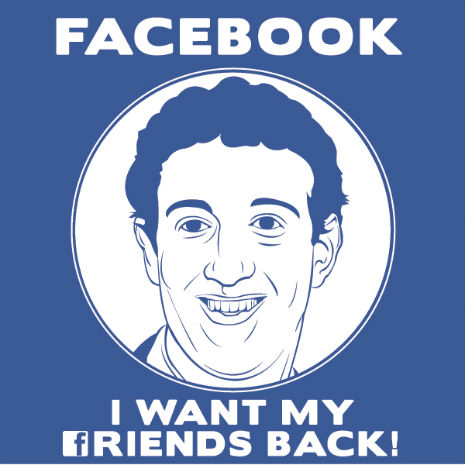
This is Dangerous Minds, in a widely circulated attack on Facebook called “I want my friends back”:

“It’s perhaps the most understated stick-up line in history, worthy of a James Bond villain calmly demanding that a $365 million dollar ransom gets collected from all the Mom & Pop businesses who use Facebook. How many focus groups do you reckon it took until Facebook’s highly paid marketing and PR consultants finally arrived at such an innocuous phrase for describing information superhighway robbery?”

Robbery? Conflict of interest? A hold-up? Bait and switch? This is the kind of tantrum that shows how easy it is for unscrupulous politicians to use the profit motive, free enterprise and capitalism as cheap scapegoats for every problem under the sun, all the better to build support for a massive, all-powerful government that will make everything right, and ensure that we all have lollipops and rainbows regardless of talent, effort, hard work or the cruel turns of fate.* Facebook created this service millions use for free—how dare the bastards try to make money out of their ingenuity and enterprise? Don’t we all, in a real sense, own Facebook? Shouldn’t we? Continue reading