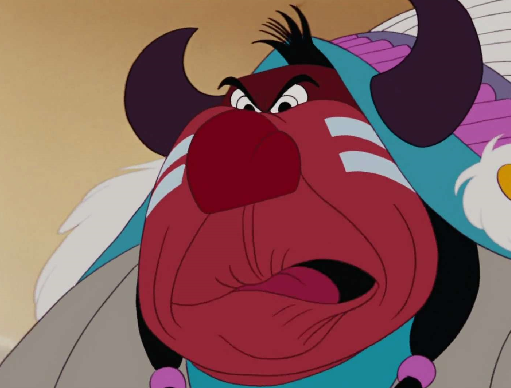
I recently watched the Disney “Peter Pan,” long my favorite of the classic animated films, which I had not seen from beginning to end in decades. I was genuinely shocked at the portrayal of the Indians, which would make the average movie Western seem politically correct and the Washington Redskins seem like a compliment. I know the story is a fantasy; I know that these are not supposed to represent real Native Americans, but a Victorian child’s visualization of the villains of their games. Nevertheless, it is hard to imagine the effect of such a film on a Native American child as being anything but devastating. The Neverland Indians, and their heroine, Tiger Lily, have been a human relations problem since at least the civil rights era, and the provocation is legitimate: did you recall (I had forgotten) that Tiger Lily belonged to the “Piccaninny tribe”? That James Barrie was a funny guy. Continue reading →
This remarkable letter is old—2005—but I just became aware of it, and it is an important document in the ongoing problem of the mistreatment of child performers.
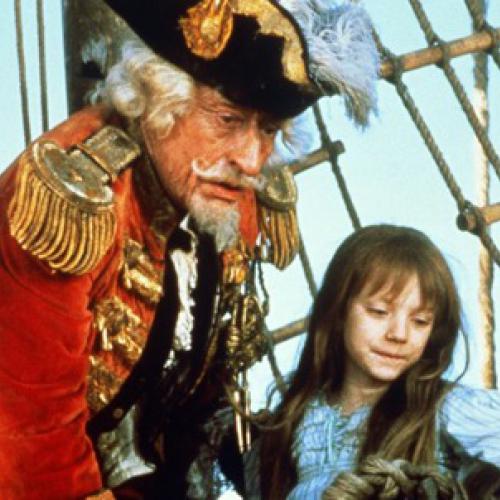
I am a fan of film director (and Monty Python member) Terry Gilliam, and a great admirer of Canadian actress/director/political activist Sarah Polley. So naturally I love “The Adventures Baron Munchausen,” Gilliam’s epic fantasy that starred Polley when she was the tender age of 9, and gave one of the most impressive performances of any juvenile actress, ever. In 2005, Gilliam was filming another movie with a young star, and 17 years after working with him, Polley felt obligated to write this letter, which speaks for itself, and eloquently too:
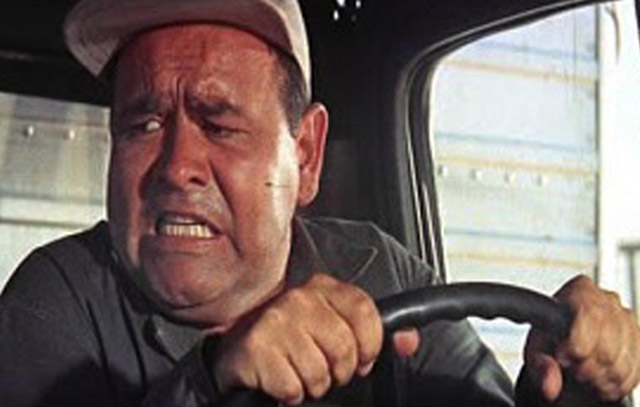
The great Jonathan Winters in the not-so-great “It’s a Mad, Mad, Mad, Mad World”
In past years I have taken the Academy of Motion Picture Arts and Sciences to task for the ethical breach of ingratitude and disrespect, as the honor roll of the year’s deceased film notables have omitted important figures who deserved their final bows. Omissions are inevitable, I suppose, but some of the past examples were unforgivable—last year alone, for example, the Academy snubbed Ann Rutherford, Andy Griffith, R.G. Armstrong, Russell Means, Harry Carey, Jr., and Susan Tyrell. 2012 was worse.
2013, however, shows that the Academy is being more careful, and Oscar deserves credit for cleaning up its act. I have ethical and historical objections to bestowing the prestigious final slot on actor Phillip Seymour Hoffman, dead prematurely of self-inflicted drug abuse, when a genuine, bona fide Hollywood legend, Shirley Temple, was on the list. I understand the thinking: Hoffman had friends and colleagues in the room, and Temple is of another generation; his premature death was a tragedy, and she lived a long and productive life. Still, the priorities and relative values such a choice exemplifies is disturbing. Great actor that he was, Hoffman was a criminal, an addict, and left his children fatherless. Shirley was the greatest child star who ever will be, a ray of sunshine in the dark days of the Depression, a one-of-a kind talent and icon, and later a lifetime public servant who raised a family. She represented the best of Hollywood and the profession; Hoffman represents its dark side. Naturally, he’s the one who received the greatest recognition. I will suppress my dark suspicions that Shirley was docked because she was a Republican. A Facebook friend actually wrote that Shirley deserved to be penalized because some of her movies were racist. My response to this slur was not friendly. Continue reading →
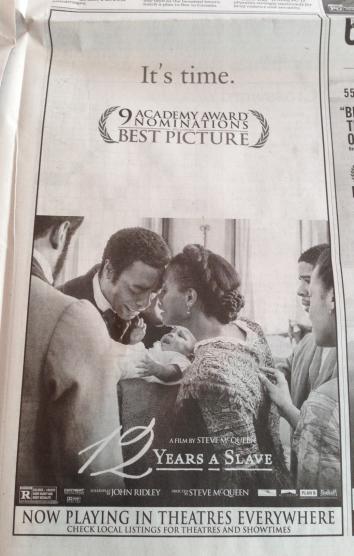
This is the tag line in the post-Oscar nomination ads being prominently run in New York and California for “12 Years A Slave,” a strong Academy Award contender (nine nominations, including best film).
Although there is room for disagreement, and the ad has the virtue of all clever advertising that it conveys different messages to different markets—Haven’t seen the film yet? “It’s time!” Desperate to see the best movie you saw in 2013 finally get its due? “It’s time!” When will the question of whether the most honored film of the last 12 months will win the biggest honor of them all be answered? “It’s time!”…or almost time, as the Oscar ceremonies are coming up on March 2—the consensus is that “It’s time” is mainly aimed at Oscar voters, and the message it conveys is, as Slate puts it, “it’s time for a movie about slavery, and with a significantly black cast and crew, to be recognized by the Academy of Motion Picture Arts and Sciences.”Film critic Phil Hammond puts it slightly differently:
“The ad not only can be interpreted as shining a light on a very dark period in American history, it also shines a light on the Academy’s fairly dismal record of awarding its top honor to any movie about the black experience. In fact there has been only one Best Picture winner in the 85 years the Academy of Motion Picture Arts and Sciences has been handing out Oscars that even remotely qualifies in this regard. In 1968, In The Heat Of The Night, a murder mystery set against the racial divide in a small Southern town, won Best Picture and four other Oscars just a few days after the assassination of Martin Luther King (the ceremony was even postponed two days out of respect). The votes were in before the King assassination, but it seemed then that “It’s Time” would have been an appropriate way to describe that victory. However, outside of lead actor Sidney Poitier — who also co-starred in another racially themed Best Pic nominee that year, Guess Who’s Coming To Dinner — this movie featured a largely white cast, white producer, screenwriter and director (Norman Jewison).”
If so many in the industry are interpreting the ad this way, it is fair to assume that this was at least one of the ad’s objectives, and on the assumption that it was an objective, your Ethics Alarms Ethics Quiztoday is this:
“Is appealing to Oscar voters on this basis fair and ethical?”
Shirley Temple Black, perhaps best known to most of us as Little Miss Marker, Curly Top,the Littlest Rebel, Heidi, or, most of all, Shirley Temple, died overnight. I learned of her passing this morning in a Facebook update from child performer advocate Paul Petersen, like Shirley a distinguished and successful former child star who has dedicated his post-performing career to important causes. He wrote:
SHIRLEY TEMPLE passed in the night. She was 85…and no age at all. What a life. What a treasure. A woman of amazing courage and dignity.The world was enriched by her accomplishments. She will always be a part of us. Rest now, Shirley Temple. We love you.
There really isn’t too much more that needs to be said. Few human beings ever began having a positive impact on society so soon in life (she began making adults smile at the age of three, when she made her first film) and continued to do so for so long. From show business, a profession that so often leads to ethical rot, and a rarefied corner of it infamous for leaving its practitioners spoiled, narcissistic, addicted to fame and dysfunctional, Shirley Temple emerged as an adult who was industrious, courageous, intelligent, compassionate, and dedicated to public service. Often dismissed and mocked as a washed-up child star, she proved again and again that her detractors were not just wrong to pre-judge her, but spectacularly wrong. She excelled as a diplomat, serving as U.S. ambassador to Ghana and Czechoslovakia, using her Hollywood fame to open doors and hearts, and also as the U.S. delegate to the United Nations. Temple never played the celebrity: my favorite Shirley moment was when she returned, in her seventies, to join a large group of former Oscar winners (hers was a special award, at the age of six) on the stage of the Academy Awards. As they announced the names of the famous performers and the camera panned the group, it was Shirley who received the most loving response from the Hollywood crowd, which stood and cheered. Shirley looked genuinely surprised, beamed, showed those famous dimples, and handled it, as she always handled everything, with charm and poise.
A proto-feminist, Shirley Temple was one of the first celebrities to go public with a diagnosis of breast cancer, and raised national awareness by promoting a frank discussion of mastectomies. In her autobiography, she also had the courage to point out the predominance of sexual predators in the the Hollywood power structure and culture, recalling that MGM musical unit head Arthur Freed*, whose career is celebrated in “Singing in the Rain,” exposed himself to her in his office when she was barely 13. (She laughed at him; he threw her out of his office.)
Historians credit Shirley Temple with saving the movie studio RKO and raising America’s spirits during the Great Depression; she also was a Cold Warrior, a mother, the inspiration for a best-selling line of dolls as well as the alcohol-free cocktail that still bears her name, and one of a kind. It is fair to say we will never see her like again.
Late in life, she told an interviewer, “If I had it all to do over, I wouldn’t change a thing.” How many of us can say that sincerely?
Paul was right. What a life!
Take a curtain call, kid…
* The original version of the post incorrectly referred to Arthur Freed as Alan Freed, who was an influential disc jockey in the early days of rock and roll. I apologize to both of them.
I thought the Tom Cruise action film “Jack Reacher” would be a good way to escape from an aggravating day at the ethics grindstone, but no. It was rapidly apparent that this would be one of these movies with a sociopathic vigilante hero—Reacher (Cruise) is kind of a cross between Steven Segal and Billy Jack, summarily executing bad guys and completely uninterested in nuances like trials. The character, from the pen of British writer Jim Grant, is supposed to be 6’5″ tall and weigh about 250, so having the diminutive Cruise play him is a bit like having Danny DeVito play Fezzik in “The Princess Bride.”
The main annoyance was the typical persistent misrepresentation of legal ethics, especially the attorney-client privilege. Reacher is dark, free-lance, drifting Mr. Fix-it, and he is engaged by lawyer Helen Rodin as an investigator to prove her client, an ex-military sniper who is being prosecuted by her father, the DA, for apparently gunning down five random innocent victims in a shooting spree, is something more than a mad dog killer. In their initial conversation about the case, Cruise asks if what he is telling her is privileged. She assures him that it is, but the sequence is misleading, for Reacher and for the audience. Continue reading →
“OK, the tiger almost drowned. No harm, no foul, right?”
Hollywood abuses its child actors routinely, and you really believed it was kind to animals?
Today the Hollywood Insider carries a thorough exposé revealing that the American Humane Association, which supposedly monitors films for their treatment of animals and grants the familiar“No Animals Were Harmed” trademark accreditation seen at the end of film and TV credits, participates in the covering-up of animal deaths and cruelty as much as it prevents them. The report suggests that the AHA has been thoroughly co-opted by the industry, so that it is not an objective advocate for the creatures it supposedly represents, but a willing participant in audience deception.
The smoking gun quote may be this one, from Dr. S. Kwane Stewart, the veterinarian who took over as the national director of the AHA’s “No Animals Were Harmed” program in April:
“This whole idea that we’re cozy with the industry — it’s simply not the case. We first and foremost want to keep the animals safe…[but] we need to keep in mind that [the producers and directors of productions the AHA monitors] want to arrive at their vision as well.”
This means, of course, that the AHA representatives are not acting as an advocate for the animals, but as a participant in the film-making process that balances the lives and welfare of the animals against the concerns, needs and profit motives of the speaking, spending, threatening and otherwise powerful human beings with which they share a species and common values. Gee–I wonder who has the most weight in reaching that balance… Continue reading →
“Would You Rather” is an odd 2012 film that sets up a film-long set of unlikely ethical dilemmas for its characters to solve. Desperate to save her dying brother with expensive medical treatment she can’t afford, the heroine (played by Brittany Snow) finds herself at a dinner party with seven other desperate strangers, hosted by a wacko family of millionaires who will help one of them after the others have been “eliminated” during the course of the evening. As what is described as a game progresses, each contestant is put through escalating rounds of risk, pain and torture in which they must make various Sophie’s Choices, such as…
Would you rather administer a painful shock to yourself with high-voltage electricity, or the person next to you? What if that person has been weakened by a previous shock? What if she is in a wheelchair?
There is more to discuss, a lot more, regarding what I will now call “The Klosterman Apology,” because it sounds like a Robert Ludlum novel. For now, however, since it is fresh in my jet-lagged mind, I’d like to focus on the inevitable result of declaring certain words and phrases so objectionable, hurtful, uncivil or politically incorrect that extraordinary means are employed to eliminate them. In the case of The Klosterman Apology, the words were “retard” and “retard,” and a Mom with a blog threatened “The Ethicist” from the New York Times magazine with an onslaught of political correctness bullies if he didn’t immediately express his abject contrition for having used these words in a harsh way a decade ago, in another job that didn’t directly involve ethics. Chuck capitulated, gracefully and well. As I will discuss in another post, I don’t think he had much choice. Still, word-banning is an ugly, and ultimately unethical business. Continue reading →
This topic isn’t really worth two posts, I know, but after some commenters mentioned other obvious examples of distinguished athletes turned actors the Rant Sports incompetent post ignored, I did some additional research myself.
The first thing I discovered was that Renae Juska’s list was about 90% lifted from other similar web lists that had appeared on various sites over the past three years. These lists were almost as incompetent as hers, though one of them included Johnny Weismuller, and another included Esther Williams. For the most part, however, all included the same basic group of athlete-actors, clearly serving as the basis for the next blogger looking for a cheap post.
This is how bad or misleading information gets stuck in the public mind and discourse, and the process occurs regarding topics and issues that matter, not just gratuitous lists.. This is why politicians still talk about women only earning 78 cents for every dollar earned by a man, and how 50% of marriages end in divorce. This how rumors and mistaken beliefs take hold and spread, changing the results of elections and the course of history…lazy writers cribbing dubious facts, unsubstantiated stats and lazy compilations of data from other lazy writers. The phenomenon feeds itself. Take the current case: someone asking themselves the question, “Gee, I wonder who the most prominent actors who were also accomplished athletes are?” will google the question and check four or five sites, read virtually the same names on all of them, and think the topic has been accurately researched. That will be an illusion, and soon there will be another post, confirming the earlier ones, and further validating informational garbage.
I also checked the biographies of actors whom I knew had athletic backgrounds, and the performing credits of prominent athletes whom I knew worked in TV, stage and films. I also considered some of the candidates, omitted by Juska, that various commenters had suggested. The result is this list of 30 athlete/actors who were ignored by Juska and Rant Sports, every one of whom is beyond question more deserving of a place on an “all-time” list of “Top 25 Athletes Turned Actors” than many of the choices on the Rant Sports list, and quite a few of which—Robson, Williams, Henie, Rigby, Weismuller, Crabbe, Norris, Beradino, and others—should rank near the top. Continue reading →



 Ethics Alarms