Stipulated: the ethics position here has been since long before the Trump years that Presidents should keep their opinions of persons, places, things and events having nothing to do with their duties or responsibilities to themselves.
Presidents are not kings, nor popes, nor universal authorities on everything. They have a role to fill, and they should fill it; it’s not like there should be plenty of time left over for weighing in on such matters as sports, popular culture, celebrities, and local controversies.
President Obama did far more of this than was responsible or good for the country, notably during race-related controversies. President Trump, obviously, has taken this misuse of his position into the stratosphere with his addiction to Twitter. His unrestrained tweets have done him at least as much harm as good; my own guess is that if he eschewed social media, his approval ratings would be 10% higher than they are.
It is also, I think, beyond argument that Trump’s use of Twitter guarantees that future Presidents will also use it to opine on matters that are none of their business. This is not a good thing.
The President’s latest self-made controversy, actually two controversies, came when he tweeted in part last week,
“How bad were the Academy Awards this year? Did you see? And the winner is: a movie from South Korea. What the hell was that all about? We’ve got enough problems with South Korea, with trade. On top of it, they give them the best movie of the year? Was it good? I don’t know? I’m looking for — where? — can we get ‘Gone with the Wind’ back please? ‘Sunset Boulevard.’ So many great movies. The winner is: from South Korea. I thought it was Best Foreign Film. Best Foreign Movie. No. Has this ever happened before? …”
And then he went off on Brad Pitt’s gratuitous crack about John Bolton. Continue reading →
Between the nauseating impeachment charade and baseball’s cheating scandal (and the largely ethically ignorant commentary regarding it), the bias of the mainsteam media reaching critical mass in episodes likethisand the Don Lemon panel’s mean girls mockery of those dumber than dumb Trump supporters, mounting evidence that Democrats are going nuts based on the rise of a superannuated Communism fan in the race for the party’s Presidential nomination, and, of course, my wife doing a face-plant into some asphalt, it was a not a happy 31 days at The House of Ethics.
Amazingly, it has been a very good month for the President, becoming the first POTUS to unequivocally endorse the anti-abortion movement by appearing at the March for Life, cutting a partial deal with China, ridding the world of Qasem Soleimani (and in doing so, prompting his domestic foes, including the news media, to publicly sympathize with a terrorist and a nation that habitually calls for America’s destruction), releasing a Mid-East peace plan that is garnering support everywhere but from Iran, the Palestinians, and, of course, the U.S. media, and seeing economic figures so good even the New York Times has been forced to acknowledge them, all while being called every name in the book and an existential threat to democracy on C-Span by the Democratic House impeachment managers.
1. “Dolemite Is My Name” We finally watched “Dolemite Is My Name,” (on Netflix), Eddie Murphy’s homage to comic Rudy Ray Moore and his 70s Blaxploitation film “Dolemite.” So much for my proud claims of cultural literacy: I never heard of Moore or his film, which is apparently a genre classic. Moore is regarded as the Father of Rap; how did I miss this for so long? Murphy’s movie tells the mostly true story about how a group of complete novices, led by Moore, made an exuberantly idiotic movie (faithful to Moore’s formula for success with black audiences: “Titties, funny, and Kung-Fu”) for $100,000 that grossed 10 million.
The movie is fun as a black version of “Ed Wood” (same screenwriters, I discovered later) and won some awards. For it to be make any 2019 Ten Best lists, however, is blatant race pandering by critics. Continue reading →
1. And the baseball cheating scandal is still roiling! I feel sorry for ethics enthusiasts who are missing out on this fascinating episode because they shut down when baseball is mentioned. One emerging issue that focuses on “woke” (and in some quadrants, sadly, female) leadership models has become evident. The two managers fired in the sign-stealing scandal were part of the “new wave” of “collaborative” baseball managers that teams embraced in recent years. They are sensitive to the players’ needs; they don’t give orders as much as set flexible boundaries; they are not confrontational, and they absorb and guide the culture of the clubhouse rather than dictate it. Then we learn, in MLB’s report on its investigation, that when Houston’s A.J. Hinch discovered (in 2017) that his bench coach and his players were operating an elaborate sign-stealing operation that he knew violated the rules , he made it known that he disapproved, but never ordered them to stop. Now baseball commentators are saying that the Astros need to hire an “old school” manager (like the ones who have been put out to pasture over the last five years) who will be leader, who will lay down the law, and who won’t shy away from confrontation for fear of not being “collaborative.”
Duh. How did anyone come to think effective leaders should do otherwise? Leaders need to lead. Leading doesn’t have to be autocratic, but a leader who acts like Hinch did in this matter is no leader at all.
In another revelation regarding the scandal, the report by Baseball Commissioner Rob Manfred states that when Manfred put teams on notice in a Sept. 15, 2017 memo that using electronic means to steal and relay opposing teams’ signs during games would henceforth be severely punished, Houston General Manager Jeff Luhnow “did not forward the memoranda and did not confirm that the players and field staff were in compliance … Had Luhnow taken those steps in September 2017 it is clear to me that the Astros would have ceased both sign-stealing schemes at the time.”
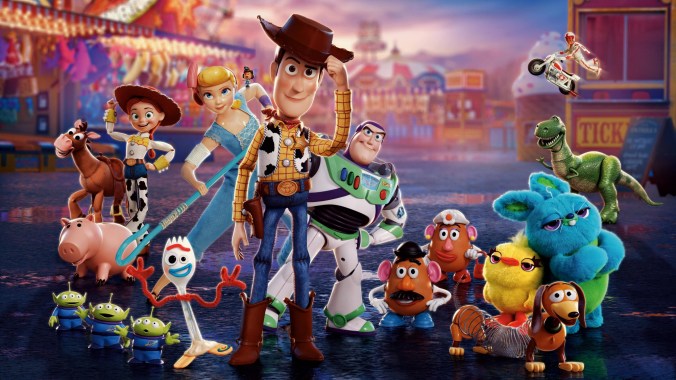
Track with me ,if you will, the fevered discourse of some poor social justice warrior named Stephen Galloway, who authored what apparently is intended as a serious critique in the Hollywood Reporter titled, “The Whiteness of ‘Toy Story 4.”
He begins,
Was there any movie this past year as exuberantly entertaining, as creatively conceived as Toy Story 4? Ever since the franchise was launched in 1995, it’s been a cornucopia of riches, from its indelible characters to its unparalleled animation…The picture … left me in awe.
Well, that’s the end of the matter, isn’t it? It should be. This was, the the other three films, a vehicle of entertainment. Virtually everyone who saw it was entertained, even me, and I found it the least of its three predecessors and annoying for its blatant pandering to feminists (Bo Peep suddenly morphed into Lara Croft).
But alas, no..
So why did a slightly bitter taste linger, a sense that something was naggingly wrong? Because in many ways TS4′s worldview seems like an Eisenhower-era fantasy, a vision of America that might have come from the most die-hard reactionary: lovely if you’re wealthy and white, but alarming if you’re black or brown or gay or a member of any other minority — in other words, more than half the U.S. population.
Oh, bite me. The characters are toys. Toys don’t have races. They don’t have sex. I wonder if a single child saw this film and spent one second wondering about why there wasn’t a gay or Hispanic toy, or thought about whether the Potato Heads are “of color,’ being brown, or if “Bunny,” voiced by African-American actor Jordan Peele, is “of color” because he’s blue. Nobody normal, of any age, thinks like that, unless they have been brain-washed into a miserable world view….like the author, who really complains that one of the new characters is “a very white fork.” Oh! Right! The second I saw “Forkie,” I thought, “Another white guy!” Continue reading →
My son is an auto tech and car enthusiast as well as a lover of speed (sufficiently to get him in trouble), so when he told me that I should see “Ford v Ferrari” and that he loved it, it was no surprise. I knew nothing about the film other than its title: no reviews, no background. My son said he would eagerly see it again, and was our guide as my wife and I attended a New Year’s Day afternoon showing (which was packed, incidentally.)
To get the basics out of the way up front, “Ford v Ferrari” is a wonderful movie. It immediately takes its place as one of the great sports movies of all time (with “Rocky,” The Natural,” “Hoosiers,” “The Bad News Bears,” “Sea Biscuit,” and a few others we could argue about), but it is also just a great movie. Christian Bale is astonishing, as usual, and the rest of the cast is uniformly excellent, as is the direction, film editing and screenplay. It is the best film I have see this year, easily leaving such critic’s favorites as “The Irishman” and “Once Upon A Time in Hollywood” in the dust. That, however, is beside the point….
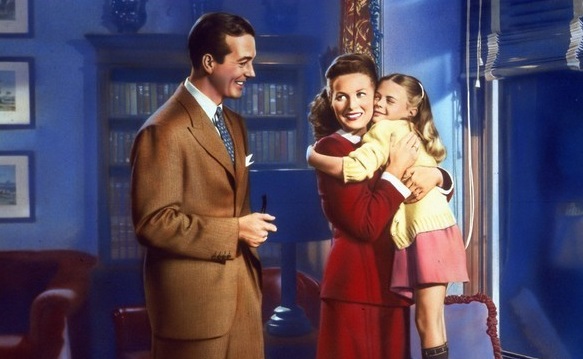
Kris’s rave reviews as Santa in the Thanksgiving Day Parade are so good, Doris hires him play Santa at Macy’s flagship New York City store on 34th Street. He agrees, which is strange, when you think about how busy he should be at this time of year, supervising the elves and all. If he really is Santa, or even if he thinks he is, taking the job in New York is irresponsible.
His supervisor gives him a list of toys to “push”—toys that are overstocked. “Now, you’ll find that a great many children will be undecided as to what they want for Christmas. When that happens, you suggest one of these items,” Kris is told. “You understand?”
Kris says he understands, but later makes it clear in his comments to a co-worker, that he has no intention of “pushing” the merchandise.:
“Imagine…making a child take something it doesn’t want…just because he bought too many of the wrong toys.That’s what I’ve been fighting against for years!”
That being the case, there is exactly one thing Kris needs to do. He needs to quit. What he cannot do, and must not do, and has a clear ethical obligation not to do, is to accept a job when he has no intention of doing what the job requires. This is a sales job. If Kris doesn’t want to sell, then he will be accepting a pay check under false pretenses. This isn’t noble conduct, as the film would have you believe. It’s unethical conduct. It’s wrong.
Let’s get this out of the way up front: Kris is not really Santa Clause. The sooner you understand that, the more sense the movie will make.
Now onward:
2. The bad mother and the sneaky lawyer.
While Kris is enjoying his starring role in the Macy’s Thanksgiving Day Parade, we meet Susan Walker, Doris’s young daughter, and Attorney Fred Gailey, who lives in the apartment next door. Susan has been raised to be a joyless little cynic, the victim of an arrogant and misguided single mother who needed to read more Bruno Bettelheim ( except that Bruno didn’t write The Uses of Enchantment until 1976). Doris, as we soon surmise, has allowed a bad marriage to make her suspicious of dreams, hope, and wonder, and she is passing her own disappointment in life off to her daughter at the tender age of nine. Nice.
Lots of parents do this, I suppose, but that doesn’t mitigate how cruel and damaging it is. I remember how horrified I was at Susan’s brainwashing when I first saw the film at about the same age as Natalie Wood was in the movie. My parents, particularly my mother, surrounded my sister and I with fantasy and whimsy. They went to elaborate measures to make Santa Claus seem real, and the Easter Bunny, and the Tooth Fairy. At one point my sister, having read a story about a lollypop tree, planted a lollypop stick in the back yard. My mother pooh-poohed the idea, telling my sister that this was just a fantastic story she was believing, and that she was going to disappointed. Then, three days later, my father exclaimed as he looked out the kitchen window, “I don’t believe it! Look at that!” And there, about four feet height and covered with lolly pops of all the colors of the rainbow, was the lollypop tree.
My sister and I weren’t idiots; we knew that our parents had made the tree. But we played along, and the lesson was taught. Life is more fun and bearable if you believe in the unbelievable, and are open to a little magic in the world. Our parents gave my sister and me a gift that made us love music, literature, humor, mystery, and surprises. Doris Walker, out of ignorance, grief or anger, was an incompetent and selfish parent. ” We should be realistic and completely truthful with our children and not have them growing up believing in a lot of legends and myths like Santa Claus, for example,” she says.
And your authority for this proposition is what, Doris? Generations of children have grown to healthy, happy maturity being raised on myths, legends and fairy tales, and you, with your invaluable perspective as a department store employee, are confident in your certitude that their parents were wrong, and you are right. Wow. Continue reading →
The position here has always been that nobody has any business telling you how to spend your money. This topic usually comes up in the context of charity, as in, “How dare that individual spend money on what they think is important when they should be spending money on what I think is important!” A couple of recent developments have raised the issue in a different context, however: incompetent and irresponsible expenditures of large amounts of money.
Take “Cats,” for example. The already immortal flop film cost a reported $100,000,000 to make, and marketing costs are on top of that. It is sure to lose many, many millions of dollars, and the question becomes, “How could movie professionals make a blunder like that?”
I always assumed that “Cats” could not be a successful movie because of its purely theatrical nature. Surely the lesson of the film version of “A Chorus Line,” another Broadway musical that never should have move to the screen, was guide enough. Yet it happened. The fiasco put me in mind of other infamous and avoidable screen disasters, like 1978’s “Sgt. Pepper’s Lonely Hearts Club Band” starring Peter Frampton and the Beegees. Before the film’s release, Robin Gibb of the Bee Gees announced: “There is no such thing as the Beatles now. They don’t exist as a band and never performed Sgt Pepper live in any case. When ours comes out, it will be, in effect, as if theirs never existed.”
Good prediction. The huge MGM film with dozens of celebrity cameos was instantly and universally reviled. Even worse, a few years later, was “The Pirate Movie,” another misbegotten big budget musical. The idea here was to do a new version of “The Pirates of Penzance” but without the dialogue, plot and music that has made the Gilbert and Sullivan show popular for more than a century….and to star Kristy MacNichol, the androgynous, non-singing teen star, as the heroine. How could such a brilliant concept fail? Continue reading →
In Part I, I said I was glad that Clint Eastwood’s latest film “Richard Jewell” was bombing, because the film impugns the integrity of a now-deceased reporter simply to spice up its story. After I read some of Clint’s comments yesterday in response to the controversy, I’m even more glad. Clint said that nobody knows how reporter Kathy Scruggs got a crucial leak from the FBI, but that it could have occurred because she traded sex for information. That’s despicable.
Nevertheless, the other dud among the Hollywood releases over the weekend, “Black Christmas,” deserved to flop even more than Eastwood’s epic.
The original “Black Christmas” (1974) was released under the name “Silent Night, Evil Night.” I saw it with my sister a few days after its opening (I was amused at the ad’s catchline, “If this movie doesn’t make your skin crawl, IT’S ON TOO TIGHT!!!”) and it scared the bejesus out of both of us, but especially her: she slept with the light on for weeks, and to this day my uncanny imitations of the maniac’s phone calls upset her (so I keep doing them, of course.)
Arriving before John Carpenter’s “Halloween” and its later, cheesier rip-off “Friday the 13th,” what was soon re-titled “Black Christmas” anticipated many of the themes and techniques of the slasher genre, perhaps too well. Blessed with a much better cast than any subsequent movie of the type (Olivia Hussey, Keir Dullea, Andrea Martin, John Saxon, and Margot Kidder) and clever and gutsy director Bob Clark (“A Christmas Story,” “Porky’s”), the film was declared too disturbing by many critics. I thought it was easily the best horror movie I had ever seen, and recommended it to many friends, some of whom were not grateful after spending the following night jumping at every sound. It was very gratifying to see “Black Christmas” finally emerge as a cult film and the acknowledged inspiration for the slasher film genre (along with “Psycho,” of course.)
I saw the 2006 “sequel,” which was terrible, and had a sense of dread when I learned that Hollywood would try again. It was clear that the new film was already off to an unethical start when I saw the trailer: this was another example of producers hijacking a familiar title while making a movie barely connected to the older film it was evoking. That trick, essentially a bait and switch, always ticks me off. In the trailer for the new film, we could see that the killer wears a black robe and uses a longbow. Clark’s original famously never shows the maniac murderer at all: much of the movie is shot from his perspective (I assume it’s a he), though we see his shadow, one mad eye, and his arm at various times. We also hear him, and a more crazy-sounding killer has never been recorded.
The new “Black Christmas” takes place in a sorority house around Christmas, and there’s someone knocking off the girls. That’s about the extent of the similarity. To be fair, the advent of cell phones ruined the original film’s most iconic scare: it was the first movie in which we heard the chilling words, “The phone calls are coming from inside the house!”
The promotion of more female film directors is a feminist cause right now. There’s even a Christmas commercial where a little girl tells her parents who have just bought Disney princess toys to put under the tree for her, “I don’t want to be a princess any more. I want to be a film director!” I have always championed female directors for the stage; there is no question that there are multiple biases against them in theater, and I assume the same bias afflicts them in Hollywood. However, I do not want to see more female directors because they bring a special, feminine perspective to their work, and I really don’t want to see more female directors so they can use their plays and films as feminist propaganda vehicles. Just make a good movie, kid: if your work only stands for the proposition that women can’t just make entertaining and effective films, but have to clobber the audience with feminist tropes, you will have created a legitimate reason for the industry to be wary of female directors. Continue reading →
The two big flops among movies that opened last weekend were director Clint Eastwood’s “Richard Jewell” and “Black Christmas,” the second attempt to re-boot the 1976 slasher cult film. Both disasters have ethics lessons to teach, or not teach. Let’s look at Clint’s movie first.
“Richard Jewell” made lass that $4.5 million in its first weekend, and has also been snubbed by the various year-end awards. It is based on the now mostly forgotten story of how Jewell, initially hailed as a hero for his part in foiling the 1996 Atlanta Olympics bombing plot, was falsely accused of complicity by local law enforcement, the FBI, and the news media. Conservative outlets loved the film, but the other side of the divide focused on a subplot, as the film’s screenplay suggested that a named Atlanta Journal Constitution reporter, now deceased, used sex to persuade a source to break the story. The Journal Constitution has been attacking the film, denying that Kathy Scruggs would ever used he body to get a scoop. Her colleagues, friends and family all insist that she would not have slept with a source, and reporters around the country circled the metaphorical wagons to proclaim they were shocked–shocked!—that anyone would even suggest such a thing. Jeffrey Young, senior reporter for HuffPost tweeted, “The lazy, offensive, shitty way screenwriters so often treat female journalists infuriates me. Depicting women using sex to get stories is disgusting and disrespectful. It’s also hacky as hell. I was planning to see this movie but not anymore.’ Melissa Gomez of the Los Angeles Times wrote, “Hollywood has, for a long time, portrayed female journalists as sleeping with sources to do their job. It’s so deeply wrong, yet they continue to do it. Disappointing that they would apply this tired and sexist trope about Kathy Scruggs, a real reporter.’ Susan Fowler, an opinion editor at the New York Times tweeted “The whole “female journalist sleeps with a source for a scoop” trope doesn’t even make any sense…”
This would be damning, except that while it may not be standard practice, there are plenty of examples of female journalists doing exactly what Eastwood’s film suggests. Last year the Times—yes, Susan Fowler’s paper—reported on the three-year affair between Times reporter Ali Watkins and James Wolfe, senior aide to the Senate Intelligence Committee, and a regular source for her stories. In October, an employee of the United States Defense Intelligence Agency was arrested for leaking classified material to two reporters, and he was involved in a romantic relationship with one of them. Both reporters are still employed by their respective news organizations, the Times and CNBC, so its hard to argue that sex-for-scoops is being strongly discouraged.




 Ethics Alarms