Silver Lining To A Homicide

Ah, those school memories!

In South Dakota,  73-year-old Carl Ericsson rang an old high school classmate’s doorbell in January and shot him dead.

Why? Norman Johnson had forced his killer to wear a jock strap on his head in a high school locker room when they were both boys almost 60 years ago. Ericsson hadn’t seen or talk to Johnson in decades, but the humiliation apparently festered. A successful family man now in retirement, Ericsson had battled emotional illness in recent years, and suddenly decided to settle the score of an old grudge.

This was a senseless death and a tragedy that scars two families. Still, I think the tale of how a victim of bullying suddenly got horrible revenge on his tormenter six decades later is s story that should be told early and often in the schools.

It may make some would-be bullies think twice before that atomic wedgie, the embarrassing photo, or the mean Facebook post.

And Mitt?

Watch out.

[NOTE: when this article was first posted, the end portion of the ABC story I linked to above and below was inadvertently copied into it after my last line. That was unintentional. Since I am both a lousy speller, a lousy typist and a computer maladroit, I sometimes copy a portion of the story I am basing a post upon into the body of the post, for easy reference, and occasionally to cut and paste names like “Ericsson” that I just know I’m going to misspell at least once. When I do that, I usually remember to delete it. And when I don’t usually Tim Levier catches it before now. My apologies to ABC, the AP, and you.]

___________________________________________

Pointer: Fark

Facts and Graphic: ABC

Reporting the Confessed Killer in Your Midst: An Ethical Dilemma That Isn’t

Pedro Hernandez, now under arrest for the murder of Etan Patz, the  6-year-old boy whose 1979 murder was a national mystery, confessed that he had strangled the child just a few years later to his prayer group at St. Anthony of Padua, a Catholic church in Camden, New Jersey.  No one, including Hernandez’s relatives who learned of his confession and the prayer group leader, reported the confession to authorities.

Hernandez’s sister, Milagros Hernandez, confessed what she described as a “family secret” to a reporter for the New York Daily News over the weekend, setting off “What would you do?” internet polls and blog posts, as if there was any question about the proper conduct for a family member or church group member who hears a murder confession. There is no question.  You report it. There are no debate issues, no competing considerations, no claims of loyalty or confidentiality.  It isn’t a Golden Rule dilemma, as in “Would I want someone to report me if I confessed to him in confidence that he had strangled a little boy?”  It isn’t a dilemma at all. There is only one right thing to do, and if you think otherwise, you missed a couple of key meetings when the ethics were being handed out. Continue reading

Legal/Ethical Train Wreck in Indiana: The Case of the Poisoned Fetus

Mother, failed suicide, accused murderer, and ethics train wreck engineer.

If there are logical and ethical holes in a law, you can count on a case eventually coming along that will make them obvious and painful. Thus it is that the the case of Bei Bei Shuai, a Chinese immigrant living in Indiana, was concocted by the vengeful Gods of Inconsistency to highlight some of the legal problems in two notorious ethical gray areas, abortion and suicide. I’m not going to even try to solve the mess. It’s hard enough to describe it.

Suicide is illegal in Indiana, but attempted suicide is not. In Indiana, as in most jurisdictions, however, if one’s unsuccessful  suicide kills another by accident, that could be prosecuted as manslaughter, through the doctrine of transferred intent. In the case of Shuai, she drank poison, ostensibly to kill herself. But she also wrote a note saying that she was “taking the baby.” Of course, when a pregnant woman kills herself, that usually suggests that she understands that her act will kill her unborn child as well.  Perhaps she was trying to kill herself and wasn’t considering the baby. Perhaps she was trying to kill the baby, and not herself. Perhaps she was trying to kill both herself and her child.

What happened, however, is that she lived. The baby was born, but died shortly thereafter as a consequence, prosecutors say, of the poison Shuai swallowed. Continue reading

Ethics Dunces: Connecticut Lawmakers

Hayes and Komisarjevky, the Cheshire, Conn. killers

Good thinking, Connecticut!

  • With home invaders/multiple murderers/ rapists/sadists Stephen Hayes and Joshua Komisarjevsky duly convicted and sentenced to death by lethal injection, the state legislature passed, and the Governor signed, a law making Connecticut the latest state to ban the death penalty.
  • Since a majority of the public, the legislators and virtually everyone aware of the horrendous facts of the infamous home invasion murders that Hayes and Komisarjevsky unquestionably committed think these two creatures deserve to die, the legislators made the law prospective only, meaning that it only would apply to those convicted of future crimes.
  • Despite the legislative intent, the obvious Equal Protection challenge to a law that treats two sets of citizens—current convicted murderers and future ones—differently may save the lives of Hayes and  Komisarjevsky,  the other 9 residents of the state’s death row, and such likely future residents as Richard S. Roszkowski, convicted of murder for gunning down a man, woman and 9-year-old girl on Sept. 7, 2006, but still facing a second death penalty phase trial, after his first one was overturned on a technicality.

It would have shown integrity for Connecticut lawmakers to have the courage of its supposed convictions, and to abolish the death penalty while having in its custody as perfect candidates for capital punishment as have ever been captured, Stephen Hayes and Joshua Komisarjevsky. In case you have forgotten the details of their June 23, 2007 invasion of the Cheshire, Conn. home of the Petit family, or were lucky enough to miss that horror story until now, here are is a mercifully brief summary. Continue reading

“No Tolerance,” Expulsion, and Poisoned Coffee

A post this weekend discussed the case of an elementary student who was expelled for showing a pocket knife to friends on school grounds. Dig around in the Ethics Alarms archives, and you’ll find many other “no tolerance” stories in which schools levied harsh punishment for perceived student infractions such as describing murderous fantasies about teachers on Facebook; a pizza bitten into the shape of a gun; taking possession of a knife from another student in order to turn it over to school authorities, and even more outrageous examples. In several of these incidents, the police were called in. You may recall the case from last year in which a Spotsylvania (Va.) high school student was expelled and charged with criminal assault for the equivilent of blowing spit-balls at a student in class.  Now we have a shining example of why this decade-long trend is not only devoid of justice and common sense, but also counter-productive. It undermines the school’s ability to send a coherent message to the students who need it—the truly dangerous. Continue reading

Greedo Ethics

Who shot first?

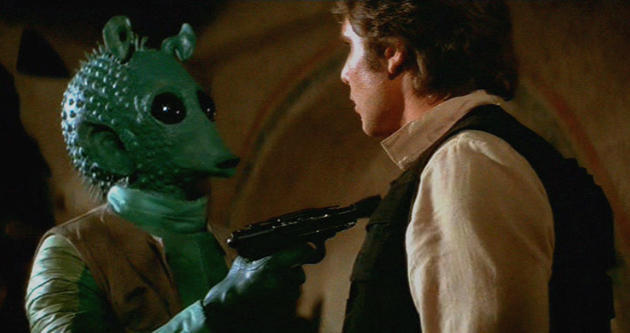
Jedi Emeritus George Lucas betrayed a warped concept of cowboy ethics, self-defense and ethics generally in a recent Hollywood Reporter interview in which he was quizzed about his technological fixes on the original Star Wars trilogy. The topic was the shooting of Greedo in the bar, when Han Solo blasts away at the green, fishy porcupine-like villain, who has a gun pointed at him:

Lucas: Well, it’s not a religious event. I hate to tell people that. It’s a movie, just a movie. The controversy over who shot first, Greedo or Han Solo, in Episode IV, what I did was try to clean up the confusion, but obviously it upset people because they wanted Solo [who seemed to be the one who shot first in the original] to be a cold-blooded killer, but he actually isn’t. It had been done in all close-ups and it was confusing about who did what to whom. I put a little wider shot in there that made it clear that Greedo is the one who shot first, but everyone wanted to think that Han shot first, because they wanted to think that he actually just gunned him down.

Lucas’s idea of what constitutes a “cold-blooded killer” runs counter to law, common sense, and ethics. Continue reading

Van Der Sloot’s Defense: Worst Rationalization Ever?

Yup: It's Natalee's fault.

Joran van der Sloot finally pleaded guilty yesterday to the murder of a Peruvian woman, Stefany Flores, whom he had met in a bar. His lawyer, Jose Luis Jimenez, blamed the crime on van der Sloot’s earlier arrest for the disappearance of Natalee Holloway in Aruba and the widespread suspicion that he was the missing teenager’s killer.

Defense lawyers, in the zealous representation of their clients, must often come up with creative theories bordering on the risable to try to wring every last drop of helpful spin out of a hopeless case. It bothers non-lawyers and legal ethicists alike when attorneys assert things about a case or their client that they couldn’t possibly believe is true, though it is enough to meet the low bar of the Rules of Professional Conduct for the lawyer to believe that such statements might be true, perhaps in a parallel universe. They are in the “well, how about this?” category. A defense lawyer with a despicable client like van der Sloot, who appears to be a stone cold sociopath, doesn’t have much to work with. Continue reading

The Murderer and the Governor

When a politician announces that he is taking a "moral stand," watch out.

Guess who has more integrity: Gary Haugen, the convicted double murderer whose scheduled execution in Oregon had been scheduled for next week, or Oregon Governor John Kitzhaber, who blocked his execution?

It’s Haugen. The resident of Oregon’s death row had waived his appeals and was voluntarily submitting to his court-decreed fate when Kitzhaber stepped in, declaring his moral objections to capital punishment. But like many politicians’ objections to that other divisive social policy issue, abortion, Kitzhaber’s supposedly moral stand has more fine print than a gym membership. He didn’t commute Haugen’s sentence, or end the death sentences of the other men who have been condemned. The Governor went half way, essentially staying the executions for the term of his governorship, and pledging to seek reforms of what he called a “broken system” in 2013. Why 2013? It’s after the election, of course. Continue reading

“Walking Dead” Ethics

American Movie Classics’ excellent, if harrowing, zombie apocalypse drama “the Walking Dead” finally raised the ethical issue looming like a zombie Woolly Mammoth over all zombie films: Is it ethical to kill zombies? Are they still human beings?

Nobody seriously disputes that killing a zombie who is about to eat you or your compatriots is self-defense, justifying deadly force. But what about the common practice in every George Romero-inspired zombie epic: shooting the shambling things (or the sprinting variety, as featured in the re-make of “Dawn of the Dead”) on sight—in the head, naturally? Is it murder? Euthanasia?

The issue was raised in this Sunday’s episode of “The Walking Dead,” as it was revealed that the prickly doctor who presides over the remote farm where our zombie-fleeing heroes are currently taking refuge keeps a batch of captive “walkers,” including his rotting wife, locked in a barn. He feeds them chickens, which are presumably finger-lickin’ good. The doctor regards zombie killing as an atrocity, the equivalent of killing a sick person. “They are humans,” he says. Continue reading

Now THIS Is An Offensive Team Name

The London, Ontario independent baseball team has decided to rename itself “The London Rippers.”
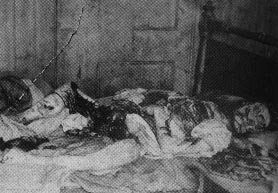
Jack's last victim: a logo, perhaps?

The city’s mayor has expressed concerns about the name, and good for him. This isn’t a manufactured political correctness complaint, based on the dubious logic that it demeans a group to honor it with an athletic team name. This is the opposite: a team name that honors a serial killer who disemboweled poor women in the slums of London in 1888. Misogyny isn’t cute or funny, and anyone who thinks that making Jack the Ripper a team symbol is anything but one more outrage perpetrated against his pathetic victims but gets indignant over the Atlanta Braves has his head on upside-down and backwards.

Now, I suppose it’s possible that an association of serial killers will protest that the name “London Rippers” dehumanizes them and puts them in the same category with lions, tigers and bears. In such an eventuality, I would side with the associations of lions, tigers and bears protesting that the name denigrates them. Sportswriting lawyer Craig Calcaterra, a sharp baseball mind whose NBC column alerted me to this story, somehow misses the point by a mile, writing:

“…Jack the Ripper did his work, like, 130 years ago. Murder is murder and it’s always awful, but at what point has enough time passed to where this kind of thing isn’t a problem?  And yes, I note the mayor’s nod to ending violence against women, but does a reference to a 19th century British serial killer who is more often fictionalized today than dealt with in his brutal reality really undermine those laudable aims?
I’m not saying it’s 100% fabulous. But really, kids were singing about Lizzie Borden taking an axe and giving her mother 40 whacks within a few years of that going down. Is it really too soon to be able to use a  long-dead historical figure as a mascot? There are a bunch teams called “crusaders” and the crusades were brutal. We still have Chief Wahoo around, and you can make an argument that the thinking behind that mascot (i.e. Indians are somehow less-than-human) represented way more death and destruction than anything Jack the Ripper did.”

Ugh. How many rationalizations are in this passage? Playground chants about Lizzie Borden (or the Black Plague, which is what “Ring around the rosey” is about) are not remotely comparable to naming a community’s baseball team after a serial killer. Playground refrains don’t become part of a community’s identity, and they don’t in any way bestow prestige on the dark subjects of their rhymes. Teams named after crusaders, warriors, braves and pirates don’t aspire to honor the deaths caused by these groups, any more than teams are named the Lions or Tigers because they have mauled people, or the Cardinals and Orioles are so named because the birds poop on our heads. There one reason, and only one, Jack the Ripper is famous. He slit the throats of desperate prostitutes and dissected them,: in the case of Mary Kelly, he minced his victim, leaving her internal organs on her night table. The London Ripper sent body parts of one victim to police, and taunted them. He didn’t possess a single admirable quality to justify a connection to a sports team, unless there are professional misogyny, mayhem or maniac leagues somewhere.

And Craig’s argument that is an expiration date on the offensiveness of trivializing tragedy is the worst of all. Seriously, Craig? So Penn State can call its wrestling team “the Molesters” in 100 years or so? What he’s really endorsing is ignorance. Kids who chant about the bubonic plague don’t realize it, and neither do their parents. That a lot of people don’t know the truth behind all the fictional Jack the Ripper tales is an argument for enlightening them, not pretending that killing prostitutes is just fun and games.

The mayor of London is right, Craig  is wrong, and if there ever was an inappropriate and harmful  team name, the London Rippers is it.