Now THIS Is An Offensive Team Name

The London, Ontario independent baseball team has decided to rename itself “The London Rippers.”
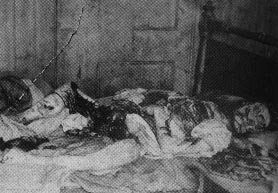
Jack's last victim: a logo, perhaps?

The city’s mayor has expressed concerns about the name, and good for him. This isn’t a manufactured political correctness complaint, based on the dubious logic that it demeans a group to honor it with an athletic team name. This is the opposite: a team name that honors a serial killer who disemboweled poor women in the slums of London in 1888. Misogyny isn’t cute or funny, and anyone who thinks that making Jack the Ripper a team symbol is anything but one more outrage perpetrated against his pathetic victims but gets indignant over the Atlanta Braves has his head on upside-down and backwards.

Now, I suppose it’s possible that an association of serial killers will protest that the name “London Rippers” dehumanizes them and puts them in the same category with lions, tigers and bears. In such an eventuality, I would side with the associations of lions, tigers and bears protesting that the name denigrates them. Sportswriting lawyer Craig Calcaterra, a sharp baseball mind whose NBC column alerted me to this story, somehow misses the point by a mile, writing:

“…Jack the Ripper did his work, like, 130 years ago. Murder is murder and it’s always awful, but at what point has enough time passed to where this kind of thing isn’t a problem?  And yes, I note the mayor’s nod to ending violence against women, but does a reference to a 19th century British serial killer who is more often fictionalized today than dealt with in his brutal reality really undermine those laudable aims?
I’m not saying it’s 100% fabulous. But really, kids were singing about Lizzie Borden taking an axe and giving her mother 40 whacks within a few years of that going down. Is it really too soon to be able to use a  long-dead historical figure as a mascot? There are a bunch teams called “crusaders” and the crusades were brutal. We still have Chief Wahoo around, and you can make an argument that the thinking behind that mascot (i.e. Indians are somehow less-than-human) represented way more death and destruction than anything Jack the Ripper did.”

Ugh. How many rationalizations are in this passage? Playground chants about Lizzie Borden (or the Black Plague, which is what “Ring around the rosey” is about) are not remotely comparable to naming a community’s baseball team after a serial killer. Playground refrains don’t become part of a community’s identity, and they don’t in any way bestow prestige on the dark subjects of their rhymes. Teams named after crusaders, warriors, braves and pirates don’t aspire to honor the deaths caused by these groups, any more than teams are named the Lions or Tigers because they have mauled people, or the Cardinals and Orioles are so named because the birds poop on our heads. There one reason, and only one, Jack the Ripper is famous. He slit the throats of desperate prostitutes and dissected them,: in the case of Mary Kelly, he minced his victim, leaving her internal organs on her night table. The London Ripper sent body parts of one victim to police, and taunted them. He didn’t possess a single admirable quality to justify a connection to a sports team, unless there are professional misogyny, mayhem or maniac leagues somewhere.

And Craig’s argument that is an expiration date on the offensiveness of trivializing tragedy is the worst of all. Seriously, Craig? So Penn State can call its wrestling team “the Molesters” in 100 years or so? What he’s really endorsing is ignorance. Kids who chant about the bubonic plague don’t realize it, and neither do their parents. That a lot of people don’t know the truth behind all the fictional Jack the Ripper tales is an argument for enlightening them, not pretending that killing prostitutes is just fun and games.

The mayor of London is right, Craig  is wrong, and if there ever was an inappropriate and harmful  team name, the London Rippers is it.

Ethics Quote of the Week: Charles Krauthammer

Let's see...nope! Still too good for Gaddafi!

“Under the normal rule of law, truth is only a means for achieving justice, not an end in itself. The real end is determining guilt and assigning punishment. But in war and revolution one cannot have everything. Justice might threaten peace. Therefore peace trumps full justice. Gaddafi could have had such a peace-over-justice compromise. He chose instead to fight to the death. He got what he chose. That fateful decision to fight — and kill — is the prism through which to judge the cruel treatment Gaddafi received in his last hours. It is his refusal to forgo those final crimes, those final shellings of civilians, those final executions of prisoners that justifies his rotten death.”

—- Charles Krauthammer, revered conservative columnist and pundit, in his column rebutting the complaints of human rights activists regarding the rebel execution that took Moammar Gaddafi’s life.

Krauthammer is right, and he is wrong. He is right that no one should feel any pity for Gaddafi, a brutal and inhuman despot who had it entirely within his own power to both save his own life and refrain from killing even more of his countrymen than he had killed already. He is wrong that Gaddafi’s crimes and cruelty suspend civilization’s principles of justice and ethics. Continue reading

Unethical Lawsuit Blame Games: The Eric Johnson Murder-Suicide

...I'm just going to blame you.

This is the kind of case that should never be brought to trial. It isn’t frivolous: I can see the theory of damages prevailing before a jury. It is just an unethical lawsuit. It is the kind of suit that attempts to exploit sympathy for the victims of a tragedy by using the court system to shift some of the burden from those victims to an innocent party. The strategy can work; it often does, in fact. It neatly uses human nature and the power of rationalization to reach a result that feels like justice, but is really the opposite.  This time, fortunately, the strategy failed.

Beth Johnson filed a wrongful-death lawsuit after her estranged husband Eric flew a private plane into her mother’s house, killing himself and their 8-year-old daughter, the only passenger. The suit against Eric’s flight instructor as well as the commissioners of Lawrence County (Indiana) and the county board of aviation commissioners alleged that they negligently allowed Eric, a student pilot, to fly solo. Continue reading

Comment of the Day: “Unethical Quote of the Month: Canadian Judge Joanne Veit”

The Comment of the Day, by Eric Monkman, is one of many excellent comments on yesterday’s post on the words of a Canadian judge in allowing a woman who murdered her newborn infant to go free.

There are many threads in the discussion, and I am not caught up. I officially apologize to combatants Eric and tgt especially for not being able to respond in sufficient detail, or in some cases at all, to their thoughtful posts. This an example of the limitations of the blog comment format. I wish I could organize a conference call.

The discussion went into so many directions that the initial post’s point was distorted, in part by me. Here is how I would summarize it:

Judge Veit’s quote, the actual focus of the post, strikes me as ethically offensive because 1) the statement that “many believe” abortion is a less than ideal solution to unprotected sex suggests that abortion is acceptable as a primary method of birth control. The commenters object to my interpretation of the judge’s phrasing to mean that she personally believes the adverse of the statement, that abortion is an ideal solution to unprotected sex. (The ideal solution to unprotected sex is not to have unprotected sex.) OK. I see their point. I still read it differently, and my comments are based upon my reading. At best, it is a sloppy, imprecise statement. 2) The comparison, and equivalency, between grief for the child—who is dead, and who was killed by the person who was most responsible for her welfare—and grief for the murderous mother, who is alive, and who is avoiding legal sanctions for her crime, shows a warped set of ethical values. The implication is that the life of a child is no more important, nor has any more regard from the society, than the emotional comfort of the mother. I know that is the standard in Canada, and in much of the US. It is wrong.

The subsequent discussion about how acceptance of abortion leads to acceptance of infanticide was focused on the U.S., but mistakenly assumed that this was the order of events in Canada. It was not; I think that is affirmatively strange, as one would assume that a human life would not be less valued in a society as it became more viable. It doesn’t change my analysis regarding the U.S., however.

Eric asks some good questions which I will address at the end. Here is his Comment of the Day, on “Unethical Quote of the Month: Canadian Judge Joanne Veit”: Continue reading

Unethical Quote of the Month: Canadian Judge Joanne Veit

“…While many Canadians undoubtedly view abortion as a less than ideal solution to unprotected sex and unwanted pregnancy, they generally understand, accept and sympathize with the onerous demands pregnancy and childbirth exact from mothers, especially mothers without support…Naturally, Canadians are grieved by an infant’s death, especially at the hands of the infant’s mother, but Canadians also grieve for the mother.”

—- Canadian Judge Joanne Viet, announcing that Katrina Effert, who strangled her newborn child and threw the body over a fence into the neighbor’s yard when she was 19, will serve a three-year suspended sentence with no jail time for the murder, reflecting a “fair compromise of all the interests involved.”

This is a cautionary ethics tale indeed for those who deny that a callous attitude toward human lives in the womb, giving them no standing against a mother’s desires and convenience, will gradually, inevitably, coarsen and warp a culture’s respect for life and its comprehension of wrong. [Addition: Many commenters have pointed out that Canada had designated infanticide as a relatively minor crime before fully legalizing abortion. That is a strange progression, though once infanticide had been declared “understandable,” abortions days were numbered. In the US, the gradual de-valuing of young life is moving in the more obvious way, from younger to older. The process, however, is the same.] Continue reading

Ethics Quiz: Is It Ethical to Confess to a Murder You Were Acquitted of Committing, or Merely Annoying?


Come on, O.J! If he can do it, so can you!

Isaac Turnbaugh of Randolph, Vermont recently confessed to the 2002 shooting murder of a co-worker, using a rifle to kill the victim as he was at work in the American Flatbread Co, stirring a pot of  sauce.  A jury acquitted Turnbaugh of the charges in 2004. In July, Turnbaugh contacted police and said, jury verdict notwithstanding, he indeed shot Declan Lyons in the head with the rifle and wished to surrender to authorities. Too bad, they told him. In the eyes of the law, you are “not guilty,” and have to stay that way. Double jeopardy and all that.

Your ethics quiz for today:

If you have been acquitted of a murder and have a guilty conscience about it, what is your most ethical course of action? Continue reading

Ethics Quote of the Week: Washigton Post Reader Elizabeth Grover

“Sun wrote: ‘Most doctors will not perform abortions beyond 22 or 24 weeks for various reasons, including legal concerns, social stigma, inadequate training or inexperience.’ She left out perhaps the biggest reason: Most doctors believe that late-term abortions are morally wrong.”

—-Elizabeth Grover of Washington, D.C., in a letter published in the Washington Post “Free for All” section. Reader Grover was commenting on a glowing Post profile of Maryland physician Dr. LeRoy Carhart by feature writer Lena Sun, extolling his willingness, indeed eagerness, to perform late term abortions, which are illegal in several states. Dr. LeRoy dismissed state restrictions on abortions of any kind as “ridiculous.”

Grover was absolutely correct to flag the bias and misrepresentation in Sun’s article. Continue reading

Ethics Dunce: Larry Flynt

BLECHHHH!

I know, I know. “In other news, the Earth spins, and the Atlantic ocean is wet!” Nevertheless, it is occasionally worth the trouble to remind ourselves what an unprincipled sleaze Larry Flynt is, especially with people still around who argue that he’s a hero.

Flynt announced on Nancy Grace’s show last night that talks are ongoing with Casey Anthony to have her nude and tattooed bod featured in Hustler magazine for $500,000 up front plus 10% of all profits. Flynt said he decided to make the offer after concluding there was a big market for seeing the acquitted child murder suspect in the buff. Continue reading

The Case of the Excessively Flexible Lawyer

A Louisville lawyer named Keith Kamenish wants to defend Dion Neal, a drug dealer, against a murder-for-hire charge.  A police informant wearing a wire recorded a hit man as he said  that he was paid by Neal to kill a competitor for him. “I put 36 slugs in that nigger’s face and stood on his head,” the independent contractor boasted, according to a transcript of the conversation filed in court. “The whole head collapsed!”

Nice.

The government is trying to get Kamenish kicked off the case, and here is why: the guy whose head collapsed, LaJuante “B.B.” Jackson, was a Kamenish client at the time of his murder. Jackson was shot just four weeks after Kamenish got Jackson released on bond on a state drug charge; the lawyer’s blood- stained business card was found in Jackson’s wallet. Continue reading

“Twelve Angry Men,” A Million Angry Fools, and the Jury System

Their defendant was probably guilty too.

Ethics Alarms All-Star Lianne Best sent me this link about a member of the Casey Anthony jury who is going into hiding because of all the hate and criticism being directed at jury members and their controversial verdict. Her plight, which must be shared by other members of the much-maligned jury, highlights the unethical, not to mention ignorant, reaction of the public to the Florida ex-mother’s narrow escape from a murder conviction she almost certainly deserved.

The problem begins with publicity. We may need to re-examine the logic behind broadcasting high-profile cases. The combination of live courtroom feeds and quasi-semi-competent commentary gives viewers the mistaken belief that they are qualified to second guess the jury, and they are not. They are not because the jury is in the courtroom, and the viewers aren’t. The jury and TV watchers see different things; individuals communicate different emotions and reactions in person than they do on camera. There is only one fair and sensible way to answer those on-line instant polls that ask, “Do you think Casey Anthony should be found guilty?”, and that is “I don’t know.”

Most of all, the viewers and pundits are not present in the jury room. Continue reading