None of my captions for this photo of Oliver Funes-Machado are in good taste. Pass.
I don’t know about you, but I’m thoroughly sick of the daily media stories about the hardship of illegal immigrant families being “torn apart” when a parenty finally is held accountable for breaching our borders and breaking U.S. laws. Here is a refreshing story about a likely deportation that everyone can get behind.
I hope.
ICE officials in North Carolina confirmed that Oliver Funes-Machado is an illegal immigrant, and I bet the news media makes sure the “illegal” is included when reporting on his case, if they do. The 18-year old has been charged with cutting off his mother’s head with a butcher knife.
This is unethical, by the way.
Originally from Honduras, Oliver is accused of repeatedly stabbing his 35-year-old mother before beheading her. He then walked outside, holding her head in one hand and the knife in the other, as he waited for Franklin County deputies to arrive. He called 911 to report the crime, just like a good citizen should .
“The state has a reason? Yeah, it does. Does it limit free speech? Dramatically. Are there other, less restrictive ways of doing it? We’re not sure, but we think probably. . . . Okay. End of case, right?”
—-Supreme Court Justice Stephen Breyer, during oral argument in the case Packingham v. North Carolina, describing how state laws are traditionally seen by the Court as infringing on freedom of speech.
Lester Packingham was registered as a sex offender in 2002 after pleading guilty to statutory rape with a 13-year-old girl (he was 21). He served his time and probation, and then, in 2010, Packingham posted on Facebook to thank the Lord for a recently dismissed parking ticket, writing, “Man God is Good! How about I got so much favor they dismissed the ticket before court even started? . . . Praise be to GOD, WOW! Thanks JESUS!”
Jesus, however, did not stop him from being prosecuted for that message under a 2008 North Carolina law that prohibits registered sex offenders from accessing social media, on the theory that it gives them access to minors.
Packingham appealed the resulting conviction, arguing that the law violated his First Amendment rights. The Supreme Court accepted the case, which could determine whether access to social media sites like Facebook, Youtube, and others are a fundamental right.
In oral argument this week, observers got the distinct impression that this is where the Court is headed. At least five justices, a majority of the temporarily reduced court, suggested during argument that they would rule against North Carolina and for Packingham , whose lawyer says that more than 1,000 people have been prosecuted under the law.
Reading various reports of what was said, I am stunned by how out of touch everyone involved sounds. The Washington Post story describes Justice Kagan like she’s a web-head because she’s “only” 59. “So whether it’s political community, whether it’s religious community, I mean, these sites have become embedded in our culture as ways to communicate and ways to exercise our constitutional rights, haven’t they?” Kagan asked North Carolina Deputy Attorney General Robert C. Montgomery, who was defending the law.
Do we really have to ask that question today? The law was passed in 2008, which in technology and social media terms makes it archaic. Legislators can be forgiven for not understanding the central role of social media in American life nine years ago, but in 2017, when we have a President tweeting his every lucid thought (and many not so lucid), how can anyone defend the argument that blocking a citizen from social media isn’t an extreme government restriction on free speech? Laws related to technology should all have sunset provisions of a couple years (a couple months?) to ensure that they haven’t been rendered obsolete by the evolving societal use of and dependency on the web, the internet, and new devices. Continue reading →
Somehow the story isn’t clear without Elsa in the picture, it it?
While national Democrats were desperately and embarrassingly search for some way, any way, to overturn the election of Donald Trump, the mania reaching apotheosis in the unhinged rantings of Michael Moore—“Trump is not president until 12 noon on Jan 20th. So we’ll continue to fight & hope to find a legal, nonviolent way to stop this madness,” the “madness” known as “losing an election”—Democrats, news media, and op-ed writers in the New York Times (but I repeat myself) have been loudly condemning the North Carolina Assembly as part of a condemnation of Republicans generally. After narrowly losing the State House, the overwhelmingly Republican legislature has been passing measures to limit the power of the incoming Democratic governor in a lame-duck legislative session. The changes drastically reduce the number of officials the governor can appoint within state government, require legislative confirmation of Cabinet-level appointments, eliminate partisan majorities in the state board of elections and strip the governor of the power to make appointments to the University of North Carolina Board of Trustees.
This is, according to Slate’s Mark Joseph Stern, for example, a “last-minute power grab” that “marks an alarming departure from basic democratic norms—a blatant attempt to overturn the results of an election by curtailing judicial independence and restructuring the government to seize authority lawfully delegated to the incoming Democratic governor.” By the end, he is foaming at the mouth with indignation:
“What’s happening in North Carolina is not politics as usual. It is an extraordinarily disturbing legislative coup, a flagrant effort to maintain one-party rule by rejecting democratic norms and revoking the will of the voters. It is the kind of thing we might expect to see in Venezuela, not a U.S. state. It should terrify every American citizen who believes in the rule of law. This is so much more than a partisan power grab. This is an attack on democracy itself.”
I was preparing to write something similar, but unlike Stern, I did some research first. What I discovered, however, thanks to the work of Volokh Conspiracy contributor Jonathan Adler, a Case Western law professor, was that as unethical as the General Assembly’s power grab is, the tactic is business as usual in the Tarheel State. Adler points his readers to the research of John Hood, who informs us…
Precisely four times in modern North Carolina history, voters have elected a new governor or lieutenant governor of one party and legislative majorities of the other party. In all four instances, the legislature stripped the newly elected executives of some power.
In the first three instances — Republican Gov. Jim Holshouser’s election in 1972, Republican Gov. Jim Martin’s election in 1984, and Republican Lt. Gov. Jim Gardner’s election in 1988 — a Democratic legislature did the stripping. As Martin’s biographer, I’m most familiar with his experience. Lawmakers limited his ability to staff agencies (including the State Board of Elections), subjected other appointments to constraints or confirmation, and withdrew gubernatorial control over state construction and administrative hearings, among other actions.
In each case, Republicans cried foul. Democrats insisted they were simply carrying out North Carolina’s longstanding preference for legislative supremacy….
Democrats upset with the special session might have been more persuasive had they chosen a different rhetorical strategy. Every time they accused GOP lawmakers of “unprecedented” acts, of “contempt for democracy,” of being “sore losers” and the like, all Republicans heard was hypocrisy. What happened in 2016 was different in detail, but not much in degree, from what happened in the past. A better argument would have been, “Yes, we Democrats went too far when we were in power. It often came back to bite us. Don’t make the same mistake.”
I am all for breaking the cycle. That will inspire greater trust and long-term thinking, from both sides.
Slightly after midnight on Monday, police in Bakersfield, Calif., received a call concerning a man thought to be brandishing a weapon in a residential neighborhood.
Shortly after police arrived, 73-year-old Francisco Serna — who family members said was suffering from the early stages of dementia — walked out of his home and into his driveway. When Serna, who was unarmed, did not comply with officers’ orders to remove his hands from his jacket pocket, one officer fired seven shots at him, killing him.
During a canvass of the premises that lasted at least until the following afternoon, police did not find a firearm on or near Serna. Instead, they found a crucifix.
Questions and Observations:
1. The shooting occurred two days ago, on December 12. There have been no organized protests, or community groups, family lawyers or anyone else suggesting that the shooting was murder, or an example of police animus toward the community. Why not?
2. The circumstances of the shooting were notably similar to the police involved shooting of Keith Scott in Charlotte, North Carolina, except that in the case of Scott, the officer believed the victim had a gun, and he did have a gun. Nonetheless, that shooting triggered two days of rioting. Why?
3. In the Scott shooting, both officer and victim were black. In the recent shooting in Bakersfield, officer and victim were white. Why did one shooting become a racial incident and the other not, when the conduct of the police officers were essentially identical, and the provocation for the shootings were similar as well?
4. One difference in the two episodes is that in Charlotte, a false narrative was launched by a family member to make the shooting appear to be a case of excessive force with a police cover-up. Is it just felicitous that this did not occur in Bakersfield, or was the Charlotte episode different in some way that caused events to resemble the aftermath in the Ferguson and Freddie Gray police-involved deaths?
5. If Francisco Serna had been black and all other facts the same, is there any reason to believe that the aftermath, including recriminations, accusations and attacks on police, the justice system and the nation’s culture, would have been any different than they have been every time an unarmed black man, or a black man who was reported as being unarmed, has been shot by police? If there is not, what does that tell us? Continue reading →
Yesterday, Mecklenburg, North Carolina District Attorney Andrew Murray announced that the investigation into September’s fatal police shooting of Keith Lamont Scott had found no legal wrongdoing. This meant, in addition to the fact that officer Brently Jackson, who is black, would not face trial, that the two-days of riots inflicted on Charlotte after the Scott’s death were even more inexcusable than riots generally are. People who claimed on social media that they had seen the shooting and that Scott was unarmed admitted to investigators that they hadn’t seen what they said they saw. Evidence in the case showed that Scott stepped out of his SUV holding a gun—his DNA was retrieved from the weapon found at the scene—and ignored at least ten commands from the five officers on the scene to drop it. Individuals who behave like that are likely to get shot, and deserve to be. No case, no outrage, no systemic racism.
Following the shooting, however, this was a Mike Brown encore, complete with angry, loud, false accounts and social media rumors focused on making Scott’s death another rallying point for race-hucksters, politicians who felt they could benefit from dividing the country by color, and irresponsible pundits.
Someone firebombed a Republican Party office in North Carolina over the weekend, and added some graffiti telling “Nazi Republicans” to leave town. Police are investigating; I don’t know why, since Donald Trump, responsible and fair as ever, already announced that the Clinton campaign did it.
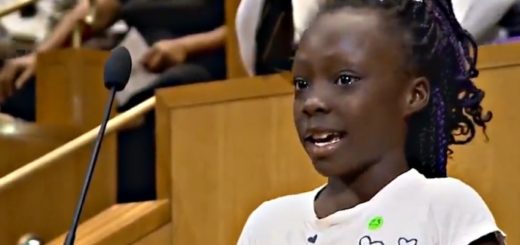
9-year-old Zianna Oliphant spoke at a Charlotte City Council meeting about race, police violence, and reform. Tears streamed down her cheeks, and, of course, the video “went viral.” She has kept talking, expert on urban governance and law enforcement that she is, since she earned her fifteen minutes of fame. “I was just feeling like what the police are doing to us, just because of our skin, is not right,” the fourth-grader told NBC.
Of course, she knows absolutely nothing about the issues involved. She has no idea whether what happened to Keith Lamont Scott was ” done to us, just because of our skin” or done to him, because he threatened a police officer. (It was done to him, by a black cop, who, if he was doing it because of the color of Zianna’s skin needs to be put on a suicide watch.)
All Zianna knows is what she has been taught, and based on what she said, she has been indoctrinated by her family and community into be a police-fearing, anti-white racist. Now that this is happening to the black children of Charlotte and elsewhere is important information that should be part of the discussion, but that’s not how her statements are being used. She is being exploited by adults who know that their opinions become more persuasive coming out of the mouths of babes, and she is being accorded undeserved moral authority because she is young and innocent. Zianna also has a fourth grade education and maybe six years of life experience. Wow.
What can such an individual contribute to a public policy debate so complex that elected officials, scholars and public policy experts don’t know how to proceed? Nothing. N-O-T-H-I-N-G. A nine year-old girl, even the most brilliant nine-year-old girl who has ever lived, is useless. A City Council that would waste deliberation and consideration of critical issues on the testimony of children, however moving, should just hand in their resignations en masse. They are incompetent and a disgrace.
In the alternative, Charlotte should give voting privileges to anyone over the age of five. Maybe they will. Continue reading →
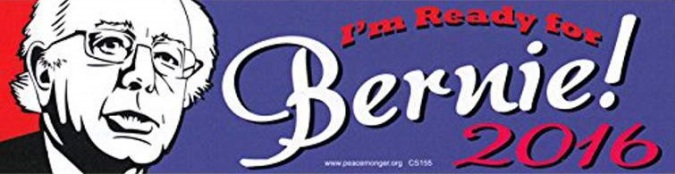
In Ashville, North Carolina, tow truck driver Ken Shupe arrived on the scene to find motorist Cassy McWade standing by her accident-disabled vehicle on Interstate 26. “He goes around back and comes back and says ‘I can’t tow you,” Wade told a reporter. “My first instinct was there must be something wrong with the car. And he says, ‘No, you’re a Bernie supporter.’ And I was like wait, really? And he says, ‘Yes ma’am,’ and just walks away.”
“Something came over me, I think the Lord came to me, and he just said get in the truck and leave. And when I got in my truck, you know, I was so proud, because I felt like I finally drew a line in the sand and stood up for what I believed.”
A few quick points and then I’ll get to the real issue:
1. Shupe is an utter, virulent, IQ-deficient jerk whose conduct and attitude makes a mockery of whatever faith it is cursed to have him belonging to it, and constitute a blight on the society, community,culture and nation so unfortunate as to be stuck with him.
2. News reports make a big deal out of the fact that McWade is confined to a wheelchair. Ah: the theory is that we are only obligated to help our handicapped neighbors in need, is it? It shouldn’t matter if she was an Olympic medalist in the 50 yard dash. You don’t treat other human beings like that in any society that values human rights and common decency.
3. Shupe’s company isShupee Max Towing in Traveler’s Rest, South Carolina.Nobody in their right mind should patronize this unAmerican creep, including his own family. This was anti-social, cruel and objectively horrible behavior toward someone in need, and Shupe needs to be shunned, hard. If he can’t co-exist with others any better than this, he needs to live in a cave somewhere, because he’s not fit for human association.
4. To anticipate an objection: you may ask how it is that I can argue that friendship should outweigh political differences and advocacy of unethical conduct, and yet designate Ken for ignominy and rejection. If Ken were a friend of mine, I can see myself standing by him even after this miserable behavior. But, as Samuel L. Jackson tells John Travolta in “Pulp Fiction,” “We’d have to be talkin’ about one charming motherfucking pig.”
In a way, however, we should be grateful to Ken Shupe, who has provided in short order and timely fashion a near perfect example of the society-wrecking virus being actively spread by irresponsible zealots on both ends of the political spectrum who are determined to divide the nation and the culture as never before. Yes, never before. During the American Civil War, generals on opposite sides of some of the most bloody battles ever fought arranged to meet and exchange pleasantries, because they had been, and remained, friends. They understood what the self-righteous tow-truck operator, and, increasingly, our entire society, doesn’t. Continue reading →
It is sobering to read the hateful and contemptuous comments from so many of my Facebook friends about the legislators of Georgia, Indiana, North Carolina, Mississippi and other states that have either passed or have tried to pass laws allowing citizens to opt out of the cultural freight train that gives them the option of boarding or getting crushed. Whether these are “religious freedom” laws or “bathroom laws,” aimed at transgendered interlopers in the once orderly realm of public bathrooms, or whether they are designed to fight for the definition of marriage as “between a man and a woman,” these laws, every one of them unwise and unethical, and probably unconstitutional too, need to be regarded as the inevitable and predictable result when human beings are forced to absorb cultural shifts in a matter of years or less that properly would evolve over generations
Culture–what any society, country, region, religion, business, organization, club, family, secret society or tree house agrees over time as how they do things, think about things, what is right and what is wrong, what is remembered and what is forgotten–is a constantly evolving process. Efforts to freeze it inevitably fail, because human beings as a species can’t stop themselves from learning. Efforts to rush the installment of major changes, however, can be disastrous, even when there seems like no alternative but to rush.
Laws don’t automatically change culture. They are part of the process, both reflecting and facilitating cultural shifts, as well as institutionalizing them. They do not even mark the end of such shifts. Nobody should be surprised, angry or abusively critical when those who have been raised to believe in certain values and practices feel betrayed and mistreated, and see the need to resist when their sense of what is right is suddenly proclaimed as not only wrong but the sign of a character deficiency and a cause for denigration and disrespect. Continue reading →
[CORRECTION:The original version of this post erroneously identified Richardson as a Republican. He is a Democrat. Ethics Alarms apologizes for the error. As far as the assessment of the conduct goes, I do not believe it makes any difference, however.]
Billy Richardson’s rational-sounding, remorseful, full-throated endorsement of diversity and respect for LGBT Americans is the most disgusting and damning piece of political weaseldry I have ever seen, and, I desperately hope, ever will see. This man voted for the new North Carolina law that validates oppression against gays and transgender individuals, and now “upon prayer and reflection,’ suddenly sounds like Dan Savage on a polite day. The law is a travesty, he says. It undermines the right to be free of discrimination based on one’s sexual orientation, he says. I agree with him, but why did he vote for the bill in the first place, and why is he suddenly a passionate human rights advocate now?
I can answer both questions, because they have the same answer. Both his vote and his sudden reversal are the result of having no principles, not integrity, no core beliefs, no courage, no honesty, and no business holding high office. The law was not mysterious: it is blatant in its objective and philosophy. Voting for such a bill is signature significance: no one who has any respect of regard for LGBT citizens, their families, or the Constitution under which they live would consider voting for such a law, unless the official voting just casts his votes according to where he senses the winds are blowing, and regards politics as a game of profit, like playing the stock market. Once the law provoked violent opposition and the likelihood that the 1) the state would lose revenue and jobs and 2) the fools who voted for such a despicable measure would pay a dear price, Richardson was suddenly filled with contempt for those “who would demonize a group of citizens to gain political advantage and to advance an unjust agenda.” You know, like him.
“Instead of recognizing the right to be free of discrimination based on one’s sexual orientation, HB2 gives green light to this discrimination in housing, employment and other areas,” he writes. “To paraphrase Supreme Court Justice Anthony Kennedy, we must never make any group of citizens a stranger to the laws of their own state.”
Gee, who sent that quote to him, God? He does tell us he was praying about this, after all. Boy, Richardson is quite a walking advertisement for the power of prayor! Just like that, BOOM!, his entire political, sexual and civil rights philosophy changed, and his favorite songs became “Kumbaya,” “We Shall Overcome,” “This Land is Your Land,” and “YMCA.”
Richardson is insulting his state’s citizens by showing that he regards them as gullible fools, and perhaps they are. I know that the foes of the bill will be happy to use him now as a politician who, mirabili dictu, has seen the light, even though he has outed himself as a cowardly, principle-free liar.
Does one of his bigoted colleagues who will fight like a rat to defend this awful law deserve more respect than Richardson? Absolutely! Richardson is the soldier who will switch sides as soon as it is clear that his own side is losing. He is the epitome of what Donald Trump’s supporters believe all politicians are–soulless, untrustworthy, craven, glib and able to wrap themselves in any disguise for a single purpose: their personal profit and survival. Such politicians are useless to anyone, and the scourge of democracy. Continue reading →