
Ethics Dunces: PayPal, And Those Applauding Its Unethical Grandstanding

PayPal-logo-1

The online payments company PayPal announced that it is cancelling plans to open an office in Charlotte, North Carolina because the state’s so-called “bathroom law” “violates PayPal values.” Dan Schulman, PayPal’s president and chief executive, wrote in a statement this week:

“The new law perpetuates discrimination and it violates the values and principles that are at the core of PayPal’s mission and culture. As a result, PayPal will not move forward with our planned expansion into Charlotte.”

My many knee-jerk progressive Facebook friends immediately slapped their seal-flippers together and barked their approval in unison. “I (heart) PayPal!” more than one wrote. “PayPal is my hero!” wrote others.

Never mind that a corporation has no business using financial muscle to exercise extra-legal vetoes over legislation in states where it is not a citizen and where the actual citizens, in their legal exercise of their rights, have elected representatives who duly passed it. This cheering on excessive and abusive influence on governance by big corporations is especially hypocritical coming from supporters of Bernie and Hillary, who regularly claim that allowing companies the right to engage in political speech magically robs voters of their ability to reason and causes all to vote, zombie-like, according to corporate America’s will.

This is why Bernie Sanders and Donald Trump are leading…wait, that doesn’t make sense, does it? Actually none of the popular and media attacks on Citizens United are grounded in reality, law, or comprehension of the Constitution, and virtually none of the indignant opponents of the decision have read it or listened to the revealing oral argument. But I digress. The point is that the progressives endorse the practice of corporations using their power to warp the system in directions progressives like, but believe that this—this meaning bullying, threats and coercion— is the only form of influence that should be allowed—certainly not speech and advocacy.

That is just half of what makes the cheering for PayPal foolish and cynical. For PayPal is playing these people like a harpsichord, and indulging in outrageous, hypocritical grandstanding. Moving an office into North Carolina where the bathroom privileges of trans citizens are being restricted “violates the values and principles that are at the core of PayPal’s mission and culture,” but somehow… Continue reading

North Carolina’s Conflicted, Disloyal, Unethical Attorney General, Roy Cooper

A candidate masquerading as a lawyer...

A candidate masquerading as a lawyer…

Roy Cooper, North Carolina’s elected Attorney General, has so many conflicts of interest that he can’t credibly do his job in an ethical manner. Fortunately for him doing his job ethically seems to hold no interest for him.

To start with, he is an announced political opponent of the current Republican governor, Pat McCrory. This situation is not unique, but if an Attorney General is going to do his job ethically, for remember he is the state’s lawyer, he has to make an effort to put his political interests aside and not allow them to interfere with his duty to represent his client the state, whose voters have made McCrory its top decision-maker.

Cooper, however, isn’t making any such effort. House Bill 2, a state law passed last week that bars local governments from enacting nondiscrimination protections for the LGBT community, is anathema to Cooper’s constituency, so he is refusing to defend it in court against a federal lawsuit. If he were a private attorney whose beliefs rendered it impossible for him to represent his client, Cooper would have to resign. Since he is elected, he need not do that, but he can’t actively interfere with his client’s legal needs either. His proper course under the legal ethics rules governing all lawyers would be to find an outside counsel to do his job in this case, since he is incapable of doing it, and to defend the law.

Instead, Cooper is actively undermining his client’s legitimate objectives.  Cooper said in a news conference that the law is a “national embarrassment” and it “will set North Carolina’s economy back if we don’t repeal it.” That’s the candidate talking, not the state’s lawyer, and thus the state’s lawyer is engaged in a bright-line breach of loyalty by talking like that in public. His duty, and his only ethical option, is to shut up. He may not be able to support his client’s objectives, but he absolutely must not impede them.

Cooper has even gone beyond that ethical violation to a massive conflict of interest breach. Instead of defending McCrory, the Board of Governors and the others being sued in the federal lawsuit, Cooper has announced that he will defend the two LGBT people and the lesbian professor bringing the lawsuit against the state! Continue reading

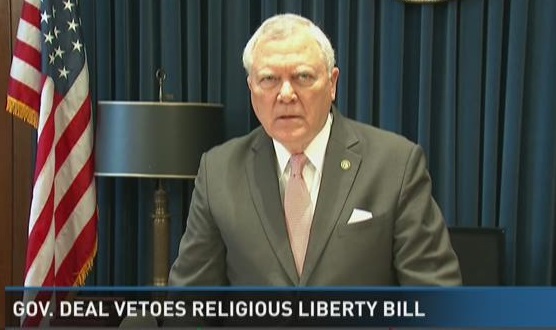
Georgia’s Religious Liberty Bill Was An Ethics Abomination, But So Is Letting Corporations Dictate Laws In A Democracy

...and corporate pressure had nothing to do with it. No, really.

…and corporate pressure had nothing to do with it. No, really.

Ethics Abomination I: Georgia’s HB 757

Gov. Nathan Deal  vetoed the controversial  “religious liberty” bill yesterday. Well, good. HB 757 was an ugly, ignorant, unethical  law in many ways, and almost certainly unconstitutional on its face.

It began with outrageous fear-mongering, appealing to right-wing hysteria and ignorance…

[R]eligious officials shall not be required to perform marriage ceremonies, perform rites, or administer sacraments in violation of their legal right to free exercise of religion; to provide that no individual shall be required to attend the solemnization of a marriage, performance of  rites, or administration of sacraments in violation of their legal right to free exercise of religion;

Ridiculous. No law, state or national, can require a pastor or minister to perform a wedding, nor could any citizen be required to attend one. These are both unalterable First Amendment no-nos, and any legislator who doesn’t know that is too ignorant to hold office. Laws should not be sops thrown to slobbering mobs, and that’s what this part of the law is—unless it’s proof that Georgia legislature is itself a slobbering mob.

Then the law ends by greasing the wheels for outright anti-LGBT discrimination:

Except as provided by the Constitution of this state or the United States or federal law, no faith based organization shall be required to hire or retain as an employee any person whose religious beliefs or practices or lack of either are not in accord with the faith based organization’s sincerely held religious belief as demonstrated by practice, expression, or clearly articulated tenet of faith.

A refusal by a faith based organization to hire or retain a person pursuant to subsection (b) of this Code section shall not give rise to a civil claim or cause of action against such faith based organization or an employee thereof or result in any state action to penalize, withhold benefits from, or discriminate against the faith based organization or employee based on such refusal.

You have to really, really hate and fear gay citizens not to reject such a bill. Continue reading

Justice vs. Process: The Case Of The Final, Mandatory, Unjust Sentence

African American in Prison

A full panel of the U.S. Court of Appeals for the 4th Circuit, fifteen judges in all, heard arguments this week  regarding whether they have the power to do anything about Raymond Surratt Jr.’s mandatory life sentence, which just about everybody—-the sentencing judge, Surratt’s defense lawyers and government prosecutors—agrees is unjust.

Until the Surratt case, no federal appellate court has faced the question of  whether a court it has a route to correcting a mistake of its own making when the error is as severe as a mandatory life sentence. The North Carolina father of two is incarcerated at a federal facility in Virginia for a 2005 cocaine conviction. If Surratt were sentenced today, he would face a mandatory minimum penalty of only ten years in prison. If he had been sentenced under current laws in 2005 rather than the laws then in effect, he would be out of jail by now.

Surratt pleaded guilty in 2005 to conspiring to distribute at least 50 grams of cocaine in western North Carolina. The judge said he had no choice under sentencing guidelines other than  to give him a mandatory life sentence because of Surratt’s earlier drug convictions. The judge called the penalty “undeserved and unjust.”

The conviction and sentence were upheld after Surratt’s  appeals. Now he has no appeals left. But in 2011, the 4th Circuit, which includes North Carolina, overruled past practice, meaning that it held that prior convictions as in Surratt’s case should not trigger a mandatory life term.

Now, I know that non-lawyers react to this by thinking, “So what’s the problem? Let him out!” That’s in line with the reaction they have when they hear about a defense lawyer who knows his mad-dog killer defendant is guilty of a heinous, bloody crime (“So tell the judge!”). However, the law can’t be changed on the fly, and the fact that a result may be obviously wrong doesn’t change the importance of addressing it within existing procedures, rules and laws. In this case, no more appeals means no more appeals.

The Surratt case involves the important judicial principle of finality. Prof. Steven H. Goldblatt, who runs Georgetown Law Center’s  appellate litigation clinic, told the court that finality is of vital importance to the legal system. Agreeing, a majority of the Fourth Circuit panel said last year that… Continue reading

The North Carolina Transgender Bathroom Freak-Out, LGBT Activists And Shared Accountability For An Ethics Train Wreck

rest rooms gender

Yes, the new North Carolina anti-LGBT law is excessive, dumb, an over-reaction and probably unconstitutional. More than that, however, it is an example what can happen when the proponents of opposing views refuse to listen to or respect each other, don’t attempt to minimize bitterness and conflict, and prefer to settle problems by going to war. The law exemplifies the ignorance, fear and reflex defensiveness of human beings when faced with inevitable cultural change, but it could have been avoided if LGBT activists and advocates had not demonized their opponents and used political leverage to push for extreme positions that were neither necessary nor clearly correct.

North Carolina’s conservatives are horrified at the idea of biological males being allowed to use women’s rest rooms when the “males” identify as female, so the state passed a law that appears to allow all forms of discrimination based on gender and sexual orientation. The new law establishes a statewide nondiscrimination ordinance that explicitly supersedes any local nondiscrimination measures. The statewide protections cover race, religion, color, national origin and biological sex,  but not sexual orientation or gender identity. Whether it is intended to do so or not, this seems to say that in the eyes of North Carolina, discrimination against LGBT citizens is fine and reasonable.

Well, it isn’t, and thus the law itself is unethical—incompetent, irresponsible, unfair, unjust, uncaring, and disrespectful.

Good job, State legislature,  Gov. Pat McCrory, and North Carolina. You’re all an embarrassment to the nation.

Still, this whole mess  occurred because activists couldn’t come up with a reasonable accommodation that would still the concerns of those old fashioned citizens who think ladies rooms shouldn’t be frequented by people who can pee standing up, while still meeting the minimal requirements of the Caitlyn Jenners of the world. Continue reading

The Greensboro College “It Stops Here” Ethics Train Wreck

Everybody’s unethical here.

As usual, however, it starts at the top.

It Stops HereGreensboro College in North Carolina  adopted a new policy on student sexual misconduct, and it requires all first year students to attend a performance of  a one hour play, “It Stops Here,” written and directed by student Michaela Richards, based upon “accounts of sexual assault submitted by survivors.”

Ethics Foul 1 (Greensboro): A female-authored play based on “survivors” accounts is a one-sided, biased and ideological work by its very nature. Do we know that the real incidents are being fairly represented, or would the claims of a “Mattress Girl” be included? Presumably proof of “sexual assault” is being validated by the infamous “Dear Colleague” letter from the Obama Administration that has led to multiple examples of male students being harshly punished in violation of basic due process principles.  It is entirely written from a woman’s/alleged victim’s point of view, and thus certain to be received as hostile and unfair by male students.

Ethics principles violated: Responsibility, honesty, fairness, competence.

Ethics Foul II (Greensboro): Using a work of fiction to inform students about a policy is incompetent. Fiction is always infused with the viewpoint, agendas and biases of the playwright; in this case, such a work is bound to be political. A sincere effort to instruct students on policy should have no political content at all.

Ethics principles violated: Abuse of power, responsibility, respect, competence.

Ethics Foul III: Forced viewing of a work of art isn’t instruction, but indoctrination. In a play, any audience member should have the option of walking out. This is especially true of a play written and performed by amateurs. “The student actors on stage are telling stories of an extremely sensitive nature that should be viewed in a respectful manner,” the president of the college said. “We expect no less of our students, who should know better than to make light of an extremely serious subject that affects us all.” WRONG. Forcing students to watch a play consisting of a slanted view of the sexual assault issue on campus is not respectful. It is, in fact, an insult and a provocation.

Ethics principles violated (Greensboro): Abuse of power, respect, fairness, prudence, regard for personal autonomy.

When people, especially young people and especially American young people who, thank heaven, are still imbued by the culture with a natural detestation of arrogant authority and the courage to defy it, are commanded to do something they shouldn’t be, like to watch an agitprop play, they tend to resist. They did, too:

Members of the audience frequently heckled the cast and shouted sexually explicit remarks.“Many of the boys started calling out ‘She wanted it, it’s not rape,’ and making masturbation noises,” stage manager Claire Sellers told a local news station. Sellers said the remarks were so excessive that cast members “became physically ill and vomited after the show because they were so vulgar.”

Continue reading

The Sexting Persecution Of Cormega Copening

sexting

Charging kids with crimes for sexting themselves to a fully consenting fellow kid always seemed excessive and cruel to me. This story is the reductio ad absurdum that settles the matter.

In Fayetteville, North Carolina, 17-year-old Cormega Copening and his girlfriend Brianna Denson, also 17, began exchanging naked photos of themselves in text messages when they were 16. They were the only ones who saw the pictures, but someone somehow tipped off local authorities, who searched Copening’s phone and discovered them.

Copeling and Denson were charged with sexual exploitation. The Cumberland County Sheriff’s Office concluded that Denson had committed two felony sex crimes...against herself. A warrant cited her as both the adult perpetrator and the minor victim of two counts of sexual exploitation of a minor, second-degree exploitation for making her photo and third-degree exploitation for having her own nude photo in her possession. A conviction could have put Denson in prison and would have required her to register as a sex offender for the rest of her life. Denson pleaded guilty to a lesser charge and was given 12 months of probation.

Her sexting partner Copening, however, is still facing as much as ten years prison time for two counts of second-degree sexual exploitation and three counts of third-degree exploitation. As with Denson, the third-degree charges arise out of the pictures Copening had of himself.  That’s not the worst of the mind-twisting logic of this prosecution, however. North Carolina is one of two states in the country (the other: New York) that makes 16  the age of adulthood in the criminal system. The state’s consent laws consider anyone 16 and under a minor, but allows minors 16 or over to be charged as adults.

Gilbertian result: Copening is facing conviction, as an adult, for exploiting a minor—himself. Continue reading

“Jaws” Ethics: A Real Life Larry Vaughn Models Rationalization #49, “It Would Have Happened Anyway”

Jaws

Wait, I’ve seen this movie!

From the Associated Press:

OAK ISLAND, N.C. (AP) — The mayor of a coastal North Carolina town where two young people were severely injured in shark attacks this weekend says she doesn’t think emergency workers had enough time between incidents to close the beaches. A 12-year-old girl was attacked just after 4 p.m. Sunday in Oak Island, and a 16-year-old boy was attacked less than two hours later about two miles away. The girl lost part of her arm and suffered a leg injury. The boy lost his left arm…

Beaches were open for the two-hour stretch Sunday but closed after the second attack.

Oak Island Mayor Betty Wallace told The Associated Press on Monday that she didn’t think that gave workers enough time to decide to close the beach between attacks. …Wallace says that even if the beach had closed after the first attack, the order might not have extended to the area of the second incident.

It was unclear whether the same shark attacked them…

The beaches were open Monday, with a boat and a helicopter patrolling the water.

OK, I know what happens next! The helicopters spot a fin in the water, and there’s a panic on the beach, and it turns out to be two kids with snorkels and a fake shark fin. The younger boy points to his brother and says, “He made me do it!” Meanwhile, the Great White goes over to the lagoon and bites the leg off a guy with a bad fake Boston accent.

If, as I suspect, Mayor Wallace is Amity Mayor Larry Vaughn come to life from “Jaws” and identifying as a woman as well as disguising herself accordingly to get another job as a resort town mayor—which means that she is a woman, of course—then old Larry sure has a flat learning curve. On the other hand, if Mayor Wallace isn’t Larry Vaughn, someone needs to make her watch “Jaws,” quick. Is it unethical—irresponsible, negligent, incompetent— for any Mayor of a coastal town not to be aware of the lessons of that film?

I think so. Continue reading

Fugitive for 39 Years Turns Himself In For Free Health Care…Wait, WHAT??

"Oh, Mr. Moore? We have that bed you made 39 years ago. Now lie on it."

“Oh, Mr. Moore? We have that bed you made 39 years ago. Now lie on it.”

From NBC:

“…Clarence David Moore, 66, called the Franklin County (Kentucky)Sheriff’s Office on Monday and said he wanted to turn himself in, the sheriff’s office said. When deputies arrived, they found Moore — who’d been living in Frankfort since 2009 and had ID’d himself as Ronnie Dickinson — partially paralyzed and unable to walk because of a recent stroke. He was arrested and taken by ambulance to a hospital for examination before he was taken to the Franklin County Regional Jail.

“Sheriff Pat Melton told NBC station WLEX of Lexington on Tuesday that Moore said he’d escaped from the Henderson County, North Carolina, Prison Unit in the mid-1970s and has been on the lam for almost four decades. But as he got sicker, he couldn’t get medical coverage to pay for the complications of his stroke and other health problems, because he doesn’t have a valid Social Security number under his alias…Moore was arraigned Tuesday morning and waived extradition to North Carolina on a charge of being a fugitive from another state. He was being held without bond pending his being returned sometime this week….”

I hate to appear uncharitable, but I don’t understand this at all.

Moore chose to defy the justice system for 39 years, and now wants to get the benefit of it on his terms, when it’s useful and convenient to him?

He chose to avoid paying his debt to society. Society certainly has no debt to him. The ethical course is for the North Carolina’s governor to pardon Moore, and allow him to fend for himself, stroke or not. For taxpayers to have to foot the bill for a felon’s health care when he has shown nothing but utter contempt for the justice system is a travesty of justice, logic and ethics. If it’s compassion at issue, take the money that would have to be spent on Moore and use it to help an elderly law-abiding citizen who can’t pay his medical bills.

Or burn it.

Does the State have some subtle ethical obligation to the fugitive that I’m missing?

Ethics Hero: Sterling Karrenstein

mobile_phone_cameraAt West Iredell High School in Statesville, North Carolina, student Sterling Karrenstein witnessed a resource officer using a taser to subdue a fellow student who punched the officer in the face. As he documented the incident on  his cell phone, school staff attempted to stop Sterling, demanding that he hand over the phone and even attempting to take it from him. He refused. The school principal apparently later told Sterling that being on school property eliminated his right to record events.

Wrong.

At least someone knows what is in the First Amendment. Obviously Sterling didn’t learn it at West Iredell High School, but Ethics Alarms salutes him for insisting on his rights as a citizen despite being pressured to do otherwise by incompetent authority figures.

If it is not disrupting class, infringing on the privacy of others or otherwise violating school policy, taking photos or video is a fully protected right.

This does not mean, it is important to note, that tasering a student who punched him was necessarily wrongful conduct by the officer.

______________________

Pointer: Tim LaVier