Bret Stephens’ Capitulation To New York Times’ Anti-Second Amendment Culture

The New York Times, to nobody’s surprise, is all-in to assist its progressive compatriots in using  every tragedy involving guns to strip away the core individual right to bear arms.  The op-ed pages and website , have, once again, become an oppressive barrage of anti-gun fanaticism and disinformation. Take this morning, for example. There is Timothy Eagan’s claim that the Second Amendment is a “cancer in the Constitution.” “The Second Amendment,” he writes, in the process of declaring the individual right enshrined in the Amendment abd confirmed by the U.S. Supreme Court as null and void, “as applied in the last 30 years or so, has become so perverted, twisted and misused that you have to see it now as the second original sin in the founding of this country, after slavery.”

Other aspects of American ideals, traditions, values and cultures that Eagan’s allies on the Left also consider cancers would include, I imagine, the Electoral College, Due Process (see: the Obama Education Department’s now defunct “Dear Colleague” letter), Freedom of Speech (“Hate speech kills!”), Freedom of Religion,  Equal Protection,  the Commerce Clause and, of course, the requirement that impeachment has to be based on a substantive crime. We get it, Tim: the Constitution is an infuriating roadblock to turning the U.S. and its culture into a clone of Sweden.

Then there is David Brooks, once the token conservative among the Times otherwise leftist columnists until his brain was removed while he slept and thoroughly washed. In today’s exhibit of Brooksian pseudo-intellectual gobbledygook, he bemoans “the left’s massive failure to persuade.” (The failure to persuade in this case is based on an escalating failure to be honest, vilifying adversaries, and the fact that the left’s strategy is based on emotion a biased presumption that the right to bear arms is “a cancer on the Constitution.”) Brooks also begins with that assumption, but as usual buries his motives in false objectivity: he writes, for example,

“The research doesn’t overwhelmingly support either side. Gun control proposals don’t seriously impinge freedom; on the other hand, there’s not much evidence that they would prevent many attacks.”

Then he declares the controversy an “epiphenomenon”—I think I know what that means, but I don’t trust writers who use words like that—to end with,

“Today we need another grand synthesis that can move us beyond the current divide, a synthesis that is neither redneck nor hipster but draws from both worlds to create a new social vision. Progress on guns will be possible when the culture war subsides, but not before.”

Brooks began with the presumption that “progress on guns” means acceptance of the anti-gun position on guns. Of course he did.

The day before, the New York Times’s new token conservative columnist had thrilled the anti-gun Left with his latest column, ‘Repeal the Second Amendment.

He deserves credit in one respect: unlike his liberal colleagues who would kill the individual right to gun ownership by incremental cuts, at least Stephens is honest. His arguments, however, are lazy and shallow. Indeed, the entire piece reads like clickbait , or perhaps something written with an editor’s gun—well, crossbow—at his head.

He writes, “From a law-and-order standpoint, more guns means more murder. “States with higher rates of gun ownership had disproportionately large numbers of deaths from firearm-related homicides,” noted one exhaustive 2013 study in the American Journal of Public Health.”  This is a fake and misleading stat arrived at by including suicides among actual murders. Since 1990, the homicide rate has dropped like stone while gun ownership has risen. “More guns mean more murder” is not even a defensible opinion; it certainly isn’t fact. He should have checked with David Brooks on that.

The whole essay is like this, however, He begins by writing, “I have never understood the conservative fetish for the Second Amendment.” It’s not a “fetish,” and it’s not intrinsically conservative. Belief in the Second Amendment springs from a commitment to individual liberty and inherent suspicion and distrust of expanding governmental power that insists that only the State, and not the citizens it is supposed to serve, should possess deadly force.

In a terrific rebuttal in The Federalist, David Harsanyi writes, “As an American-Jew whose ancestors came here escaping both Nazism and communism, I totally ‘get’ the Second Amendment ‘fetishists.’And when I read columns like the one Stephens wrote today, I definitely get it.”  For Stephens’ argument reduces to “Resistance is futile”–Come on, he asks, how are a bunch of pathetic citizen gun owners going to resist the government? Better to just submit: I swear, we can trust these people! I work with them every day! They only want the best for everyone!” Stephens writes like he has Stockholm Syndrome. Continue reading

Unethical Op-Ed Of The Month: “Don’t Weaken Title IX Campus Sex Assault Policies” (The New York Times)

Do you know what this monstrosity of an op-ed finds outrageous about Betsey DeVos’s efforts to undue the Obama administration’s “guilty unless proven innocent”  standard for campus rape allegations?  It involves too much due process, as in basic fairness before a citizen is grievously punished and harmed by the determination that he or she has committed a crime.. The authors, Jon Krakauer and Laura L. Dunn, put it this way:

Damn right it does. Before someone is punished for a vile crime like rape or sexual assault, the accuser’s credibility and motives must be established. Astonishingly, with all the horrific examples of men being falsely accused of rape, like here, here, and here, the campus activists, feminists, progressives and the social justice warriors continue to insist that any female accuser should be presumed to be a victim, meaning that the accused is de facto presumed to be guilty.

“Sex-crime trials, like all criminal proceedings, set an extremely high bar for conviction to diminish the chance that an innocent person will be unjustly incarcerated. In contrast, the harshest penalty a university can inflict in a Title IX hearing is expulsion, an outcome that does not demand such a stringent burden of proof. In these hearings, neither party is favored, and by leveling the procedural playing field, Title IX makes it more likely that students will report sexual violence.”

The problem with this supposed fairness of “neither party is favored” is that for one party, there are no negative consequences of an insufficiently-supported accusation being rejected. For the individual accused, the stakes are far greater, life altering and potentially dire. More:

“Whenever a student is accused of sexual assault, university administrators need to render their judgment with tremendous care, because erroneously determining that a student is responsible for sexual misconduct can cause lasting harm. But just as much care needs to be taken to make sure that students who commit sexual assault are not let off the hook.”

In other words, the ends justify the means. This is the same mindset expressed in 2015 by Democratic Congressman  Jared Polis, at a congressional hearing on campus sexual assault. 

He said, earning him an Unethical Quote and an Incompetent Elected Official designation on Ethics Alarms,

“If there’s 10 people that have been accused and under a reasonable likelihood standard maybe one or two did it, seems better to get rid of all 10 people. We’re not talking about depriving them of life or liberty, we’re talking about their transfer to another university.”

Krakauer and  Dunn similarly shrug off the consequences to a young man of being falsely tarred as a rapist and kicked out of school: it’s not like staying in the college you enrolled in is a right. Like Polis, they pretend that there are minimal adverse life consequences from being branded a rapist. Continue reading

Unethical Quote Of The Week: NYT Columnist David Brooks [UPDATED}

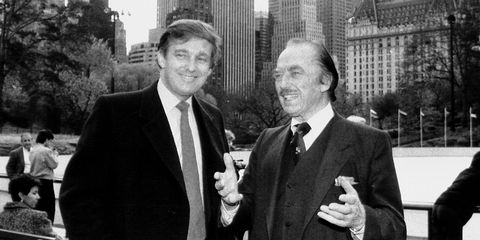
“Biographies describe a man intent on making his fortune and not afraid of skating near the edge to do so. At one point, according to Politico, federal investigators found that Frederick used various accounting measures to collect an extra $15 million in rent (in today’s dollars) from a government housing program, on top of paying himself a large “architect’s fee.” He was hauled before investigating committees on at least two occasions, apparently was arrested at a K.K.K. rally in Queens (though it’s not clear he was a member), got involved in a slush fund scandal with Robert Wagner and faced discrimination allegations.”

—New York Times columnist David Brooks arguing that Donald Trump, Jr.’s conduct in holding the controversial meeting  with some Russians and Russian-Americans to acquire useful negative information about Hillary Clinton for his father’s campaign came about because his family is just no damn good, as shown by the conduct of Fred Trump, the President’s storied father.

Unlike some commentators, I have no ethical problem with Brooks’ basic thesis. Culture molds ethics, children are influenced by the conduct and values modeled by their parents, and I have pointed out too many times to  count that Donald Trump doesn’t know ethics from a merry-go-round, and appears to have no  conventionally functioning ethics alarms at all. It makes perfect sense that Donald Jr. would grow up similarly handicapped.

However, Brooks’ evidence that Trump family patriarch Fred Trump was corrupt and without scruples is all innuendo and supposition, and thus dishonest, incompetent, and unfair. Let’s examine the components of Brooks’ attack:

  • “federal investigators found that Frederick used various accounting measures to collect an extra $15 million in rent (in today’s dollars) from a government housing program, “

Were the accounting measures illegal? Apparently not. Was the  “architect’s fee”? I guess not: Fred wasn’t indicted or prosecuted. Being investigated by the feds does not prove or indicate wrongdoing. Maybe Fred was cheating; I wouldn’t be surprised. But Brooks has no facts to support that assumption, just a pejorative characterizations.

  • “He was hauled before investigating committees on at least two occasions…”

I love the “hauled.” Being asked to testify isn’t evidence of wrongdoing either. Continue reading

The New York Times’ Smoking Gun Op-Ed

Robert Leonard is the news director for the radio stations KNIA/KRLS. He wrote a jaw-dropping op-ed yesterday, one that only could be written and voluntarily made public by someone completely committed to the idea that the news media should decide what the public thinks, and who should run the government. That the New York Times would publish this unethical, biased and anti-democratic screed is signature significance. If the Times editors had any respect for the nation’s democratic processes or the proper boundaries of journalism, it would have regarded the column as risible and an embarrassment to its profession. Instead, the Times published Leonard’s piece in the prime left-hand column of its op-ed page.

Let’s begin with the creepy headline: “Want to Get Rid of Trump? Only Fox News Can Do It.”

No, you arrogant jerk, only democratic elections can “do it.” The entire premise of Leonard’s essay, and it is the premise that the mainstream media now believes, though won’t admit, is that journalists have the power and the obligation to take down a government they don’t approve of. That is what it is trying to do, and that is what the Times is trying to do in concert with the rest. If this was not the case, the Times would not allow such an incendiary headline in its paper.

The op-ed begins with a lie, at least a lie by the kinds of standards applied by the Times in assessing what constitutes “lying” by the President:

“President Trump’s administration is in crisis, consumed by fears of what Robert Mueller, the special counsel investigating Russia’s meddling in the election, might find. Everyone’s lawyering up — even the lawyers have lawyers.”

The Trump Administration isn’t in a crisis according to any facts in evidence. It’s a crisis because the news media wants it to be in crisis, and keeps publishing whispers from leakers  trying to undermine the administration as it says so. Everyone is “lawyering up” is a pejorative phrase intended to imply guilt: in a government investigation, anyone likely to be questioned or come under scrutiny gets legal representation, and this partisan hack knows it. Nevertheless, he is making an innuendo suggesting guilt. Nor does he have any justification that the Trump administration is “consumed by fears of what Robert Mueller might find.” That assumes there is something incriminating to find,  a false assumption, and thus a false statement.

Normally, I would stop reading at that point. This is an incompetently cooked stew of partisan, anti-Trump propaganda, not worth my time, written to appeal to the Times’ “resistance” subscribers. I continued however, because I sensed a vivid illustration of how estranged from objectivity, moderation and responsible writing the Times has become.

The op-ed continues… Continue reading

It’s Time For That Exciting Ethics Alarms Game Show,”Spot The Hypocrisy!”

time-to-play

Are you ready?

Here comes…

Hypocrisy Challenge I

The New York Times

Like much of the mainstream news media but more so, The New York Times is flogging the “fake news” narrative. In part there is something legitimate to report, as with the crazy conspiracy theory about a pedophilia ring run out of a Washington, D.C., pizza place by John Podesta and Hillary Clinton that culminated in a nut case showing up there with a gun “to rescue children.”  (Most of the “fake news” crisis is really the “Stupid people” crisis.) The media’s excessive enthusiasm and daily fulminating about fake news, however, appears to be a desperate effort to make its own incompetent, inaccurate, slanted and dishonestly selective reporting during the campaign and election just completed appear more palatable by invoking Ethics Alarms Rationalization #22, Comparative Virtue, or “It’s not the worst thing.” This story, for example, was on today’s Times front page, where its headline read, “As Fake New Spreads Lies, More Readers Shrug At Truth.”

Meanwhile, tucked away at the bottom of the op-ed page of the same issue, was this “Correction”:

Because of an editing error, an Op-Ed essay on Friday about Donald Trump’s efforts to keep jobs in the United States misstated the change in auto sector employment in both the United States and Mexico between 2007 and 2015. In Mexico, jobs grew to 558,000 from 405,000, not to 675,000 from 174,000. In the United States, auto jobs declined to 762,000 from 828,000. The article also misstated plans by Detroit car companies in Mexico. Ford and General Motors plan to invest a combined $9.1 billion and hire 12,200 more workers; Detroit car companies are not planning to invest $30 billion and hire 30,000 more workers.

Now…

Spot the Hypocrisy!

Continue reading

The Unethical Self-Delusion Of Open-Borders Supporters

She was killed because an illegal immigrant didn't want her to report that he was illegal, but her death had nothing to do with illegal immigration., or the fact that her killer was able to kill her because he was here illegally.

She was killed because an illegal immigrant didn’t want her to report that he was illegal, but her death had nothing to do with illegal immigration or the fact that her murderer was able to kill her because he was here illegally.

The New York Times op-ed headline online is (at least until someone at the Times figures out how damning it is)…

“My Wife’s Killer Was Not an ‘Illegal Immigrant’”

Author Andy Ostroy‘s wife, actress Adrienne Shelley, was murdered by an illegal immigrant, and the fact that the Times thinks this headline is a responsible one speaks volumes to the increasing dishonesty from Democrats and the news media on the issue of illegal immigration.

Ostroy ties himself into logical and ethical pretzels while explaining his kindly open-mindedness over the murder of his wife by “a 19-year-old undocumented Ecuadorean construction worker” who feared she would report him and have him deported. Writes Ostroy:

“Given the anger and grief I still feel, I could easily be seduced by Donald J. Trump’s anti-immigrant rhetoric that is the cornerstone of his presidential run. “They’re bringing drugs. They’re bringing crime. They’re rapists,” he said as he began his campaign in 2015. And in these final weeks before the election, rather than tacking to the middle, he seems to be doubling down. “We’ve got some bad hombres,” he said in last week’s debate, referring to immigrants who commit crimes.”

First, Donald Trump’s rhetoric is anti-illegal immigrant rhetoric, not “anti-immigrant.” The intentional blurring of these two very different categories is a strategy of deceit. Any writer who engages in it has marked himself as untrustworthy, and any publication that does the same has also flagged itself as dishonest and biased.  The use of the intentionally vague term “undocumented” immigrant is similarly proof of unethical advocacy. The immigrants at issue are here illegally, hence they are illegal. If they had documentation that they were illegal, they would still be illegal, and if they had documentation that they were legal, that would be additionally illegal, since the documents would necessarily be false. Continue reading

Donald Trump Candidacy Ethics Train Wreck Passenger List Update: Georgetown Law Prof. Paul Butler Scores A Perfect Rationalization #28

We're real sorry about this, but these are not ordinary times...

We’re really sorry about this, but these are not ordinary times…

The human ethics train wreck named Donald Trump is now in the process of exposing how thin the veneer of professionalism is for many alleged intellectuals, scholars and lawyers. On an e-mail list of most of the legal ethicists in the country, one of them posted this in reaction to Justice Ginsberg’s unethical and unjudicial shots at Donald Trump:

“I love RBG way too much to be critical of her in any way . Long may she live!”

This opne expression of willful denial, from not merely a lawyer, but an ethics specialist! It is the epitome of one of my father’s favorite quotes, “My mind’s made up, don’t confuse me with facts.” I responded to the list that it was the most depressing statement I had ever read from any of the list’s participants.

Paul Butler’s op-ed in the New York Times isn’t much better. The Georgetown Law Center professor defended Ginsberg’s indefensible comments by arguing that these times are special, and thus suspend the ethics principles that must govern judges if the judiciary is to engender any respect or trust at all. He writes:

“Normally Supreme Court justices should refrain from commenting on partisan politics. But these are not normal times. The question is whether a Supreme Court justice – in this case, the second woman on the court, a civil rights icon and pioneering feminist — has an obligation to remain silent when the country is at risk of being ruled by a man who has repeatedly demonstrated that he is a sexist and racist demagogue. The answer must be no.”

No, Professor, the answer must be “yes.” Continue reading

The Quest For A Positive Argument For A Donald Trump Presidency Continues: The Pathetic Professor Kesler

Searching

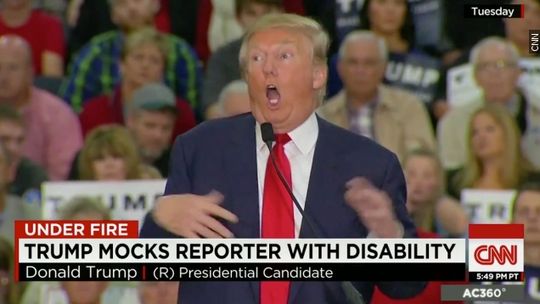
I am not a “Never Trump” advocate. I can conceive of a Presidential race that would force me to vote for Donald Trump, over, say, a Gorn, frightful Florida Congressman Alan Grayson, “Simple Jack” or Darth Vader. None of those, fortunately, are likely to be running in 2016, however, so the issue is moot. I have stated that there is no rational reason to vote for a candidate as undeniably unfit as Trump when the alternative is a candidate as undeniably as unfit as Hillary Clinton. Unlike Trump, Clinton does have positive features in her resume. As a Senator and former Secretary of State, she presumably has a passing comprehension of how the government works, and she comprehends the importance  of  public decorum and civility for a national leader, meaning that she knows that boasting about her penis or doing this…

Trump-Mocks-Disabled-Reporter-CNN-USA-Today

…is not remotely Presidential. Hillary’s positive features are, we all know, buried beneath the avalanche of her dishonesty, venality, incompetence and corruption,  but still, she has something. +1 beats – 1,606…even zero beats – 1,606.

Months ago, I challenged Trump supporters, Trump fans, Trump defenders and even Trump “oh come on, nobody is that bad”-ers to present a single, substantive, positive feature of Donald Trump that could justify voting for him as President. I have searched for and read alleged posts by professional pundits and others; I have listened to (until overcome with depression and nausea) Trump’s uniformly idiotic surrogates, and I have invited submissions. The results? Zilch. Nada. Bupkis.

“Hillary is evil!” is not a positive argument for Trump. Other submissions— “He’ll destroy the Republican Party, those collaborating traitors!”“I’m mad as hell, and I’m not going to take it any more!,” “He says what he thinks!,” “I hate political correctness!,” “He’ll stick it to the elites!” and the ever-popular incoherent grunt—are similarly non-responsive. I don’t think it is too much to ask, and the lack of any entry remotely meeting the modest requirements (the best so far is, “At least the news media might do their job with someone like him as President”) makes me more certain by the day that 1) I am correct to reject him and 2) that Gorn may not be so bad.

Clearly I am not the only one engaging in this quest. The Washington Post obviously searched under every rock to come up with an academic who would put his name on an op-ed last week titled “Why ‘Never Trump’ conservatives are wrong about Trump.”

He is Charles R. Kesler, a professor of government at Claremont McKenna College, and the editor of the Claremont Review of Books. My heart soared like a hawk when I saw the column:  Claremont McKenna is an excellent institution, and finally someone who does not communicate in howls, hocks and memes had written down a substantive argument to vote for Donald Trump!

But no.

Here, alas,  are his “substantive” points: Continue reading

On Climate Change And The First Amendment, Yale’s Law School Dean Gives Us A Reason To Be Very Afraid

I just wrote in a comment thread,

“The one thing that could change my mind to believe that Trump is less dangerous than Clinton is that the trappings of Trump and his followers reek of stupidity, and the trappings of Hillary and her allies are redolent of totalitarianism.”

The effort by Democrats and anti-gun zealots to deliberately breach the Fifth Amendment to allow “pre-crime” anti-gun laws was one example of the Obama/Clinton/Sanders left’s creeping embrace of totalitarian principles.

Here is another.

Over the weekend, Robert Post, the current dean of Yale Law School where both Bill and Hillary learned to be unethical lawyers, authored a shocking 0p-ed for the Washington Post. In it, he attached his influence and credibility to the idea that the government should use the power of prosecution to intimidate opponents of government policy and widely accepted left-wing agenda items. I have never seen such a disgraceful breach of academic prestige. If I were a Yale grad, I would be heavily involved in calling for Post’s resignation.

Post is supporting the attempts by Democratic, climate change policy-supporting attorneys general to target Exxon-Mobil for fraud because the company opposes certain climate change measures. This comes after eco-facists like Robert Kennedy, Jr. and climate change shills like  Bill Nye (The Self-Promoting Not-Really-The-Expert-He- Pretends -To-Be  Science Guy) have suggested that “climate change deniers” should be jailed. That’s not the theory, though. The theory is that Exxon-Mobil has defrauded investors by misleading them about the results of their own research. Thus the company has been hit by demands for documents by the Massachusetts and New York attorneys general to reveal all of that research.

Exxon-Mobil, as well as others, has condemned this effort as an attempt to chill First Amendment debate. Post, who has allied himself with the censors because climate change is “settled science,”  bolsters the political inquisitioners’ deceit. “It may be that after investigation the attorneys general do not find evidence that Exxon-Mobil has committed fraud. I do not prejudge the question. The investigation is now entering its discovery phase, which means it is gathering evidence to determine whether fraud has actually been committed,” the esteemed dean writes.

Cute. Of course, once the precedent had been established that the government can force someone into expensive legal defense for “the fraud” of disagreeing with the pronounced truths of the State, then dissent and political opinion will be repressed, suppressed, and discouraged. Continue reading

From A Proud Abortion Defender, An Inconvenient Truth….

Snake eating its tail

A New York lawyer named Janice Mac Avoy gifted the Washington Post with an op-ed that was supposed to be a powerful brief for abortion. Viewing it as someone who is deeply conflicted about the ethics of abortion, which is to say, someone who is objective and who didn’t make up his mind first and then look for rationalizations to support that position, I recognized it as a perfect example of why abortion advocates still haven’t made a strong enough case for me, and perhaps why they can’t.

I am still surprised, somehow, when lawyers, like Mac Avoy, display poor reasoning skills. I shouldn’t be, I know: I’ve known plenty of dumb lawyers, even rich and successful dumb lawyers. I suppose I am hostage to the mythology of law school, that professors take students whose “minds are much,’ to quote Professor Kingsfield, and transform those minds into whirring computers of emotion- and bias- free rationality. Unfortunately, mush in, mush out tends to be reality.

Mac Avoy places her own mind in the mush column immediately, with her title “I’m a successful lawyer and mother, because I had an abortion.” This shows her adoption of the classic logical fallacy Post hoc ergo propter hoc, or “After this, thus because of this.” The statement is factually nonsense, and her column takes off from there.

Some highlights:

1. She writes…

“In spring 1981, I knew I wanted to be a lawyer. I was about to become the first person in my family to graduate from high school. I had a scholarship to college, and I planned to go on to law school. I was determined to break a cycle of poverty and teenage pregnancy that had shaped the lives of the previous three generations of women in my family — all mothers by age 18. Then, just before graduation, I learned I was pregnant. Knowing that I wasn’t ready to be a mother, I had a friend drive me to a Planned Parenthood clinic, where I had an abortion.”

Pop quiz: What crucial piece of information is glossed over, indeed strangely omitted, from that account? Mac Avoy “was determined to break a cycle of poverty and teenage pregnancy” —so determined and laser focused on the life goal that she suddenly woke up pregnant! How did that happen? Apparently, despite her representation to the contrary, she was not sufficiently determined that she was willing to refuse  to engage in the exact and only conduct that could foil her intent, and that she knew could foil her intent.

I’m not arguing that a teenage mistake of judgment should derail a life, but I am pointing out that to ignore that personal conduct, as Mac Avoy does, and pretend that pregnancy in every case is some unavoidable random tragedy like a rape or incest, is self-serving and intellectually dishonest, and like most pro-abortion rhetoric, avoids the key issues that make abortion a difficult ethical problem.

2. She writes… Continue reading