Shrugging Off Cheating: It Is As I Feared…[Corrected]

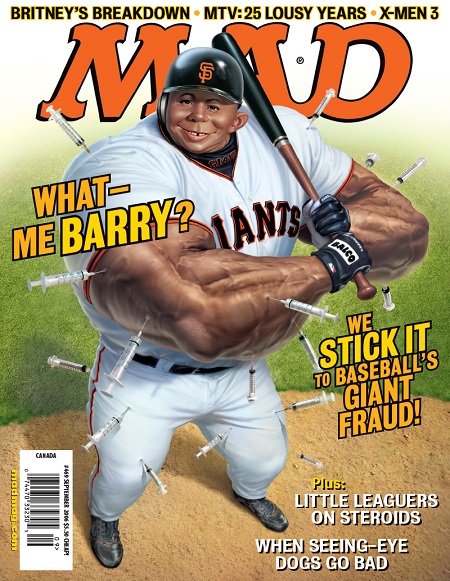
Unfortunately, MAD is no longer around to protect our values…

My favorite Christmas gift this year, as it has been in recent years, is the new Bill James Baseball Handbook, which will be my primary bathroom reading for the next ten months. Oh, it’s not as much fun as the old Bill James Abstracts, but in those days, three decades ago, Bill was revealing then-unknown nuances of the game that spawned  the elaborate (and still developing) analytical tools that have changed how baseball is played, watched, and understood.

James typically writes a few long, Abstract-like articles for the Handbook, which has many contributors, and he is, as always, fascinated by the selection criteria for the Major League Baseball Hall of Fame in Cooperstown. My gift is especially timely, because his observations in the Handbook dovetail nicely with the recent voting by sportswriters on the latest entering class, including Derk Jeter, naturally, and perhaps others. The results won’t be announced for a while.

Bill did research this past year to determine who the public wanted to see elected to the Hall among players who had not yet been deemed worthy ( meaning that they hadn’t been listed on at least 75% of the ballots cast, or are not yet eligible for various reasons, including players who are still active. The results, as he explored the gap between public opinion and past voting, were disturbing, if not exactly shocking. Continue reading

Morning Ethics Warm-Up: 8/1/17


Good Morning, World!

1. Follow-Up on the 7/28 morning post: Sometimes a popular public figure’s words and conduct so obviously show a deficit of character that I wonder if those who admire him or her are not paying attention, or are creeps themselves. “Harry Potter” author J.K. Rowling is officially in this category. First, I do not care for foreigners who obsessively bash our leaders, however bashable. They don’t have standing, in most cases, and their opinions are by definition uninformed if they don’t live here. Most obnoxious of all, however, in Rowling’s case, was her indefensible conduct regarding her recent infamous fake news tweet that circulated to her mob of followers a deceptively edited video showing President Trump cruelly ignoring a boy in a wheelchair, when he in fact stopped, crouched, and spoke to the child. She did this (“When someone shows you who they are, believe them.’ – Maya Angelou” was the snotty accompanying comment) on July 28, and the same day it was widely debunked, with the actual video being circulated on the web. No response came from Rowling, even as her tweet and libel continued to be liked and retweeted by “the resistance.”

On July 30, even CNN’s Brian Stelter, with extra time on his hands because his alleged news media ethics show avoids criticizing bias in the news media, flagged the bad tweet, and asked why Rowling hadn’t retracted it. Come on, Brian, you know why! It is for the same reason CNN continues to use unethical journalism to attack the President: they don’t believe he’s worthy of fairness or honesty.

Finally,  after various conservatives dredged up this year-old tweet from Rowling to show her hypocrisy and shame her with her own chosen words…
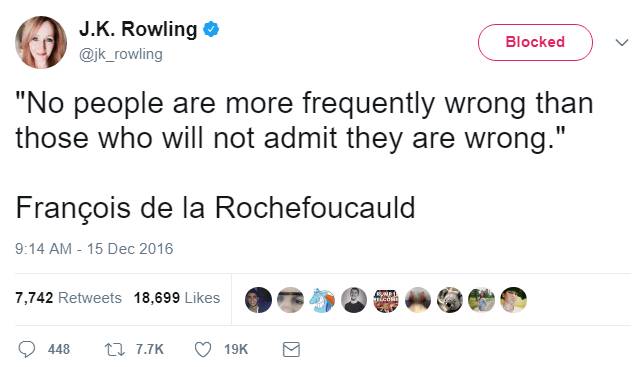
and after left-wing, fellow Brit Trump-basher Piers Morgan expressed frustration with her, and after PunditFact, a spin-off of PolitiFact, rated Rowling’s claim “Pants on Fire,” and after the boy’s mother herself denied that Rowling’s version occurred, the author finally retracted the tweet and took it down. She also tweeted this unethical apology:

Re: my tweets about the small boy in a wheelchair whose proferred hand the president appeared to ignore in press footage, multiple sources have informed me that that was not a full or accurate representation of their interaction. I very clearly projected my own sensitivities around the issue of disabled people being overlooked or ignored onto the images I saw and if that caused any distress to that boy or his family, I apologise unreservedly. These tweets will remain, but I will delete the previous ones on the subject.

This is a miserable apology, containing the stinking tell of the non-apology apology, “if anyone was offended” in this case the equivalent “if that caused any distress.”  The two people she non-apologizes to had no reason to be “distressed,’ since the tweet wasn’t an attack on them. This is not an apology at all, since it does not apologize ..

…to the person fraudulently attacked, President Trump, as well as his family and supporters

…to those deceived by her retweeted lie, and

…to the people who trusted her and became accessories in the false attack

…for taking four days to take down a lie that had been thoroughly exposes as one.

On the Ethics Alarms Apology Scale, it is a bottom of the barrel #10:

An insincere and dishonest apology designed to allow the wrongdoer to escape accountability cheaply, and to deceive his or her victims into forgiveness and trust, so they are vulnerable to future wrongdoing.

This rot is actually worse than a #10, as Rowling dares to ladle soppy virtue-signalling onto it. She only falsely attacked the President of the United States and spread a lie around the world because she is so, so sensitive and concerned about the treatment of handicapped people! Don’t you understand? It’s because she’s so compassionate and good that this happened!

It is my experience that good people can usually manage a sincere and remorseful apology to those harmed by their words or conduct.

2. This unethical lawsuit could sustain a stand-alone post, but I refuse to devote one to it as a matter of principle. Continue reading

From The Law vs Ethics Files: The July 24, 1983 Pine Tar Incident, When Baseball Chose Ethics Over Law, And Was 100% Wrong

I have written on this topic before, but this is the famous incident’s anniversary, and I have come to believe that the lesson learned from  the pine tar incident is increasingly the wrong one, and the consequences of this extend well beyond baseball.

On July 24, 1983, the Kansas City Royals were battling the New York Yankees at Yankee Stadium. With  two outs and a runner on first in the top of the ninth inning,  Royals third baseman George Brett hit a two-run home run off  Yankee closer  Goose Gossage to give his team a 5-4 lead.  Yankee manager Billy Martin, however, had been waiting like a spider for this moment.

Long ago, he had noticed that perennial batting champ Brett used a bat that had pine tar (used to allow a batter to grip the bat better) on the handle beyond what the rules allowed. MLB Rule 1.10(c) stated: “The bat handle, for not more than 18 inches from the end, may be covered or treated with any material or substance to improve the grip. Any such material or substance, which extends past the 18-inch limitation, shall cause the bat to be removed from the game.” At the time, such a hit was defined in the rules as an illegally batted ball, and the penalty for hitting “an illegally batted ball” was that the batter was to be declared out, under the explicit terms of the then-existing provisions of Rule 6.06.

That made Brett’s bat illegal, and any hit made using the bat an out. But Billy Martin didn’t want the bat to cause just any out. He had waited for a hit that would make the difference between victory or defeat for his team, and finally, at long last, this was it. Martin came out of the dugout carrying a rule book, and arguing that the home run shouldn’t count.  After examining the rules and the bat, home-plate umpire Tim McLelland ruled that Brett used indeed used excessive pine tar and called him out, overturning the home run and ending the game.

Brett’s resulting charge from the dugout (above) is video for the ages. Continue reading

Ethics Dunce: “The Big Hurt,” Frank Thomas [UPDATED]

An ethics whiff for Frank Thomas

An ethics whiff for Frank Thomas

Baseball, and all its annual ethics puzzles, begins in about two weeks when Spring Training gets underway.  Meanwhile, I have to tolerate everyone talking about Tom Brady and the Cheating Patriots as the NFL makes billions encouraging  Americans to cheer for the gradual lobotomizing of young athletes for their pigskin entertainment. Still, even the off-season of America’s Pastime provides ethics fodder.

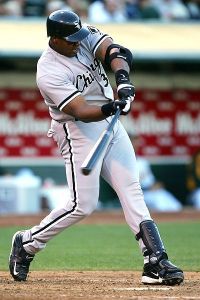
Frank Thomas, the 6’6″ 300 pound ex-first baseman, never was suspected of using steroids before he was elected to the  Hall of Fame, in part because he was naturally so huge and strong that if he had used steroids he would have ended up battling Godzilla in Tokyo. “The Big Hurt,” as he was called, was and is an outspoken opponent of steroid use in baseball, but speaking at  the annual White Sox fan convention last week, he proved that he is an ethics bush-leaguer.

The recent Hall of Fame vote  elected two players, Jeff Bagwell and Ivan Rodriguez, long rumored to be users of performance enhancing drugs, and the vote totals showed  increased support for uber-steroid cheat Barry Bonds and accused steroid-user Roger Clemens. The New York Post reported that Thomas said, without mentioning names, after he was asked how he felt about the election results, Continue reading

Ethics Dunces: Fox Sports And Major League Baseball

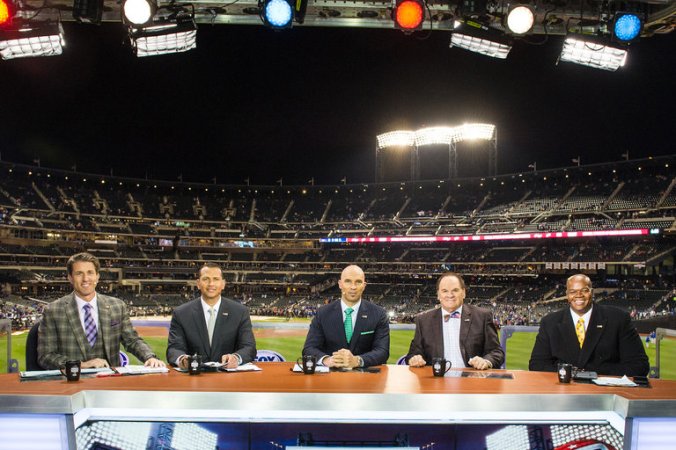
The ex players are (R to L), Hall of Famer Frank Thomas, banned Pete Rose, rapidly being forgotten Raul Ibanez, and the nearly universally detested Alex Rodriguez.

The ex players are (R to L), Hall of Famer Frank Thomas, banned Pete Rose, rapidly fading from memory Raul Ibanez, and the nearly universally detested Alex Rodriguez.

Among the commentators at the desk in the pre- and post game show for FS1 (that’s Fox Sports One) as it carries the National League Championship Series between the Cubs and the Dodgers, are Pete Rose, and Alex Rodriquez.

Pete Rose, baseball’s all-time hits leader, is banned from baseball for gambling on the game while a manager. This has been taboo since the 1919 World Series was fixed by gamblers. (Donald Trump has never accepted that the Cincinnati Reds won). Rose lied about whether he bet on baseball for over a decade, then he lied about whether he bet on his own team a little longer. In the meantime, he served prison time for tax evasion.

Alex Rodriquez eventually was suspended from baseball for more than a season for using banned performance enhancing drugs, years after he tested positive for steroid use and told the public sincerely that it was “one mistake” and he’d never do it again. He is also a serial liar. Eventually the increasingly cynical and ethically-addled younger sportswriters may vote him into the Hall of Fame, but he is second only to Barry Bonds as the worst of the worst. Currently, he is regarded as flunking the Hall’s character and sportsmanship requirement. Duh. Continue reading

Ethics Dunces: The New York Yankees

Yankees

Ah, thaaat’s better: the old, values-free, win-at-any-price New York Yankees we’ve grown to know and hate.

The Yankees today announced the acquisition of left-hander Aroldis Chapman from the Cincinnati Reds in exchange for four minor league prospects of no great note. Chapman is arguably the most dominating late inning closer in baseball, as well as its hardest throwing pitcher: the left-hander averaged  99.5 mph on his fastball last season, and threw more balls in excess of 100 mph than all other major league pitchers combined. So why were the Yankees able to acquire him so cheaply?

Well, it’s because Chapman was regarded as virtually untradable due to his being investigated  by MLB for choking his girlfriend, and this was not the first instance where he was involved in alleged domestic violence.  The Dodgers had a trade for Chapman in place earlier this month, but pulled out when the team learned the details of the choking incident. (As usual, the girlfriend refused to press charges, and is gambling that she’ll end up rich rather than dead.) Most believe that Major League Baseball will suspend Chapman for up to 40 games under its new domestic violence policies.

Hey, but after that little hiccup, Yankee fans, the Pinstripes will have three beasts in the bullpen to close out games, with the three highest strikeout percentages in all of baseball from 2014-15 in Chapman (46.3 percent), Andrew Miller (41.6 percent) and Dellin Betances (39.5 percent)! What’s a little girlfriend choking when you can get talent like that? Continue reading

Ethics Quiz: The Nazi Scientist

Scientist, genius, Nobel Prize winner, Nazi. Now what?

Scientist, genius, Nobel Prize winner, Nazi. Now what?

Konrad Lorenz, 1903-1989 ,  was an acclaimed Austrian zoologist regarded as the founder of modern ethology, which is the study of animal behavior. His research  explained how behavioral patterns may be traced to through evolution,  and he made major contributions to the study of aggression and its roots. Lorenz shared a Nobel Prize for Physiology or Medicine in 1973 with the animal behaviorists Karl von Frisch and Nikolaas Tinbergen.

It seems that documentation surfaced proving that Lorenz joined the Nazi Party in 1938, however, and for that, Austria’s Salzburg University last week posthumously stripped him of his honorary doctorate.

Your Day Before The Night Before Christmas Ethics Alarms Ethics Quiz is…

Is this the right thing to do?

Continue reading

The Lesson Of The Pete Rose Saga: It’s Hard Being Ethical When You’re Stupid

Rose rejected

Pete Rose’s final appeal to have his ban from Major League Baseball lifted was rejected, as Commissioner Rob Manfred delivered a stinging rebuke. (You can read his letter here.) The very first ethics post I ever wrote was about Pete, and I have posted about his character and plight several times since. Rose, the all-time leader in hits and undeniably a great player, was banned from the game in 1989. An investigation concluded that he had bet on baseball games while a manager of the Cincinnati Reds, a violation of MLB’s famous “third rail” no-gambling rule, which makes it an automatic expulsion from the profession to place bets on baseball games as a manager, coach or player. This is regarded as an existential rule for baseball, which was nearly ruined when gamblers fixed the 1919 World Series.

Rose maintained his innocence of the allegations for decades, then admitted(to sell a book) that he had been lying, and did gamble. Just a few months ago, evidence surfaced that he had also bet on baseball while a player, which Rose has always denied.

In his letter rejecting Rose’s appeal, Commissioner Manfred noted that one of the conditions that had long been set for Rose to have any chance of reinstatement—though Rule 21 has no exceptions, MLB was willing to do almost anything not to have the holder of the record for lifetime hits on its blacklist—Rose would have to earn a pardon by showing he had turned his life around, meaning that Pete was no longer a sleazeball.

Manfred wrote that Rose, who had, among other black marks, served time in prison for tax evasion, asserted in his latest appeal that he indeed was a new and better man. Nevertheless, Rose…

1. Refused to admit that he had bet on baseball as a player, when the evidence was incontrovertible, and

2. Revealed that he still gambles on horse racing and professional sports, including baseball.

Manfred came to the obvious conclusion that “Charlie Hustle,” who pretty clearly has a gambling addiction, has taken no positive steps toward addressing it, is still a risk to gamble on baseball games or get himself in debt to gamblers if he returned to the sport, and  can’t be trusted.

All of the above could be more concisely summarized by six words: Pete Rose is a stupid man. As comedian Ron White says, “You can’t fix stupid.” Manfred, in his letter telling Pete that he can forget about any future employment in baseball, noted more than once that Rose does not appear to understand the import and purpose of the rule he violated, which exists  to protect the integrity of the game. Indeed,  Pete Rose wouldn’t know what integrity was if it sat on his face. Continue reading

Baseball All-Star Game Ethics Musings: Taking Confirmation Bias Out Of Appeal Plays, and More

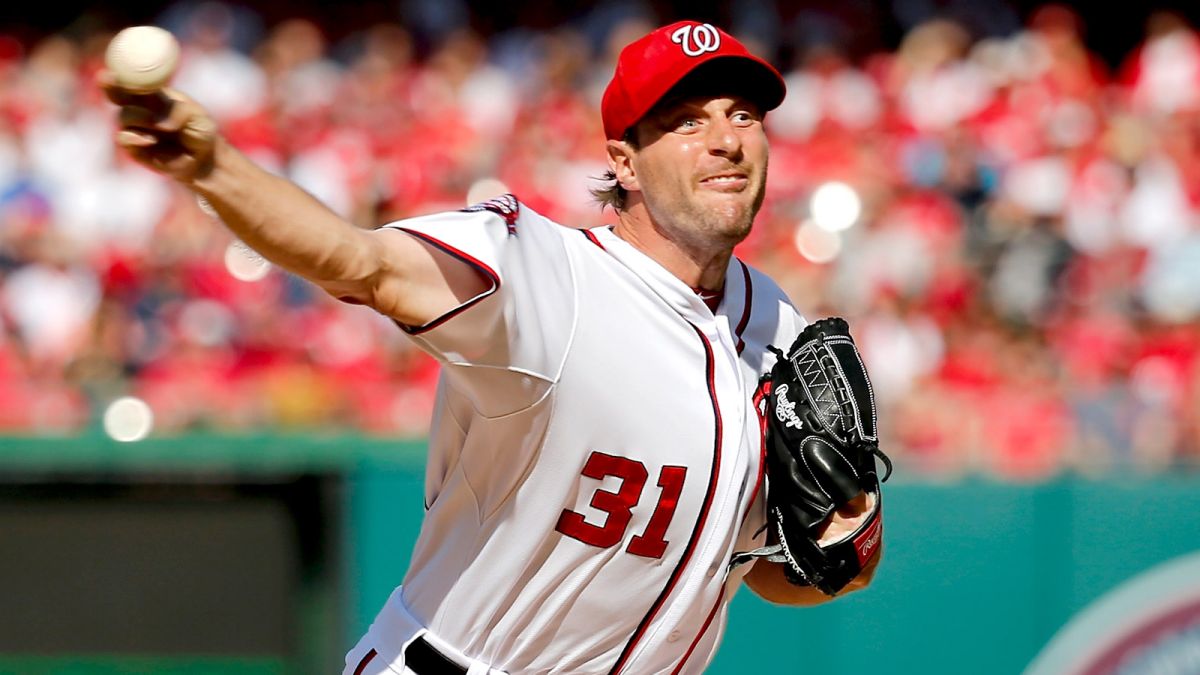
Max-Scherzer

Some baseball ethics musings on the night of the All-Star Game:

1. Why is MLB going ahead with letting Pete Rose take a bow at the All-Star Game? This made sense–barely–when it was announced, since Pete is a hometown hero despite being a rest-of-the-world slime-ball. But after that announcement, it was revealed that Rose had bet on baseball as a player, thus rendering all of his statements to the contrary the lies they were. He should have been banned from the game just to make sure this latest revelation of his sliminess adds something to his punishment.

2. The best ethics controversy of the 2015 season’s first half? This: Washington National pitcher Max Scherzer was one strike away from a perfect game, leading  the Pirates in a 6-0 win, but hit Jose Tabata with a pitch to make it “only” an-hitter. A perfect game is 27 consecutive, outs, and the most difficult feat in baseball. Tabata had fouled off four pitches, before he  was hit on the elbow. Many believed that he that Tabata allowed the ball to hit him intentionally, just to wreck the masterpiece. This violates one of the “unwritten rules” of baseball, which are ethics rules. After all, any perfect game could be ruined the same way, and the pitcher is powerless to stop it. This is correctly deemed to be unfair to the pitcher, the fans, and the game.

Real rules also are involved. A batter hit by a pitch is supposed to be awarded first base only if he attempts to avoid a pitch or doesn’t have an opportunity to avoid it. If the ball is in the strike zone when it hits the batter, it should be called a strike, according to the Rule Book:  “If the ball is outside the strike zone when it touches the batter, it shall be called a ball if he makes no attempt to avoid being touched.” (Rule 6.08(b).)

Thus  home plate umpire Mike Muchlinski could have awarded Tabata a ball to make it a 3-2 count if he felt Tabata should have gotten out of the way.

Seven points:
Continue reading

Observations On The News That Pete Rose Bet On Baseball As A Player After All

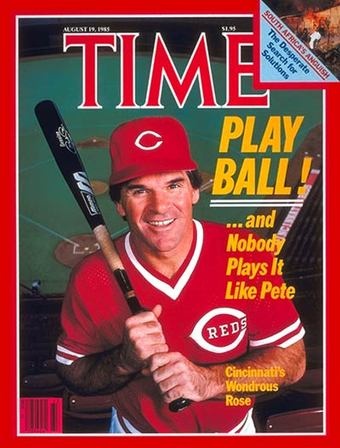
Rose Time cover

The story is here.

To summarize for those new to this story and its various issues:

Because the 1919 World Series fixing scandal nearly toppled the sport, any player, manager or coach who bets on baseball games will be automatically banned from the game for life and from the Major League Baseball Hall of Fame for perpetuity. Pete Rose, the all-time hits leader as a player and a certain Hall of Fame admittee under normal circumstances, was shown to have bet on baseball while a manager, after his playing career. For many years he lied, denying that this was true, then came clean in time to hawk his autobiography.

Rose has always had a lot of sympathy from fans and players, in part because he was such an exciting player, in part because he played with the innocent enthusiasm of a child and  he is a child, at least emotionally, and mostly because it was believed, since Rose insisted that it was true—yes, I know that sounds strange, given Rose’s record of serial dishonesty—that he never gambled on baseball while he was a player.

This season, public sentiment had been building to finally pronounce Rose forgiven. He had even progressed to the stage that some advertisers were using him in TV commercials. Baseball has a new Commissioner, and he had signaled that he would give Rose’s long-standing and ignored petition for reinstatement due consideration.

All of that is gone now, presumably forever.

Some last thoughts on Rose, as with any luck this is the last occasion I will have to write about him: Continue reading