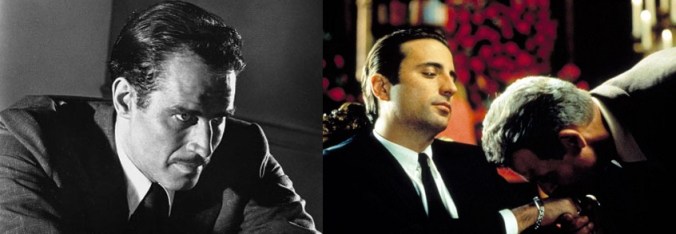
Sorry To Be A Pest, But Yes, It Matters: There Was And Is Nothing Wrong With Casting Charlton Heston As A Mexican D.A.

Quiz: which is obviously unethical? Casting a Scotch-English actor as a Mexican, or casting a Cuban-American as a Sicilian-American?

Pop Quiz: which is obviously unethical? Casting a Scotch-English actor as a Mexican, or casting a Cuban-American as a Sicilian-American?

I was watching Turner Movie Classics over the weekend, and guest Louis Gossett Jr, best known for playing the drill sergeant who makes An Officer And A Gentleman out of jerk Richard Gere, had chosen the Orson Welles cult film “Touch of Evil” for the evening’s viewing. Host Ben Mankiewicz noted that the film, which he agreed was a classic, now causes politically correct eyes—like his and Gossett’s— to roll because Charlton Heston had the role of a Mexican district attorney. Without saying why, both Ben and Lou tut-tutted and agreed that this would never be tolerated today, and the role would obviously be cast with someone like Antonio Bandaras. It was too obvious to decent viewers to explain, I guess.

We have gone over this issue before here, and more than once, but what was special and disturbing about this conversation was that it assumed a new cultural ethics standard as if everyone agrees with it; the previous standard, we now know in our wisdom, was wrong; and now it’s clear what is the right path going forward. This is how mass media, which is pervasive, powerful, and overwhelmingly controlled by none-too-bright and none-too-ethical knee-jerk leftists, accelerates the natural evolution of societal and cultural ethics. When the media sends a united message that an issue is decided, those of slug-like alertness and apathetic mind—and there are a lot of them— will simply absorb the edict without applying critical thought.

Oh…the right thing is to just let anyone who wants to come to this country jump the border. Got it. Oh…guns should be confiscated and banned by the government if it can save one life. Of course. Oh…the minimum wage should be a living wage. How true…

The fact that there is not and should not be cultural consensus on such conclusions because they make no sense logically or ethically will be buried  by sheer repetition and certitude, unless sufficient numbers of people who are paying attention and do not surrender to false authority protest loudly and repeatedly. In a previous post on this topic, I wrote…

“Through the fog of such distortions, the idea of rigid ethnic casting doesn’t seem so crazy, though it is crazy indeed. I regard it my duty as someone who has both professional expertise in ethics and casting to slap down this rotten and indefensible idea every time it raises its repulsive head.”

Thus I am keeping my promise. The principle that Ben and Lou are assuming our society accepts is nonsense. It is also bad ethics. Continue reading
“Bewitched” Ethics: A Startling Lesson In How Increased Sensitivity To Other Cultures Constitutes Progress

The Sixties witchery sitcom “Bewitched” is a guilty pleasure, mostly because of the superb cast and unabashed silliness of the enterprise. (I do avoid the episodes with Darrin 2, Dick Sergeant, who took over the role of Samantha’s befuddled mortal husband—without any explanation in the series—after the Definitive Darrin, Dick York, became unable to perform.) A new cable channel is running the series in the morning, and today I saw an episode that delivered a series of shocks that never would have registered in 1968, when it first aired. Some of them should have, though.

The episode, “A Majority of Two” (the title evokes the stage and film comedy “A Majority of One,” about a romance between a middle-aged Japanese man and a Jewish widow from Brooklyn)  involves Darrin’s boss, the weaselly Larry Tate, conning Samantha into hosting a dinner for important advertising client Kensu Mishimoto, who is flying in from Japan. Sam agrees—after all, a nose twitch or two is all it takes—but asks Larry what to serve, Japanese or Western cuisine. Larry is prepared: he gives Samantha a note with the name of what Mishimoto’s secretary told Tate was the businessman’s favorite  dish: Hung Ai Wan Goo Rash. There being no internet, Sam worries about how she will get the recipe.

Let’s count the insensitivity jolts here: Continue reading

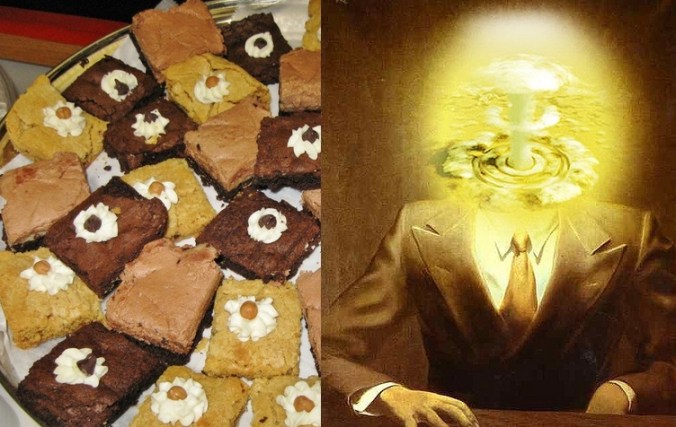
KABOOM! The Tale Of The Third-Grader’s Racist Brownie Offense: No, I Don’t Understand This At All

brownies explosion

This story made my head explode, and thus it will be tagged “Kaboom!” Unlike most such Kaboom! posts, however, this one is likely to make my head explode every time I read it. Or think about it. Forever.

On June 16, a third grader made a comment about the brownies being served to his class during an end-of-the-year class party at the William P. Tatem Elementary School in Collingswood, New Jersey.  After another student opined that the remark was “racist,” the school called the Collingswood Police Department.

Okay, stop. I’m puzzled already, and my head exploded again just writing that:

  • How could a comment about brownies be racist? Did the child say, ” As with human beings, the blonde brownies are innately superior to the dark ones”? Somehow, I doubt it.
  • Another third grader pronounced the statement as racist. Not a teacher, now. An eight-year old. How can that trigger anything, in a sane world, but a discussion led by the teacher about what is and isn’t racist, and how people shouldn’t leap to such  inflammatory observations, because it makes human interaction difficult if not impossible?
  • The school called the police department? For what? A threatened brownie massacre? How is this conceivably a police matter? Why did the police come?

“What is the nature of your emergency?” “A third-grader in my class made an inappropriate remark about brownies!” “Calling 911 with prank calls is a crime, ma’am. Don’t do this again.” 

It is per se unethical and irresponsible for any police department to treat such trivia seriously.

All right,slogging on… Continue reading

The “Ghostbusters” Remake Controversy

The fact that I even know about this issue is both my reward and punishment for being a popular culture junkie.

To bring you up to date: Since the stars of the classic movie comedy “Ghostbusters” are now collecting Social Security (and one of them—Harold Ramis— is dead), Hollywood’s only sensible option to try to squeeze some more profit out of the property (and maybe introduce it to a new generation) was to remake the 1984 film. This was a risky enterprise, for even the sequel with the original cast more or less recognizable was a disappointment, and remakes of classics are inherently dicey. If an original film really was special and the stars truly stars, forcing younger contemporary stars to step into iconic shoes is asking for not just trouble, but humiliation. Poor Alex Cord, for example, never recovered from being cast as The Ringo Kid in a misbegotten remake of  1939’s “Stagecoach,” where he was supposed to replace John Wayne. It can work, as with Jeff Bridges’ turn as Rooster Cogburn, not only a Wayne role but the one that got him an Oscar, only if the remake is sufficiently excellent and different enough in tone and purpose that the original and the remake can co-exist without compelling unflattering comparisons. (“True Grit I” is a funny John Wayne valedictory with a great story; “True Grit 2” is more faithful adaptation by the Coen Brothers of a wonderful novel. I still like the original better.)

The best option, though, is often to make the reboot different in appearance and feel by switching race or gender. This is also helpful when everyone over the age of 13 has seen the original on TV about ten times already. The scheme attracts a new audience, ideally—the first “Ghostbusters” had a male teen demographic—and allows the remake to refer to the first version without seeming like pale copy. Almost never are the non-traditional casting versions big hits, but they can be quietly profitable. “Ghostbusters,” moreover, is a merchandising machine. The original spawned cartoon versions and action figures. Why wouldn’t the new movie?

However this is 2016 America, and everything is political as well as partisan. An all-female remake of “Ghostbusters” was launched with feminist swagger. The new version starring Melissa McCarthy (love her) , Kristen Wiig (great)  and Kate McKinnon ( also great), excellent comic actresses, given good material, would show that women can and do everything men can do—fight ghosts, make hilarious supernatural movies, be President of the United States. The July opening in an election year was no coincidence; it is part of the Hollywood effort to join the media’s efforts to make Hillary President despite, well, her lack of fitness to lead.

Although the usual naysayers when a classic is recast were immediately critical, most moviegoers were enthusiastic about the project. I know I was. Then the trailer came out. It is bad (you can watch it above). We are used to seeing great trailers for movies that turn out to be boring and horrible, but good movies with terrible trailers are rare because making previews has become a fine art.

The strikingly unfunny “Ghostbusters” trailer was especially ominous for a comedy. The usual method for hyping a mediocre comedy is to put all the funny bits in the trailer; I hate that, don’t you? Not only is the whole movie an unamusing slog with 6 minutes of laughs in 90 minutes of filler, but you’ve already seen the best gags. What does it say, though, when a trailer for an alleged comedy isn’t funny, and worse, the gags included don’t appear to be as side-splitting as the movie’s makers seem to think they are?

Oh-oh. Continue reading

Why Does Colby College Think That It’s Ethical To Keep A “Bias Incident Log”?

Might be time for a new motto, Colby. On the other hand...

Might be time for a new motto, Colby. On the other hand…

Wait…you say that more than a hundred campuses have this or the equivalent?

Oh-oh.

I am scheduled to teach a legal ethics class in the avoidance of bias in the practice of law next year, and I’m already worried. Past engagements of mine on this topic have been popular with attendees, but not always appreciated by my clients. The bar associations that make such training mandatory usually want to get someone to drone on about how lawyers should love Big Politically Correct Brother and search their souls for any germ of an attitude that would make Chris Matthews say they are racist, or the President of NARAL say they are sexist, or a Black Lives Matter activist call them privileged.  In other words, these are often devised as political indoctrination courses, using “bias” as code for “non-conforming thoughts according to progressive orthodoxy.”

I can’t and won’t teach that, because it’s as wrong as it is boring. Bias includes all ideas wedged in our minds that overcome reason and prevent just, even-handed, logical and fair decision-making. Bias makes us stupid, and for lawyers, the kind of bias I’m talking about undermines justice. Ironically, what most proponents of anti-bias courses want to do is instill biases that they and their partisan allies approve of. Once that is done, the Orwellian process is complete. “Bias” then means “not accepting our biases, which aren’t biases because we believe them, and we are good.”  The rationalization involved is 14. Self-validating Virtue.

The news and ethics issues are reaching one of those crisis points for me where everything seems to be connected to everything else, and I am torn whether to write one huge, conceptual post (the ones most readers skip) or a series of single episode posts. Facebook, a topic on its own, is revealing most of my friends whom I would identify as Democrats or progressives as in the grip of a crippling cognitive bias-based malady. Why did they think it was just wonderful for so many elected officials to deliberately ignore the core Constitutional principle of due process? Why did they reflexively attack the British vote to leave the European Union as “racist” or “xenophobic” rather than recognize it as a principled reassertion of their nation’s autonomy and democratic principles? How did freedom of speech, freedom of thought, true civil rights, and democracy itself become so alien to so many supposedly intelligent and self-proclaimed liberal adults?

Don’t worry, I’m coming back to Colby. It really does come down to bad and anti-American education poisoning the culture. In an excellent though disturbing essay on the Ethics And Public Policy website, Stanley Kurtz persuasively argues that U.S. education itself has turned against liberty, resulting in an increasing majority of citizens who do not believe or accept the virtues of core American ideals.

The incident that brought my attention to the Colby Bias Incident Log, which, at Colby and elsewhere, sends a Bias Response Team into investigation mode, was one in which a student was reported for allegedly using the idiom “on the other hand.”

No, this is not a hoax. It is not a joke. And what the fact that I am writing this suggests is far from funny. It is tragic. Continue reading

The Redskins Native American Poll: Integrity Check For Progressives And Race-Baiters

Washington-Redskins

My Washington Post is filled with articles and columns reacting to the “surprising” poll results released yesterday—a poll taken by the Post itself— that appears to settle a manufactured controversy of long-standing. If it doesn’t, that will tell us more about those who resist than it does about the merits of the controversy itself.

The Washington Post-commissioned poll shows that 9 in 10 Native Americans are not offended by the Washington Redskins name, despite a steady tom-tom beat of complaints and insults from activists, pandering politicians, cultural bullies and politically correct journalists insisting otherwise. The poll, which was analyzed by age, income, education, political party or proximity to reservation, shows that the minds of Native Americans have remained unchanged since a 2004 poll by the Annenberg Public Policy Center found the same result. (Actually,  Native Americans are somewhat less offended by the name than twelve years ago.)

The immediate question that the poll raises is one that Ethics Alarms has raised repeatedly as a rhetorical one. As the Post wrote today, speaking specifically of the segment of the sports media that had been so doctrinaire in attacking the name, even to the point of censoring it:

“Can they be offended on behalf of a group that they’re not part of, especially a group that appears, overwhelmingly, not to be offended by the word media figures object to?”

To ask the question is to answer it.  If the name in fact isn’t offensive to the group it is claimed to offend, then it is ridiculous for non-Native American to continue to be offended on their behalf.

Thus the poll results pose an excellent test of integrity and honesty for all of the liberals, politicians, political correctness junkies, pundits, social justice warriors and fringe Native American activists who have been so insulting and shrill to supporters of the name. Do they have the courage and fairness to admit they were wrong? Can the ideologically programmed ever do this: do facts matter, or is it essential for them to interpret the world according to cant rather than bend, adapt and compromise to inconvenient, messy reality?

Well, we shall see. The Post’s early results do not speak well for the anti-Redskins zealots. Continue reading

Comment Of The Day: “Dear Harvard: Fire President Drew Faust And Dean Rakesh Khurana”

Polar bear snowstorm

Not a comment on the post so much as on the underlying conditions that spawned it, Ethics Alarms reader Chris Bentley weighed in on the lack of ideological diversity on campus and the fact that many leaders both educational and political think that’s just fine. The key  question: do you listen to an argument against what you may believe with an open mind, or a closed one? The ethical answer is “Open,” but the predominant mindset on college campuses believes there isn’t any question to that effect.. Wrong is wrong, and the Left is Right, so the the only question is, “Do you allow those with wrong ideas speak at all?”

It is terrifying that universities, of all places, would ever consider that issue unsettled in the United States of America.

Here is Chris Bentley’s Comment of the Day inspired by the post, Dear Harvard: Fire President Drew Faust And Dean Rakesh Khurana:

“They know best, after all.”

Only a tertiary connection to the topic, I know, but I just got done listening to Obama’s Howard Univ. speech. While there is no doubt that he is a captivating orator, one thing kept striking me. The repeated refrain to the students, that they needed to “listen” to those that they disagree with, and not try to have speakers who think differently from you banned from campus, b/c, as his grandmother used to say “Don’t do that…Every time fool speaks they are just advertising their own ignorance. Let them talk.”

Continue reading

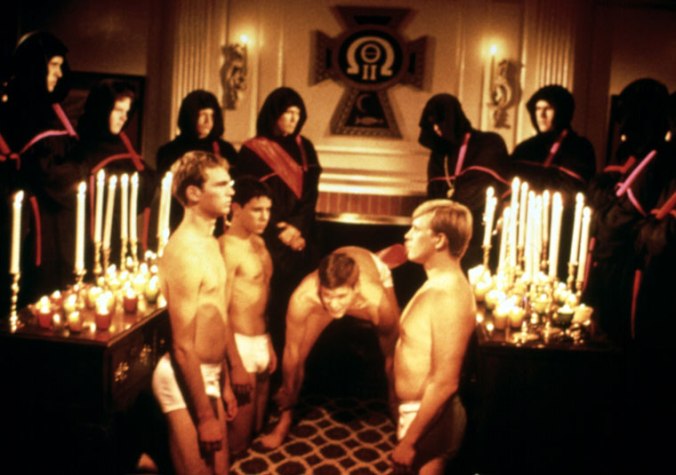
Dear Harvard: Fire President Drew Faust And Dean Rakesh Khurana

If these idiots are off-campus, 1) GOOD and 2) it's none of the college's business.

If these idiots do this off-campus, 1) GOOD and 2) it’s none of the college’s business.

In an e-mail to undergraduate students and the Harvard community, University President Drew Faust announced that beginning with next year’s entering class, undergraduate members of unrecognized single-gender social organizations will be banned from holding athletic team captaincies and leadership positions in all recognized student groups. They will also be ineligible for College endorsement for top fellowships like the Rhodes and Marshall scholarships.

The unrecognized single-gender social organizations are what is left of the old fraternities and sororities. When the Greek system was banned many decades ago (and Harvard was an all-male college), the frats reorganized as exclusive college clubs located in houses around Harvard Square in Cambridge. After Harvard merged with all-female neighbor Radcliffe College in the Seventies, sorority-like clubs emulated their male counterparts. In 1984, Harvard issued an ultimatum to the clubs to go co-ed, and the clubs responded by disaffiliating with the University.

Wrote Faust in part:

“Although the fraternities, sororities, and final clubs are not formally recognized by the College, they play an unmistakable and growing role in student life, in many cases enacting forms of privilege and exclusion at odds with our deepest values. The College cannot ignore these organizations if it is to advance our shared commitment to broadening opportunity and making Harvard a campus for all of its students….Captains of intercollegiate sports teams and leaders of organizations funded, sponsored, or recognized by Harvard College in a very real sense represent the College.They benefit from its resources. They operate under its name. Especially as it seeks to break down structural barriers to an effectively inclusive campus, the College is right to ensure that the areas in which it provides resources and endorsement advance and reinforce its values of non-discrimination.”

Faust was following the recommendation of Dean of the College Rakesh Khurana’s recommendations, who wrote in his report on the results of a “study”,

“[T]he discriminatory membership policies of these organizations have led to the perpetuation of spaces that are rife with power imbalances. The most entrenched of these spaces send an unambiguous message that they are the exclusive preserves of men. In their recruitment practices and through their extensive resources and access to networks of power, these organizations propagate exclusionary values that undermine those of the larger Harvard College community…Ultimately, all of these unrecognized single-gender social organizations are at odds with Harvard College’s educational philosophy and its commitment to a diverse living and learning experience.”

Let us be clear what Harvard is trying to do here. It is seeking to punish students for their associations and activities unrelated to the school itself, and using its power within the limits of the campus to indoctrinate ideological values and require conduct that is unrelated to education. This is a rejection of the principle of freedom of association, one of those enumerated rights protected by the Ninth Amendment of the Bill of Rights, and a cornerstone of American principles. If the college can, in effect, create a blacklist withholding institutional honors from those who choose to belong to an all male or all female club completely distinct from the university, what clearly delineated line prevents the same institution from declaring that membership in the Republican Party, Occupy Wall Street, Americans For Trump or the NAACP are similarly undermining its values?

There is no such line. Continue reading

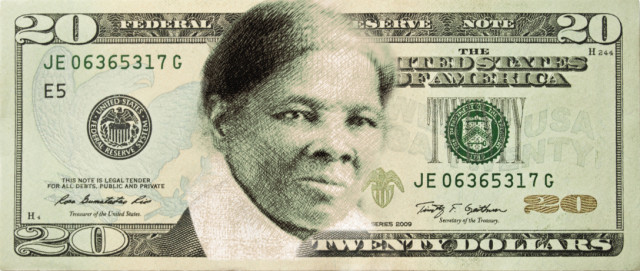
Observations On Donald Trump’s Harriet Tubman Comments

Harriet.Tubman 20

Don’t worry. Despite Donald Trump’s supposed “new leaf” that has him trying act and sound “presidential,” he’s going to continue to say ignorant, stupid and offensive things, because he really doesn’t know what is “presidential,” or ignorant, stupid and offensive, for that matter.

Today’s example was his off-the-cuff commentary about Harriet Tubman replacing President Andrew Jackson on the twenty-dollar bill.Trump said:

“I think Harriet Tubman is fantastic. I would love to leave Andrew Jackson and see if we can come up with another denomination. Maybe we do the $2 bill or another bill. I don’t like seeing it. Yes, I think it’s pure political correctness. He’s been on the bill for many, many years and really represented somebody that was really very important to this country.”

Observations:

1. Ethics Alarms offers this competence and responsibility-based rule for public figures, especially those running for President of the United States.

If you can’t say something that is constructive, coherent and adds substance to the discussion, keep your opinion to yourself.

Of course, that would mean Trump would seldom get to say anything. Still, this statement was completely gratuitous, vapid, clumsy and wrong. Continue reading

Comment Of The Day: “Update: This Is The Student’s Controversial Essay Emulating The Satire Of Swift’s ‘A Modest Proposal'”

Grading

The indefatigable Charles Green delivered a tough critique of Connor Poole’s essay fulfilling the requirement of an assignment asking  high school students to emulate the satire in Jonathan Swift’s “A Modest Proposal,” and similarly propose an outrageous solution to a contemporary social problem. There are really two issues here, and Charles only deals with one: I believe Connor’s paper was an excellent attempt at Swiftian satire, especially for a high school student, and this is Charles counterpoint to that position. He does not, as far as I can perceive, try to justify the school, North County High School, turning the essay into a controversy and Connor into a pariah.

Good. That, which is the primary ethics issue, is beyond rational dispute. What the school and community are doing to Connor is the equivalent of ordering a kid to juggle flaming torches, and then attacking him when something gets scorched.

Here is Charles’ Comment of the Day on the post, Update: This Is The Student’s Controversial Essay Emulating The Satire Of Swift’s “A Modest Proposal”.

I’ll be back at the end.

Here is what I think Poole’s teacher should have written to him in response to his essay:

Connor, I’m giving you a grade of C+ on this paper. Here’s why.

Continue reading