Maybe Cheerleading Isn’t Unethical, It’s Just Useless And Encourages Unethical Values…Like In This Case

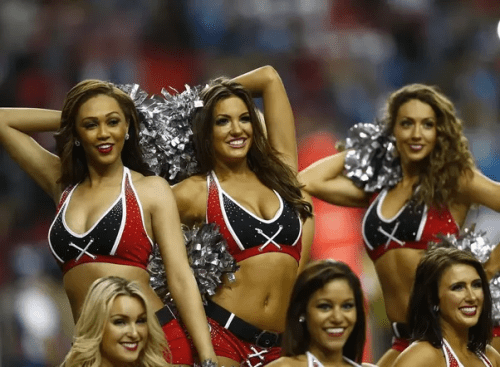
Sexy-Redskins-cheerleaders

In Bucks County, Pennsylvania, Raffaela Spone anonymously sent the coaches of her high school student daughter’s cheerleading squad “deepfake’ photos and videos that depicted the girl’s competitors nude, drinking, or smoking to get them kicked off the team. She also sent the manipulated images to the girls, and urged them to kill themselves, Bucks County District Attorney Matt Weintraub’s office said.

Nice! Of course, the woman is insane. Still, there have been far too many episodes like this. One is too many.

On a utilitarian scale, cheerleading is so deep in negative territory that it couldn’t see the positive side with super-vision. It is, of course, the epitome of presenting girls and women as sex objects while pretending that it is something else. The alleged function, “leading cheers,” is gratuitous and annoying, like those “Cheer!” commands on baseball park electronic scoreboards, or “Charge!” trumpet riff. Home crowds know when to cheer; I’ll cheer when I feel like it, thanks: BACK OFF!

But everyone knows that’s not why cheerleading squads exist. In pro sports, they are blatant eye-candy for middle-aged male fans and sexual prey for the players. Otherwise, why not have male cheerleaders? (Yes, yes, I know some schools have them). As an earlier post here pointed out,

Continue reading

The Pre-Unethical Condition Of Planning A Public Memorial: The Maya Angelou Debacle [Corrected]

_maya_angelou_proposal

(The ghost family isn’t part of the design, in case you were wondering…)

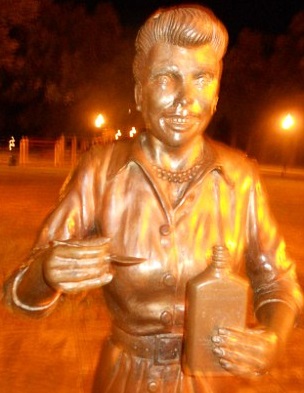
I use the term “pre-unethical conditions” to describe situations which have a record of leading directly to ethical conflicts and misconduct. “Ethics Chess,” another Ethics Alarms term mandates that a participant think multiple moves ahead, and thus anticipate, plan for, and with luck and skill, even avoid the ethical perils ahead. The task of honoring a famous or accomplished public figure with a monument or memorial structure for the ages once was simple and straightforward: you put up a statue after a respected and credentialed artist designed it. Of course, if you picked a hack to do the job and got something like this…

Lucy statue

That’s supposed to be Lucille Ball, in a now-replaced statue in her home town.

..there would be trouble, but usually the standards for statues were reasonable and the public easy to satisfy. That was fortunate, because any committee decision involving art of any kind is bound to be contentious; as the saying goes, there’s no accounting for taste. I’ve had to oversee the organizational acceptance of a new logo more than once, and it is impossible. When the board meeting reaches the point where members are scribbling their own crude designs on pads, you know you’re doomed. Public art is much, much worse, because it’s more visible, there are people who make their livings criticizing whatever the final result may be, and it’s expensive. Good luck.

Continue reading

The Cheerleader Awards

What would EVER possess someone to give out body part awards to cheerleaders?

This astounding, depressing story, out of Wisconsin, not only makes me wonder about the ethics alarms of everyone involved. It makes me wonder about whether such alarms exist in out species.

Kenosha’s Tremper High School  cheerleading squad held its annual banquet last March,  and handed out some “gag awards” to members of the squad. Among them:

  • The Big Boobie Award. for the girl with the biggest breasts. The coach giving the award joked that the girl  concussions when she ran because  her “enormous boobs” might flip-up and knock her out.
  • The Big Booty Award.  The coach presenting that one said: “We love her butt. Everybody loves her butt.”
  • The String Bean Award, given to a  freshman who “was so light and skinny.”
  • The previous year, a blonde wig was awarded to a cheerleader for being a “ditzy girl.”

The one hundred guests at the event included many parents. Apparently the coaches were surprised that many of them had problems with the tenor of the “awards.”  As this year’s awards approached, and after the school and its coaches had brushed aside the complaints, arguing that it was all in good fun, the ACLU interjected itself for some reason. (A parent sicced the civil rights group on the school.) From the Times story: Continue reading

Yet Another Comment Of The Day On “Comment of the Day: ‘Morning Ethics Warm-Up: 6/14/17’”

Steve-O-in NJ continues the very topical discussion of hate and partyism in our society. This story from yesterday is on point: increasingly Americans regard those supporting different parties as unfit for friendship, marriage, and other forms of association. I have been writing about this trend for almost two decades; it has accelerated greatly due to social media, the increasing bias and incompetence of the news media, divisive political leaders and bad luck. Democracy cannot thrive or even survive in an atmosphere of such distrust. This should be obvious, and as I have observed elsewhere on Ethics Alarms, those who are feeding the hate and distrust appear to bee doing so deliberately for some imagined political gain. This is madness.

More stories surface every day showing members of the political class embracing the madness. Like this one, about a Democratic strategist who has started promoting the hastags #HuntRepublicans and #HuntRepublicanCongressmen. on Twitter. “We are in a war with selfish, foolish & narcissistic rich people,” wrote James Devine on Twitter. “Why is it a shock when things turn violent? #HuntRepublicanCongressmen.” A Democrat who has has run for office, consulted for numerous New Jersey candidates, and worked for New Jersey lawmakers, Devine said in an interview, “If you want to invite a class war, then you have to expect people to fight back at some point.”

Wait….Bernie Sanders is a Republican? All those people cluttering up Wall Street vilifying the “1%” were conservatives? Republican Congressmen called citizens who wouldn’t fall into line “deplorables’? 

This is the latest rationalization I have been seeing on Facebook: Donald Trump has made Democrats act like spoiled street gang members. How? Why, by having the audacity and bad manners to win the election, of course. Here was Peggy Noonan correctly diagnosing the phenomenon:

Here I want to note the words spoken by Kathy Griffin, the holder of the severed head. In a tearful news conference she said of the president, “He broke me.” She was roundly mocked for this. Oh, the big bad president’s supporters were mean to you after you held up his bloody effigy. But she was exactly right. He did break her. He robbed her of her sense of restraint and limits, of her judgment. He broke her, but not in the way she thinks, and he is breaking more than her.

We have been seeing a generation of media figures cratering under the historical pressure of Donald Trump. He really is powerful.

They’re losing their heads. Now would be a good time to regain them.

They have been making the whole political scene lower, grubbier. They are showing the young what otherwise estimable adults do under pressure, which is lose their equilibrium, their knowledge of themselves as public figures, as therefore examples—tone setters. They’re paid a lot of money and have famous faces and get the best seat, and the big thing they’re supposed to do in return is not be a slob. Not make it worse.

By indulging their and their audience’s rage, they spread the rage. They celebrate themselves as brave for this. They stood up to the man, they spoke truth to power. But what courage, really, does that take? Their audiences love it. Their base loves it, their demo loves it, their bosses love it. Their numbers go up. They get a better contract. This isn’t brave.

Today, on Facebook, my wife intervened in a liberal echo chamber exchange among women saying they were going to boycott a local department store because it sold Ivanka Trump’s merchandise.  She pointed out that this was unfair and made now sense, and kept batting away various rationalizations offered by the women, who were lawyers. Finally one wrote, “Ok, I admit it. I just hate Donald Trump.” That was the best and only argument she had.

This is both admitting bigotry and being so comfortable with it that you accept it.

Here is Steve-O-in NJ’s Comment of the Day on the post, “Comment of the Day: “Morning Ethics Warm-Up: 6/14/17”: Continue reading

Comment of the Day: “Morning Ethics Warm-Up: 6/14/17”

Some of Ethics Alarms’ most adept and provocative commenters have not authored official Comments of the Day. This is mostly due to the randomness of the selection process, as well as the fact that masters of the long-form have an inherent advantage over those who are more succinct.

I failed to get the Best of Ethics 2016 posted this year, but one of its items is always Commenter of the Year. That honor was going to go to Chris, who not only has been one of the most prolific commenters here since he first dropped by, but also one of the most resilient, forming the bedrock foundation of the Ethics Alarms liberal contingent, which still needs some recruits to balance the teams. Chris’s recognition in the Comment of the Day category does not accurately reflect his value here.

Here is his Comment of the Day on the post, “Morning Ethics Round-Up: 6/14/17, taking off from one of my numbered observations therein. I’ll be back briefly at the end.

Jack: “2. It is astounding to me that so many Democrats deny that there is a liberal (progressive, really) climate of hate.”

This is because when most liberals use the term “hate,” we are referring to prejudice, bigotry, and other forms of unjustified hatred. The term has become closely associated with people who favor oppression: “Hate groups.” “Hate crimes.” “Hate speech.”

But of course, when we liberals hate someone, it’s because they deserve it.

I am going to be completely honest: I hate the current president. I think he’s a terrible person. I think he is doing damage to our country. And, of course, I think he is hateful of others for illegitimate reasons: xenophobia, misogyny, religious hatred…these are all forms of hatred that we universally condemn. But how to go about fighting this type of hatred without succumbing to hatred ourselves?

Hatred is a natural human emotion. We all hate someone. Your Christian grandmother who says “I love all sinners” probably hates one of the other Christian grandmothers at church who says the exact same thing, because that other woman is a judgmental gossip. Hating someone isn’t unethical…but how we process that hatred can be. Continue reading

Willful Amnesia And The Great Cat And Dog Massacre

Did you know that animal-loving British families killed an estimated 400,000 household pets—cats and dogs—in the first week after Great Britain declared war on Germany in September, 1939? Neither did I, and now a new book by Hilda Kean, “The Great Dog and Cat Massacre,” sets out to remind us of that ugly episode.

As the New York Times review of the book notes and Kean explains, the mass euthanasia was “publicly lamented at the time,” but has since been erased from memory.  But why has it been erased from memory, and how? This is a disturbing cultural phenomenon that Ethics Alarms has covered before, notably in the post about dance marathons in the U.S. during the Depression. One of the definitions of culture is what we choose to remember and what we choose to forget. Forgetting, however, while often psychically soothing and an easy way to avoid guilt and accountability, is a pre-unethical condition. That which has been forgotten can no longer teach us, and a society that collectively decides to pretend something cruel, horrible or traumatic didn’t happen risks allowing it to happen again.

This, of course, is one more reason why the recent progressive mania for historical airbrushing is dangerous, irresponsible and unethical. Keep that statue of “Joe Pa” on the Penn State campus. Leave  King Andy on the twenty dollar bill.  Don’t take down that bust of Bill Cosby in the TV Hall of Fame. All civilizations have fallen heroes, moments of panic, times when they forget their values and betray their aspirations. Of course it is painful and embarrassing to remember these things, but also essential if human ethics are going to progress instead of stagnating, or even going backwards. We associate the elimination of cultural memories with totalitarian regimes, and for good reason, for they are blatant and shameless about it.

No nation is immune from the process’s appeal, however. When I was going to grade school and studying the Presidents of the United States, Jackson and Woodrow Wilson were routinely hailed by (mostly Democratic) historians as among the greatest of the great. The first Jackson biography I read barely mentioned the Trail of Tears. I read four well-regarded biographies of Wilson that ignored his support for Jim Crow, and the degree to which he deliberated reversed advances in civil rights, being an unapologetic white supremacist. The influenza epidemic that killed millions was excised from my school’s history books. Thomas Jefferson’s concubine, Sally Hemmings? Who? Continue reading

Pre-Unethical Conditions: Surrogate Mother Contracts And Making Babies With Jerks

womb-for-rent2Most surrogate mother arrangements work out exactly as intended by the participants. A couple or a single parent gets the biologically linked baby they bargained for, and the mother gets what she wanted, cash. To many the contracts seem unethical because the idea, only recently beyond the realm of science fiction, of a woman bearing another couple’s child, or allowing a stranger’s seed to impregnate her,  appears strange, unnatural and  icky, which it is. No, it is not unethical, but it is what we call a pre-unethical condition, a situation that lays a foundation for unethical conduct and results if care isn’t taken and one or more participants lack functioning ethics alarms. Three recent episodes demonstrate how icky can turn to unethical, especially when the wrong kind of people are involved.

I. The Unwanted Triplet, continued.

Earlier this year, Ethics Alarms hosted a spirited debate regarding Melissa Cook, a surrogate who fought against the man who owned her three unborn triplets, having rented out her womb to gestate them. He wanted to have one of them aborted, because two babies were all he felt he could support. She refused, and challenged the surrogacy contract in court. I asked… Continue reading

Rushed Ethics

Feeling pressured?

The Economist points its readers’ attentions to two studies showing the ethical benefits of delay to decision-makers. It is an important topic, with profound ethical implications. Deadlines and the perception of urgency are both what I call pre-unethical conditions, situations that so frequently lead to unethical conduct that our ethics alarms should start ringing the second we start feeling the dread of time-pressure. The Economist article notes that…

“…[ in ] an obscure article in the Academy of Management Journal by Brian Gunia of Johns Hopkins University… Mr Gunia and his three co-authors demonstrated, in a series of experiments, that slowing down makes us more ethical. When confronted with a clear choice between right and wrong, people are five times more likely to do the right thing if they have time to think about it than if they are forced to make a snap decision. Organisations with a “fast pulse” (such as banks) are more likely to suffer from ethical problems than those that move more slowly….The authors suggest that companies should make greater use of “cooling-off periods” or introduce several levels of approval for important decisions.” Continue reading