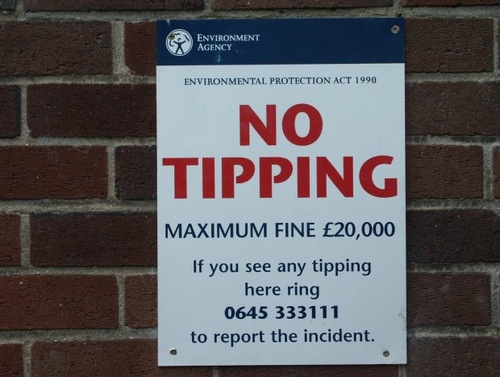
Just In Time For Christmas, Here Are All The Bad Arguments And Rationalizations Against Tipping So You Can Feel Self-Righteous About Being A Scrooge

See? The rest of the world knows how to deal with you sexist, racist, aristocratic poverty perpetuating, self-esteem destroying bastards!

See? The rest of the world knows how to deal with you sexist, racist, aristocratic poverty perpetuating, self-esteem destroying bastards!

Vox has published an entertaining screed against tipping, massing all the contradictory, facile rationalizations and faulty arguments against demonstrating one’s gratitude when someone serves you well. This is Vox, remember—Ezra Klein’s uber-progressive website with an agenda. Think about what the alternative to tipping is, and where the critics of tipping are going with these claims. Hint 1: It has nothing to do with democracy or individualism. Hint 2: The piece argues that tipping is classist, racist, sexist, “lookist”…the works.

The full illogical, ethically confused character of this junk has to be read to be fully appreciated, but here is a quick overview:

1. Hoary old quotes. There are these, for example:

English author Lynne Truss on visiting New York: “In this great financial capital … tips are not niceties: give a ‘thank you’ that isn’t green and foldable and you are actively starving someone’s children.” No, Lynne, you’re being cheap, that’s all.

The Village Voice’s Foster Kamer: “It reinforces an economically and socially dangerous status quo, while buttressing a functional aristocracy.”   Ah. You see, if lower paid service professions are treated like robots and underpaid, they will rise up and overturn this monstrosity called capitalism.

 Michael Lewis: “I feel we are creeping slowly toward a kind of baksheesh economy in which everyone expects to be showered with coins simply for doing what they’ve already been paid to do.” Who is being “showered with coins?”

2. “Tipping lets employers off the hook.” Translation: It gets in the way of the progressive “living wage” campaign. Mandatory salary levels drive businesses out of business and reduce jobs. Want to see all restaurants go to the iPad, self-ordering, system running rampant at airport restaurants—and no, I don’t tip a runner who just carried my food to the table—by all means, force restaurants to pay “a living wage.”

3.  “Tipping is undemocratic.” This is the George Orwell, “Peace is War” argument. The government should stop me from giving my money to whoever I want in the name of democracy. Continue reading

Encore: “Ethics Call To Arms: Fight the ‘Fuck You!’ Culture”


kid fu

[This happens sometimes with 5000 posts in the bank: some topic causes me to find one that I can’t even remember writing, and I realize that I still agree with it, and if I forgot about, everyone else probably did too. The previous post led me to link to this one, and I decided that the list of steps I recommended to try to halt the culture’s slide into permanent vulgarity and incivility was worth re-posting, especially since five years ago the blog got less than a fifth of the traffic it does today. Thus I am re-posting this one, slightly edited to remove a few rhetorical excesses and outdated references, from November 18, 2010.]

“Every action done in company ought to be with some sign of respect to those that are present.”

This was the very first edict in the list of civility rules memorized by George Washington as a child, rules that shaped his character and significantly influenced not only his life and career but the fate of America. Like most of Washington’s 11o rules, the first has universal and timeless validity, pointing all of us and our culture toward a society based on mutual respect, caring, empathy, and fairness.

Recently, however, there has been a powerful cultural movement away from George’s rules and the culture of civility that they represent. Rudeness has always been with us, of course, and public decorum has been in steady decline since the Beatniks of the Fifties, to the point where it is unremarkable to see church-goers in flip-flops and airplane passengers in tank-tops. Something else is going on, however. Like the colored dots of paint in a George Seurat painting, isolated incidents and clues have begun to converge into a picture, and it is not one of a pleasant day in the park. I believe we are seeing a dangerous shift away from civility as a cultural value, which means that we are seeing a cultural rejection of ethics. Continue reading

“It’s Unethical To Be A Weenie,” Part I: The Lipreading NFL Fans

Preface: The Rise of the Weenies
Tom Brady, mid-

Tom Brady, mid-“Fuck!”

Everywhere we look, it seems, we see the United States culture being threatened by weenies and the rise of Weenyism. In a nation founded on the principles of self-reliance and individual liberty, built and shaped by stunningly brave men and women who hacked civilization out of an uncertain and perilous wilderness, there is a growing mass of citizens—the cancer imagery is intentional—who are committed to giving the government near total control over every conceivable danger, threat, peril, offense, inconvenience or annoyance, real or imagined, as the role of individual Americans devolves into pointing and saying, “There! Fix that! I don’t like that! Arrest them. Fine him.” Increasingly, the primary motivation for public policy is fear, planted by activists and politicians to panic, terrify and mobilize the weenie base, who are ever eager to trade individual freedom for protection against, well, almost everything.

I know I am hyper-sensitive to the weenification problem right now, having spent three weeks reviewing the history of the American West and its portrayal by Hollywood in preparation for my Smithsonian Associates program last week on how the Hollywood Western shaped American culture. Around the same time that the Sixties exploded, the culture’s unified acceptance of traditional American values began to collapse, just as the primacy of the Western as an entertainment genre declined. Now weenyism is in its ascendency. There are those who claim that the name of a distant football team causes psychological trauma to Native Americans who don’t follow football. Blogger Andrew Sullivan (a candidate for Head Weenie) asserts that the United States should have the “courage” to do nothing about ISIS and allow it to run amuck (the ultimate goal of the Weenies: an Orwellian “Weenies Are Heroes” motto). Feminists insist that women are so vulnerable to male sexual predations on campus that due process, fairness, common sense and much of the respect as equals their predecessors fought for must be surrendered, in a new system that begins with the presumption that all men are potential rapists and all women simpering, helpless victims, even when they say “yes.” College students and other are demanding that books, stories, essays and blog posts contain “trigger warnings” to alert weenies that words and topics in the text might give them the vapours. Needless to say—I hope—this not a healthy development for the United States, or  our culture.

The resistance to Weenyism ought not to be a partisan issue. The obligation to help the weak, disadvantaged and powerless become stronger, overcome their handicaps and acquire power is part of the American tradition too. Somewhere, however, this obligation was distorted by the realization that in a system where the government is looking for victims to justify its existence, Weakness Is Power (Orwell again). Weenies—fearful, risk-averse, passive-aggressive citizens who shrink from conflict, confrontation and the messy process of democracy— have realized that they can mobilize power to satisfy their narrow biases and interests, often at the expense of their fellow citizens’ right to liberty and the pursuit of happiness. Now the culture is tilting away from the uniquely American model that encouraged individuals to fight their own battles and succeed or fail on the merits of their causes and their own determination and skill, to one that rewards the perpetually offended, victimized, and passively unsuccessful.

It is unethical to be a weenie, and equally unethical to allow Weenieism to overcome what has been an American cultural strength.

Part I: The Lipreading NFL Fans

Several TV viewers who watched the NFL’s  New England Patriots-Green Bay Packers made official complaints to the Federal Communications Commission because they could see Patriots quarterback Tom Brady saying “fuck” repeatedly on the sidelines in frustration over his own play.  They couldn’t hear it, mind you: they were just able to read his lips. This was so horrible that they felt that the Federal government needed to investigate and take remedial action.

One complaint was from an Indianapolis parent who wrote that their “6 year old children know how to read lips.” Another was from a Pennsylvania grandparent who complained to the FCC,  “My 8 year old grandson was watching the game with me and even commented that he should not have said that.”

The Horror. Law professor Jonathan Turley opined on his blog,  “I do not believe that this was a good thing for a NFL QB to be doing.” Well, sure: he should be picking his nose of grabbing his crotch, either, but this isn’t scripted, and its a football game.  The whistle has to be blown for Federal retribution for mouthed obscenities to nobody in particular, as these sensitive parents and grandparents happily allow their delicate charges to cheer men in the process of maiming themselves and risking that their children will be changing their fathers’ diapers in the disturbingly near future?

The really frightening thing is that our regulatory morass encourages such attempts at censorship. Continue reading

Ethics Alarms Mail Bag: The Cologne Allergy

Perfume allergyEvery now and then readers think I’m Ann Landers. Today I got a “Dear Ethics Alarms: What’s right?” e-mail from a friend, and I thought I’d answer it on the blog because it raises a classic ethics conundrum.

The inquirer belongs to a social group that meets weekly. It is a weekly joy, I am told; the writer has been attending for years. Everyone convenes, on the given day, right after work. Attendance varies, and membership is informal, though individuals have been told, on rare occasions, to come no more.

Of late an infrequent attendee, but a member of long standing, has begun to attend meetings with some regularity. My friend says this is not the happiest of developments, because the two do not get along. It is a breach of long-standing, I am told and is not going to be healed. “She is an asshole,” is how the letter delicately puts it.

Last week, shortly before the end of the 90 minute gathering, the recent interloper stood up and declared that she had developed a serious allergy to colognes, perfumes, aftershave, and all chemical scents. Looking right at my friend, she declared that this allergy made exposure to any sort of commercial scent unbearable, and she asked that in the future no members should wear perfume of any kind.

“I have worn a favorite brand of cologne every day for over thirty years,” the from my acquaintance letter says. “I always get complimented on it; the scent is subtle and nobody would notice it unless they were right next to me. The asshole and I have been separated by the length of the room since she started coming. Personally, I think she made the demand just to make me miserable. She knows, from our previous relationship [NOTE: I think it was more than just a friendship], that I wear the cologne.”

The question: Is she ethically obligated to stop wearing cologne on the day of the meeting (she goes right from work) to accommodate this member’s special problem?

Add to this the broader ethics question that comes up often: Does a group member with special sensitivity have the ethical upper hand allowing such a member to demand that all other members avoid conduct that only bothers that member? Continue reading

On Its 100th Anniversary: Remembering The Great War’s Christmas Truce Of 1914

christmas-truce-1914-H

On December 7, 1914, as the horrible, pointless, world-disrupting “War to End All Wars”  was only five months old, Pope Benedict XV suggested a truce for the celebration of Christmas. The governments of the battling nations rejected the idea, but in the days leading up to  Christmas and after, many of  the soldiers in the trenches of this ugly conflict took the Pope’s advice.

On December 20, Germans soldiers in some areas took in British wounded from the no man’s land between the warring armies. A German soldier reported on December 22 that both sides had been heard singing Christmas Carols in the trenches. German troops arriving into the lines had begun bringing Christmas trees, and some men placed them on the parapets of the fire trenches. Then, on Christmas Eve, many German and British troops serenaded each other across the lines. Allied soldiers reported that sometimes their singing was accompanied by German brass bands. Then, Christmas Day, 1914, some of the German soldiers left their trenches and  carefully approached Allied lines, shouting“Merry Christmas” in French and English. Allied soldiers climbed out of their trenches, and shook hands with the men who had only recently been trying to kill them. Some even exchanged exchanged gifts of cigarettes and and food. There were even instances where soldiers from opposing sides played soccer: in England, one organization is holding a match next week against a German team to commemorate such contests. Continue reading

Transparency, Causation, Eggshells, Trust : Seven More Ethics Issues In The Eric Garner Case

jigsaw-puzzle-record

1. There is near unanimity in the response to the non-indictment by the Staten Island jury in the Eric Garner case. In light of the graphic video, it is hard to see how there wasn’t probable cause to indict. The coroner verdict of “homicide” would see to provide sufficient evidence all by itself. However, in the absence of the complete record of what the grand jury heard and saw, nobody can be certain that this was a miscarriage of justice. However, given the context of the case and its deleterious impact on faith in the justice system, that is no solace and scant mitigation. As in Ferguson, it is prudent and essential that the public see what the decision was based upon. It is true that those who are determined to see injustice, bias and racism will do so regardless of what the evidence shows–again, as in Ferguson—but the only evidence that has been made public, the various videos and the officer’s testimony–only makes the non-prosecution more suspicious.

2. Can the non-prosecution be justified? If so, the only reason I can see would be lack of proof of causation. Causation is tricky, and  juries get confused about how to analyze it. Since it is fair to assume Daniel Pantaleo did not intend to kill Eric Garner, the issues are a) whether his actions during the arrest were negligent, and b) whether they were the proximate cause of Garner’s death. That his conduct was negligent is not enough to sustain and indictment—that negligence had to be the reason Garner died. Remember, he was not choked to death. The medical examiner ruled that Garner died from a collection of factors: compression on his chest and throat, the position he was forced into, his obesity, weak heart, and asthma, all causing asphyxia.

  • If Pantaleo’s actions alone would not have caused Garner’s death, then it could be legitimately argued that he was not guilty of a crime. The other officers were given immunity for their testimony, which seems like either a bad decision by the district attorney, or intentional sabotage of the case against Pantaleo’s. If it was the collective action of the police that caused Garner’s death, it would be unjust to make Pantaleo the sole officer punished. If some of the testimony from the unchargeable cops made the case that it was another officer, or several, who really caused Garner’s death, that would explain the no indictment result.

In the widely seen video of the arrest, Pantaleo can be seen with his arm around Garner’s neck as Garner is taken to the ground and for some time thereafter, but in watching the video it’s difficult to determine whether Garner was in fact choked. And if he was, it did not appear it was long enough even to render him unconscious, much less kill him…I saw nothing excessive in the manner in which the officers subdued Garner. He was neither beaten with batons nor even punched. To me, it appeared to be a fairly typical scuffle with a large man who had clearly demonstrated his unwillingness to be arrested peacefully.

He misses the point. The question is whether the take-down was excessive for Garner, not some theoretical average arrestee. It is true that with a normal, healthy subject, what the officers did would not typically cause death….but Garner was obviously not normal, nor healthy. He was morbidly obese, and 350 pound middle-aged people tend to have the kinds of heath issues Garner in fact had. Nobody would argue that an elderly woman or a ten-year old girl or someone in a wheelchair should be manhandled like that. Such treatment was negligent for Eric Garner, and the deadly result could and should have been anticipated.

It is true that the officers couldn’t know that Garner had a weak heart and suffered from asthma, but it doesn’t matter: the rule in negligence is that “you take your victim as you find him.” If your negligence is the proximate cause of someone’s death, the fact that it wouldn’t have caused anyone else’s death is no defense. This is the so-called “Egg-shell Skull” rule.

Garner was an egg-shell perp. Continue reading

The Wall Street Journal’s Uncultured Culture Critic

Joanne Kaufman was here...

Joanne Kaufman was here…

In a jaw-dropping essay for her employer, The Wall Street Journal, alleged culture critic Joanne Kaufman proudly and candidly disabuses readers of any misconceptions they might have had regarding her qualifications for her job. She is not merely unqualified, but willfully, shamelessly, spectacularly unqualified. In a smug screed in which she admits to habitually walking out on Broadway shows at intermission, Kaufman reveals herself as lazy, arrogant, disrespectful of artists, and most crippling of all, to be afflicted by the attention span of the average Twitter addict.

“Don’t ask me what happened during the second acts of “Matilda,” “Kinky Boots,” “Pippin” and, reaching back a few seasons, “Boeing-Boeing” and “Billy Elliott, ”  Kaufman boasts.  “Really, I have no idea. But I am nothing if not cosmopolitan in my tastes, or distastes—French farces, English musicals set in gritty industrial cities, and American entertainments involving Charlemagne ’s Frankish kin.”

You can read her entire piece here; if the Journal doesn’t fire her, it is run by fools. “I’m of the “brevity is the soul of wit” school and of the belief that only a few bites are required to determine that you just don’t like a particular dish,” she happily admits. “My ideal night in the theater runs 90 minutes without an intermission (it is best not to put temptation in my path), which means that Shakespeare and I don’t tend to see a lot of each other.” This is the culture writer, remember. Yet she is admitting to membership in the lazy, sound-bite, bumper-sticker, multi-processing, distracted, ADD-addled public that has caused writers, playwrights, producers, book publishers, film-makers and song-writers to dumb down, redact, trivialize and simplify entertainment in an accelerating death cycle: plots don’t make sense, explosions start early, subtlety is forbidden, and no issue, thought or topic that can’t be fully explored in the time it takes to do a load of laundry is going can find its way on stage or screen. The Journal’s culture writer doesn’t have the time or interest to sit through King Lear, Hamlet, The Ice Man Cometh, or Death of a Salesman,  or to view all of “Seven Samurai,” “A Man for All Seasons” or “Gettysburg”—hey, a movie about one of those short Civil War battles for Joanne, please: she’s got a 15 minute segment of “Robot Chicken” to catch. Continue reading

Ethically Incoherent Statement Of The Month: Van Jones

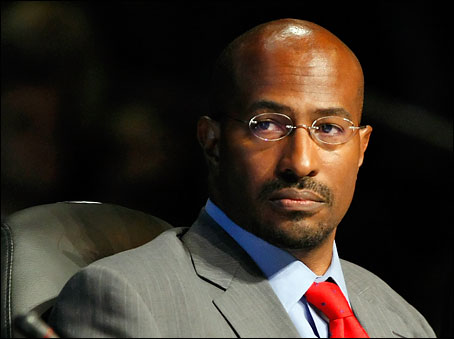
Van Jones: Reasonable or biased?

Van Jones: Reasonable or biased?

Van Jones, the former White House “czar” of something or other turned smooth-talking racialist warrior on CNN’s “Cross-Fire” and various TV panels, was arguing for frank racial dialogue on ABC’s “This Week With George Stephanopoulos,” in the context of the protests over the Ferguson and Staten Island police grand jury decisions. Sounding reasonable as he often does, Jones then said that what should be an area of agreement is the need for a special prosecutor whenever police misconduct is before a grand jury, noting that it was an “obvious conflict of interest”for prosecutors who work with police as a core element of their job.

I have addressed this argument before, but let me be clearer. This is a conflict of interest that a competent and ethical prosecutor should acknowledge and be able to deal with as the legal ethics rule require. The prosecutor should get a waiver from his or her client—not the victim’s family, but the government the prosecutor represents—and honestly assess whether the fact that the police serve the same client will prevent the prosecutor from being fair and objective. If the answer is yes, then the prosecutor must recuse, but I see no reason why the answer should be yes, if the prosecutor is ethical and worthy of the position.(Jones and other advocates for this “solution” have a bias against prosecutors, whom they view as presumptively unethical.)

Theoretically, every case in which an officer’s credibility determines whether a citizen should be charged poses the same conflict: it is endemic to the prosecutor’s job. Indeed, prosecutors have a very good reason to want bad cops punished and removed from the police force; I’m not at all certain that there is a necessary bias on the part of prosecutors in favor of letting such cops escape legal consequences of their actions. That assumption is based on the assumption that prosecutors don’t care about  justice. Nobody who doesn’t care about justice becomes a prosecutor. Why would they? It is a hard, frustrating job and the pay isn’t anything special.

The strongest argument for a special prosecutor is a different ethical problem, the appearance of impropriety. If the decision to prosecute or not is tainted with suspicion of bias, then the justice system is compromised and breaks down. This is why, for example, it is terrible that the Justice Department, a super-politicized one at that, is supposedly investigating the I.R.S. scandal.

As George moved to another topic, Jones blurted out a final statement that caused me to spit-take a mouthful of coffee. It undermined all of his finely tuned rhetoric about fairness and non-partisan dialogue about race, and exposed, ironically, his own biases. He said;

“If there had been a special prosecutor in Ferguson, we would have had a different result.”

AHA! Continue reading

Cellphone Videos Of Stand-Up Comedy Routines Are Unethical: Ban Them

no cell phonesVulture features an interview with Chris Rock, on which he waxes forth on many topics.I don’t especially care what Chris Rock has to say about Ferguson, but I care a lot about his views on stand-up comedy, where he qualifies as an expert, and the disastrous effect unauthorized videos are having on his art.

Rock has walked off the stage in appearances when he couldn’t stop audience members from filming him, and for very good reasons. He doesn’t want untested, half-baked material to get out to the public via YouTube:

“There are a few guys good enough to write a perfect act and get onstage, but everybody else workshops it and workshops it, and it can get real messy. It can get downright offensive. Before everyone had a recording device and was wired like Sammy the Bull, you’d say something that went too far, and you’d go, ‘Oh, I went too far,’ and you would just brush it off. But if you think you don’t have room to make mistakes, it’s going to lead to safer, gooier stand-up. You can’t think the thoughts you want to think if you think you’re being watched.”

On Elahe Izadi’s Syle Blog in the Washington Post site, other comics voiced similar concerns. Continue reading

Ethics Dunce and Unethical Facebook Post of the Month: Elizabeth Lauten, Spokeswoman for Rep. Stephen Fincher (R-Tennessee)

Elizabeth Lauten, communications director for Republican Congressman Stephen Fincher, decided that she is authorized to give parental advice to First Offspring Sasha (13) and Malia (16) Obama. She was deeply troubled by the young ladies looking bored in photographs she saw online, so she posted this jaw-dropper on Facebook:

Facebook lecture

Wow. What a Thanksgiving feast of unethical features! Let’s see: Continue reading