The Washington Post, Faking it.

This one’s for you, Bob Hoskins.

You deserved better.

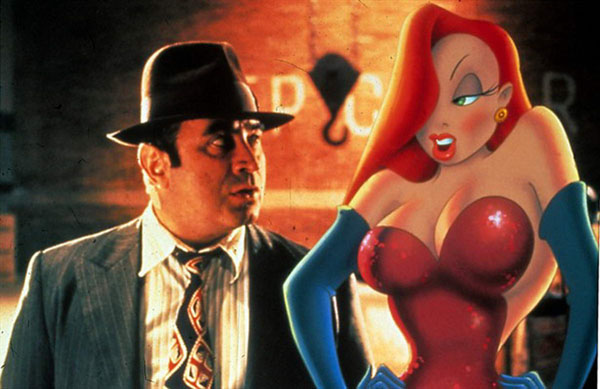
Who-framed-roger-rabbit-Jessica-RabbitIf you come here frequently, you know that I deeply resent lazy, inadequate or inaccurate obituaries of famous and accomplished figures. Obituaries are the beginnings of their legacies, and set the foundations for how, and even if, they will be remembered. Not fairly representing these lives is lousy and lazy journalism, and worse, it is disrespectful to the deceased and contemptuous of history.

Bob Hoskins, the superb and versatile British actor, died this week. He was one of my personal favorites—a better, cockney version of Joe Pesci—but even if he meant nothing to me, the Washington Post’s sloppy and factually wrong obituary today would have been inexcusable. I liked Hoskins’ various tough guys and mobsters, but the film role that blew me away was his amazing portrayal of the human detective trying to unravel a cartoon mystery in the 1988 Disney classic, “Who Framed Roger Rabbit?” Hoskins, in addition to wielding a perfect American accent (he was really a Cockney), was intense, funny, moving and entracing while interacting with characters that were drawn into the scenes long after he performed them. He made the complex conceit of the movie work, and I would rank it among the most impressive acting turns of all time.

Here is how obituary writer Adam Bernstein described Hoskins’ most famous role in the print version of the Post today:

“(He) won over American audiences as a detective who falls in love with a voluptuous cartoon character in “Who Framed Roger Rabbit?”‘

and

“Mr. Hoskins was a boozing detective who falls for Jessica Rabbit, a cartoon human of pneumatic proportions who can’t help but bewitch men. “I’m not bad,” insists Jessica (voiced by Kathleen Turner). “I’m just drawn that way.””

Continue reading

The Maryland Supreme Court Clearly Doesn’t Believe In Signature Significance

PeepingTom

But I do.

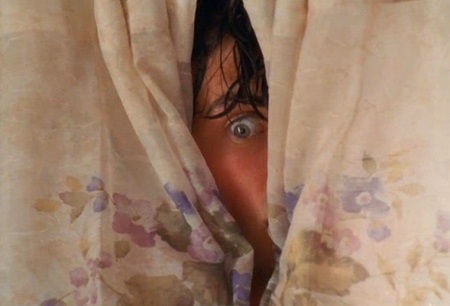
The Maryland Supreme Court just reinstated a Clayton W. Boulware, a Montgomery County attorney who had been suspended for six months after being convicted of covertly filming up the skirts of two women, one of whom was a minor, in a public place.  Boulware was suspended in September for six months with a three-year probationary period to follow the suspension.

In his defense, Boulware blamed his upskirt peeping on an “open relationship” with a younger woman, introducing him to a “swinging lifestyle” that included filming themselves having sex. But that relationship is over now, the court notes, so, hey, no problem.

The bar disciplinary board noted in its report to the court that it believed  a more lenient approach to punishing Boulware was called for because of those “mitigating circumstances.”  Lawyers are, as everyone knows, putty in the hands of swinging young women, and this always results in them shooting up other women’s skirts.

I feel like I am losing my mind. Continue reading

My Friend, Greg

stand by me

I’m not sure exactly what this post has to do with ethics. Obligation, perhaps. Still, I have to write it.

Yesterday, I learned that Greg Davidson had died. The news thrust me into the heart of some intense and strange hybrid of “Stand By Me,” “Animal House,” “Mister Roberts,” and “The Sandlot.” I hadn’t seen or talked to Greg for 41 years, since the day he sold me my first car, a red Nova that I paid for with cash, using my bank account started for me by my Dad when I was a baby. Wiped it out, too. But that’s not why Greg Davidson was important in my life.

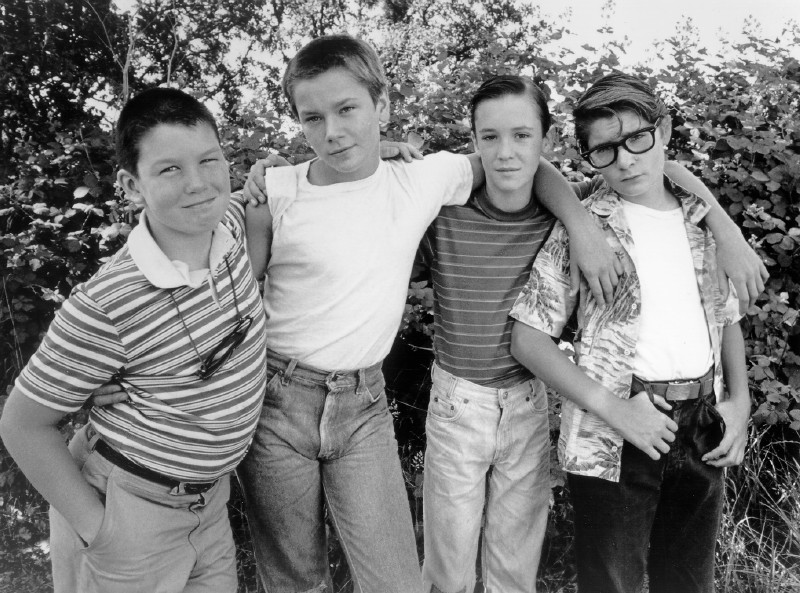
I met Greg in the 7th Grade, when we were both 12. He was the first un-self-consciously cool kid I ever met, and one of the few people I have known had this distinction. (I will embarrass him by saying this, but my son is one of them too.) If you can picture the character of Chris (River Phoenix) in “Stand by Me,” that was Greg—athletic, physically graceful, blond, with a buzz cut, relatively quiet, and a natural leader. He was, essentially, a man in attitude and conduct long before the rest of us (some of us are still working at it)—he won the affections of my 6th grade crush, Margie, and formed a famous, much admired steady couple with her that lasted well into high school.

He was smart, but defiant in a puckish and courageous way: this was the early Sixties, and we all regarded the regimentation of school as an insult. Greg undermined that, regularly, and at considerable personal cost, by waging clever, chaotic war against authority that he considered an affront to human dignity—the equivalent of Mr.Roberts throwing the Captain’s palm tree into the drink. One of my favorites was when he tweaked a pompous high school English teacher who chafed under the nick-name Greg had devised for him—“Tweety Bird”—because it caught on, and because it was so dead-on accurate. Greg went to the trouble of making stationery with a small picture of the Warner Brothers avian in the corner, distributed it, and that week poor Mr. Hendrickson received an assigned essay from every student on Tweety paper. Greg denied that he had anything to do with the plot, but accompanied his denials with Otter’s iconic wink to Dean Wormer, so he left no doubt who Mr. H’s true tormenter was, not there was any doubt.

The teacher did not take it well. Continue reading

Comment of the Day: “Ethics Quiz: Peeps Ethics”

Peeps Last Supper by Leonardo DiPeepchi

Peeps Last Supper by Leonardo DiPeepchi

Extradimensional Cephalopod’s thoughtful answer to today’s ethics quiz was instantly recognizable as a Comment of the Day, so here it is, EC’s musings on the ethical limits on peeps art, as posed by the post, Ethics Quiz: Peeps Ethics:

Full disclosure: I identify as a freethinker, which in my case means my opinions are informed by this idea: “It is the mark of an educated mind to be able to entertain a thought without accepting it.” –Aristotle (or so the Internet tells me)

With that in mind, offhand I’d say anyone who can’t handle the juxtaposition of a serious scene with a cutesy or comical medium is not emotionally mature enough to be trusted to react appropriately in today’s complex and nuanced culture, and their reverence is likely to be taken to unhealthy levels. I think it is not only ethical, but a requirement for intellectual health to be able to entertain different perspectives and styles of presenting even the most serious subjects. Before someone asks, yes, that includes depictions of the prophet Muhammad, along with all other historical figures on pedestals. I think taboos are unhealthy for a society because they limit critical thinking and creative free thought, both of which are necessary (yet seldom employed) to resolve social issues and differences in perspective.

Bad taste is still a valid concept, but it is context-dependent. It is possible that a subject is not appropriate for most contexts because it leads people to feel bad, but it is imperative that there be some place where it can be discussed, even if it is only under the Jester’s Privilege. My subjective judgment rules that depicting the Civil Rights Movement with marshmallows in this case is not intended with disrespect: the contest stipulated that the medium be marshmallows, and the artist chose a powerful scene without regard for the medium, as is the artist’s prerogative. I personally think the marshmallow scene is quite dignified, but then I am a bit out of sync with humanity as to what I take at face value and what I don’t. I form opinions of peeps by their actions, not by their countenance. It’s unethical for an artist to deliberately spread misconceptions about history, and it may be unethical for an artist to deliberately show disrespect to powerful agents of good. Disrespect is usually unethical because it causes so many problems. However, I’m not sure a sincerely respectful artist can be unethical in their art, unless they simply fail to do the research on the facts they depict and the cultural context for showing respect.

If depicting scenes from the Civil Rights Movement with marshmallows (and putting a good deal of effort into it) is wrong, though, what else is wrong? Crayon drawings by kids? Macaroni? Charcoal? Embroidery? Spray paint? Etch-A-Sketch? Is anything that looks insufficiently grandiose for depicting humanity’s legendary heroes an affront upon their memories? Are scenes of historical importance off-limits to mediocre artists, for fear the general public will lose respect for heroes drawn with funny expressions and ridiculous poses? What if an artist is deliberately depicting a heroic person comically, but without telling lies? Why can’t we be mature, and tell the history with respect while artists do their best in sincerity or spite? Why not simply say, “Well, it’s nice, but it really doesn’t do it justice,” and walk away?

Continue reading

Ethics Quiz: Peeps Ethics

peeps winner

I collect sentences that can safely be said to have never been uttered before in the history of mankind, and encountered one this morning in a letter of complaint to the Washington Post. It read…

“To take a sacred and historic event in our nation’s history and depict it using marshmallow candy is highly insulting and offensive to the legacy of the Rev. Martin Luther King Jr. and to all those who worked, and continue to work, for racial justice in this country.”

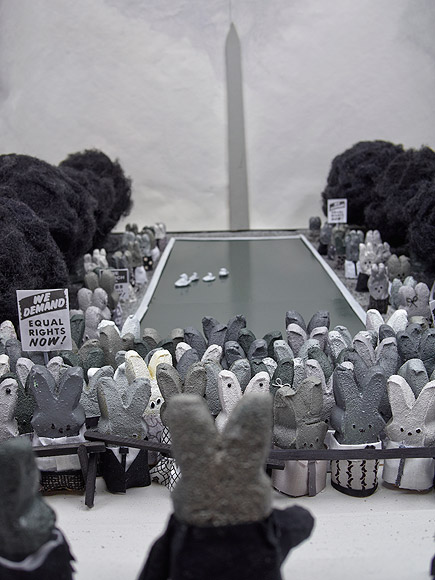
Like all of the sentences in my collection, my favorite being my sister’s immortal, “That fish looks so good, from now on I think I’ll wear my bra on my head,” this one requires some context. The Post holds an annual contest for its readers around Easter, challenging them to submit the best diorama of a scene, using marshmallow peeps. This year’s winner was created by Matthew McFeeley, Mary Clare Peate, and Alex Baker, and involved meticulously painting the colorful bunny stand-ins for King and his throng  at the 1963 March on Washingtonian eight shades of gray to evoke the black-and-white photographs of the event.

Your Ethics Alarms Ethics Quiz, in the sadly neglected field of peeps ethics, is…

Is it unethical to use marshmallow candy as a medium to portray serious, solemn, or other events that many feel deserve respect and reverence?

I know my answer, but this time, I’ll hold my fire until I hear from readers. I’d also be interested in whether any events—Gettysburg…JFK’s assassination…the Lindbergh baby kidnapping…the Crucifixion…Pearl Harbor…9-11…  are ethically off-limits for peeps creativity as inherently offensive, or if this is just  an unappetizing mixture of “ick,” art, humor, and candy.

Cover Art Ethics: Sexism, “Rape Culture” or Just Marketing

If you had asked me thirty-five years ago whether we would still be debating what is the appropriate and ethical use of women as sex symbols—or “objectification,” if you like—in non-sex trade publications today, I would have answered, I think, “Are you kidding? By 2014 we will have hashed all this out. Either the combination of consensus  political correctness and the increased influence of women in business in general and publishing in particular will have reformed standards of acceptable practices, manners and taste, or emerging feminism will embrace the power of sexuality as a source of influence and power over the male of the species. The battles over this are too hot now to keep going on indefinitely! Either using sexy women and models in “take me” poses will be considered shameful and unappealing in 2014, or they will be accepted as part of an “anything goes” culture.”

No, I’m not very bright.

Case Study #1: The Golf Digest Cover

Paulina-Gretzky-on-cover-of-Golf-Digest

The cover of the latest issue of Golf Digest caused a stir by featuring Paulina Gretzky, who plays a little golf but who is primarily a model, and obviously there for other reasons. Until the Gretzky cover, the only woman to appear on the magazine’s cover without having won a pro or major amateur event was Golf Channel personality Holly Sonders, in May 2013. From the New York Times: Continue reading

Bergen Community College Shows Us Why Justin Carter Is Being Persecuted

Can't have this. Terrifying. Dangerous.

Can’t have this. Terrifying. Dangerous.

Remember Justin Carter? Last I checked, he was being tried for making a joke on Facebook, because of the culture of fear and speech monitoring created by the irresponsible hysteria over guns and terrorism.  He faces prison time. That this is a freedom-suffocating societal illness that threatens any and all of us is chronicled in Ken White account, and accompanying commentary, on the astonishing mistreatment of Bergen Community College Professor Francis Schmidt by the school, which was sent into a frenzy of terror because he posted to Google+ “a cute picture of his young daughter wearing a Game of Thrones t-shirt in a yoga pose next to a cat.”  Inside Higher Ed reports what happened next: Continue reading

Ethics Dunces: Paula Deen and “Uncle Bubba”

uncle-bubba-s-oyster

Like breaking up via text message and telling your spouse you want a divorce in an e-mail, here’s a crummy use of technology that we should hope doesn’t catch on.

Uncle Bubba’s Seafood & Oyster House, a restaurant owned by Paula Deen and her younger brother, Earl W. “Bubba” Hiers Jr., told all of its employees that the place was going out of business on its Facebook page, and that was all. The message:

“Since its opening in 2004, Uncle Bubba’s Oyster House has been a destination for residents and tourists in Savannah, offering the region’s freshest seafood and oysters. However, the restaurant’s owner and operator, Bubba Heirs, has made the decision to close the restaurant in order to explore development options for the waterfront property on which the restaurant is located. At this point, no specific plans have been announced and a range of uses are under consideration in order realize the highest and best use for the property.The closing is effective today, Thursday, April 3, 2014. Employees will be provided with severance based on position and tenure with the restaurant. All effort will be made to find employees comparable employment with other Savannah restaurant organizations.”

Yechh.

Cruel, rude, impersonal, cowardly. Also callous, lazy and inefficient: how many employees were told by third parties about the announcement?

Well, at least Paula’s not a racist. I wonder if the Food Network fired Paula via Facebook? I’m pretty sure it didn’t.

_____________________

Pointer: Evil HR Lady

Facts: CBS

Not Diversity, But Bigotry

No whites

It has troubled me for decades, troubles me still, and I know it troubles others. How can the double standard of  prejudice and discrimination so often embraced by various minority groups in the United States continue to be respected and tolerated? To me, this not only seems self-evidently wrong, but also inevitably destructive. You may not gain my support by cautioning me against favoring members of groups that I belong to, and yet openly discriminate against those same groups on behalf of your own.

I raised this issue back in 2011, when Christiane Amanpour, then the host of ABC’s Sunday morning public issues show, brazenly led three male-bashing female guest commentators in a discussion of how much better the world would work with more female leaders who were not addled by all that testosterone. I wrote, and none too happily,

“An all-male panel smugly talking about how “Estrogen really is a problem” and how decisions made in the throes of PMS are inherently untrustworthy would guarantee a feminist march on ABC headquarters, blogger and op-ed fury, NOW declarations of war and the rolling of network heads.When he was president of Harvard, Lawrence Summers was run out of his job by faculty and feminist fury when he suggested that it was possible that differences between the genders might be part of the explanation for the under-representation of women in the worlds of science and mathematics. Yet I just watched the host of a mainstream news program aggressively participate in a stacked and rigged discussion that began with the unchallenged presumption that men—not just Weiner, or Dominique Strauss-Kahn, or some men, or many men, but men as a monolithic, homogenous, stereotyped group—-are fatally handicapped by their hormones and brain-wiring when it comes to leadership and management.”

You know what? I don’t like groups that stereotype and discriminate against me.

But this was hardly the most egregious example, nor the most recent. Consider:

Case study #1: Pro-Gay Bigotry In D.C. Continue reading

The Cruelest Month And The Duty To Remember

sultana-ablaze

If we have the education, curiosity, perspective and respect for our origins and those who have gone before us, the calendar is a source of constant reminders of what matters in life, and how we can be better citizens and human beings. It is a common belief among Millennials, and a lot of older Americans too, that history is irrelevant to their lives, and this is both a fallacy and a self-inflicted handicap. Not that keeping history in mind is easy: in this month, which T.S. Elliot dubbed “the cruelest,” paying appropriate respect by remembering is especially difficult.

Still, respecting history is our duty. It won’t be remembered, perhaps, but in April, 2012, a 23-year-old drunken fool named Daniel Athens was arrested for climbing over a barrier to urinate on a wall at the Alamo. Monday, a Texas judge threw the book at him, sentencing him to 18 months in state prison for vandalizing a National Monument and a shrine. The sentence seems extreme, and is a good example of how the law is a blunt weapon with which to enforce ethics. The Alamo has near religious significance in Texas, brave men died there, and the ruins serve as a symbol of critical virtues like loyalty, sacrifice, dedication, courage and patriotism. Athens, himself a Texan, defiled the memory of the fallen and symbolically rejected the values and heritage of his community and fellow citizens. Unfortunately, the harshness of the sentence will create sympathy for him: 18 months for peeing? But how else does a culture reinforce the importance of respect for the past? I don’t have an answer. Perhaps I would have sentenced him to take an exam on the lives of Travis, Crockett, Bowie, Seguin and the rest, as well as the siege itself, and imposed the jail term only if he flunked.

Yesterday, Major League Baseball celebrated the heroism and transformative life of Jackie Robinson, who broke baseball’s color barrier on April 15, 1947 by becoming baseball’s first black player, setting in motion powerful forces that propelled the cause of civil rights. Every player wore Robinson’s now retired uniform number 42, and there were commemorative ceremonies in the ball parks where it wasn’t too cold and wet to play ball. This remembrance had a difficult time competing with tax day, as history usually does when our immediate life concerns beckon.

Other important historical events deserving reflection, however, were more or less ignored entirely, for April 15 is a historically awful day: Continue reading