Addendum: To “The Euthanasia Slippery Slope: A Case Study,” Hypothetical And Poll

The Euthanasia Slippery Slope: A Case Study, this morning’s post, has attracted a wider range of opinion than I expected. I considered attaching a poll to the original post; now I’m going to go a step farther, and base that poll on a hypothetical of the kind that I use in my legal ethics seminars.

Speaking of those, on Tuesday, September 17, in Richmond, VA, and Wednesday, September 18, in Fairfax, VA, I’ll be presenting  “The Greatest Legal Ethics Seminar Ever Taught!” for three hours of legal ethics CLE credit to Virginia lawyers and others. The title reflects, other than my own warped sense of humor (“The Greatest Story Ever Told” is one of the worst movies I’ve ever seen), the fact that the legal ethics hypotheticals being discussed cover what I have found to be many of the most contentious, fascinating legal ethics issues extant over 20 years of doing these things. Moreover, I am being joined by my friend and colleague, John May, who approached these issues from the perspective of a practical litigator as well as one who often defends lawyers accused of ethical improprieties. He’s also one combative and clever pain in the ass who loves disagreeing with me, so I recommend bringing popcorn. The details are here.

Now here’s your hypothetical:

Continue reading

The Euthanasia Slippery Slope: A Case Study

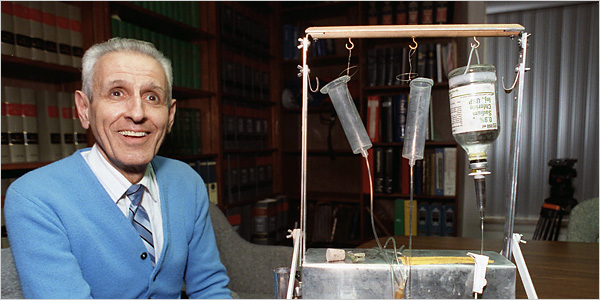
Dr. Kevorkian was happy to help you kill yourself…

As health care costs rise and the public as a whole becomes more financially responsible for the care of individuals; as the population ages and the massive increase in health care costs in the final years and months of life becomes an increasing burden on society, and as legal abortion stays front and center as the most brutal form of utilitarianism, where a weaker and “lesser” life is deemed expendable for the well-being of others, I expect the United States culture to be drawn closer and closer to the seductive policy of legal euthanasia.  It is now legal in Washington, D.C.,  California, Colorado, Oregon, Vermont, Maine (as of next year), New Jersey, Hawaii, and Washington. You may note what these states all have in common….not that there’s anything wrong with that.

I believe that permitting an individual to kill another with the victim’s consent is so ripe for abuse—Dr. Kevorkian comes to mind—that it crosses an ethical line that should be thick, black, and forbidding.  The alleged consent can too easily be coerced or manufactured for the convenience of others. A recent case in the Netherlands confirms my strong reservations.

The unidentified patient, 74, had asked in writing for doctors to end her life if she had to be admitted to a nursing home, and if she thought the time was right. When she entered a home in 2016, however, though incapacitated, she appeared to have changed her mind, and gave what prosecutors called “mixed signals” about her desire to die. Continue reading

Poll: The Racist Comment

Ethics Alarms received another one of its periodic racist comments today. As with most of them, it was generated by this post, about the racist site Chimpmania.

Unlike most of the comments I get of this ilk, this one is reasonably well-written: the writer probably has most of his teeth and would beat the kid who plays the banjo in “Deliverance” handily in Scrabble.

I routinely spam these kinds of comments, even the articulate ones. For a while I would allow the first one in, with a warning, but for more than a year I’ve just refused to publish them. Is that both ethical and wise, though? I am liking all forms of viewpoint censorship less and less of late, especially since Ethics Alarms is a victim of it. If there are substantial numbers of people who think like this bigot, shouldn’t the rest of us know about it, and learn what we can about their reasoning and motivation?

The contrary view is that this comment and the others like it are res ipsa loquitur, inarguable examples of uncivilized discourse that society reasonable and legitimately refuses to tolerate for its own safety The problem with this construct is that there are no clear standards to block the slide on the slippery slope. If it is legitimate to put racism, anti-Semitism, Holocaust denial and misogyny in the category of the properly censored, why not, according to another censor’s sensibilities, climate change skepticism or support for President Trump?

I’m interested in how you respond to this poll:

Most Unethical Abortion Ruling Ever?

“OK, now where’s my gavel?”

You have to hand it to the Brits: I would have thought that it was impossible to come up with an abortion ruling that simultaneously violates the core principles of both pro- and anti-abortion advocates. Mostly, however, the ruling places one more slippery slope quiver among the anti-abortion movement’s  metaphorical arrows. This is what can happen when unborn human life is accorded no respect whatsoever.

Yesterday, Justice Nathalie Lieven issued the ruling at the Court of Protection, which hears cases on issues relating to people who lack the mental capability to make decisions for themselves. She ordered an abortion for a mentally-disabled woman who is 22 weeks pregnant, although both she and her mother wanted the baby to be born.  The judge said the decision was in the best interests of the woman, and, of course, the Court knows best. Presumably it did not think the abortion was in the best interests of the unborn child, which apparently was healthy and unimpaired.

But I’m just guessing at that.

The unidentified woman is in her 20s and reportedly has the mental capacity of a 6- to 9-year-old child. Nobody is certain how she became pregnant, but obviously that was not a determining factor in the decision, nor should it have been. The unborn child doesn’t care.

“I am acutely conscious of the fact that for the state to order a woman to have a termination where it appears that she doesn’t want it is an immense intrusion,” Justice Lieven said, but held that in the woman’s “best interests, not on society’s views of termination,” the baby must go.  Wait, what? How is aborting a child that both the potential mother and her own mother want to have and care for in the woman’s best interests? Or anyone’s best interests, other than members of the “It’s no baby, its an invading clump of cells that you better kill fast before it grows anymore” cult? Continue reading

KABOOM! YouTube Pulls “The Triumph Of The Will”—Hate Speech, You Know. Can’t Have That!

I would have included a clip of “Triumph of the Will” here, but apparently such a film never existed…

Well, I can’t complain too much; it’s been a while since a news story propelled my brains through my skull to the ceiling. However, the trigger this time demonstrates that several developments are even worse than I thought—or believed they would get—such as…

  • The Left’s embrace of historical airbrushing and censorship as part of its strategy of controlling thought and knowledge.
  • Social media’s meat-axe approach to policing online content.
  • The perilous state of the First Amendment as both the Left and its allied media seek to control art as well as speech.

YouTube released new policies regarding “hate speech” yesterday  to “reduce more hateful and supremacist content from YouTube.”  Since the new policies almost immediately resulted in the removal of Leni Riefenstahl’s 1935 Nazi propaganda epic “Triumph of the Will,”    I can confidently conclude the the policies are far too broad, and also that those executing them have the perspective of the average person who has grown up in a cave, and the judgment of the PTA scold who wants to ban “Huckleberry Finn.” Continue reading

Are “Pre-Crime” Measures Absolutely Unethical?

Yes.

I guess that would be a too-short essay on an important topic with special contemporary relevance, so I am bound to say more. Nonetheless, I would be more comfortable with my fellow society members and more confident of the future of the the nation if the answer to the title query was universally accepted in absolute terms. For the acceptance of the principle of pre-crime is dangerous. It places less than a spiked mountain-climber’s boot on a slippery slope to totalitarianism, which is the real-life equivalent of the Devil in the scene above from “A Man For All Seasons,” both the play and the movie, based on the writings of Sir Thomas More, in which  More emotionally refuses to arrest a man because of the evil  he might do, before he has actually broken any laws:

More’s Wife: Arrest him!

Sir Thomas More: For what?

Wife: He’s dangerous!

William Roper (More’s Son in Law): He’s a spy.

Margaret (More’s daughter): Father, that man’s bad.

More: There’s no law against that.

Roper: There is – God’s law.

More: Then God can arrest him.

Wife: While you talk, he’s gone.

More: And go he should, were he the Devil himself, until he broke the law.

Roper: So, now you’d give the Devil the benefit of law?

More: Yes! What would you do? Cut a great road through the law to get after the Devil?

Roper: Yes, I’d cut down every law in England to do that!

More: Oh? And when the last law was down, and the Devil turned ’round on you, where would you hide, Roper, the laws all being flat? This country is planted thick with laws, from coast to coast, Man’s laws, not God’s. And if you cut them down – and you’re just the man to do it – do you really think you could stand upright in the winds that would blow then? Yes, I’d give the Devil benefit of law, for my own safety’s sake.

Few more profound and important thoughts have been so eloquently and powerfully  presented in a motion picture as this scene from “A Man For All Seasons,” to which I will note (again) in passing, “Rotten Tomatoes” gives a lower score than “Birdman,”a fact that provides a disturbing snapshot of the state of our education, culture and priorities in 2019.

Both political parties have placed their feet on this slippery slope in the past. The essence of pre-crime is punishing a citizen for what he or she is, rather than for what he or she has done, on the theory that what an individual is makes that person “dangerous,” in the words of Mrs. More, for what they might do. President Franklin D. Roosevelt (and the Supreme Court that backed him) was responsible for probably the worst example of pre-crime in our history, when the United States, in full panic mode after the bombing of Pearl Harbor, imprisoned loyal Japanese-American citizens as a precautionary measure. Another panic, also not entirely groundless, led to a pre-crime mentality during the Red Scare and McCarthy episodes, seeking to punish Americans who belonged to the dreaded Communist Party, a nonetheless legal organization.

To be abundantly clear, I will define pre-crime as when the government removes a civil right, a Constitutional right, from a citizen, not as punishment for breaking a law, but based on what that individual believes, says, is or is understood to be. Continue reading

Cross-Filed Under ” Historical Airbrushing” And “Corporate Cowards”: Damn You For Making Me Defend Kate Smith, Even If It Means I Get To Bash The Yankees!

My father hated Kate Smith. Hated her. The jumbo alto radio star from the Thirties and Forties was still showing up on TV variety shows in the Sixties and Seventies, and my father always made us change the channel when she appeared. Smith had made a virtual career out of belting her four-square rendition of Irving Berlin’s “God Bless America,” and Dad regarded it as patriotic pandering and exploitation. Thus it seemed appropriate that two teams we all hated in Boston, the New York Yankees and the NHL’s Philadelphia Flyers, periodically used the recording of Smith—and sometimes Smith herself— singing the song during games. Once 9-11 caused baseball to add the song during all games at the Seventh Inning Stretch (time to end that, by the way), Kate’s immortality seemed assured, especially in Yankee Stadium, where her rendition was rotated with a few other versions.

Then some enterprising social justice fanatics and “Hader Gotcha!” masters decided to do a deep dive and find something on Kate Smith. What they found was that among her hits in the Thirties were two songs that make Stephen Foster seem like Snoop Dog. One was “Pickaninny Heaven,” which described a “colored” paradise  with “great big watermelons,” and the momentarily famous “That’s Why Darkies Were Born,” which we will look at in some detail later. These presentist censors—remember, presentism is the fallacy of judging conduct from the past by the updated ethics and values of the present—protested to the Yankees, and that’s all it took to get Kate banished, presumably forever.  (The Flyers have also banned Kate.) The mighty Yankees whimpered in a public statement,

“The Yankees have been made aware of a recording that had been previously unknown to us and decided to immediately and carefully review this new information,. The Yankees take social, racial and cultural insensitivities very seriously. And while no final conclusions have been made, we are erring on the side of sensitivity.”

Continue reading

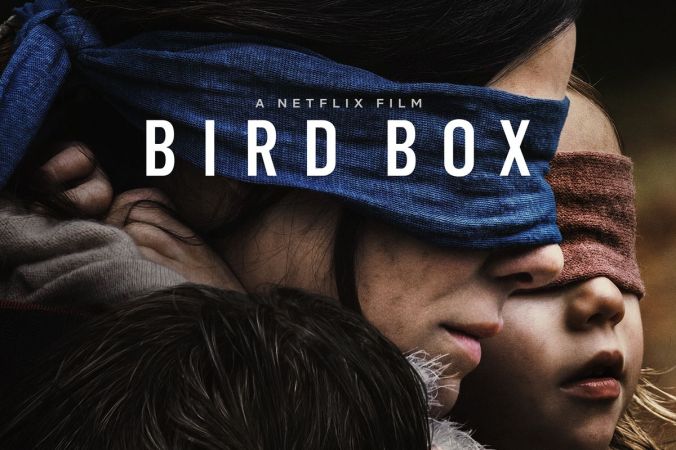
Demanding Blindfolds

From the New York Times:

“Netflix said on Thursday that it would not edit its movie “Bird Box” to remove footage of a disaster that killed 47 people in a Canadian town, rebuffing calls from town leaders who called the use of the video insensitive.”

Good.

This has got to stop somewhere, and “Bird Box,” the sensationally popular sci-fi horror film about Sandra Bullock and her children wandering around a forest blidfolded so they won’t see whatever it is that is driving everyone crazy and making them kill themselves, is a good a place to make a stand as anywhere.

In the movie, some things, or demons, or vibes cause insanity if they are seen: people really aren’t safe if they see them. Images that raise unpleasent thoughst and memories in real life are different, but somehow the idea was pawned that people have the right to expect to be “safe” from thoughts, memories, sights, symbols and ideas that might bother them. Thus “woke” college instructors felt compelled to give students “trigger warnings.” This principle, a really bad one that mistakes censorship for sensitivity, quickly metastasized into historical and artistic airbrushing. The National Park Service banned Confederate flags and their images from battlefield  gift shops—might remind some people of the Dylan Roof church shooting. Or slavery. Or racism.  Then the statues started coming down, because, as Carol Folt, blessedly outgoing chancellor of the University of North Carolina at Chapel Hill explained about why the terrifying pedestal of now toppled “Silent Sam,” a campus statue of a fictional Confederate soldier, must be destroyed:

“The presence of the remaining parts of the monument on campus poses a continuing threat both to the personal safety and well-being of our community and to our ability to provide a stable, productive educational environment. No one learns at their best when they feel unsafe.”

Unsafe! Continue reading

Afternoon Ethics Distractions, December 1, 2018 [UPDATED]

Happy birthday to me.

Birthday ethics quiz: When I was 13, my mother decided to throw me a real surprise birthday by having my friends and relatives hiding in our basement, but to stage the ambush four full days before the actual anniversary of my birth. She sent me down into our (creepy, musty) basement on a pretext, and the 25 or so people leaping out of the dark screaming scared the hell out of me. I nearly fell down the stairs. On your real birthday, there’s something in the back of your mind that prepares you for the possibility of a surprise party, however remote. When the surprise comes on another day, it feels more like an attack. As a consequence of that trauma, I detest surprise parties, and am afraid of dark basements. My mother, who loved scaring people, was always proud of her “surprise party that was really a surprise.” I thought it was sadistic and irresponsible, and still do.

What do you think?

1. The Drag Queen Principal Principle? Readers here Know Ethics Alarms frequently explores the various ethical dilemmas raised when a primary or secondary school teacher allows herself to appear naked of nearly so on the web. The tag is “The Naked Teacher Principle.”

This is a variation I haven’t seen before, out of Great Britain, from the BBC:

Andrew Livingstone, 39, is the head of Horatio House in Lound, Suffolk, and he also has a second job outside of work, as an entertainer called Miss Tish Ewe. According to the Eastern Daily Press, his act contains explicit material.

Great Yarmouth Community Trust, which owns the school, said it had agreed guidelines with him to ensure “a separation between his two jobs”. Mr Livingstone’s act is labelled on Twitter as “Queen of Quay Pride and Great Yarmouth!”, and boasts he has performed in places including Cardiff, Bristol and Dundee.

Mr Livingstone was appointed in July as the head of the independent school, near Lowestoft, and its proprietors said he brought “considerable expertise in education and school improvement to the trust”.

The school said his drag queen act came up during checks, but that it did “not believe that the two jobs are incompatible, and agreed with Mr Livingstone clear guidelines to ensure that there is a separation between his two jobs, including the use of social media in promoting his act”.

Both Norfolk and Suffolk county councils said they had not received any complaints.

Note that the key factor in most NTP scenarios isn’t present here. The teacher’s employers knew about the individual’s unusual avocation and approved of it in advance: there was no unexpected revelations or publicity. Note also that this is England, where drag has a somewhat different tradition and reputation than it does in the U.S.

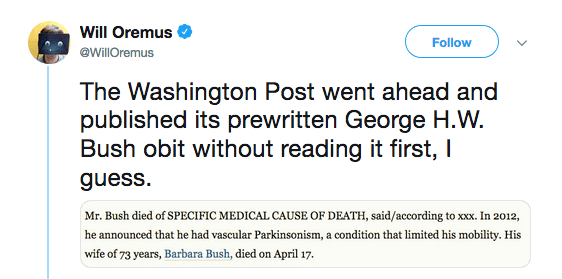
2. George H.W. Bush death ethics. a) Incompetence. Here is the Washington Post’s first obit after the former President’s demise yesterday:
b) Nah, there’s no mainstream media bias! The New York Times dredged out the infamous photo it employed to help sink Bush’s reelection in 1992, purporting to show him being “amazed” at a supermarket scanner. Bush was “out of touch” with how real Americans lived, you see, unlike Bill Clinton, who “felt their pain.”  That was the false narrative the news media was pushing against THAT Republican President. It was a lie, of course. Times reporter, later editor, Andrew Rosenthal wasn’t even present at the grocers’ convention where the photographed scene took place. He based his article on a two-paragraph report filed by the lone pool newspaperman allowed to cover the event, who only noted that Bush had a “look of wonder” on his face, But President Bush was wondering at new  a new technology “regular” Americans would have wondered at too—a prototype  scanner that could weigh groceries and read corrupted bar codes.

c) Paranoia! Confirmation bias! Newsbusters and Instapundit found the Associated Press’s obituary nasty and biased. Read it. The piece is fair and accurate. Mine would have been much tougher. Bush joined James Buchanan as men who became President because they had held every other conceivable elected and appointed government post and it was the only step left. That’s a lousy reason to run for President, and both Buchanan and Bush learned that lesson the hard way.

d) This is how it is done, John. The Bush family made it known that President Trump would be attending Bush’s funeral. President Trump was much harder on the Bushes than he was on John McCain. [CORRECTION: I mistakenly and carelessly posted that the Bushes “boycotted” Trump’s swearing in. W. and wife were there; Jeb wasn’t, but he was not obligated to, and H.W. was old and frail enough that he had an automatic excuse, though I doubt that he was inclined to show up. I apologize for the error.] But living ex-Presidents and the one in office traditionally attend the funeral of one of the exclusive club. The Bush’s understand that respect for the Presidency takes precedence over dislike of the man in it. Continue reading

Morning Ethics Warm-Up. 11/27/18: Unethical Perry Mason, Icky Science, Race Card-Playing Democrats, Intrusive Bosses And Slanted History

Good morning…

1. They are showing “Perry Mason” reruns again on cable TV. That was the show that made my generation want to be lawyers, under the delusion that a defense attorney could regularly prove a criminal defendant innocent. (Pssst! They are almost all guilty.) The show holds up, but boy, Perry was sleazy. In an episode I watched while I was sick, he had his investigator tell the hapless prosecutor, Hamilton Burger (Ham Burger to his friends) that he had found an incriminating piece of evidence that proved someone other than Perry’s client had committed murder. Ham relied on the information and got the killer to confess once he was faced with the production of the “smoking gun.” But Perry’s investigator hadn’t really found anything.

Having one’s agent lie to the state prosecutor is a serious ethics breach. Perry also caused the DA to tell a falsehood to get the confession, though Burger wasn’t lying, since he believed Perry’s contrivance. Prosecutors are no more allowed to lie than other lawyers, but when they do lie “in the public interest,” they seldom get more than a slap on the wrist from courts and bar ethics committees, if that. Burger didn’t seem very upset that Perry conned him, because the real killer was caught. The ends justifies the means, or did in “Perry Mason.”

2. Ick or ethics? A Chinese scientist claims that he had successfully employed embryonic gene editing to help protect twin baby girls from infection with HIV. We are told that bioethicists in China and elsewhere are reacting with “horror.” Writes the Times,

“Ever since scientists created the powerful gene editing technique Crispr, they have braced apprehensively for the day when it would be used to create a genetically altered human being. Many nations banned such work, fearing it could be misused to alter everything from eye color to I.Q….If human embryos can be routinely edited, many scientists, ethicists and policymakers fear a slippery slope to a future in which babies are genetically engineered for traits — like athletic or intellectual prowess — that have nothing to do with preventing devastating medical conditions.”

As with cloning, my view on this controversy is that a new technology does not become unethical because of how it might be used. That unethical use will be unethical, and that is what needs to be addressed when and if the problem arises. (Airplanes could be used to drop atom bombs!) The fear of “designer babies” also seems to be an example of “ick”—it’s strange and creepy!—being mistaken for unethical. Making stronger, smarter, more talented and healthier human beings is not in itself unethical, even if it is the stuff of science fiction horror novels and Josef Mengele’s dreams. Continue reading