Finally, A 2017 Inspiring Ethics Story! A 5th Grade Basketball Team Teaches Adults About Priorities And Values

st-johns-vote

I love this story out of New Jersey.

A Catholic Youth Organization 5th grade basketball team out of Clark, New Jersey had played all season with an 11-child roster including nine boys and two girls. In late January the director of the CYO league informed the team that the word had come down from the archdiocese that playing as a coed team offended Jesus or something and thus violated league protocol T team would either have to remove the two girls from the team or forfeit the rest of its season.

The adults running the team had screwed up, you see.

Oops. Sorry kids. Our bad, you pay for it.

These options were unacceptable, and any 10-year old would see it. In fact, any 10-year old did. Continue reading

Now THIS Is An Unprofessional Airline Pilot! (Also, I Fear, Nuts..)

freakoutAs the Wall Street Journal James Taranto used to say on his late, lamented blog, “Everything seemingly is spinning out of control!”

United flight 455 from Austin to San Francisco was scheduled to depart Austin’s Bergstrom airport when the pilot, who was not in uniform, began ranting over the plane’s intercom first about her divorce, and then Donald Trump and Hillary Clinton.

Police removed the pilot from the plane, a new pilot was assigned to the flight, and the plane departed approximately two hours late. United Airlines apologized to its customers “for the inconvenience.”

Gee, United, how about apologizing for frightening the passengers to death by giving them good reason to believe they were about to be trapped in an airborne jetliner with an unraveling madwoman at the controls?

Of course, had she merely complained about President Trump to her trapped and captive audience, she would have been well within “Hamilton”  ethics.

(And no, I am not letting that fiasco go until every one of my friends from the theater world admit how wrong they were to make excuses for that miserable betrayal of theater ethics, and those who called me on the phone to shout at me and hang up apologize to my face, and maybe on their knees. I haven’t decided yet. They entirely relied on emotion and about twelve rationalizations, attacked me for being objective and not allowing my standards, unlike theirs, to be swallowed whole by ravenous partisan bias, and I will not soon forget it.)

___________________________

Pointer: Fred!


Ethics Quiz: Italy’s New Strategy To Fight The Mafia

corleone-family

Anyone who has seen “The Godfather” I or II has a sense of the mafia culture in Italy. That wasn’t fiction; indeed, it was probably understated, and is strong as ever. Now legislators are experimenting with a radical new approach to fighting organized crime in the country, a deep-rooted pathology that has persisted for centuries.The strategy is draconian: separating children from their mob families and moving them to a different part of Italy to end a generational cycle of crime. Families are the heart of organized crime: the “Godfather” films’ portrayal was absolutely accurate on that score.

Italian magistrate Roberto Di Bella began taking children away from their criminal families after seeing children as young as 11 or 12 serving as lookouts during murders, participating in drug deals and mob strategy sessions, and learning how to shoot an assault rifle. “Sons follow their fathers,” he told New York Times reporter Gaia Piani Giani. “The state can’t allow that children are educated to be criminals.”

Di Bella began taking children away from parents convicted of mob ties five years ago,  separating about 40 boys and girls, ages 12 to 16, from their families. Sometimes the children’s mothers accompany them to the new locales. The rest of the embryonic mafiosi  go into foster care.Di Bella says that none of the children he has taken away from their families have committed a crime since, and impressed with his results,  Italy recently passed statutes that legalize the strategy as a way to destroy crime families.

Of course the program is controversial.  Di Bella, however, believes that it is a utilitarian necessity. He told the Times that mafia fathers have written to him to thank him for for giving their children a chance at a normal life, their children have told him they feel liberated, and mothers ask if he will do it for their children.

Your Ethics Alarms Italian Ethics Quiz of the Day:

Is the policy of removing children from organized crime families ethical?

Continue reading

Comment of the Day:”Unethical Website Of The Month: #GrabYour Wallet”

boycotts

Should I regret when readers explain my positions better than I do? I don’t. It is one of the great advantages of the Ethics Alarms symposium format: very smart people often refine my views and make them clearer for me, as well as others.

An example is Glenn Logan’s Comment of the Day, on a topic that has come up her before, boycotts. Every time it has, someone has countered my ethical conviction that boycotts are intrinsically wrong with the argument that we all have a right and often good reasons to refuse to patronize a business, so why is it unethical to urge others to follow our lead? Glenn does a better job answering that question than I ever have.

Here is his Comment of the Day on the post “Unethical Website Of The Month: #GrabYour Wallet.”

This is how I see boycotts, and I’ll explain by responding to parts of [reader Spartan’s] comment:

Assuming people have X amount of dollars they are going to spend, those X dollars will just go to other companies. Every time I buy a GM car (I only buy GM cars), am I hurting someone from Ford, Nissan, BMW, etc.?

Are you buying the car for its value, or in order to hurt other companies? Presumably, most people buy cars for their perceived value, or their styling, or some other characteristic that pushes the correct buttons of their personal taste in cars.

But if the only button GM presses is related to politics/religion/etc. then yes, it would be unethical.

I have a Mormon colleague who will only stay at Marriott hotels because it is a Mormon-owned chain. Is he boycotting other hotels?

Let me answer this question with another question: Is it ethical for a white person to patronize white-only restaurants because of the race of their ownership? Is it ethical for a gay person to patronize only gay-owned establishments? How about Catholics using a religious test for their patronage? Continue reading

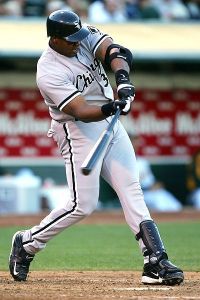
Ethics Dunce: “The Big Hurt,” Frank Thomas [UPDATED]

An ethics whiff for Frank Thomas

An ethics whiff for Frank Thomas

Baseball, and all its annual ethics puzzles, begins in about two weeks when Spring Training gets underway.  Meanwhile, I have to tolerate everyone talking about Tom Brady and the Cheating Patriots as the NFL makes billions encouraging  Americans to cheer for the gradual lobotomizing of young athletes for their pigskin entertainment. Still, even the off-season of America’s Pastime provides ethics fodder.

Frank Thomas, the 6’6″ 300 pound ex-first baseman, never was suspected of using steroids before he was elected to the  Hall of Fame, in part because he was naturally so huge and strong that if he had used steroids he would have ended up battling Godzilla in Tokyo. “The Big Hurt,” as he was called, was and is an outspoken opponent of steroid use in baseball, but speaking at  the annual White Sox fan convention last week, he proved that he is an ethics bush-leaguer.

The recent Hall of Fame vote  elected two players, Jeff Bagwell and Ivan Rodriguez, long rumored to be users of performance enhancing drugs, and the vote totals showed  increased support for uber-steroid cheat Barry Bonds and accused steroid-user Roger Clemens. The New York Post reported that Thomas said, without mentioning names, after he was asked how he felt about the election results, Continue reading

Comment Of The Day: “CVS Line Ethics”

golden-2

Texaggo4’s Comment of the Day  enriched the surprisingly lively discussion about  the ethical conundrum of how many single-item purchasers a CVS customer in line should let go before him to checkout if he had, as I did last week, a full cart.

 His discussion of applying The Golden Rule to the situation took off from my comment referring to his earlier assertion that it wasn’t strictly a question settled by Reciprocity. The numbered statements on Tex’s post are from me. Here is Tex’s COTD on the post, “CVS Line Ethics”—I added another brief comment he offered in the same thread at the end, as it is germane:

1.“I don’t recall Jesus, Zoroaster, Buddha and the rest ever noting the CVS exception.”

I don’t recall ever noting an exception either…since this isn’t necessarily Golden Rule territory. In this scenario, application of the Golden Rule would arise as the exception.

“2. The GR has nothing to do with an obligation. It is never an obligation. It is based on altruism.”

It is very much about obligation– and obligation isn’t a dirty word. The real question here is where do you draw the line on whose needs outweigh the others, and if they really do or not. Golden Rule would compel you to allow someone to cut if their cutting *actually* decreases *actual* harm. The Golden Rule doesn’t compel you to allow someone to cut *just because* it increases an already-present level of contentment in their lives. It may strongly suggest such conduct in so much as it doesn’t needlessly impose on you, but it no means compels it, hence this isn’t necessarily a Golden Rule scenario.

You see, “so whatever you wish that others would do to you, do also to them, for this is the Law and the Prophets” is a painfully open ended, and as such-much criticized maxim, when taken out of context. So, the Golden Rule IS the Law. Looking at the phrase elsewhere one would glean that ALL the Law, and therefore the Golden Rule, depends on two basic commands:

“You shall love the Lord your God with all your heart and with all your soul and with all your mind”
“You shall love your neighbor as yourself”

Continue reading

CVS Line Ethics

Nothing is simple for an ethicist...

Nothing is simple for an ethicist…

Today, I was sent to the local CVS with an unusually long list. The store was almost empty, and only one clerk was checking out purchases. I had a full cart: paper goods, drinks, over the counter drugs, items on sale, all sorts of stuff.

One shopper was ahead of me in line, and just as she had paid, I noticed an older man standing nearby holding a single tube of ointment. “Go ahead, “I  said. “Thanks,” he replied. For some reason the man’s transaction took an absurdly long time: he was chatting with the clerk, and wanted cash back, and he had some coupons. Just as he was done, an elderly woman holding two small cans of cat food walked up and raised her eyebrows at me.

“Sure, be my guest,” I said, smiling, but not really feeling the smile. I had run out with dinner waiting, and I wasn’t planning on my mission taking this long. Just as I motioned her ahead, another woman, younger than the cat lady, stepped up to me holding a bag of cough drops and a box of Nyquil. “Could I possibly go ahead too? My husband is so miserable!”

“Sure, no problem,” I said, not smiling this time. Continue reading

Obamacare’s Epitaph: “Live By The Rationalization, Die By The Rationalization”

obamacare-gravestoneRemember in 2010, when the Democrats ensured that the Affordable Care Act would clear its final hurdle to passage this way?

Democrats will finish their health reform efforts within the next two months by using a majority-vote maneuver in the Senate, Majority Leader Harry Reid (D-Nev.) said. Reid said that congressional Democrats would likely opt for a procedural tactic in the Senate allowing the upper chamber to make final changes to its healthcare bill with only a simple majority of senators, instead of the 60 it takes to normally end a filibuster.The move would allow Democrats to essentially go it alone on health reform, especially after losing their fillibuster-proof majority in the Senate after Sen. Scott Brown’s (R) special election victory in Massachusetts.

Republicans have protested the maneuver as a hyperpartisan tactic to ram through a health bill, and have said that plans to use the reconciliation process make moot a bipartisan summit at the White House this week, where both GOP and Democratic leaders are supposed to present their ideas on healthcare.

At the time, Republicans, as is their wont, over-stated their objections to the maneuver, calling it unconstitutional and a breach of rules. No, it wasn’t quite that, nor was it as unusual as the GOP claimed. It was within Senate rules, but still the first time it was ever used to amend a bill that had already passed the Senate via cloture, and under such contentious circumstances.  Reconciliation was legal, all right, but since the Affordable Care Act was so revolutionary and controversial, its passage needed to be seen as democratic, and it wasn’t. Democrats ignored the Golden Rule, and extended the acceptable use of reconciliation by using a number of rationalizations, as well as “the ends justify the means.”

Let’s see: “Everybody Does It” wouldn’t work, because the problem with using reconciliation was that everybody didn’t do it, at least not very often.  So Democrats opted for 13. The Saint’s Excuse: “It’s for a good cause”23. Woody’s Excuse: “The heart wants what the heart wants”#24. Juror 3’s Stand (“It’s My Right!”)25. The Coercion Myth: “I have no choice!”28. The Revolutionary’s Excuse: “These are not ordinary times.”31. The Troublesome Luxury: “Ethics is a luxury we can’t afford right now” 40. The Desperation Dodge or “I’ll do anything!”59. The Ironic Rationalization, or “It’s The Right Thing To Do”…and perhaps a few other rationalizations on the list. Continue reading

UPDATE: Cyber-Zombie Peter Cushing And The Prospect Of Cyber-Zombie Carrie Fisher Remind Actors To Fight For Control Of Their Post-Mortem Acting Career

cgi

It looks like I wasn’t the only one who felt that Peter Cushing was being abused by finding himself in “Rogue One” without his prior consent. Of the late actor being digitally inserted into a role he never agreed to play and deliver lines he never contracted to deliver, I wrote…

The emerging technology raises many ethical issues that didn’t have to be considered before, but when it comes to using a dead actor in a new role, the ethics verdict should be easy. It’s unethical, unless a performer  gives informed consent for his image to be used post mortem in this fashion. Presumably, the consent or the lack of it will be part of future negotiations and standard contracts. Actors who agree to have their images used as cyberslaves will also probably want to limit the uses of their names and images.

Cushing’s exploitation and the subsequent death of Carrie Fisher with widespread speculation that she would soon be added to the “Star Wars” franchise’s army of CGI clones have now sounded the alarm loudly. But apparently many actors were already aware of the threat, and taking affirmative action to control their destinies. Continue reading

“Rogue One” Ethics: Peter Cushing Returns From The Grave

He's baaaaack!

He’s baaaaack!

Hammer Films horror icon and Christopher Lee foil Peter Cushing died in 1994 from prostate cancer. That couldn’t stop the makers of the latest “Star Wars” movie from bringing his image back from the grave.  The gaunt-faced British actor—an early “Doctor Who”!—played Grand Moff Tarkin in the original “Star Wars,” a bad guy, Cushing’s specialty. Since “Rogue One,” the current addition to the series, is a prequel, Tarkin is alive again (he went down with the Death Star in Episode IV). Instead of recasting the part, the producers decided to recreate Tarkin/Cushing using CGI technology. Lucasfilm-owned digital effects house Industrial Light & Magic reanimated Cushing’s likeness so that a recognizable Tarkin could make a convincing  appearance in “Rogue One.” The results are not perfect, but it is still one step closer to allowing future movies to cast avatars of long dead stars to interact seamlessly with live performers.

We have recently seen actors like Arnold Schwarzenegger, Jeff Bridges and Anthony Hopkins digitally youthened, but forcing a dead actor’s image to perform is a different matter entirely. The use of computer animated images of dead performers to do the bidding of their director masters evokes memories of “Looker,” a science fiction film directed and written by the late Michael Crichton of “Jurassic Park” and “Westworld” fame. In that 1981 movie, a corporation transferred the images of living models to a computer program that could use the new cyber-models to do and say anything more effectively and attractively than the models themselves in television ads. Then the company had the models killed—less residuals that way.

The emerging technology raises many ethical issues that didn’t have to be considered before, but when it comes to using a dead actor in a new role, the ethics verdict should be easy. It’s unethical, unless a performer  gives informed consent for his image to be used post mortem in this fashion. Presumably, the consent or the lack of it will be part of future negotiations and standard contracts. Actors who agree to have their images used as cyberslaves will also probably want to limit the uses of their names and images. No porn films, for example. No uses of an actor in a role he would have never agreed to playing while alive. Don’t make John Wayne shoot someone in the back. Don’t show Fred Astaire as clumsy on his feet; don’t make Jimmy Cagney a weenie.

Allowing another actor to use a dead one’s face and body, like Andy Serkis wore his cyber King King suit, is a closer call. If it is clear that the dead actor isn’t the one doing the acting, and that digital technology is being used as the equivalent of make-up, maybe that practice is just icky rather than unethical, provided the credits are clear.To make Cushing’s Tarkin live again on screen, “Rogue One’s “film-makers hired Guy Henry, a 56-year-old British actor who resembles Cushing. Henry played the part of Tarkin on the set, then the tech wizards transformed him into a Cushing clone. Continue reading