Ethics Quiz: The Sixth Grade Dance

A furious mother is making an issue out of a Utah middle school’s policy requiring sixth-graders to agree acquiesce when a classmate asks them to dance.

Alicia Hobson’s 11-year-old daughter, Azlyn was asked to dance by a boy she thought was icky. She “politely” refused, but the principle at Rich Middle School in Laketown, Utah,  intervened, telling the couple to get out onto the dance floor. Was the boy short, fat, covered with acne, bad-smelling, a bully, afflicted with Down Syndrome? Was he poor, have a lisp, or Muslim? Was there a cool boy Azlyn was waiting to play Prince Charming? Never mind: As the principal, Kip Motta, later explained in a letter to Alicia Hobson, the school has a policy requiring students to accept dance invitations, and sticks by it. Motta wrote,

“We do ask all students to dance. It is the nice thing to do and this will continue to be our policy. There have been similar situations in the past where some students have felt uncomfortable with others, and, as stated prior, the issues were discreetly handled. This allowed all students to feel welcome, comfortable, safe, and included.”

Hobson equates the policy with “rape culture,” and is prepared to take the issue to the Utah Board of Education. “Girls HAVE to learn that they have the right to say no and that those around them have to respect that,” Hobson wrote on Facebook. “I’m not going to quietly stand by while my daughter and all of her classmates are being wrapped up in rape culture. No way.”

Ethics Alarms dealt with a similar issue in a different context in this post, about children accepting kisses and hugs from repulsive family members.

Before I pop the quiz question, I have three observations. The first is that that the principal’s fad use of the word “safe” has just got to stop. That’s not what “safe” means, and if we keep using “safe” to mean “insulated from any event, feeling or experience that someone might prefer to avoid,” the word will cease to have any communication value. The second is that equating the social obligation to accept an invitation at a supervised dance with “rape culture” is a hyperbolic crock, and should be identified as such immediately.

The third observation is that the “Today” headline is intentionally misleading and unfairly supports the mother’s inflammatory framing. “School policy forbids kids from saying ‘no’ when asked to dance” presumes the conclusion Hobson wants. “School policy requires students to be kind and considerate when asked to dance” promotes  the school’s rationale. An ethical and responsible headline would be, ““School policy requires students to accept an invitation to dance.”

Your Ethics Alarms Ethics Quiz today :

Is the school’s policy wise and ethical?

Continue reading

Comment Of The Day: “Ethics Quiz: Plot E”

The quiz about the American military cemetery of shame in France provoked many varying opinions, none more eloquently expressed than this Comment of the Day by JutGory.

I only post quizzes when I am at least somewhat unsure of the ethics call. My position in the post was in response to the blogger’s argument in favor of giving the graves headstones, which I felt was unpersuasive. I’m not sure Jut has changed my mind, but his points are much, much better.

Here is JutGory’s Comment of the Day on the post, “Ethics Quiz: Plot E”: Continue reading

Lunchtime Ethics Appetizer, 2/12/20: With Just Desserts!

Bon Appetite!

In a perfect example of how avoiding bias can create bias, I am accumulating a backlog of genuine and valuable ethics stories that are triggered by or related to political developments, and deliberately talking myself out of posting them. As regular readers here know, this has been a problem since the beginning of the Trump administration, when the Democrats, the resistance and most of the media  resolved to try to bring him down and cancel the election results with a campaign to delegitimize President’s Trump’s election. I regard this as one of the greatest ethics crises in U.S. history (another, running concurrently, is the near complete abdication of professional ethics by journalists), and I can’t ignore it. But doing my job, as repetitious as it seems, also means that I am reluctant to write about other political stories that I would have included otherwise, and often they involve important issues.

1. Which reminds me: One of the Washington Post’s most reliable anti-Trump columnists, Greg Sargent, issued an opinion piece that would be a strong entrant in a “Hypocrite of the Year” competition. Here’s the line that made my head explode: “Such delegitimization of the opposition strikes at the core of our system. Recognizing the opposition’s legitimacy is a key pillar of accountability in government…”

Astounding! Sargent’s ideologically compatible pals have been working overtime to deny the legitimacy of Trump’s election, from attacking the Electoral College to claiming a Russian conspiracy,  encouraging and cheering “Not my President!” demonstrations, manufacturing impeachable offenses out of thin air, and turning such once-neutral and unifying events as the Inauguration, the Kennedy Center Honors and the White House Correspondents Dinner—and more recently, a State of the Union address where the speaker of the House, on camera, symbolically rejected the legitimacy of the speech by ripping it up on live TV——into opportunities to directly challenge this President’s right to be in office and to be accorded the same respect and civility of his predecessors. If anyone who has been part of this assault, and Sargent definitely has, makes the accusation that Trump is wrong to “delegitimize the opposition,” that critic is either deliberately gaslighting the public, or so devoid of self-knowledge as to be functionally crippled.

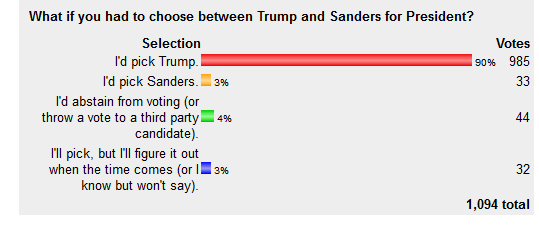
2. Here’s an unscientific poll result that should give Democrats chills. Ann Althouse asked her readers whether they would vote for Bernie Sanders or President Trump if that was the choice in November. Ann readership is Madison, Wisconsin heavy, consisting of many of her former students. She is resolutely politically neutral, laning Left, as she voted for both Hillary and Obama, twice. She has also criticized many of the attacks on Trump, including in the news media, causing her commenters, if not her readership, to see an exodus by the Trump-Deranged, much as what has occurred on Ethics Alarms. Those commenters remaining, I believe, are not uncritical of the President, and I would expect to find them on the “disapprove” side in a Gallup poll. I was very surprised at Ann’s poll results:

In a related development… Continue reading

Ethics Alarms To “The Ethicist”: It’s Called “The Golden Rule”—Why Is That So Hard?

I hadn’t checked in for a while on Kwame Anthony Appiah, the N.Y.U philosophy teacher and author who finally brought ethical consistency to the New York Times magazine’s advice column, “The Ethicist.” I was surprised to find him struggling to answer two family related queries that I would have assumed he could and should have answered  easily with three words: “The Golden Rule.”

The first inquirer asked in part,

Recently a mutual acquaintance who knows my friend’s husband well told me that he has been cheating on my friend on and off for years with someone who once worked with him.I know that if I reveal this information, my friend will take their child and leave her husband. Do I sit on this information and pretend the affair isn’t happening, or do I tell her?

Isn’t that an easy call? Of course she should tell her friend. The Golden Rule applies: would she want to be told if the positions were reversed? Sure she would; anyone would. Not telling her would be a betrayal of the worst kind.

Yet Appiah uses 608 words to reach that conclusion. 608! This makes a slam dunk of an ethics decision appear to be a difficult one. Oh, it’s difficult in the sense that the inquirer has to take sides in a crisis affecting a couple she and her husband are close to, and thus the repercussions as well as the process will be unpleasant, but that’s life. One of the Ethics Alarms rules is that if you can fix a problem, fix it. The Ethicist’s rabbinical musings about the decision just supplies a dangerous volume of rationalizations to temp the questioner into keeping the husband’s secret, and abetting the harm. Continue reading

Jim Lehrer’s 16 Rules Of Journalism. Awww! How Quaint!

I can’t say I watched the MacNeil-Lehrer Report on PBS (and later after Robin MacNeil’s retirement in 1995,  the PBS NewsHour hosted by Jim Lehrer alone ) more than a handful of times in my life. I wish I had. (I should have: when Lehrer moderated Presidential debates, as he did eleven times, there was never any hint of bias or favoritism, unlike virtually every other debate.)   Lehrer died last week at the age of 85, and his 16 Rules of Journalism, which he often condensed to nine, were published in many news sources upon his passing.

I found myself wondering what various editors and young reporters were thinking as they read Lehrer’s tenets of his now-rotting profession’s integrity. Could they possibly think that the rules accurately reflected widely held and embraced standards of reporters today? Did they read the list with confusion, wondering what in the world this old guy was babbling about? Perhaps they regarded Lehrer’s aspirational list as an archaic and amusing reflection of a bygone era, as many regard George Washington’s 110 Rules of Civility, with its exhortations like Rule #9:

“Spit not into the fire, nor stoop low before it; neither put your hands into the flames to warm them, nor set your feet upon the fire, especially if there be meat before it.”

I wonder. I do know that Lehrer took his rules seriously, though sometimes falling short of his own standards. Below is the version of his rules that he explained in a 1997 report by The Aspen Institute. It’s an excellent, excellent list, reflecting an experienced and ethically astute professional’s keen understanding of what his profession is supposed to do for our society, and the best way to do it.

How many of them do you think motivate journalists today? Continue reading

Comment Of The Day: “From ‘The Ethicist’: Revealing The Real Bigots Among Us”

A.M. Golden asks, in his Comment of the Day, “When did Americans start thinking that destroying someone and/or that person’s livelihood is acceptable behavior when it comes to a difference in opinion?” It is an issue also raised in the previous COTD, considering the mall Santa fired after someone complained about his Facebook post showing him as the Jolly Old Elf, but wearing a red MAGA cap. A.M. understands that this is not an idle question, but an important one that raises vital concerns about the erosion of core American values, the public’s belief in our founding documents, and the acceptance of the ethical standard of reciprocity.

Here is A.M.’s Comment of the Day on the post, “From The Ethicist: Revealing The Real Bigots Among Us.”

When did Americans start thinking that destroying someone and/or that person’s livelihood is acceptable behavior when it comes to a difference in opinion?

This goes far beyond boycotts to allow blacks to sit at the front of the bus or at lunch counters. This goes well beyond punishing companies for dangerous or illegal practices that have harmed customers. It goes against the heart of what it means to be an American. Too often, we are told that opinions have consequences. Sure, they do. They always have. Doesn’t it seem, though, that the consequences have become far more ominous than they used to be?

I have never understood ideological boycotts. I remember the Disney boycotts of the ’90s when people with too much time on their hands began seeing obscene Easter Eggs in the new animated films. When gays started congregating at Disney parks on certain days, the company was castigated for not warning people ahead of time that it was Gay Day, despite its protests that Disney had no sponsored days for any groups at its parks.

I thought the whole thing was silly then and it’s still silly.

While in college, I worked at a McDonald’s restaurant. One day, sitting in church, a woman pressed a news article into my hands that reported on health benefits being extended to same-sex partners at McDonald’s corporate offices (I didn’t have health benefits myself at the store where I worked).

I gave her a funny look as if to say, “What am I supposed to do with this?”. She whispered, “Well, you WORK there!” Continue reading

Cancel Culture Ethics: Two Gaffes, Two Polls

Chuck Bonniwell and Julie Hayden, a husband and wife team, co-hosted the “Chuck and Julie “show  on KNUS AM TalkRadio in Denver. Riffing about the impeachment this week, Bonniwell said,  “All right, here, a little after 1:30, talking about the never-ending impeachment of Donald Trump. Then he added, chuckling, ” You know, you wish for a nice school shooting to interrupt the impeachment news….”  Julie quickly jumped in, saying, “No! No! Don’t even — don’t even say tha!. No, don’t even say that! Don’t call us. Chuck didn’t say that!”Still laughing,  Bonniwell tried a save, finishing his handing sentence with “in which no one would be hurt.”

Jason Salzman of the Colorado Times Recorder, who said that after hearing Hayden’s plea for listeners not to call their complaints about her husband’s joke, he “called anyway.” Sandy Phillips, who lost her daughter in the Aurora theater shooting, posted on Twitter: “This guy should be fired. Total ignorance. Shootings hurt us all … just ask witnesses and first responders. You don’t have to be shot to be wounded.”

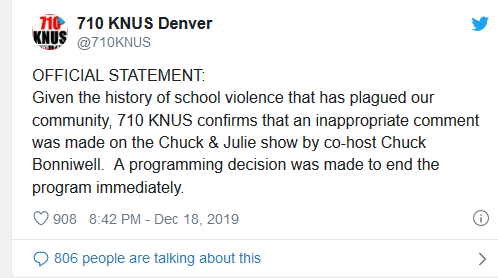
Bonniwell isued an apology the next evening after 24 hours of criticism on the “Chuck & Julie” Twitter feed, saying,  “I made an inappropriate comment meant as a joke. I’m sorry it was not received that way.”  Too late. KNUS fired Chuck and Julie later that evening:

Was this a fair decision?

I’m not sure it was. As I have held here on other occasions, those who take extemporaneously for a living, especially when they are expected to be amusing, are constantly walking a high wire. Occasional gaffes, including moments when certain metaphorical landmines are tread-upon or lines are crossed, are inevitable, and the more creative and bold the talent, the more likely such events are. A no-tolerance policy is unreasonable, and it is virtually always the ethical approach to treat the first such error with a warning or punishment short of dismissal. Virtually, because there may always be single gaffes that are so terrible and potentially destructive to the talent’s employer that firing is the only response.

Thus the question here is whether Chuck Bonniwell’s comment falls in the latter category. My view si that it does not: Continue reading

Afternoon Ethics Notes, 12/17/2019: Miller, Hillary and the Duke [CORRECTED]

Hark!

1. Lesson: Don’t underestimate the Duke! It looks like John Wayne is stronger than the cancel culture after all.  Earlier this year the Woke Avengers tracked down an old Playboy interview where the actor made some inflammatory remarks about blacks and Native Americans (I thought then and I think now that the Duke was deliberately trolling his liberal critics, but it was still a bad interview.) Predictions were rife that the most enduring, influential and popular screen icon of all time had reached the end of his run. It doesn’t appear so: at least two cable channels are running John Wayne film marathons on or around Christmas.

2. The ethical response: feel compassion for Hillary. There are people who get run over and squashed by life, their own failings, and bad luck. We don’t have to like all of them, but the Golden Rule argues that we should feel some pity and compassion for them, even though many have brought some of their misery on themselves.

I think about this when I see, for example, Marcia Clark, the losing prosecutor in the O.J. Simpson case, and her desperately tucked and altered face as she transitioned into a B-media personality. The earliest example of this syndrome that I can remember noticing was perennial Republican Presidential candidate Harold Stassen, with his dazed expression and bad toupee, who once thought he was going to be President. Dubbed the “Boy Wonder,” Stassen was only 41 when he seemed to be on his way to winning the Republican nomination for President for the 1948 election in which President Harry Truman was widely regarded as both a lame and dead duck. Stassen lost the convention battle, however, to Thomas Dewey, of subsequent “Dewey Defeats Truman!” fame. After that, Stassen ran for President in 1952, 1964, 1968, 1980, 1984, 1988, and 1992 , gradually becoming a laughing stock. (He also ran unsucessfully for Governor of Minnesota,  the United States Senate twice, Governor of Pennsylvania twice, Mayor of Philadelphia once; and U.S. Representative). I just thought he was a buffoon until my father told me about his many accomplishments before his dreams were crushed. He was one of the founders of the United Nations, for example.

As I made pretty clear in 2016, when I wrote almost as many critical posts about her and her generally awful ethics as I did about our current President when he was a candidate, I am not a fan of Hillary Clinton. I’ve continued to write critical commentary about her, because she continues to operate with wildly malfunctioning ethics alarms. She is stuck now, in Kübler-Ross terms, in the first three stages of grief: denial, pain and guilt, and anger and bargaining because she lost the election she was certain she was going to win. (So is the entire Democratic Party.)

Now look at her:

3. Marvin Miller makes it into the Hall of Fame. Yecchh. Marvin Miller was described in his obituary as “an economist and labor leader who became one of the most important figures in baseball history by building the major league players union into a force that revolutionized the game and ultimately transformed all of professional sports.” I have no quarrel with any of that. Miller was a labor activist who did his job extremely well. I would put him into a labor leader’s Hall of Fame—-I’m sure one would get at least a hundred or so visitors a year—without blinking. He no more belongs in the the Baseball Hall of Fame in Cooperstown, NY than I do, but he was posthumously elected to that Hall of Fame last week.
Continue reading

Comment Of The Day: The Betrayal And Ultimate Triumph Of Dorothy Seymour Wills”

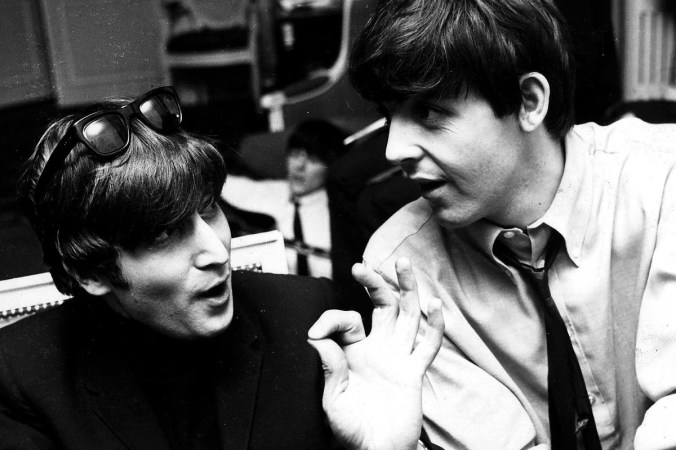
The smartest –and most ethical—thing John and Paul ever did: agreeing to share credit for every song, no matter who wrote it.

On the topic of authors being reluctant or resistant to sharing authorship credits,I wrote in a replay in a comment to the post,

I have shared the authorship credits of several stage shows where I was the initiator and the creator of 75-95% or more. There are two shows, a drama and a musical, that have made substantial money without my sharing in any of it—one because I added co-authors out of respect for their non-authorship contributions, the other for which I got no credit at all despite making the alterations that made the difference between the show being a hit and a flop. My wife thinks I’m a sap and a patsy. No, I think sharing credit liberally is the right thing to do, and that generosity should be the rule, not the exception. And I will continue to do unto others what they should have done unto me, even if the others usually don’t.

Here is a different personal perspective on the issue, in mermaidmary99’s Comment of the Day on the post, “The Betrayal And Ultimate Triumph Of Dorothy Seymour Wills”:

I was a record producer in the early 1980’s. (Still am.)

In ones early 20’s it was unheard of to be a producer unless one was in the group. To be a woman in their early 20’s was shocking to most every man who would arrive to the studio to see me in charge. They often assumed my boss was coming.

The men were always respectful and helpful as I cut my teeth in those early days.

How did I get a job like that?

The label owner, who was a studio musician and had played with The Righteous Brothers and other acts, had heard 3 songs I wrote on an album (my boss chose them and was the producer) and loved them. He asked my boss who wrote them, and he said I had. (And that I assisted on production on those too) so the owner said. “have her write and produced the next record, this stuff is amazing!”

So along with my then boyfriend, I did.

Yes, later I was a mom and asked to produce for another label. (Women producers were still unheard of) and I accepted. I asked my husband to help.

I’ll never forget his reply.

He kindly declined saying. If he did, I’d not get the credit, They’d think, “Oh, she helped her husband and probably nagged for credit.”

I was hurt because I wanted him to share in it. He explained nicely again how it wouldn’t support my Dream. And he LOVED producing too .

I’ve often felt lucky he was so supportive, and reading this I realize how very fortunate I am to have had him by my side.

I’m glad this story is being told. This woman deserves credit and I can see why men would both want her to, and not. Continue reading

Comment Of The Day #2 On “Comment Of The Day: ‘High Noon Ethics Warm-Up, 11/12/2019: Laser Eyes And Science Trees’”

The Wisconsin Governor’s endorsement of holiday trees with science ornaments continues to pay dividends here at Ethics Alarms. Here is Ethics Alarms veteran commenter luckyesteeyoreman‘s Comment of the Day on Michael West’s concise COTD, “Comment Of The Day: “High Noon Ethics Warm-Up, 11/12/2019: Laser Eyes And Science Trees.”

Lucky begins with a quote from my intro, but here is Michael’s full post:

What part of Christmas do they hate? The individual and spontaneous demonstrations of generosity, spawned entirely from personal choice free from central coordination and bestowed as private individuals see fit free from oversight? Or Christ?

Now heeeeere’s Lucky!

But really, why would anyone in their right mind object to Christmas…?

Because many are in their right mind who object. Most of us here at EA might not understand such people – even more likely do not even think like such people – but, that isn’t because the objectors aren’t in their right mind.

I assert the foregoing, coming from a history as a sibling who was the youngest of the brood. Much younger than all of my siblings. As a result, I had “multiple parents.” Also, as a consequence of that “virtual only child” status, I quickly deluded myself into thinking I was the center of the universe, the sole reason why any and all of the others existed. Any circumstance or appearance of a reality that in my perception was in conflict with that delusion, became a “trigger” for me to remind everyone, by any means necessary, that, “HEY!: THIS IS ALL ABOUT ME, here.”

Despite how my comments here might suggest otherwise, I really did out-grow that delusion. I thank the humbling influence of baseball for that, at least in part. In my case, learning about the example of Christ helped greatly, too. Continue reading