Law vs. Ethics In Baseball: The Great On-Deck Circle Controversy!

What’s going on here?

During last night’s Texas Rangers, in a crucial moment with the bases loaded, Rangers third baseman Adrian Beltre, waiting for his turn at bat,  suddenly turned up within a few of yards of home plate, watching a pitcher he wasn’t familiar with to give Beltre an edge when he got to the plate. Baseball’s rules, however, require that the next batter remains in the on-deck circle provided, which is closer to the dugout and not behind home plate. Reasons for this include making sure that on-deck batters don’t interfere with play, can’t relay stolen signs to the batter, and aren’t killed by foul balls.

The home plate umpire called time and told Beltre to get back in the on-deck circle. Beltre then moved the on-deck circle to where he had been standing.

The umpire threw him out of the game, and rightfully so. Continue reading

From The Law vs Ethics Files: The July 24, 1983 Pine Tar Incident, When Baseball Chose Ethics Over Law, And Was 100% Wrong

I have written on this topic before, but this is the famous incident’s anniversary, and I have come to believe that the lesson learned from  the pine tar incident is increasingly the wrong one, and the consequences of this extend well beyond baseball.

On July 24, 1983, the Kansas City Royals were battling the New York Yankees at Yankee Stadium. With  two outs and a runner on first in the top of the ninth inning,  Royals third baseman George Brett hit a two-run home run off  Yankee closer  Goose Gossage to give his team a 5-4 lead.  Yankee manager Billy Martin, however, had been waiting like a spider for this moment.

Long ago, he had noticed that perennial batting champ Brett used a bat that had pine tar (used to allow a batter to grip the bat better) on the handle beyond what the rules allowed. MLB Rule 1.10(c) stated: “The bat handle, for not more than 18 inches from the end, may be covered or treated with any material or substance to improve the grip. Any such material or substance, which extends past the 18-inch limitation, shall cause the bat to be removed from the game.” At the time, such a hit was defined in the rules as an illegally batted ball, and the penalty for hitting “an illegally batted ball” was that the batter was to be declared out, under the explicit terms of the then-existing provisions of Rule 6.06.

That made Brett’s bat illegal, and any hit made using the bat an out. But Billy Martin didn’t want the bat to cause just any out. He had waited for a hit that would make the difference between victory or defeat for his team, and finally, at long last, this was it. Martin came out of the dugout carrying a rule book, and arguing that the home run shouldn’t count.  After examining the rules and the bat, home-plate umpire Tim McLelland ruled that Brett used indeed used excessive pine tar and called him out, overturning the home run and ending the game.

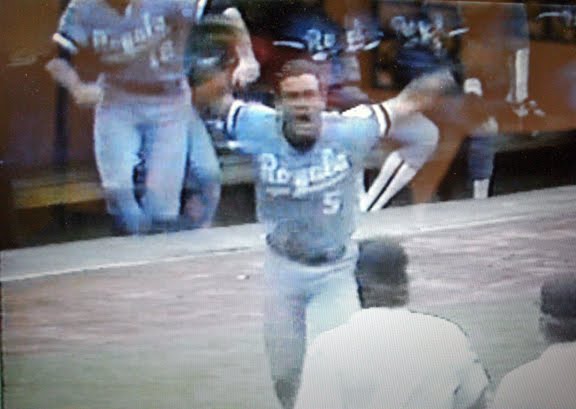
Brett’s resulting charge from the dugout (above) is video for the ages. Continue reading

Jacoby Ellsbury, Catcher’s Interference, And The Perplexing Ethics Problem Of “Using A Shield As A Sword”

interference

I led two legal ethics seminars for the Oregon State Bar yesterday. For some reason the issue of “using a shield as a sword ” kept coming up.

“Using a shield as a sword” is when lawyers game the ethics rules. Many local bar associations include a pledge within their creeds promising not to intentionally use the ethics rules as a tactical weapon; still, it’s not an enforceable promise. Examples are limited only by a lawyer’s devious ingenuity, but they usual involve one side creating a conflict of interest for the opposing firm or lawyer that will force the lawyer to withdraw from the case. One ploy: a lawyer recruits a key expert witness specifically because she was once a client of the the lawyer on the other side, making it impossible for her to be impeached on the witness stand by that lawyer because he would have confidential information about her that he would be bound to keep secret, even while being required to represent his current client by ripping her credibility to shreds.

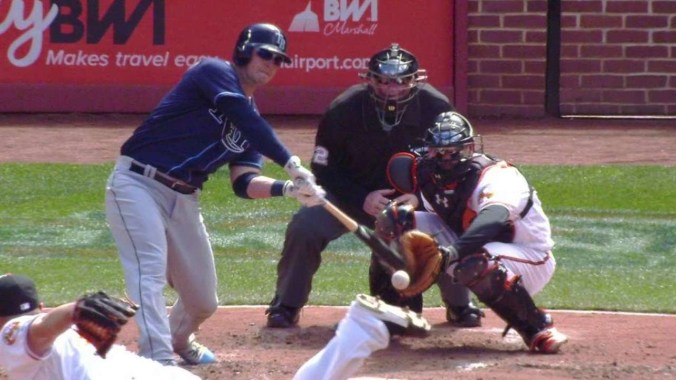
What does this have to do with Yankee centerfielder Jacoby Ellsbury? Well, Ellsbury is in the process of shattering an obscure baseball record: number of times reached base on catcher’s interference during a season. Catcher’s interference refers to instances in which a catcher makes any contact with a batter or his bat during a pitch. Usually, this involves the batter’s bat hitting the catcher’s glove, as in the photo above. When that happens, a player is awarded first base. The rule is based on fairness and  designed to protect the batter, but apparently Ellsbury has perfected the weird practice of using it as an offensive weapon.

Jacoby Ellsbury became the single-season record holder in catcher’s interference calls  in July with his ninth instance  getting rewarded for it. The record was formerly held by Roberto Kelly, who did this eight times in 1992.  Since breaking the record, Ellsbury has gotten catcher’s interference called three more times, for a current total of 11 with almost a month  left to the season. He is also second all-time in catcher’s interference with 23. The career record belongs to Pete Rose with 29; since Rose is baseball’s all-time leader in games played and career at bats, we would expect him to hold this record. No one else in baseball history has more than 18. Ellsbury is only five catcher’s interferences shy of Rose’s mark, and has done it in less than a third of the at bats. Continue reading

Calling Balls And Strikes

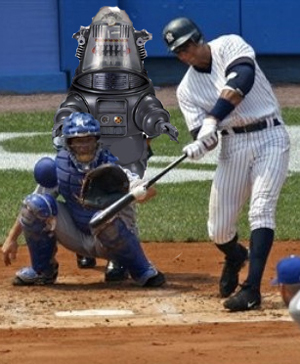
Robot Umpire

Calling balls and strikes in major league baseball has to be mechanized. This is obvious and beyond argument, and the only question is what will finally make the bitter-enders abandon their rationalizations and capitulate to reality.

I last wrote about this in 2012 in a post titled “Umpire Accountability, As the Day Of The Robot Approaches,” following a 1-0 game in which a batter in a position to tie the game was called out on strikes by an umpire named Larry Vanover, who rang him up with three balls out of the strike zone for the final 9th inning out. This particular contest was between two teams that had finished the previous season with one of them edging out the other for the play-offs by a single game, on the last day of the schedule. The pitches called strikes in this particular at bat weren’t even close to being over the plate. You could see that all three were wide with the naked eye as they arrived in the catcher’s mitt; you could see it in the computer graphic on the screen, and after the game, the pitches’ locations were charted to show that they were, in fact, balls. I wrote…

Baseball fans invest too much time and emotion into following the games and their teams to just shrug off results warped by obvious incompetence. The kind of atrocious umpiring demonstrated by Vanover…poses a direct challenge to baseball’s integrity. What will baseball’s leaders do about it?

They have only three choices:

1.They can, for the first time, take public and punitive action against umpires whose poor performance exceeds a missed call or a human mistake, and demonstrates inexcusable incompetence or a lack of professionalism. First time: a stiff fine. Second time: a suspension without pay. Third time: dismissal.I know that the umpires union in Major League Baseball protects its incompetents as zealously as the teachers unions, but baseball has its product to protect.

2. Baseball’s leaders can make a commitment to automated strike and out calling, and cut back on crews to one field umpire to keep order and one booth umpire to read the printouts, watch the TV screen, and study the replays.

3. Baseball can reject integrity and credibility, and continue to let the Vanovers on the field wreck the games and alienate fans.

So far, disgracefully, the sport has chosen #3, but the clock is ticking. Continue reading

Baseball All-Star Game Ethics Musings: Taking Confirmation Bias Out Of Appeal Plays, and More

Max-Scherzer

Some baseball ethics musings on the night of the All-Star Game:

1. Why is MLB going ahead with letting Pete Rose take a bow at the All-Star Game? This made sense–barely–when it was announced, since Pete is a hometown hero despite being a rest-of-the-world slime-ball. But after that announcement, it was revealed that Rose had bet on baseball as a player, thus rendering all of his statements to the contrary the lies they were. He should have been banned from the game just to make sure this latest revelation of his sliminess adds something to his punishment.

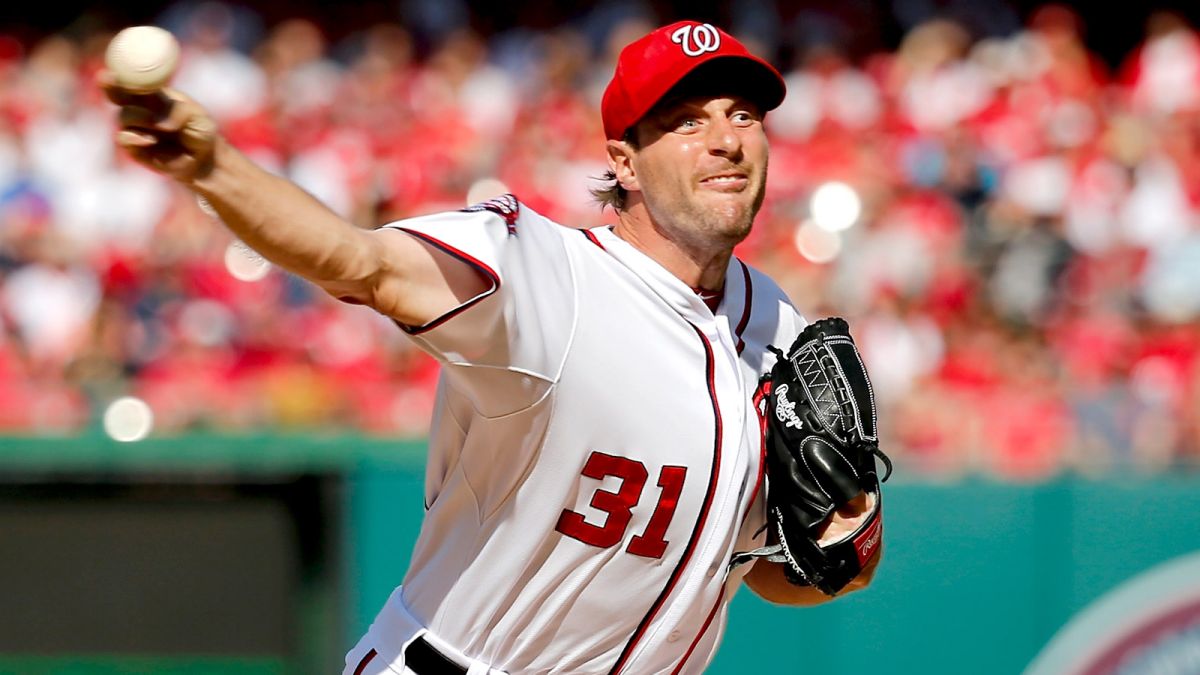
2. The best ethics controversy of the 2015 season’s first half? This: Washington National pitcher Max Scherzer was one strike away from a perfect game, leading  the Pirates in a 6-0 win, but hit Jose Tabata with a pitch to make it “only” an-hitter. A perfect game is 27 consecutive, outs, and the most difficult feat in baseball. Tabata had fouled off four pitches, before he  was hit on the elbow. Many believed that he that Tabata allowed the ball to hit him intentionally, just to wreck the masterpiece. This violates one of the “unwritten rules” of baseball, which are ethics rules. After all, any perfect game could be ruined the same way, and the pitcher is powerless to stop it. This is correctly deemed to be unfair to the pitcher, the fans, and the game.

Real rules also are involved. A batter hit by a pitch is supposed to be awarded first base only if he attempts to avoid a pitch or doesn’t have an opportunity to avoid it. If the ball is in the strike zone when it hits the batter, it should be called a strike, according to the Rule Book:  “If the ball is outside the strike zone when it touches the batter, it shall be called a ball if he makes no attempt to avoid being touched.” (Rule 6.08(b).)

Thus  home plate umpire Mike Muchlinski could have awarded Tabata a ball to make it a 3-2 count if he felt Tabata should have gotten out of the way.

Seven points:
Continue reading

Ethics Hero: Umpire Jim Joyce…Again

Obstruction play

Last night, a close and exciting Game #3 of the baseball’s World Series ended in the most unsatisfying manner possible, especially for Boston Red Sox fans. The winning run in the bottom of the ninth inning scored because of an obstruction call at third base, made by umpire Jim Joyce, giving the victory in a tense battle to the St. Louis Cardinals. Although fans saw baserunner Allen Craig tagged out at home for the final out of the frame, sending the game into extra-innings, or so they thought, Boston third baseman Will Middlebrooks was ruled to have obstructed Craig from getting up and scoring from third on an errant throw, though both runner and fielder were caught in a tangle after a collision at third due to no fault of their own. The relevant rule says that if in the umpire’s judgement a fielder, regardless of fault or intent, impedes a runner trying to reach the next base, and that the umpire also concludes that the runner would have reached the base safely without the fielder’s impediment, then the runner will be awarded the base. This meant that Craig was awarded home plate, his team was awarded the winning run, and the game was over.

The obstruction was clear and undeniable, but in many sports, such a technical call would never be permitted to decide a crucial or championship game, and even in baseball, there are umpires who might not have the courage to make such an unpopular call. Rules, however, are rules, and a sport that suspends or alters its rules for entertainment value lacks integrity.

Baseball was fortunate to have an umpire at third base who has proved his integrity before, veteran Jim Joyce. Millions of Boston fans hate him ( though not quite as much as they hated umpire Larry Burnett, whose failure to make an interference call in Boston’s favor cost the Red Sox Game #3 of the 1975 Series) this morning, but the game they care about so passionately, in my view, has never looked better.

_____________________

Pointer: Craig Calcaterra

Facts: NBC Sports


Case Study: The Botched DP, Baseball, Ethics Evolution, and “Getting It Right”

manager-mike-matheny-argues

I know this is a long essay.

Yes, it involves baseball.

Bear with me. I think it is worth your time.

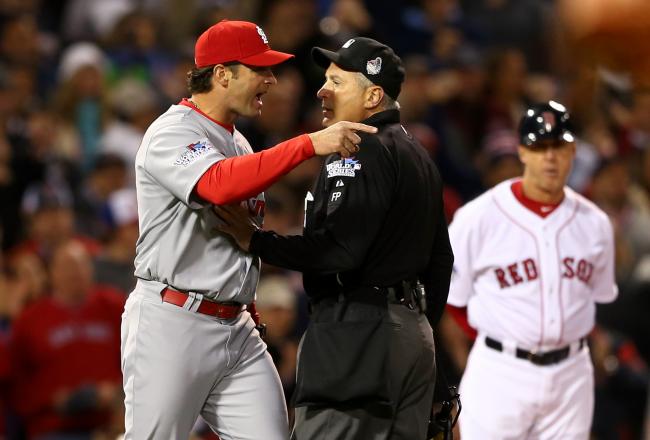
Last night, in Game 1 of the 2013 World Series, embarrassingly kicked away by the St. Louis Cardinals and won handily by some team called the Boston Red Sox,  an intricate ethics drama appeared, allowing us to see the painful process whereby a culture’s ethical standards evolve and change in response to accumulated wisdom, altered attitudes and changing conditions. An obviously mistaken umpire’s call was reversed by the other umpires on the field as the Cardinals manager argued not that the original call had been correct, but that reversing it was a violation of tradition, established practice and precedent….in other words, doing so was wrong, unfair, unethical because “We’ve never  done it this way,” a variation of the Golden Rationalization, “Everybody does it.”   You should not have to appreciate baseball (but if you don’t, what’s the matter with you?) to find the process illuminating and thought-provoking. Continue reading

Angel Hernandez’s Botched Home Run Call, Continued: Now THIS Would Justify Over-Ruling It

"You blew that call deliberately! Didn't you? DIDN'T YOU???"

“You blew that call deliberately! Didn’t you? DIDN’T YOU???”

Yesterday I wrote about the terrible, tomato-worthy botch of a home run call by Angel Hernandez in an Oakland-Cleveland baseball game, and how as bad as it was, the rules of the game don’t permit such rules to be over-turned, and thus over-turned they must not be, lest the game’s integrity be damaged. But on the Dan Patrick radio sports show today, renowned baseball writer Peter Gammons theorized that Hernandez may have refused to credit Adam Rosales of the A’s with a home run, despite the instant replay proving to anyone with eyes that it was not a double as he had ruled, because he, like many if not all major league umpires, hates the concept of allowing instant video replay to over-rule umpire judgments.

And, of course, Hernandez has a well-earned reputation as a spiteful jerk.

Hernandez would never admit to so unprofessional an act, but I think Gammons’ speculation is fair, and also very possibly correct. The alternative is to conclude that Hernandez literally can’t see, which seems unlikely. What seems far more likely is that he and his umpiring crew decided to register a nasty and unprofessional protest over the gradually expanding trend in Major League Baseball of letting technology do better what umpires have traditionally done well. Continue reading

Once Again, Fairness vs. Integrity In A Baseball Controversy

George Brett was a bit chagrined when his home run was disallowed...

George Brett was a bit chagrined when his home run was disallowed…

It has happened again, as it has thousands of times since the great game of baseball was invented. A result that is permitted by the rules violates the sense of fairness of  objective observers, who thereupon demand that the result be “fixed,” after the fact, by baseball’s powers that be. The most infamous recent example of this scenario was in 2010, when umpire Jim Joyce robbed a deserving pitcher of the perfect game he had pitched (27 batters, 27 outs) by calling the final batter safe at first on a close play, when the player was obviously (to all but Joyce, that is), out. The umpire quickly and openly admitted his error after the game, but there is no provision in the baseball rules for the League or Major League Baseball reversing an umpire’s judgment call after the fact, no matter how bad it was or how unjust the results. Baseball’s Commissioner Bud Selig, to his credit, refused to yield to the popular outcry to give the unfortunate Detroit Tigers pitcher, Armando Galarraga, the achievement and place in baseball history that should have been his. The rules say that unless umpires have actually misinterpreted the black letter rules of the game, there is no remedy. Umpire errors, like player errors, are part of the game.

Last night, what should have been a game-winning home run was called a double by umpires, and what was worse, they held to their mistaken call even after the mandated video review MLB now allows for disputed home run calls. The umpires viewed video that clearly shows the Oakland A’s Adam Rosales’ hit clearing the wall, but crew chief Angel Hernandez bizarrely claimed that the video wasn’t conclusive enough to justify a reversal. Since the A’s lost the game by one run, this altered the result, and there have been calls for an official reversal with the game being replayed. Continue reading

Ethics Dunce: Tony Kornheiser

Ugh.

No pardon for you, Tony...

No pardon for you, Tony…

Tony Kornheiser is a sportswriter and humorist as well as a television and radio personality. I’ve been reading, watching and occasionally laughing at him since I moved to D.C. eons ago, when he was a Washington Post columnist. This post has nothing to do with sports, however, though the issue arose in a sports context. It has to do with the depressing fact that Tony’s mode of ethical analysis is still based on consequentialism and an ignorance of moral luck, and that he is, despite being an educated, erudite and clever man, typical of the public in this respect.

It is depressing, and thus I say, “Ugh.”

For the second time in two days,  the ten minutes I had time to watch TV randomly brought me to a discussion of umpire Marty Foster’s botched third strike call to end a close game between the Tampa Bay Rays and the Texas Rangers. Tony was arguing with Michael Wilbon on their hit ESPN show, “Pardon the Interruption.” [ Aside: And why did my channel surfing pause there? Because the project that has eaten my life the last couple weeks requires me to mention, in a speech, the HBO Larry David show “Curb Your Enthusiasm, ” and I keep wanting to say “Pardon the Interruption.” I blew it again last night, so naturally, the first thing I see this morning is the show I’m trying to purge from my brain.] They were debating whether Foster should be disciplined for his bad call, an idiotic issue, since the answer is “Of course not; are you nuts?” Umpires make hundreds of judgment calls every game, and mistakes are inevitable. As I wrote yesterday, Foster’s handling of this botched call was exemplary, because he admitted that he had erred. Punishing him or any umpire who misses a visual call would be unfair and destructive; such punishment could only be valid in the case of actual misconduct or negligence, as in the case of an umpire ignoring or not knowing the rules. Continue reading