What Does AI Have To Do With President Trump? Oh, Just Nothing, But Don’t Ask The Trump Deranged…

I must credit Ann Althouse for pointing me to an August opinion piece by the New York Times’s NeverTrump fake conservative Bret Stephens (who wants to repeal the Second Amendment!). I guess I should check out the Times more often; it’s just that it is an enemy of the people, one of the worst, and I resent what the paper has done to American journalism and, as a consequence, our nation.

But I digress. The subject of Stephens’ August column, “I’m Begging You: Never Write With A.I.,” is that learning to write clearly and well is an essential human skill, and one that has important feedback. In addition to making communication between human beings better (more effective, more persuasive, more rational) writing also clarifies the writer’s thoughts, requires close examination of arguments, biases and assumptions, and, essentially, the more one writes, the more adept one becomes at life competence.

I agree with the theory, with a blazing caveat. Stephens is speaking from the biased perspective of one whose associates are all in the upper echelons of educated society, are well above average intelligence, and who work, play and live among the minority of Americans who read, have articulate conversations, and place a high priority on verbal interaction. My late wife and I would sometimes change our table at a restaurant because the conversation at a table next to us was so banal and inarticulate that we wanted to scream.

Military analysts have noted that one of the reason Ulysses S. Grant was such a successful general during the civil war was that his written orders were masterpieces of clarity, telling subordinate exactly what they had to do in straightforward prose. You can see that same skill in his autobiography, which Grant wrote in his final days while dying of throat cancer so his family could pay off his debts with the income from its sale. (Which it did. Mark Twain published Grant’s story.) Today, most students graduate from high school unable to write well, or even coherently. You learn to write by reading and writing; I had to compose five-page essays in the 5th grade, ten-page essays in the sixth grade, and up to 20-page compositions, (with footnotes!) in high school. I wrote a 116 page honors thesis as a senior in college. Later, when I was an administrator at Georgetown University Law Center, I was stunned to learn that GULC was admitting students who had never written a substantive paper at all.

I’m digressing again, but my point is that for, tragically, the majority of Americans, being able to let a chatbot turn their jumbled thoughts, flawed logic and infantile vocabularies into clear prose is a major boon for them and the people they are trying to communicate with. Is it likely to be great writing or even good writing? Not right now, it isn’t. I am working on a project that requires a clear web page to describe it, and the content I have seen was heavily dependent on AI. Nobody had to tell me that; it was obvious, and bot-writing usually is. And it’s bad.

However. the theme of this post is that Stephens felt that he had to somehow virtue-signal to the Trump Deranged. Here is how he ended the column:

Not Surprisingly, “The Ethicist” Is Hoplophobic

I have a like-hate relationship with Prof. Kwame Appiah, the current proprietor of the New York Times Magazine’s “The Ethicist” column. The most credentialed of the many individuals who have manned the column (one was female) has provided me with fodder for many EA posts, often critical ones, and I am properly grateful. However, his embedded New York Times Standard Progressive bias is a constant problem for him (and me, as an ethicist observing his conduct), and his latest column is a particularly annoying example.

A friend of a senior married couple [Aside: the Times illustrator draws them as an inter-racial pair, though there is nothing in the facts to suggest that. This is just one of the thousands of little ways our media tries to surreptitiously embed its priorities into the culture. I feel my arm being twisted. Don’t you?] writes,

“I have friends in their 70s who have taken in their adult son following his divorce. It is going on two years now, and he is making no progress at finding work or moving out. Granted he has mental-health issues, like panic disorder and depression, but he lives rent-free, has a dog he does not take care of and berates his parents on a regular basis. His parents won’t even ask him to help around the house because they are afraid of his volatility. He can become extremely angry, especially toward his father. He also owns a gun. This last bit scares the heck out of me. His father is going to retire in a couple of months, and they are planning to sell their home and move out of state. They have told their son that he is not coming with them, and the son is upset about this. His mother is trying to put together family counseling sessions but is having difficulty finding something they can afford. As the deadline of the move approaches, I truly worry the son will shoot himself or shoot his parents and then himself. I’ve known this family for 35 years. Do I call adult protective services? Do I alert the police that a mentally ill man owns a gun? I am truly concerned.“

Fine. Be concerned. Give them advice. However, there is literally nothing in the friend’s narrative—and she doesn’t live with the family—that suggests that the son is going to shoot himself or his parents except the single fact that he owns a gun, which he has every right to do. Hoplophobia is popularly known as gunphobia, and a lot of American have it, especially women and progressives as well as Democrats and members of the news media like “The Ethicist,” and, obviously, “Name Withheld,” who writes most of the questions that get published in Prof. Appiah’s column.

I find it incredible that The Ethicist’s advice in this case includes,

Comment Of The Day: “Trevor Noah’s Critics”

Bravo: a  deft,  quirky and thought-provoking comment about “how difficult writing and reading is and how easy misunderstandings are born”—and my own careless—or not!—phrasing was the writing at issue.

Here is Zanshin’s Comment of the Day on the post, Trevor Noah’s Critics:

Jack,

In the sentence,

version 1. We should respect consistent standards and integrity instead of hypocrisy, not treat them like they are qualifications for sainthood.

I guess you meant expect instead of respect.

version 2: We should expect consistent standards and integrity instead of hypocrisy, not treat them like they are qualifications for sainthood.

And even then, I, with English as a second language, would read ‘ should expect’ firstly as “To consider likely or certain” but given the current climate that is not a given anymore. Therefore, to emphasize the (intended?) meaning of ‘expect’ as “To consider obligatory; require” the following sentence would have been clearer to me,

version 3:We should demand consistent standards and integrity instead of hypocrisy, not treat them like they are qualifications for sainthood.

Flash of insight: By pondering your sentence and rewriting it I realized that your sentence is fine but that I bracketed the sentence in a wrong way; which is made possible given the complexity of two polarities involved in this sentence:

a. consistent standards and integrity versus hypocrisy
b. [treat them with] respect versus treat them like they are qualifications for sainthood

Lets name the different parts of the sentence,

A: [should respect
B: consistent standards and integrity
C: hypocrisy
D: treat them like they are qualifications for sainthood

The bracketing I now think you meant is: { A { B_C } } versus { D }

The bracketing I understood first was: { A { B } versus { C } } versus { D }

But in bracketing the sentence in my way, ‘respect’ felt awkward once reading part D. That’s when I backtracked to A and thought-up ‘expect’. while thinking, “Just another typo by Jack and/or wrongly suggested/inserted word by the word processor.” Continue reading →

KABOOM! Roy Moore’s Lawyer Just Made My Head Explode. Or As He Would Say, Just Made My Head Exploded

I hate early morning head explosions. Among other reasons, those bits of skull and brain ruin the taste of my coffee.

No, I don’t blame Trent Garman for representing a vile creepazoid like Roy Moore. Creepazoids have rights too, and should have access to trustworthy and competent counsel. My problem with Garman arises from those last four words. Lawyers as untrustworthy and incompetent as Garman, in my opinion (don’t sue me, Trent, it’s just my opinion that you’re an idiot; I can’t prove it, but I do think you did), shouldn’t be representing clients. Garman, in truth, needs to go back to the sixth grade.

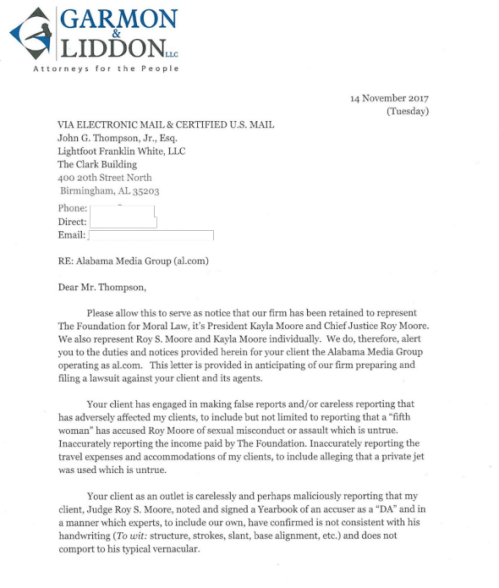
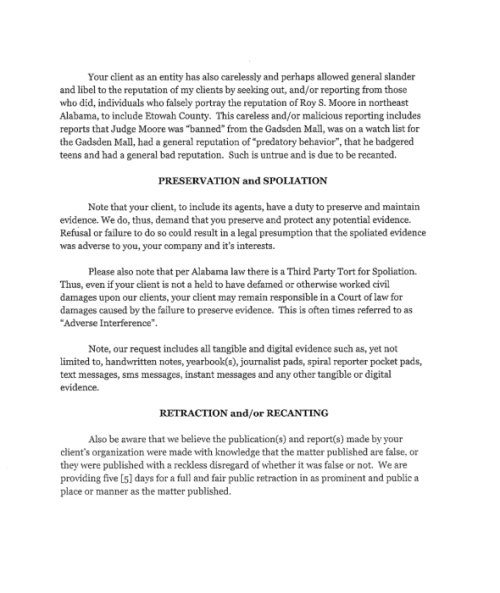
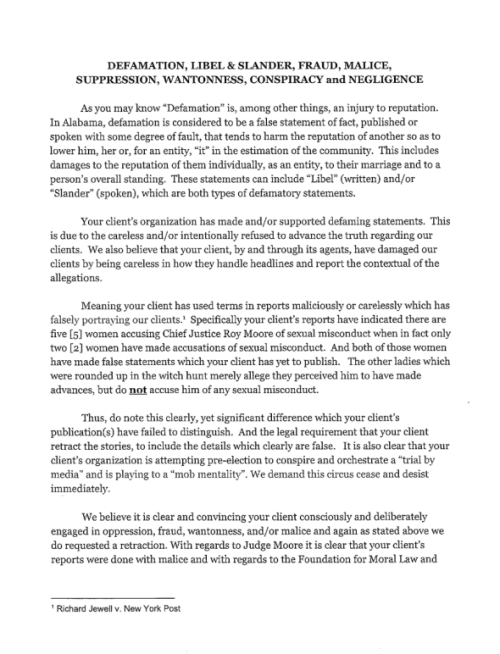
Here is the letter Garman authored on Moore’s behalf. I’ll follow it with the stuff that blew my head; you don’t have to read the whole thing unless you’re into inflicting pain on yourself, like that albino monk in “The Da Vinci Code.”

If you do read the letter, you will note that Attorney Garman never learned that the possessive “its” has no apostrophe, and that he writes English like it is a second, and perhaps third, language. Here are the best, as in worst, examples of his professional writing:

 Your client’s organization has made and/or supported defaming statements. This is due to the careless and/or intentionally refused to advance the truth regarding our clients. We also believe that your client, by and through its agents, have damaged our clients by being careless in how they handle headlines and report the contextual of the allegations.

The second statement  actually says “This is due to the careless and/or intentionally refused to advance the truth regarding our clients.” Diagram that for me. That head-scratcher is followed by “We also believe that your client, by and through its agents, have damaged our clients by being careless in how they handle headlines and report the contextual of the allegations.”This isn’t even the worst example of Authentic Frontier Gibberish in the letter. This is:

Thus, do you know this clearly, yet significant difference which your client’s publication(s) have failed to distinguish. And the legal requirement that your client retract the stories, to include the details which clearly are false.

I can’t even decide what to bold on that one.

Disturbingly, we learn in Trent’s biography that he earned a Masters in Theology from Regent University and  translated two books of the Bible from Greek.  I can just imagine what that translation was like.

I’m not nit-picking a blog comment or a hasty tweet. Roy Moore is fighting for his professional life and reputation, and this is the best legal representation he can find? That letter is a professional product. Garrman is obligated to be competent and diligent, not to send the message far and wide that the former judge thinks that this is persuasive logic and deft prose. Do they not proofread at Garman & Liddon? Do they know what proof-reading is? Do they know what syntax, punctuation and grammar are? Coherence? Professionalism?

Shame on the Troy University and Birmingham School of Law for graduating this careless, inarticulate boob. Heck, no high school should graduate someone who can’t write a letter better than that. Shame on his high school too. Shame on his the Alabama Bar for giving him a license.(I would use words other than “shame,” just to reliev the monotony , but as I’m sure you understand, my vocabulary is affected when my brains are on the ceiling…)

The legal field’s dirty little secret is that lawyers who can’t write or articulate a coherent argument are not as rare as they should be, and they should be extinct.  Nonetheless they get fees from innocent clients who assume that these hacks are smart and skilled because they call themselves lawyers.

But Roy Moore called himself a judge, didn’t he?

Hmmmm…

Maybe this is what George Will calls “condign justice.”

______________________

Pointer: Red Ipsa Loquitur


Ethics Quiz: The Case Of The Creepy Student

Muse and Artist, Victim and Harasser, or Censor and Victim?

Muse and Artist, Victim and Harasser, or Censor and Victim?

Joseph Corlett’s essay, though I have not found the full text of it,  is undoubtedly creepy.

In fall 2011, the 56-year-old countertop refinisher was taking a writing course at the Oakland University in Rochester, Michigan. His teacher, Pamela Mitzelfeld, gave the class an open writing assignment for their journals, and, Corlett says, assured them that any topic was acceptable, with no-holds barred.  She said, Corlett’s lawsuit now asserts, that she wanted “the raw stuff.”

That’s just what she got. Corlett wrote an essay called “Hot for Teacher,’ inspired by a Van Halen song by the same name, describing how his sexual attraction to Mitzelfield was irresistible. “Tall, blonde, stacked, smart and articulate…” he described her in his daybook. “Are you kidding me? I should drop right now. There is no way I’ll concentrate in class especially with that sexy little mole on her upper lip beckoning with every accented word. And that smile.”

Mitzelfield alerted university officials, saying that Corlett’s essay frightened and upset her, and that she refused to teach him any further. Moreover, she insisted that either he be ejected from the campus, or she would quit herself. He was escorted out of Mitzelfeld’s class a few days later by the Oakland University Police. A sexual harassment charge was dropped, but a hearing by university officials found Corlett guilty of intimidation and he was expelled for the rest of the semester. University officials allegedly told him that he would be arrested if he returned to the campus. His suspension lasts for  three semesters, and he must go through sensitivity counseling before he can reapply.

Aided by The Fire, Corlett is now suing for over two million dollars in damages, maintaining that his First Amendment rights have been infringed. “The university has essentially issued a straightjacket to every writing student to protect the delicate sensibilities of faculty and staff,” says Greg Lukianoff, FIRE advocate. The legal issues look pretty clear: Oakland University has a terrible case. “Write anything” means write anything, and certainly cannot mean “write anything except something the instructor will freak out over, in which case we’ll fix you good.” If it is true, as Corlett alleges in his lawsuit, that Mitzelfield made no objection to other sexually themed compositions by him that referred to her, his treatment by the school is indefensible. That’s not the ethical question, however. That question is your Ethics Alarms Quiz for the day, and goes like this: Conceding that Oakland University mishandled the episode…

Was Corlett’s essay ethical and blameless?  Continue reading →