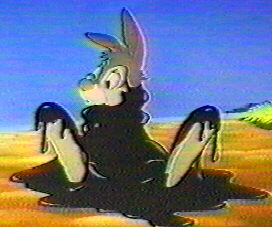
"Super Glue doll? "Mucilage buddy?" "Fly-paper friend"
Ah, politics! Words that are dishonest are winked at by the media without objection, and harmless terms generate apologies that support ignorance and vagueness.
I. Colorado Republican Congressman Doug Lamborn apologized yesterday for using the term “tar baby” during a Friday appearance on a Denver radio program. Lamborn said this: “Even if some people say, ‘Well the Republicans should have done this or they should have done that,’ they will hold the President responsible. Now, I don’t even want to have to be associated with him. It’s like touching a tar baby and you get it, you’re stuck, and you’re a part of the problem now and you can’t get away. I don’t want that to happen to us, but if it does or not, he’ll still get, properly so, the blame because his policies for four years will have failed the American people.”
The term “tar baby” is a perfectly acceptable metaphor, based on African folklore, for something that, once touched, is impossible to get free from. Lamborn used the term in proper context, to describe a sticky matter that is dangerous to embrace. But because he, or someone on his staff, knows that race-baiters stand ready to treat any opportunity to accuse President Obama’s critics, Sheila Jackson Lee-style, of a racist “gotcha,” Lamborn felt compelled to issue an apology to the White House and the public, assuring all that he meant no offense. Well, that was obvious to anyone literate who was not determined to find offense. Apologizing, unfortunately, suggests that Lanborn said something improper, and he did not. His apology also serves to further ruin the tar baby metaphor, which is vivid and useful, for future legitimate use. Like all capitulations to political correctness, it makes communication more difficult, less clear, and boring.
If you are going to use a term like “tar baby,” Congressman, it means that you are assuming that you are working with and communicating to adults. Once having made that decision, and it is the proper one, to lose your nerve and start issuing preemptive mea culpas to the paranoid, the cynical, the race-obsessed and the ignorant just gives these individual more power, and they already have too much. In addition, you put another nail in the innocent and correct use of “tar baby.” Thanks a lot.
II. I don’t trust people who use euphemisms, because euphemisms are by definition tools of dishonesty and deceit. They proliferate in politics, unfortunately, because pollsters check which words ans phrases raise potential voters’ blood pressure, the answer usually being “the clearest ones.” During the recent debt ceiling crisis, the White house and Democratic spokespersons started substituting the term “revenue” for “taxes.” This is because the American public generally doesn’t like taxes, which they know comes from them, even when, as now, they realize that an increase in taxes is unavoidable and necessary. They like revenue, though. Who doesn’t like revenue? Except when the revenue is taxes. The last presidential candidate who ran on raising taxes was Walter Mondale, and we all know what happened to him. Thus I listened today as White House press secretary Jay Carney repeatedly used the term “revenue” to indicate what was needed to address the fiscal crisis, when what he was talking about was raising taxes.
This is dishonest and cowardly, and I personally find it insulting. If Obama is talking about selling Yellowstone and Alaska to pay off our creditors, then OK….that’s non-tax revenue. But he isn’t. Revenue is being used to keep the T-word out the discussion when Democrats are speaking, and that means that they are trying to deceive us. I resent it. It’s doubletalk, and deceitful. Say what you mean, and stop using polling to find ways to sugar-coat unpleasant truths.
 Ethics Alarms
I’m with you on tar baby, and I’d add Little Black Sambo to the list. But you’re too hard on “revenue.” When I give $100 to charity I know I’m giving $60 and I’m drawing on Uncle for $40. If the rules change, is that a tax increase? Or loophole closing? Or revenue? The significant thing is the rule change; the label depends on who’s saying it.
I call eliminating a tax deduction eliminating a tax deduction. You have to admit, “revenue” is intentionally vague, and if something is intentionally vague, someone is trying to hide something.
I never understood Black Sambo. Why did the tigers turn into butter?
Everybody knows that. If a tiger runs fast enough in a tight circle he’ll turn into butter.
I did not know that!!
Normally I’d be annoyed about the faux-outrage over a word, but I’ll make an exception for “tar baby”. There is beautiful irony in the fact that “tar baby” has itself become a tar baby. The word is now self-demonstrating. Exquisite.
What’s the word for a self-demonstrating word?
Autological.
The day is already a success!
I think both subjects are more nuanced than you suggest. There is, in my mind, no doubt that Rep. Lamborn meant no racial offense in his use of the term “tar baby.” And I have no doubt that there are many people who seek to be offended: it is a useful if intellectually bankrupt alternative to actual argument. It is also clear that “revenue” has become a weasel word—the equivalent of finding Bill Clinton’s “DNA” on Monica Lewinski’s dress.
That said, “tar baby” does indeed have racial overtones. Maybe it shouldn’t, but it does. My aunt was not being intentionally offensive in describing her son’s college roommate as a “Jew-boy,” but that doesn’t make it appropriate speech. While I do not doubt the sincerity of Mr. Lamborn’s apology, it also served the pragmatic function of allowing him to repeat and explain his comments—which were, of course, already clear in context—because the point he wanted to make was getting lost in the righteous indignation. In short, I wasn’t upset by the initial use of the term and I’m not upset that he responded to criticism by apologizing.
Similarly, “revenue” is a term which includes taxes but is not limited to taxes. (Tariffs, fees, etc., are revenue but not, technically, taxes.) It is obvious to me that taxes do need to be raised, but that’s a different matter. A wide swath of GOP senators and representatives had signed the “no tax increases” pledge, demonstrating more fealty to Grover Norquist than to the common weal or to the responsible fulfillment of their duties. (There’s now a Facebook group called “I pledge not to support a candidate who signs a pledge.”) John Boehner was running around proclaiming that “tax increases are off the table,” all the while yammering about how it was The Other Guys who weren’t serious about the negotiations.
Well, we need more money, and a proposal that can’t be called anything but a tax increase can’t pass the House: not because it’s a bad idea, but because a group of folks who are perfectly willing to lie about other things couldn’t possibly sacrifice their precious integrity by voting for even a good idea when they’ve said they wouldn’t. So, in the last few days of negotiations, what still had a chance of happening was in fact raising revenue without “raising taxes.”
OK— closing tax loopholes without changing the marginal rate isn’t technically raising taxes (maybe), but it would generate revenue. Allowing existing tax breaks to expire isn’t raising taxes—even Norquist said so, before retracting. Raising licensing fees is legitimate because fees aren’t taxes. This was, I presume, the kind of thing that was still being discussed. Under these conditions, “revenue” was the accurate word.
But I think this is all ducking the question, Rick. The concern here is clarity, and the Administration’s point of using “revenue” isn’t more clarity, but less. It is designed to avoid thinking about taxes, and taxes is what the American people need to think about seriously. Similarly “tar baby” is a useful metaphor, and nobody is going to use it if they have to apologize or fend off charges of racism every time. Lots of words have both insulting and non-insulting meanings. If context isn’t going to be a complete, presumptive defense, say goodbye to chink, queer, bitch, jerk, pig, creep, drip, clod, fairy, fag. cock, slant, whore, and the nickname Dick. And more. “Jew-boy”, on the other hand has no such dual uses.
Didn’t we also, as a nation, lambast the last politician who used the word “niggardly”? As a Black woman, I am sensitive to the fact that I AM SENSITIVE on issues regarding my ethnicity!! It is my job to be SELF-aware. And must I apologize for using verbiage or word choices that others find offensive just because THEIR vocabulary is restricted?? Our sad history of African enslavement got us here: a place where it is easier to point a finger than to read good literature and have healthy debate. Our sad school systems keep us here.
I loved the Uncle Remus stories as a child, and Little Black Sambo was one of my heroes. He was a very clever boy who defeated the tigers who threatened him. The rejection of African folklore by Americans of African ancestry, and the offense taken toward the Sambo story, simply because they were passed on/offered by people of a light-skinned race, has long been a source of great sadness to me. Wish we didn’t have to assume the worst motives from people who are “different” in one way or another, but it seems that we always do. It goes in all directions, and I wish it would stop.
I agree, Margie. I grew up with all sorts of stories like those… to include those. It’s a sad commentary on our culture when such on-time staples as the Uncle Remus stories are eliminated because there’s a black character that Wesley Snipes couldn’t play in a movie! It’s a loss to children everywhere.
Nor can I blame the congressman for the use of the “tar baby” metaphor. This is an old political term that has no racial overtones at all… and which makes the point clearly. No matter what some officials say in public, somebody will try to brand it with racism or political correctness. So why bother to avoid them? If you do, they’ve won because they have you on the defensive from the onset. Which is, of course, the idea.