I’m not even sure what the question should be, but let’s wade into this Twilight Zone dilemma.
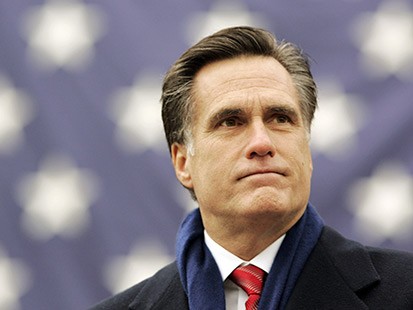
"Your mission, Mr. Romney, should you accept it, is to save these dead Jews from vicarious baptism. Your head will explode in 8 seconds..."
Apparently the Mormon Church has been baptizing dead Jews for a long time. You don’t have to be a Mormon for Mormons to want to save your soul (as I found out when I lived with a Mormon my freshman year in college), so this is undeniably an act of love, if a bit presumptuous. The Church of Jesus Christ of Latter-Day Saints performs what they call “proxy baptisms” in order to save ancestors and others who weren’t baptized in life or who were baptized “without proper authority,” and such a baptism can even take place after a person has died. When the live Jewish community discovered this was going on, and that even Holocaust victims like Anne Frank were getting baptized posthumously, it strenuously objected and negotiated a baptism cease-fire of sorts, with the Mormons promising to only proxy baptize dead Jews who were ancestors of Church members. The deal, however, fell through, and lot of deceased Jews are apparently being sent to Mormon Heaven, or somewhere, against their wills.
Thus Ellie Weisel has decided who is responsible for fixing this—whatever it is…Mitt Romney. Weisel has said that Romney should tell his church to cut it out, because, he says, “it’s scandalous.”
So the Ethics Alarms Ethics Quiz for today is:
If the Mormons believe that baptizing dead Jews saves their souls, do they have any ethical obligation to stop doing it because the Jewish Community, Ellie Weisel, Mitt Romney or anyone else asks them to?
You know what? I don’t think so.I think if the Church made a deal it should keep its promise, but the deal aside: who does this hurt?
I also don’t think it is fair for Ellie Weisel to publicly demand that Mitt Romney throw his weight around in his Church to please another constituency.
Admittedly, however, the weirdness factor here is strong, and it may be blurring my reasoning powers. What do you think?
 Ethics Alarms
Apologies; I posted this with comments off by accident. My error.
I think the whole thing is another example of how silly religion is. AND it speaks of the inherent insecurities of Mormons if they have to expand their list of “saved souls” by including dead people, Mormon or not.
There is no ethical conflict, or social issue, with praying for those that have undergone horrendous atrocities. Say a prayer, erect a memorial, donate to a charity—there are lots of ways to express love and compassion for another human being. But posthumously baptizing others into your religion reeks of moral superiority in a weak attempt to expand your sphere of influence. Even if Mormons believe that you can baptize someone via proxy, I doubt that anywhere in their scripture does it say they must maintain a database of every soul that has been saved. God doesn’t care about a database. That is their flaw. Delete any record of these ceremonial inductions and everyone will be fine.
As for the related parties (Weisel/Romney), it’s all just political theater.
Great comment…but aren’t religions by definition embodiments of moral superiority?
Religions and moral superiority, hmm. ..that’s a baited question.
I would say—yes (perhaps not inclusive of all religions). But from the perspective of trying to impart their influence on the greatest number of people by stimulating out of fear. Historically, religions provided answers to the unknown (and some could argue still do). I think man’s greatest fear is his mortality, and religions provide a sense of comfort/solace that eases the transition to this final state.
So, indirectly, playing to the greatest fear of the masses is a form of moral superiority.
By their own definitions? Yes. In reality? Absolutely not.
OK, the weirdness factor is high, but there is an ethical dilemma here. Any Mormons here, please jump in and correct any error, because it is fairly technical. From talking to Mormons I know, this is how it works. In the LDS church, there are three ‘heavens’.
The lowest heaven is for ‘good’ pagans, Jews, Christians, Muslims, etc. It is a pleasant place where Socrates can have good discussions with Abraham Lincoln and Bohr and Einstein can debate quantum mechanics.
The next heaven is for Mormons who don’t marry, Mormon men who marry Mormon women who only got a common divorce, and Mormon who aren’t Temple-worthy (unsure about the last one).
The third (and highest) heaven is for Temple-worthy Mormon men. Their wives (including divorced wives) come with them. It used to just be for men with three wives (like Jesus), but God changed this when the US government objected too strongly. The men get their own planet and their wives populate the planet with their husbands’ spirit children.
By proxy Baptism, the soul is moved from the third to the second heaven (which is a nicer neighborhood). However, in the cases in question, this would remove them from their Jewish community and loved ones for all eternity. The Baptism has removed them from Judaism and claimed them for Mormonism. So, is this unethical? Can the soul that is the object of the Baptism refuse?
But according to Judaism, the dead Jews are just dead. Aren’t the better off in any heaven than they would have been without Mormon meddling?
It is way too confusing if you try to mix and match theologies (and don’t some Jews believe in an afterlife? I know some don’t, but I thought some did as well. Why else would it be important to bury the body within 48 hours?). I was just trying to look at it purely within Mormonism. Are they being unethical within their own belief system? Mormons believe good Jews go to a heaven. They would then join the community of all good Jews from throughout time. Is it right to remove the ‘best’ Jews from their community for eternity?
Yes, yes, many theological questions get reduced to something that seems absurd if it isn’t your belief. But this is the question at hand. (sigh)
I just checked and most Jewish groups believe in an afterlife although what that means has many interpretations.
Two issues:
Should the Mormon’s stop? I’d say yes. If a person went their entire life and never chose to be baptized in the Mormon faith, then it’s a pretty clear indication that this person would not want to be baptized in death. The ethical issue is respect for the legacy and wishes of the dead. (Do I need to add a “No Mormon Baptism” clause to my will now?)
Should Romney say something? I’d say yes, and I’ll invoke Hamm’s Excuse as the reason. If we stipulate that the posthumous baptisms should stop, then Romney (as probably the most famous and influential Mormon in existence at the moment–like it or not) has a duty to say something. He is actually in a position to credibly make it stop and I’m hard pressed to think of ANYONE else who could.
–Dwayne
GREAT use of Hamm’s Excuse. That settles the issue for me, provided that Romney agrees that it’s wrong, and doesn’t oppose his Church just to pick up votes.
I have to say it feels wrong. I resented my Mormon room mate telling me that he had to save me whether I cooperated or not—but then, I wasn’t dead. The dead baptized Jews aren’t being harmed, but living Jews are being insulted—but that’s from their perspective. From the Mormon perspective, OK, we’re putting people’s noses out of joint, but we’re sparing their dead relatives an eternity of torment. Easy utilitarian call, don’t you think?
Jack,
If posthumous baptisms DO work, then it’s all the better for those deceased Jews (and others) who are, in turn, saved from eternal damnation. However, if the things on Earth (as I suspect is the case) are NOT mere reflections of those in heaven, then the souls of the dead will be left otherwise unaffected. I’m with you. Who’s purportedly being hurt by this?
It reminds me of when I attended Catholic school many moons ago even though I was not Catholic and, because of which, was not allowed to partake in communion (as presumably Christ’s body and blood are only for an elect few), which struck me as equally silly. Should the wine and wafers contain the power claimed by the church, surely God was smart enough to understand I wasn’t deserving and appropriately un-bless my portion.
In other words, I’m pretty sure God can’t be so easily swindled, nor do I think the laws of judgement, whatever they are, are quite so easily subverted …
Best!
-Neil
Right on. Though I’d comment that souls most likely don’t exist, so it’s even more silly.
Now, discussing these posthumously baptized people as if they actually were mormons, misrepresenting what the actually did believe, would be unethical.
As a convert to the LDS faith, I find baptism for the dead to be a particularly attractive compromise between traditional Christian theology and universalism. Most descriptions of LDS soteriology herein are basically accurate, with three exceptions: membership records are not increased by proxy baptisms, as some cynics might guess; Jack’s (and anyone else’s) salvation, regardless of his descendant’s endeavors, is entirely his own (rejection of a proxy baptism is possible, though examples are scant for obvious reasons); and the “wallowing in torment” of mainstream Christianity is not a feature of Mormonism.
Unfortunately, there’s very little the Church can do to ensure that its members are adhering to its compromise with the Jewish community. Names are submitted by members; the work is done by members; the only records kept are to ensure that the work is not repeated. Should the Church (by which I mean, in this case, a volunteer temple record-keeper possibly across the world from Salt Lake) receive the name of a Holocaust victim, he/she will no more know this tidbit than that the next name was an accountant from Fresno.
I believe that the Church should absolutely adhere to the compromise, and the First Presidency should reiterate the policy in a letter to be read in Sacrament (kinda-sorta equivalent to a papal encyclical). However, as would-be President Romney is no longer Stake President Romney, there’s very little he can do about it that the other most influential Mormon in the world (Thomas S. Monson) hasn’t already.
As a parting thought, I wonder why the position of Rick Santorum and Newt Gingrich’s religious leader on the souls of dead Jews (and Mormons) never comes up when Romney’s does. I find that a lot more offensive.
As a parting thought, I wonder why the position of Rick Santorum and Newt Gingrich’s religious leader on the souls of dead Jews (and Mormons) never comes up when Romney’s does. I find that a lot more offensive.
Because their stupid faiths do the traditional crazy thing of treating a dead person’s soul as already judged, while mormons do a new fangled crazy thing.
We tend not to comment on what we think of as usual.
I find it offensive that Romney has no original thought in his head….and his idea of politics is to tell lies and half truths in massive media campaigns…and in any form of debate gets destroyed…..here’s one for the cultists…..Luke 12
You get one free irrelevant comment; now please read the comment policies and shape up.
As for the off-topic points: Your description of Romney’s ads describes every political media campaign—that’s not acceptable, but it makes no sense to single out Romney as if he’s unique or varies from the norm. “Originality” is hardly a requirement for successful leadership—Newt is “original”, and so what?—and Romney holds his own in debates. I didn’t look up the Bible quote, but after that trio, I assume that it’s equally unrelated to the Quiz question.
I have thought about this one a lot because I have a sister-in-law that was baptised Mormon after death by a group of my mother-in-laws cronies. My thoughts at the time were that a) my sister-in-law is dead so why would she care and b) too bad that church made my mother-in-law terrified that she wasn’t going to see her daughter in what she believed to be eternal heaven, which is why she did it in the first place. She was afraid to be alone forever on some high level of heaven and nothing we said could make her see that any loving God, would not be that cruel. That certainly he would let her VISIT! My husband’s feelings were not that simple. His sister spent her life devout to another religion. She was an activist and worked all her life professionally and personally for the health of the religious community she was committed to. He was offended, for himself and for her. What they don’t tell you is that when family asks for this to be done, the family is also in a position to change and replace headstones. If you were to go to my sister-in-laws grave today, you would think she was Mormon in life – despite all the records, awards and accolades to her in life that I could show you to prove otherwise (at least I am told, I do not visit graves myself). So yes, I think it is unethical in the same way that not correcting the Martin Luther King memorial is. She is not famous, like MLK, but her life was meaningful to many in all the ways she wanted it to be and the Mormon community tried their best to erase that. A couple generations from now, they will have likely succeeded and her great-great-great grand-daughter could concievably think she came from a Mormon history. It is the same as rewriting history so how can it not be unethical?
How would the Mormons like it if their dead ancestors were converted into, let’s say, Islam by similarly crazy Islam groups?
Not much, is my guess.
The Jews object, I’ve heard, because first the Mormons must prove that the holocaust victims existed (as 6 million) by finding their birth certificates.
They could not find them, because, as the continually revised holocaust victim numbers reveal. THEY NEVER EXISTED.
This is the true reason for their objection.