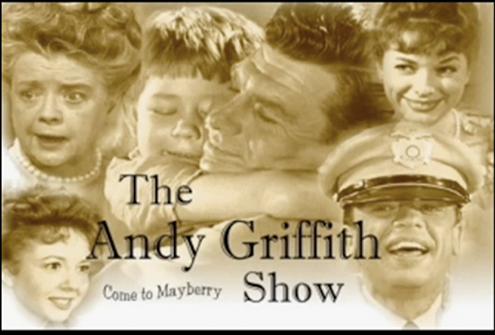
In the wake of Andy Griffith’s death today, a friend of mine wrote this on Facebook: “If you’re waxing nostalgic about Mayberry as an idyllic 1960s Southern town, remember that it had no Negroes living there. Is it any wonder that show was so popular in the midst of the turmoil of the civil rights movement?”
The sentiment was undoubtedly motivated by good intentions, but boy, it is unfair. America was a largely segregated society in 1960, when “The Andy Griffith Show” began its trek to television Valhalla, and it was not up to the producers or writers of a folksy sitcom set in small North Carolina town to remedy that, protest it, or comment on it. This wasn’t “Andy Kills a Mockingbird.” It was a comedy, and a comedy unique and precious for celebrating basic ethical values like kindness, loyalty, friendship, tolerance, community, cooperation, patience, respect and virtue. There were no racist sentiments or attitudes expressed in Mayberry, and no reason to doubt that if a black family moved into the town, they would have been embraced, appreciated, and treated like everyone else. The fact that this may not have been true of a real North Carolina town of that period is as irrelevant as pointing out that real Scottish villages don’t disappear and reappear centuries later like Brigadoon.
I know that in the Sixties political correctness began to sink its teeth into the culture, and some knee-jerk liberals in the entertainment field felt they had to prove their dedication to civil rights by making silly gestures. Suddenly a black kid showed up in “Peanuts,” for example. There was no point to it, and if anyone can recall a single funny strip involving him, please let me know. “Peanuts” wasn’t about race, or civil rights. There were no African-Americans on “Yogi Bear,” either, or “Huntley and Brinkley,” or “I Love Lucy.” There were no blacks in “My Fair Lady” or “The Odd Couple,” and the Beatles didn’t have a black drummer. Going back a few decades, Chico, Harpo and Groucho didn’t have a black brother, who of course couldn’t be called “Sambo.” “Death of a Salesman” had no black neighbors or colleagues, and in “Oklahoma!”, the settlers in the aspiring territory weren’t racially diverse. That doesn’t mean these works of art and diversions were racist. It means they had other objectives, and legitimate ones.
It is unfair to criticize an artist or artists for pursuing their objectives rather than yours, especially when pursuing yours would have made theirs more difficult, and perhaps unpopular. [Aside: this is especially true of TV sitcoms. If there is one thing you can be sure of when the promotion for a popular situation comedy promises “a very special episode,” it is that it won’t be funny.] It is doubly unfair when this criticism comes retroactively, with 20-20 hindsight bias. It is spectacularly and unconscionably unfair when the criticism undermines the praise justly due to a work of entertainment that never wavered from its goal of laughing with human beings, rather than at them, and celebrating core American virtues. An admirable work of contemporary art doesn’t have to accomplish everything, solve all the world’s problems, or even try. “The Andy Griffith Show” made us laugh, and also reminded us weekly about how to be good neighbors, good citizens, and good human beings.
That was plenty.
Sheriff Taylor had nothing to be ashamed of, neither did Andy Griffith, and either do we, for loving them.
_________________________________________
Spark: A Facebook friend
Sources:
Graphic: Sparsely, sage and timely
Ethics Alarms attempts to give proper attribution and credit to all sources of facts, analysis and other assistance that go into its blog posts. If you are aware of one I missed, or believe your own work was used in any way without proper attribution, please contact me, Jack Marshall, at jamproethics@verizon.net.
 Ethics Alarms
And today there will be a run on “The Andy Griffith Show” ringtone for your iPhone. Move over “Brave Sir Robin.”
Do-do-doo, doo-do-do-do, doo-do-do-do, do-do-doo-do-do…
CR
I can hear the whistling theme song now. I liked them all– “Sanford and Son”, “Chico and the Man”, “Welcome Back Carter”, “Hogan’s Heroes”, ” I Love Lucy” and still watch “The Andy Griffith Show” every chance I get. The race issues never bothered me. I just loved the comedy surrounding the culture. I even got a “kick” out of Archie Bunker with his problems involving the Jeffersons and getting kissed by Sammy Davis Jr.
Andy, Don, Ron Howard…. what was not to like? TV has always been about ratings…. even when they try to make it about issues.
Each show of that time was a reminder of how near impossible it was for an African-American to get a leading role in hollywood let alone thier own sitcom. When people say the show was racist, its really in reference to the climate of show buisness and how segregated Hollywood was at that time.
There goes another little piece of my childhood.
Jack, this is a beautiful piece; thank you. And I don’t usually thank someone for bringing tears to my eyes at 6:50 a.m.
If I may paraphrase that comment by Jack’s facebook acquaintance:
“Why did that show spend all its energy and resources on ITS agenda instead of on MY agenda?”
Glad I randomly stumbled on this one.