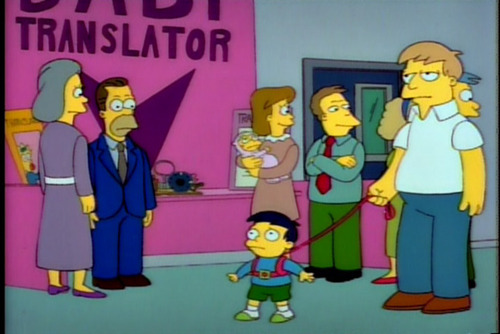
It is constantly amazing to me that journalists so seldom identify obvious and critical ethics issues in the topics and events they cover. The rest is mixed emotions: this absence of ethics awareness is a serious culture-wide problem; then again, were this not so, I’d probably be in a different, and less stimulating profession.
Today I sat down to lunch as CNN engaged in a breathless discussion of whether using leashes on toddlers and even older children was a good idea, as it is either a growing trend among parents, or CNN was having a slow news day. The phone lines were open, and many viewers weighed in, with the primary camps expressing the following positions:
1. “If it makes children safer, then there is no reason not to do it. Safety is everything. Kids have been killed running into the street. A leash will prevent that.”
2. “This shows the decline of child-rearing skills in the United States. If you can’t control your kid better than this, you are the problem.”
If the question of whether it was fair, kind, respectful or right to treat your child like a cocker spaniel occurred to anybody in this discussion (I know the CNN staff never considered it), I saw and heard no evidence of this. Yet that is the central question, and it is an interesting one to consider. The fact that matters of human dignity, responsibility, respect, fairness, autonomy, kindness, proportion and prudence need to be balanced to answer the question at hand never came into the discussion, and those debating the issue demonstrated neither awareness of the competing ethical values, nor the ability to know how to employ them.
This also showed the disturbing cultural tendency to make avoidance of risk the primary consideration in all balancing exercises, particular those involving children. Is it any wonder that college students are now demanding “trigger warnings” in literature, lest their delicate sensibilities be damaged by a surprise plot turn?
My view is this: it’s unethical. I’ll accept arguments that the “Ick Factor” may be in play, but I believe that treating a child in exactly the same manner as a dog on a walk crosses a critical line that, once crossed, allows other an more sinister indignities to be visited upon powerless children in the name of “safety.” Why not have the kids in restraints at home, so they can’t hurt themselves? Roll them around in public in mobile cages? I’m sure iot might save some lives and prevent some injuries to do this. Surely all kids should wear helmets inside and out, at all times. And knee pads. And elbow pads. Plastic face masks would also be a good idea. Muzzles too–kids can bite.
I have no expertise on the topic, so I won’t speculate what it does to a child’s self-esteem and self-perception to be treated like this, but I know I would have deeply resented it, and if I saw photos that proved I had appeared in public on a leash, my respect for my own parents would have dropped several notches. (As it happened, their opinion on the subject was exactly the same as mine.)
The definitive verdict on this ethical controversy (even if CNN and its viewers couldn’t recognize it was such), was delivered over a decade ago, on the Simpsons. The episode involved Homer’s brilliant but unlucky brother, who invented a “baby translator,’ which allowed parents to understand baby talk. (All the translations are rendered in the voice of Homer’s bother, played by Danny DeVito) One of the children who tests the device is the child on the leash pictured above. The Baby Translator reveals his opinion of the practice, and it is an ethical bullseye. He says:
“This leash demeans us both.”
Bingo.
_____________________
[Further commentary, in part based on comments here, can be found in the next post.]
 Ethics Alarms
On CNN??
Did they find the missing airplane???
LOVE the trivia about Elizabeth Taylor – thanks! (I have watched only a few episodes of The Simpsons.) Maybe the ethics of leashing truly depends, and ought to depend, on the kid – and/or on his parents? Crowds are truly dangerous places for the little ones, and it seems the best parents may be finding it harder than ever to avoid crowds while with their toddlers.
Priority management, planning, and acceptance of consequences. Deal with it parents. You accepted the mantle of trying your hardest despite nature being against you, to manufacture a healthy functioning adult in less than 18 years who possess ideally no more than half your own neuroses, psychoses, and character flaws. That means work. And I don’t think leashes communicate the balance of independence, risk taking, caution, exploration and experimentation that is healthy for youngsters.
Another question is–what’s the matter with modern day parents’ hands??
I know.
I didn’t want to provoke a huge reaction by asking:
Anyone hear of hands?
Shoulders?
NOT GOING OUT IF YOU REALLY THINK IT IS THAT RISKY?????
You or Jack have any energetic toddlers on your hands these days?
As a matter of fact yes.
But if I didn’t that wouldn’t change my assessment.
“How would you feel if it was YOUR child who was shot?”
Crowds are truly dangerous places for the little ones,
*********
A situation like that is what I had in mind.
Not putting a leash on the kid every time you leave the house as you do with your dog.
The trivia, unfortunately, was WRONG. I fixed it. Liz did indeed utter “Maggie’s first word,” but it was on another episode. I apologize. It came to me that I had made a mistake about 10 minutes later, but I was out with Rugby.
On a leash.
Aww shucks! Now you owe me. Take Rugby to the park – and let him RUN.
Who names their kid after a contact sport…. and then worries about safety?
Nobody. Of course, Rugby is my Jack Russell terrier, but you knew that.
Don’t let him know about your other child — Fisticuffs Queensbury Marshall…
I was reading this enjoying a Scotch, which I promptly shared with my keyboard. Thanks, guys.
5. By age 5 a child’s personality for life is almost completely established or at least damn difficult to alter. Their habits and other facets of life become relatively rock solid by age 18. But in 5 short years, you must already try to encourage a child’s (already innate tendencies) in certain directions. Are they helpful? Are they selfish? Are they independent? Are they overly reliant on others? Are they overly risky, overly cautious, or a comfortable medium?
I don’t see how the leashes can at all be beneficial for the child’s psyche. I’ll let my kid fall and cry thank you, and I’ll gladly look like a fool if I have to reach out awkwardly to grab them if they head in the direction of a busy street. But I won’t let a leash allow me to ignore what my child is doing so I can pursue my own extremely temporary interests at the moment, not considering what it *must* be doing to the currently developing personality.
Crowds, Tex. Thick, teeming, swirling crowds. I would not want my kid to become crowd-phobic by never exposing him to one. But I also can’t say with complete confidence that I would be able to monitor and protect my kid adequately in every crowd that I might want to join with him, without the leash. True: I would not want the leash to become a crutch for myself, or an unnecessary limitation on the kid. I would not use it habitually, even in crowds, unless there was something inherently dangerous and unreasonable about my NOT using it in such a way (example: I have a cast on one limb, while the kid is extraordinarily energetic and inquisitive; you just can’t impose a one-way-fits-all on everyone in matters like this).
It’s been a long while…I do believe we used a leash on one of ours, during one season of time, maybe only two or three times at most. The rudeness of strangers and their stupid mutterings-while-passing-by made the crowd they were in a bigger danger to themselves than they probably realized – because they didn’t know how much they pissed me off, and how close I came to taking the leash off my kid and wrapping it around THEIR necks.
Been in em, Eeyoure. I don’t think crowds are inherently different than the ones we were children in.
By the way, if you noticed something exceptionally dangerous about a crowd, what exactly were you doing there with children?
It’s the dangers I do NOT notice, but cannot fairly expect not to be present, that I refuse to deny myself – or my kids – some exposure to. Umm, how about…the 4th of July, at the base of the Washington Monument?
No, I understand fully the utter terror that life presents to the current generation. But if a crowd is truly full of all those unseen dangers, surely alternate locations of relatively equal experiential impact are available that don’t require saving your child by treating them like Benji?
Balancing act of what actually matters…
And “denying yourself” could easily be the mantra of the cult of the parent.
But do understand, as with all rules relying on optimization, I do understand that certain factors may make the child leash an only option… As our friend Steve alluded to below.
Today I sat down to lunch as CNN engaged in a breathless discussion of whether using leashes on toddlers and even older children was a good idea, as it is either a growing trend among parent
*************
I was watching this at lunch, also.
I don’t have a strong feeling either way about using the leash, but
I was struck by the fact that so many people think they have a right to tell another person how to keep their kid safe.
Oh, no doubt parents have the right to do so.
I think the question asked is if it is ultimately better for the child or not.
It was more like “should you?”.
One guy said, “the number of kids abducted while wearing a leash is zero”.
I was thinking it was one of those damned if you do/don’t.
Put the leash on, the kid doesn’t get grabbed in a crowd but suffers from low self esteem for the rest of his life.
Meh. Self esteem is a waste of time anyway. Our culture has enough kids who suck at life but are happy with themselves as it is.
I’m more concerned with subtle notions sitting on their psyche of being tied up like a dog and restrained from independence, not by a reasoned adult’s hand or voice, but by some mysterious and ever present frustration.
I hate those things, yes it is unethical, yes it is a sign of poor parenting and whoever thought of the damn things should be made where one at all times. Your child will grow up and act and treat people as they have been treated, they are a reflection of their parents, in rare exceptions some figure out their parents are idiots or have a family member, teacher or friend clue them in but it is hard to combat the stupid parents effect on their children. Did I mention I hate those things? So demeaning.
Here is my only exception, a friend of ours is wheel chair bound and used one when she and her toddler had to travel by themselves and had a couple hour layover at an airport, still demeaning but in that chaos with limited options I think insuring the safety and well being of the kid is the more important ethical obligation.
I believe it’s possible to use those things in a way that the kid either never remembers, or remembers only because its use was effective for a reason that had nothing to do with his being demeaned.
Age 5 Eeyoure. There must be something in those 5 short years that is PERMANENTLY ingrained whether they are aware of it or not that affects their personalities.
I would not use a leash on a pre-school, post-toddler. Age 5 is a good age to start with, but you know how widely different kids are at all ages.
Wait… What?
You’d leash older but not younger?
No, I was unclear. I meant that age 5 is a good age for starting to consider that “they already are who they are going to be” and therefore the leash will not be effective – but, as another commenter suggested, handcuffs might work best. (Ankle shackles could be optional; “time out” could instead be performed publicly, so that (1) the child with self-restraint issues, (2) the parent or guardian obsessed with control, and (3) the general public, could all experience the gratification of realizing how World Order should look.)
I woke up silly from poor sleep, so the closest I came to seriousness above was through the first half of the second sentence.
We just make it a policy of once a week to don a George Clooney mask and beat our children senseless.
Then social control becomes a simple matter of saying “stop doing that… You don’t want George Clooney to come over do you?”
Well, hell, I can vouch for the fact that when you really need them is when the kid hits about 14….
For mine (at least all but my youngest), the need hit around ages 9 to 10.
yes, “wheel chair bound”, maybe some other affliction other then stupidity and selfishness.
Yeah, mixed feeling about this one. I can remember being an elementary age kid at the local fair which was big and crowded and seeing a younger kid on a lease and being horrified. Still, then I go to Walmart from time to time and witness some little bastard tearing things off the shelf and watching the self indulgent parent smiling blankly. So is it ethical for someone to do nothing about their out of control kid who creates more work for the overloaded employees? Maybe handcuffs would be a good idea. The kid will probably be wearing them sooner or later. 😉
Jack, I think you have the trivia wrong. The episode where Maggie speaks is the one where they flashback to Lisa’s first word.
http://en.wikipedia.org/wiki/Lisa%27s_First_Word
The Baby Translator episode has Maggie speaking baby gibberish voiced (I think) by Nancy Cartwright (she’s credited on the IMDb page as Maggie for this episode).
http://en.wikipedia.org/wiki/Brother,_Can_You_Spare_Two_Dimes%3F
Ha! Already fixed it. Took my dog for a walk, realized they were two different episodes, and rushed back to try to beat you. Phooey.
I never used one. Not because of a reasoned ethical objection, but because my children were not impulsive or prone to run away from me. My daughter has an extremely willful, impulsive and defiant child. He came into the world that way and they have been dealing with it more successfully than not since he was born. She used a child restraint when the whole family went to a theme park in California because it was either that or keep everyone home because he cannot be counted on not to run away when he’s being told to come back. She is neither a poor parent nor is he a bad child. They are dealing with life as it is given to them and it’s no one else’s business.
Is it ethical? Not sure. Necessary? Yes.
If you’re a good shot, you can kneecap the kid if he tries to walk away. Or hobble him, like they did Kunta Kinte. Or maybe a ball and chain?
I don’t see how a leash (“child restraint” is a euphemism) teaches the kid not to run away—it hasn’t taught my dog not to run away in 10 years. His predecessor didn’t require a leash.
I agree, even if i do find them icky. Ultimatey, the leash is for the parent and the other children they happen to be raising in order to give them the ability to allow the child a wider range of activity because, well, you know where they are in pace where continuous monitoring is not always possible.
One way or another, a child is leashed. Whether by rules that you hope they follow 100% of the time (yah, right), or by your monitoring 100% of the time (hey, we’re parents, not robotic security cameras). The leash is an acknowledgement that neither you or the child are perfect, and the additional layer of security allows for an additional layer of exploration (otherwise, it’ continuous handholding- and how is that better?)
I agree. I never used one, but I came close with my second one. I used to *inwardly* smirk at other parents who had children on leashes as my perfect first-born would stick to my side like glue, say please and thank you, and never act out in public. And then I had a runner. I was terribly afraid that she would break away from me at the zoo, park, etc. and I wouldn’t be able to find her. She just turned 4 and it is only now that I will take both kids out at the same time without my husband or another adult along. One adult always was needed to hold the hand of toddler No.1 and a second adult was needed (running shoes required) to drop everything and chase after No. 2 — frequently.
Anyone remember that wonderful scene from “The Sound of Music” where Captain Von Trapp demonstrates the whistle signal for each of his children? He then comes up with a convoluted signal for Maria who interrupts him in horror, telling him, “I could never answer to a whistle. Whistles are for dogs and cats and other animals, but they’re not for children and definitely not for me. It would be too…humiliating”.
This is my opinion of leashes on kids.
Forgot about SOM…thanks.
Awesome, very good.
There was an earlier German film made in 1956. Baron Von Trapp would have not appreciated his wife’s concern about whistling. Probably he would have said something like “Achtung Frau! I am in show business and a Baron. So you keep out of this one and get in the kitchen where you belong.” 😉
Maybe it could be called a “love tether”? Instead of a LEASH.
would that change the fact that it is a LEASH?
No but it would market to an entirely different cohort of adults than those who are parents.
And maybe some who are…
But not for child rearing purposes.
And leashes wouldn’t?
I wish not to delve into that guess when discussing “child leashes”.
My mind ends at “furries” I wish not to imagine further.
Mixed feelings on the leash, leaning towards not just NO! but HELL NO!!! However, I’ve got to wonder about CNN just now noticing them. I saw my first one on Broad Street in downtown Richmond, Va…..wait for it….in 1974. Must be a slow news day, or as Tex mentioned, has the plane been found?
If a large number of people are using leashes on their kids, then it becomes standard, and no longer associated with just dogs. If the only ethical qualm is in fact it’s association with dogs, then that is no longer an issue. I see the backpack leashes all the time, it doesn’t really raise eyebrows. It seems like a really useful device, especially for parents with a lot of small children.
Why not have the kids in restraints at home, so they can’t hurt themselves? Roll them around in public in mobile cages? I’m sure iot might save some lives and prevent some injuries to do this. Surely all kids should wear helmets inside and out, at all times. And knee pads. And elbow pads. Plastic face masks would also be a good idea. Muzzles too–kids can bite.
I don’t think the key analysis should be whether or not we also use it for animals. That could be a lot of products. We also use comb and brushes to groom our animals….and gasp! our kids too! And toys, and little snacks. We crate dogs, and we put little kids in a pack and play. The insides of people’s houses are babyproofed. and also dogproofed for the same reason, to make sure they don’t harm themselves. The list goes on. Little kids have no sense of self-preservation, nor any sense of dignity, so you can’t insult it. But even if they did, in the battle between safety and dignity with children, safety should win, pretty much every time.
You forgot to mention that dog toys and toddler toys look virtually interchangeable.
Now my iPad needs to be cleaned. Hope their Pepsi-proof?
When you have toddlers and a dog they *are* interchangeable.
It’s animal-like treatment. Yes, if everyone fed their child from a dish on the floor, then that wouldn’t be associated with dogs, either; if everyone trained their kids to beg, roll over and play dead on command, same thing—and that’s not the point, is it?.
You are a great case study—you gravitate to the predictable Left position on every possible controversy: how does someone become like that? Is there a directory? A hotline?
Do I really have to go through all the ways this statement “In the battle between safety and dignity with children, safety should win, pretty much every time” leads to safety helmets 24-7, a programmed life, fearful, cowardly, timid children–and then adults— with weak characters, risk averse, looking to a womb-like environment where a benign Nanny Government keeps them safe?
Thank you.
I give myself until 10 PM (Central) to bring this up if no one else did…
Didn’t want Beth to accuse me of politicizing everything.
Maybe we’d have a stronger populace if we encouraged toddlers to juggle with knives.
Clever attempt at slippery slope in the other direction…
But it fails. You’d see, the slippery slope Jack seeks to avoid allows for proportion in the raising of a child. Yours doesn’t, it ultimately relies on a false dichotomy. Ponder on it.
I didn’t use a leash. But I also would never let my child play football. And yes, I am clever.
I didn’t say you were clever.
Orange juice on keyboard – thanks, Beth!
It’s animal-like treatment. Yes, if everyone fed their child from a dish on the floor, then that wouldn’t be associated with dogs, either; if everyone trained their kids to beg, roll over and play dead on command, same thing—and that’s not the point, is it?.
That was your stated point, that it is associated with dogs. But if a lot of human beings are doing it too, then it is no longer animal-like, no? Otherwise you have a fine set of circular reasoning on your hands.
In a lot of ways, the preschool and younger set do have to be treated like animals. As they develop reasoning skills, you gradually civilize them so that they can be around other human beings. A lot of things vary depending on the child, and the circumstances. I can’t have a knee-jerk reaction to judge what a parent might be going through, especially if the whole purpose of the device is to keep the child out of danger. I don’t see the argument for putting a 2-3 year-old in unnecessary danger against a parent’s better judgment. Because it looks bad to other people? Because we do something similar for dogs? This seems like the very essence of a MYOB matter.
Do I really have to go through all the ways this statement “In the battle between safety and dignity with children, safety should win, pretty much every time” leads to safety helmets 24-7, a programmed life, fearful, cowardly, timid children–and then adults— with weak characters, risk averse, looking to a womb-like environment where a benign Nanny Government keeps them safe?
Assertions with no evidence. But putting that aside, my statement is if that is the only argument against some safety measure for children, that it is undignified for them, then the greater weight should be given to safety, no question. Young children don’t have any dignity anyway. It’s hard to argue about dignity for children when they will happily make wall art with their own feces.
By the time children acquire a sense of dignity and shame (not to mention a working memory), the leash is useless anyway. When the child is 5+, they will have figured out how to take it off if they wish.
You are a great case study—you gravitate to the predictable Left position on every possible controversy: how does someone become like that? Is there a directory? A hotline?
I wasn’t aware this was some sort of political position, just a practicality issue. I can’t think of a single lefty friend of mine that uses a leash backpack for their kids. But I can see how someone would probably more prone to using it in the city (crowds, cars, dogs) than in the suburbs or country, where you can let kids run free more easily without as much fear or oversight.
not without precedent
Noooooooooooooo! They’re! they’re! they’re! I want to kill myself now. My pet peeve turned on me.
I think it depends on the situation and the child. I waited until I was 38 to have a child. I spent many years discretely rolling my eyes at parents who used leashes on their children and swore that I would never do such a thing. Well, now I have a 2 year-old son and I broke down and purchased a backpack with a leash when he was about 18 months old. My son loves it. He is already highly confident and friendly so I have no worries about a long-term impact. In fact, he loves it because he feels more independent. I have rarely use the backpack leash (maybe 4 times in the past year)…..only in situations with large crowds. Am I a bad mom because I have used it a few times? Maybe, but I have a confident toddler with very well developed verbal, fine motor and gross motor skills so I think i am doing ok and really don’t care if other adults are rolling their eyes at me as I used to do to other parental leash users.
In any case, it is not a worthy topic for a “news” organization. There are many more important issues in the world that CNN chooses not to but should be covering.
And if I may hop in here, those leashes are NOT for the safety of the child. An observant and caring parent is for the safety of the child. The leashes are for the comfort and convenience of the parent, and that is ALL they are for, so parent can day-dream, window shop or generally screw off and not have to worry about the kid. Wonder what would happen if somebody slipped, say, a Jack Russell Terrier onto the end of the leash held by an oblivious parent?
And if I may hop in here, those leashes are NOT for the safety of the child.
Anyone who was holding a small infant, and had an older toddler breakaway from their handhold and start madly running somewhere would beg to differ.
But even if they are a fail-safe for the oblivious parent, why wouldn’t we want that? It definitely beats the alternative of not having that fail-safe, I would think.
I do like “tether” better than “leash,” because it reminds me of the space programs and spacewalks, and all the dangers inherent to those, and of how life in 1 g on terra firma can actually get that dangerous (and worse), for some parents and some toddlers. No one can just dismiss the whole idea out of hand and expect everyone to do without a leash, always. That (dismissal) is as authoritarian as requiring a leash on all toddlers.
As someone who has raised three sons (all three are in their 40’s now), you can differ all you want to. I was a parent, not a pet owner.
Ok I now realize that leashes are just wrong. Especially if you name the kid Fido and train him to bark on command. 😉
It is obvious to me that the anti-leash folk here are men who presumably “babysit” their child and are able to give him/her their undivided attention.
The female perspective here is a little more tolerant, coming from a totally different perspective. Comfort and convenience? No, I don’t think so.When you have more than one kid under the age of four, one or more who is hyperactive or autistic, and are a busy and/or pregnant mom who is doing the laundry, cooking, cleaning, shopping, etc., you will use any means necessary to keep your kids safe – no matter how observant and caring you are.
As for me, I raised four, used a harness and leash on number three – he who slept 2-3 hours out of 24, tried to climb out windows, would sneak out of bed, once unlocked the front door and ran into the street. Had to harness him into the stroller so he wouldn’t lean out of it and drag his head on the sidewalk while I was walking a mile trying to get to the grocery store.
That was almost fifty years ago, and he is now an intelligent, well-educated, decent, loving human being – a good husband and super father whose own two kids are making him (and me) proud.
This whole thing boils down to common sense. When my father had to spend the last months of his life in a nursing home, I found out it is illegal to harness someone into a wheelchair because it is an affront to that person’s dignity. Better to call the family at all hours of the day and night to inform them that the patient fell out of the wheelchair. Again.
I loved this comment.
I was lead around in public by my father’s hand tightly clamped around the back of my neck for almost 18 years; I’d have taken a leash over that degradation any day. Certainly would have been less painful.
On point, I see child leashes as a tool that can be used or abused. On a toddler, used sparingly, I don’t see the problem; it grants them far more freedom than they’d otherwise have in certain public situations. The trouble is when idiotic parents rely on it at all times for far too long, probably the same type of parent who lets television and cellphones babysit the kids at home. In the hands of a parent with half a brain, if you can find such a beast, things are different.
I agree that for children under four, or have some other developmental issue they could be acceptable if used sparingly. And if there is that many children young enough to be leashed, it’s funny sad.
But how are they to learn and demonstrate autonomy in public and responsibility if they are only tethered satellites of a parent? Autonomy really requires they be able to handle themselves when they think their parents are not near. If they are always attached and shielded at all costs, they can’t handle the skinned knees and unfriendly fellow students in the future,
Ripping away anyone’s dignity for convenience is cruel.