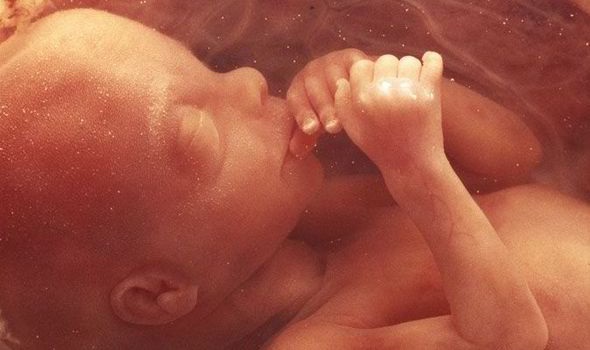
This blog doesn’t discuss evil very often because it is not a term appropriately associated with ethics. Evil is a concept related to morality. In an ethics discussion, I would take evil to mean something extremely, irredeemably unethical by any ethical analysis or system. The statement “I think abortion is evil, but it is a necessary evil” appeared parenthetically in a comment by Beth, a frequent commenter on Ethics Alarms who is a mother and a lawyer, regarding the Planned Parenthood videos. Though the news media appears to have successfully distorted that story by focusing only on whether the videos were evidence of illegal “trafficking in body parts” by Planned Parenthood, that was not the reason I posted the essays, and it is not the reason those videos are significant in the ongoing debate over abortion rights. Two high ranking individuals in the organizations casually discussed the crushing and crunching of the heads and torsos of living and helpless individuals with the sensitivity I would associate with stepping on a roach. If this doesn’t disturb you, it should. If it does disturb you, as it did Beth, what does that mean?
Abortion is one of the most important and difficult ethics issues in the culture, indeed in world culture. It involves millions of lives and millions of deaths, law, bioethics, religion, social policy, science, human rights and feminism, as well as society’s ultimate respect for life itself. I have written about the ethics of the abortion debate frequently (you can find most of the relevant posts here), but to summarize the Ethics Alarms views on the topic:
1. Abortion is an ethics conflict, meaning that there are ethical principles in opposition to each other, requiring society to set priorities.
2. The absolutist position on the anti-abortion side is that abortion involves the taking of innocent human life, which begins from conception, and is thus unethical in all cases. It is a strong position if one accepts the underlying assumption.
3. However, no absolute position is really absolute. Every ethics absolute has an exception, or several: there must be some circumstances when abortion is necessary and right. (This is not true of moral absolutes, since moral absolutes are self defining. If the power dictating a moral precept says it is absolute, it is so.)
4. The absolutist position on the abortion side of the argument holds that a woman’s right to have complete dominion over her body, reproductive activity and health justifies abortion in all cases. This is not a strong position, and in fact is one that cannot be honestly argued or sustained. It supports abortion on demand for any purpose or preference, entirely at the mother’s discretion.
5. To make that argument, extreme pro-abortion advocates have had to deny the humanity and human rights of unborn children, even to the point of arguing that they are not individuals at all, but mere “parasites,” or “tumors.” The removal of a second life from the equation that is at the core of the abortion problem makes the abortion decision easy and guilt-free; it also settles the debate by pretending the central issue doesn’t exist. That issue is that there is another life involved, not just the mother’s.
6. The debate over the ethics of abortion has been handicapped by the tactic of both sides to pretend a legitimate interest championed by the other doesn’t exist. A woman’s ability to control her own life, career and what happens to her body is an important societal issue, yet the term “pro-life” ignores it entirely. It is not the only important interest involved in the abortion decision, however, as the term “pro-choice” suggests.
7. Neither absolute position, whatever its theoretical virtues, is practical from a policy perspective. Desperate women who are pregnant will seek abortions, people will help then (or exploit them, or kill them), and public policy cannot pretend otherwise. Society will not tolerate punishing women for aborting their unborn children, whether they deserve to be punished or not. Yet allowing mothers to have unborn children killed on a whim leads to the callous, ugly, dangerous attitude toward innocent life on display in the Planned Parenthood videos. Callousness toward any human life, history has shown us, is a slippery slope with the potential of doing terrible harm to the culture.
8. Roe v. Wade was a premature Supreme Court decision and a badly reasoned one. Until and unless it is overturned, abortion is a right. That does not mean, and never meant, that abortion necessarily is right.
9. Because absolutism fails here, abortion is a problem that demands utilitarian analysis–balancing of interests and values, in the best interests of society, long and short-term, and everyone in it, according to the facts as we understand them.
10. Balancing requires an honest acknowledgement that there is something to balance. The “pro-choice” and “pro-life” dichotomy doesn’t acknowledge that in their most extreme incarnations, and since abortion is currently a right, the pro-choice lobby detects no reason to yield to logic, science and reality.
When Beth wrote her comment, I immediately saw the value of discussing the abortion problem from the perspective of her assessment of it, even though I am not certain I agree with her. I am not certain that abortion is “evil” in all cases, and if it is, I do not agree that it is “necessary,” again, in all cases. The statement however advances the discussion, and the discussion needs advancing. I admire the fact that her statement acknowledges the need for balancing outcomes: the very designation of a “necessary evil” evokes utilitarianism over absolutism, which would hold that an “evil” is never ethical, and thus is never “necessary.” This is a starting point for debate and eventually consensus, because to have a productive debate, the pro-abortion forces have to be willing to accept and admit that there is an objective wrong in this equation—it doesn’t have to be called evil—the taking of innocent human life, however undeveloped, limited, or “potential.”
If abortion is evil, then calling it a necessary evil places the act in the same category as war. War is extreme utilitarianism: so vital is some interest that it justifies thousands if not millions of wrongs. However, not all wars are necessary. Are all abortions necessary? If an abortion is not necessary, is it then just evil, as in horribly unethical, and worthy of criminalization? Is a promiscuous individual using abortion as a primary means of birth control necessary if its is completely irresponsible? If abortion is inherently wrong (“evil”) as Beth holds, then does it not mean that it should be avoided in favor of other alternatives when possible? Isn’t allowing the child to live and allowing other parents to raise him or her preferable to the “evil” in most cases? Is abortion “necessary” or even defensible if, for example, the child is being aborted because it is female, or “not perfect,” or black, or, as may be possible to determine in the near future, it has been determined to have “the gay gene”? Necessary? Like World War II?
Or “necessary” like the Iraq War?
Discuss.
And thanks, Beth.
 Ethics Alarms
“Discuss.”
I think you both just did. Very thoughtful and thought-provoking….I’m thinking…
Ditto charlesgreen. (Thinking is hard.)
One of the major dishonesties I find frustrating in the argument is the suggestion that a woman can be going about her business, working on her career, living her life, and then -bam- out the blue, for no reason, she’s pregnant. There’s no respect for her agency.
Further, I also find the “Women will always have abortions” shrug to be quite disingenuous. The more legal abortion is, the fewer people will take the time to find anything wrong with it. If the pro-life absolutists were to have their way and all abortion banned, it’s true there would still be some performed. But the societal pressure would be against it instead of for it, leading to a great reduction in that number.
Re your second point, history (and current evidence) demonstrates the opposite. Rather, the: (1) more developed the country (e.g., the U.S. and Western Europe), the less likely a woman is to have an abortion; and (2) ditto if abortion is legal.
http://www.guttmacher.org/pubs/fb_IAW.html
The answer is: more education re birth control and more access to reliable birth control abortions. If you educate, fewer women will have unwanted pregnancies. And, the fewer unwanted children in this world, the better.
The truth is, the busy executive example you cite above (although it happens), is not the norm. Most abortions in the US are in situations where the woman (or girl) is in a bad situation — either due to age, extreme poverty, drugs, and/or violence. And add to that a healthy dose of ignorance and bad decision-making in general.
Education, education, education.
I’ve nothing against education, and we agree that it would solve many problems, including the number of surprise pregnancies.
However, according to the most recent CDC stats I could find (2011), 58% of abortions were to women in their 20’s. 25% were in their 30’s. That’s 83% where age is not a factor.
According to Guttmacher’s 2008 data set 42% are considered poor – that is, below the poverty level. A significant number, and increased from the years before – but not most. That’s not to say that the mother FEELS they have enough money to raise a child – feeling that they don’t have enough to raise a child is a very popular reason.
As for why women have an abortion, http://www.guttmacher.org/pubs/journals/3711005.pdf table 3 illustrates that 25% do so because they don’t want a child right now. 23% say they can’t afford one. Conversely, only 4% have health concerns about themselves, 3% have health concerns about the child, and less than 0.5% are concerned about violence.
That’s not most.
And those unwanted children not being around may make life easier on their parents and even society – but each one is a snuffed out life. And no one is completely unwanted – they still have value as human beings.
I used “most” to describe a woman falling into one of those risk factors.
And, in any event, the fact remains that more education and legal abortion = fewer abortions. Indeed, abortions are in the decline in the US.
Well, that’s still only 30-40%, assuming that there is zero overlap between any of the risk factors. Most women get one because they don’t want a kid right now. Would you be in favor of that education including things like the mandated ultrasounds and images of the baby about to die?
“I’ve nothing against education”. I do; it’s Goddamn expensive !
As a results to dollars ratio, public education in America has been one of our Nation’s most egregious failures… even worse than the various “stimuli” and “bailouts” and on par with the failed “war on poverty”.
Not true when it comes to sex education. It works. Teen pregnancies and abortions are way down.
What are you talking about? The educational system is an astounding success! They’ve corrupted the thinking process so much, that the number of democrat voters ready for fast-food, social services work, or the dole is increasing at a near-exponential rate. Soon, the hegemony will be complete, and they won’t even need the votes of illegals and dead people to maintain it. A generation or two from now, we’ll have a near-starving peasantry that won’t dare to even nip the hand that feeds it.
In my view this:
“The absolutist position on the abortion side of the argument holds that a woman’s right to have complete dominion over her body, reproductive activity and health justifies abortion in all cases.”
Is a very STRONG argument, if and when there is no consideration of the morality of abortion, and no possibility of designating an action as ‘evil’.
The use of the term ‘evil’ must have a relationship to a moral, and an existential/religious platform, in which one has decided or come to understand that an action goes against cosmic law. But to speak in such terms involves metaphysical considerations and decisions.
So, in the absence of a morality of abortion, it seems to me nearly unassailable to say: A woman has the right to end pregnancy by removal/killing of the fetus, just as she has the right – as we all have the right – to control our body within the parameters of our body.
To understand the “absolutist” position in-pro of the woman’s right to choose one must at least be cognizant of the school of thought that produces a non-moralized position that is essentially ethically-based. That position, I would suggest, is one that comes out of the philosophy of ‘critical theory’ which regards any and all ethical and moral decisions to be ‘constructs’. It is not possible within that theoretical position to speak in terms of ‘morality’ which implies a priories which, in critical theory, are ALL challenged. It then becomes possible to describe a fetus as a nub or a node or even a parasite since no one has the right to assign any moral designators.
Additionally, I think it has to be spoken of that ‘Pro-Life’ is couched very firmly within a Christian (and religious) perspective, and that it is Christianity and Christian morality that defines persons as parts-and-parcels of the divine. This is the literal bedrock of the Christian perspective.
I wish to suggest that if there is a culture war on-going between these two poles, that it helps to understand the philosophical foundation for that war.
“The debate over the ethics of abortion has been handicapped by the tactic of both sides to pretend a legitimate interest championed by the other doesn’t exist.”
I suggest that there is no “handicap” and that each position is true to the philosophical assumptions that underlie them. From the philosophical position of so-called critical theory morality is an invention, an agreement, a collusion of interests, and that one of the primary fields for the assertion of cultural, and of course ‘paternalistic’, morals and ethics, has been and still is woman, and “the female body”. I would like to suggest that it is very likely that we have all absorbed tenets of critical theory and that these views are part of our conceptual structure. Just try an assert something different and see how difficult it is, and see how quickly you will require recourse to a religious argument.
And similarly, the Christian Pro-Life argument resolves to a purely religious and thus to a metaphysical argument. That soul, no matter how it has come to live in that body, has FUNDAMENTAL and indeed PRIMORDIAL rights. It is a grave sin, and thus immoral, to kill that life. (It is important to mention as-against this high-handed moral argument that many who have it and use it give evidence of hypocrisy to fundamental Christian morals and ethics insofar as they do not oppose war, the manufacture of armaments. Some do of course: the Maryknoll Christian school, the Quakers, etc.)
1. The pro-life position requires an acknowledgment and respect for life, as in Kantian philosophy. It requires no religious connection whatsoever. Religion is not necessary to respect life.
2.“Is a very STRONG argument, if and when there is no consideration of the morality of abortion, and no possibility of designating an action as ‘evil’” Huh? And slavery is perfectly fine if we leave out the nasty part about buying, selling, and owning human beings. Sure, if you ignore the FACT that abortion involves killing a distinct, growing, living human individual, it can’t be seen as unethical or evil. But since it does—that’s what abortion is—this statement is all fallacy and no substance. This is like Marion Barry’s argument that if you ignore all the murders, DC’s crime situation is pretty good.
If the pro-life stance is religious/metaphysical in nature due to its reliance on morality, in the absence of that consideration what is the difference between killing a fetus and killing a 1-year old child? What would be your basis for objecting to the killing of the 1-year old?
You need to get over the religious connotations of the anti-abortion movement, because pretending the issue is per se religious in nature means that the moment someone comes out as atheist and anti-abortion, your argument falls apart. It’s ad hominem.
I find myself in agreement with Jack on this, an absolute ban on abortion won’t work and will fail society in cases… But I’m still biased for the child. I used to be one. In this era of education, contraceptives and birth control, it is beyond the pale for anyone to put themselves in the situation where an abortion seems to be the best option. This guilt free, consequence free attitude is inappropriate. There should be guilt. They should feel awful. They should do everything in their power never to be in that situation ever again, and should be held up as examples of what not to do. It should be known: This is cripplingly stupid, utterly juvenile, really shitty behavior. And if you have to do it, it’s there, but you will be judged.
I only meant to say that in general terms the pro-lifers are more often than not Christian, and with a great deal of Christian zealousness, and that on the other side of the issue, at the other extreme, and in the pro-choice camp, there are folks who have stepped out of traditional religious perspectives.
But what you say makes sense: there could very well be a sound anti-abortion argument put forward by an atheist or an agnostic. My impression so far is that Jack himself is exemplary of such a position. The argument in contra would I imagine follow Jack’s arguments pretty much. It would amount to a utilitarian argument, overall.
I don’t regard morality-based arguments against abortion as helpful or even rational, and more than morality-based arguments against get marriage. Thought stops after “God says so.” That’s useful for societal order and control, but it’s not an argument.
No, unless I read you wrong, you implied that an argument against abortion ends up finding its way back to religion by necessity. You seem to be trying to make the case that you’re left with a choice between religion/morality, and philosophical relativism. All the popular species of relativism, moral, philosophical, and cultural, suffer from the same set of fatal flaws. For the sake of brevity, I found a list of the flaws that apply directly to moral relativism. With a little bit of imagination, you can see how they apply to philosophy for our current purposes:
1.Relativists can’t accuse others of wrongdoing.
2.Relativists can’t complain about the problem of evil.
3.Relativists can’t place blame or accept praise.
4.Relativists can’t make charges of unfairness or injustice.
5.Relativists can’t improve their morality.
6.Relativists can’t hold meaningful moral discussions.
7.Relativists can’t promote the obligation of tolerance.
Your only recourse is no judgment at all; not even your assertion that the state has no business within the boundaries of a woman’s body.
Jack: “I don’t regard morality-based arguments against abortion as helpful or even rational, and more than morality-based arguments against get marriage. Thought stops after “God says so.” That’s useful for societal order and control, but it’s not an argument.”
I understand, I think, the perspective from which you speak, yet I intuit that it is also a reduction. I mean that to consider ‘God’ is really to consider physical-metaphysical platform and it also has much to do with ‘meaning’ and ‘value’ and how these things are grasped. I apologise for the use of these sort of knotty terms. But they, and what they refer to, are crucial to understand how religious viewpoints inform philosophical determinations. Our philosophical structures have arisen out of religious perspectives, and these religious perspectives could not be considered as ‘rational’ in the sense that you seem to mean. My investigations have led me to understand that even as we abandon dogmatic religious constructs, it does not follow that we must or should abandon the investigations or definitions about ‘metaphysical platform’ (the base or structure of creation and essentially the reasons for existence).
If you said – and you seem to say something like it – “I have no interest in those things and indeed they make no sense at all to me” – I would say that that stance, or that choice, is subjective. To say “Thought stops after ‘God says so’ ” is a statement that will result from a reductionist predicate. Indeed, there is absolutely no reason why thought must stop if, as it is possible, one can identify thought, intelligence and indeed consciousness with divinity, and thus with life in its most expansive sense.
“…That’s useful for societal order and control…”
Its is true though that society and society’s ethics and moralities often mask power-management systems. And these moral view-structures can be seen and exposed as power-systems and the means by which populations are forced to submit to authority, and authority that cloaks itself in righteous garb when, self-interestedly, it really pursues its interests. In Marxist and post-Marxist terms this is done through ‘dialectic’, such as the conversations we are having now. And with that I would again mention the Frankfurt School and also Critical Theory, and I would mention again that Critical Theory has had and is having a tremendous effect in our thinking-world. All of our thinking, and I am reasonably certain I could include you too, is soaked with CT ideas. You mentioned that you thought it was all about word games and such and, once again, I would have to agree. Critical Theory challenges power-constructs and it identifies dogmatic constructs. The idea of seeing through systems of dogma and doctrine that allow for ‘societal order and control’ is an idea pursued by CT.
In simple terms everyone can understand, if ‘we’ are defined as souls in bodies and in incarnated forms, and if those souls are part of, or have a relationship with the Totality, with divine intelligence or being, and if this knowledge is intuited at the most profound level of our thinking and being, it will be an inescapable component – a dominant one too – in that person’s life. It is possible to have and enjoy a religious/spiritual relationship (as I just described) and still be vitally, and responsibly, involved in all the questions that come up here and anywhere.
If a religiously-inclined person, and one who might accept that God (divinity, being, etc.) has indeed established guidelines for conduct in this plane of existence, comes to understand at a psycho-somatic level that abortion is a grave evil, and if that person chooses to explain his her revelation of that fact in that way and in those terms, you have no objective stance with which to oppose it. You can oppose it subjectively of course until the cow jumps over the moon, but you cannot ethically nor morally defeat that chain of reasoning.
Sorry: A correction:
I wrote: “You mentioned that you thought it was all about word games and such and, once again, I would have to agree”
should read
“You mentioned that you thought it was all about word games and such and, once again, I would have to DISAGREE”.
And I should have added to this:
“You can oppose it subjectively of course until the cow jumps over the moon, but you cannot ethically nor morally defeat that chain of reasoning nor undermine it as substantial and valid use of reason.”
Firstly, I can absolutely guarantee that I won’t recourse to a religious argument, because I don’t subscribe to any religion. My ethics, or as you would call it, “morality,” derives from the goal of protecting existing consciousness and promoting its development (but not necessarily creating more consciousnesses) and the creation of sustainable systems to support such. Sustainability is only rational and forms the basis of societal rules such as the Kantian Categorical Imperative, while consciousness is the only category of entity that cares about anything and can form normative statements, and therefore it is the basis for deeming anything “right” or “wrong”, or positive or negative.
For the purposes of this argument, let us assume that for some range of time during development, a fetus has a consciousness comparable to that of a baby, and therefore has the same right to live, whatever that may be. Consistency is key, here.
I should like to address your point about the autonomy of a person with regards to their own body. I call into question the idea that someone has a right to control their own body to the extent that they violate the bodily autonomy (or integrity) of another person, even one who just so happens to be within the body of the first person. The first person’s attempt to extend their bodily autonomy to destroy the body of the person within becomes far less justified if they knowingly took the risk of pushing their euphoria buttons and accidentally pushed the “create sapient being in my body” button in the process.
Humans of both sexes easily develop senses of entitlement based on an implicit expectation that their past experiences and observations will continue to be true. “I can’t get caught/arrested/injured/pregnant because it’s never happened to me before!” There’s a certain lack of willingness to take responsibility for risky behavior. Granted, contraception does promise a very low rate of unwanted pregnancy. However, that is no excuse to assert that a person has the right to kill a person simply because they caused the existence of that person and because that person is in a place that makes life more difficult. Even squatters in a person’s home, if they were invited to stay for an indefinite amount of time, have the right to stay a while longer after they are given notice of eviction, in order for them to have sufficient warning to find shelter. I think the parallel between the home and the body is valid for this issue. If you’ll pardon me for the macabre hypothetical, aborting a conscious entity within oneself that one created through one’s own actions is ethically (or “morally”) basically identical to winning a baby in a lottery one occasionally plays (that one knows beforehand sometimes awards babies) and then killing the baby because it’s become a nuisance and one can’t otherwise get rid of it at a moment’s notice.
Also, minor nitpick: “..it is Christianity and Christian morality that defines persons as parts-and-parcels of the divine. This is the literal bedrock of the Christian perspective.” I think you mean the literal figurative bedrock.
Hello, thanks for your comments, they are interesting. The issue is loaded and intense and naturally spins out to many many other issues, problems and considerations.
It seems obvious that you have a good and a solid point. A situation could be imagined where the person in the womb of the last surviving woman was critical to survival. And in that situation she would be duty-bound. It would be appropriate to hold her against her will and force her to carry it through to birth.
Myself, I would agree with your view that 1) the forming embryo is essentially, and of course potentially, a person. One could quibble about it but it seems intuitively clear, and 2) that that aborting it is a form of killing it off. And you could explain that neutrally, or you could apply the term ‘murder’. The definition would likely reflect your intention and another set of predicates.
What I would say, therefor, is the following: A woman has the right, when the survival of the species (as in my example or some other really compelling imperative does not apply) to kill off the embryo inside her – to murder it if you will – and she has the right to take those consequences on her own shoulders. Where I begin to have issues, as I assume most or all do, is at the later stages: the late term. There is indeed a point where the killing off begins to look like infanticide as the Australian contributor wrote (if I remember right).
I agree with you regarding categorical imperatives. It is a ‘moral’ work to examine oneself and to ask the harder questions about conduct and actions and to act from those decisions. But don’t you think it is largely a personal and subjective arena?
I think a woman has the right to kill off a child forming in her, and I also think she has the ‘right’ as it were to go through all the processes of suffering/learning that will or may follow her decision. At that point I would put our arguments that have to do with ‘free will’.
In the end, I think the principal way to reach a woman who is pregnant and get her to have the child, all hinges on persuasion, on presenting arguments to her, and as well helping with all the costs and decisions involved in bringing that child into the world, either under her care or someone else’s.
But her right (barring certain circumstances) trumps other rights and imperatives.
Certainly I see your point. Our world is driven by erotic force. All of nature is permeated by sexual force. We exist in it. Our object is certainly to learn how to control and channel it.
I see your point. It is a conversation that extends well beyond the general philosophical limits of this blog. But a couple of comments are not out of keeping. Our mental and conceptual background – those in the West but all people really – is one that could be called medieval. It is a perspective which sees the Earth as a collection point for the detritus and even the sewage of the Cosmos. The more dense, the more demonic. The more airy, light and bright, the more angelic. This Cosmos was – to our present perspective – an ‘imagined world’. What that means is that in the imagination of man ‘the world’ is conceived and viewed. There are very interesting books that deal on the medieval worldview such as Lovejoy’s The Great Chain of Being” and Basil Willey’s “The Seventeenth Century Background”.
https://en.wikipedia.org/wiki/Great_chain_of_being
From our present perspective, yes, the ‘imagined world’ in which Christianity (and all religious ‘metaphysical dreams’) is made to vanish in the acid of our strict material imagining. But as Basil Willey says we are just as much involved in a metaphysical dream though we cannot, and will not, see it as such. To see it, we have to avail ourselves of a ‘master metaphysician’, and they are few and far between.
So, I accept what you say: The Christian Dream (and all ‘metaphysical dreams’) is a delusion, a chimera. The closer we move toward it with our ‘instruments’ of perception, it recedes more. ‘Our world’ will then reduce itself to pure mechanics, and men and mind to robotic mechanics. Well, you can surely see where this goes. I suggest though that that is just as much an imposed metaphysic as is any other one! But it is terribly dreary. Although it has many advantages, too.
To explore ‘metaphysics’ requires more than just a mental or intellectual investment, in my view. One has to go into it with one’s whole being.
But ‘Life’ in that sense is a psycho-somatic plunging-in.
The way that we get ‘meaning’ from a poem is similar to the way we get ‘meaning’ from a metaphysical dream. (These sorts of vague references are often not very popular these days, I admit).
One final note, about this:
“Because absolutism fails here, abortion is a problem that demands utilitarian analysis–balancing of interests and values, in the best interests of society, long and short-term, and everyone in it, according to the facts as we understand them.”
This is true, but only in a civil and legal context. It seems to me that civilly, and legally, and I mean without the introjection of a moral (religious) argument, there is no way that the legal system could fail to protect a woman’s right to choose. Even if she regarded it as sport or akn to cutting her finger nails.
But to suggest to a religiously-motivated person (a practicing Christian), whose life and will is aligned in a very different way, that they approach the issue through utilitarianism is, quite literally, the Devils invitation. They won’t take you up on the suggestion. Utilitarianism is, in a very real sense, anathema.
(I am not arguing any of this because I hold to the Christian perspective but only because I have looked into it and these sorts of ethically-laden questions interest me. This is just one among numerous.)
This is true, but only in a civil and legal context. It seems to me that civilly, and legally, and I mean without the introjection of a moral (religious) argument, there is no way that the legal system could fail to protect a woman’s right to choose.
Why? There is no ethical reason why a state couldn’t say, “if you create a life, your choice is to raise it, or late someone else raise it.” The problem is enforcement, but the law itself would do a lot of the lifting, just by setting the cultural standard. It’s supremely ironic to say that society has no choice but to allow women the choice of killing as many unborn as they want, for any reason. We always have a choice. We may not like the consequences, but we have a choice.
This is true, but only in a civil and legal context. It seems to me that civilly, and legally, and I mean without the introjection of a moral (religious) argument, there is no way that the legal system could fail to protect a woman’s right to choose.
Why? There is no ethical reason why a state couldn’t say, “if you create a life, your choice is to raise it, or late someone else raise it.” The problem is enforcement, but the law itself would do a lot of the lifting, just by setting the cultural standard. It’s supremely ironic to say that society has no choice but to allow women the choice of killing as many unborn as they want, for any reason. We always have a choice. We may not like the consequences, but we have a choice.
“The pro-life position requires and acknowledgment and respect for life, as in Kantian philosophy. It requires no religious connection whatsoever. Religion is not necessary to respect life.”
I see the Kantian perspective as a form of hyper-Christianism. (http://plato.stanford.edu/entries/kant-religion/)
There are numerous problems in saying (that a pro-life position) “requires no religious connection whatever”. One is that even in secular culture, as ours has become/is becoming, the ethical and moralistic perspectives, engineered by and through our (mostly) Christian heritage, shine forth. I see modern liberal culture as still essentially Christian. The value-assessments, the prejudices and judgments, still function.
And while it is possible, I suppose, to ‘respect life’ from a mere biological or physiological perspective, there is NO REASON at all from that perspective essentially, to see a human fetus as different from a a piece of meat, or a gnat. In that perspective, as is obvious, there can be no (justifiable) hierarchizing of life-value. A biologist/physicist will see all life on the planet as just a heat-transfer reaction.
I think that the “critical theory” perspectives borrow quite heavily from scientific and biological arguments.
And it is quite possible to ‘respect life’ while still choosing to cut one very small part of it out of you, or weed your garden, or eat a lamb chop…
“Sure, if you ignore the FACT that abortion involves killing a distinct, growing, living human individual, it can’t be seen as unethical or evil. But since it does—that’s what abortion is—this statement is all fallacy and no substance. This is like Marion Barry’s argument that if you ignore all the murders, DC’s crime situation is pretty good.”
No, you could just as easily say it is a pruning away of a potentially inhibiting biological trifle that will operate against the self-fulfilment of that woman. To make another statement requires a specific MORAL position, and a defined morality.
Your argument has become very moralistic.
It does not matter if it is an individual or a semi-individual, or only the potential of an individual. What matters from a viewpoint in which moral judgments have been excised, and all such judgments are questioned and challenged, is ONLY that a given woman has decided to remove an ounce or two of flesh from her womb. To call it a “murder” is an assignment of value.
I will not say that this is MY view—mine is far more complex—but that this is how the view seems to be constructed.
“The use of the term ‘evil’ must have a relationship to a moral, and an existential/religious platform,”
“It seems to me that civilly, and legally, and I mean without the introjection of a moral (religious) argument,”
Are you arguing that an atheistic society would be essentially immoral? That there would be no rules, that there would be no crime, because everything is permitted? Of course not, there are things that we can agree with outside of a Christian lens. From a Christian perspective, murder is wrong. Does that mean criminalizing murder is wrong? Of course not. This is horrible argumentation. Regardless where our code of laws originates, we can look at laws and judge them on their merits.
“One is that even in secular culture, as ours has become/is becoming, the ethical and moralistic perspectives, engineered by and through our (mostly) Christian heritage, shine forth.”
This is a form of ad hominem. You can attack the ethics and morals on their merits, and perhaps find some lacking, but attacking them on the basis that they are rooted in Christianity fails to take into account that some might be good policy.
“I will not say that this is MY view—mine is far more complex—but that this is how the view seems to be constructed.”
You do this… and it seems…. skittery. Like you want to put your views out there, but not own them in the case they are responded to. What ARE your views?
Humble Talent poses the question: “Are you arguing that an atheistic society would be essentially immoral?”
Not quite, and not exactly. Because my interest is in the borderline where religious concepts and commands become philosophical concerns and imperatives that must be defended through argument, or to put it another way when religious imperatives morph into philosophically-defended imperatives, I see morality as functioning in both.
But there are atheistic platforms which have no need or use for the word ‘morality’ which is loaded with all manner of different connotations. Atheistic arguments, and perspectives, seem to tend toward the utilitarian. Do you see it differently?
However, when people who are essentially religious, or who have been informed by religious concepts and imperatives (a moral sense about things that arises in them non-rationally), find that their religious connection has dissolved, or is being dissolved, and supposing they do not have access to a rigorous philosophical training that would allow them to work out all the definitions and statements that would encompass ‘ethical and moral positions’, that they seem to wind up in a sort of in-between world. Some part of them still has a root in older ‘senses’ of right and wrong, and good and evil, while their intellect may have been formed, or partially formed, through either a tiny amount of dedicated study (to philosophy), or perhaps (in rarer cases) to more dedicated study.
“That there would be no rules, that there would be no crime, because everything is permitted? Of course not, there are things that we can agree with outside of a Christian lens. From a Christian perspective, murder is wrong. Does that mean criminalizing murder is wrong? Of course not. This is horrible argumentation. Regardless where our code of laws originates, we can look at laws and judge them on their merits.”
No part of this is what I asserted nor would I assert it necessarily.
Christian forms of thought (and assignations of value, or right and wrong, defining the platform of life, etc.) pretty early melded with Greek philosophical thought. And Christian thinking has incorporated a great deal of its substructure from the pagan world. And so yes, beyond any doubt, one could exit or leave aside a specific Christian perspective and yet still fall back on all the pagan philosophical structure, which is part-and-parcel of our language and the way we think.
“Regardless where our code of laws originates, we can look at laws and judge them on their merits.”
I see your point, certainly. I would add a caveat though: It is quite possible to ‘judge on the merits’, it is not possible to (fully) escape from a whole structure (of thought, perception) that informs us, consciously understood or not. Or do you feel that bringing forward this element is picayune on my part?
I wrote: “One is that even in secular culture, as ours has become/is becoming, the ethical and moralistic perspectives, engineered by and through our (mostly) Christian heritage, shine forth.”
You commented: “This is a form of ad hominem. You can attack the ethics and morals on their merits, and perhaps find some lacking, but attacking them on the basis that they are rooted in Christianity fails to take into account that some might be good policy.”
It is not at all intended as ‘ad hominem’. I only make an effort to express what I see. But it is certainly opinion and only opinion.
I see so-called liberal culture, the culture of our modernity, as being essentially informed by its Christian heritage.
I am not interested in attacking morals or ethics, or anyone, and in fact I see Christian ethics as totally pervading and informing how we see and interpret the world. Even if one became a declared atheist one still arises and comes out of a philosophical and existential substrata that is fully informed by those values. While I find this topic interesting I doubt that this blog and this thread is the place to fill out these ideas! An interesting resource though is “The Oxford Companion to Christian Thought” (http://www.amazon.com/Oxford-Companion-Christian-Thought-Companions/dp/0198600240).
Christian views and perspectives have been interwoven into the very fabric of our perceptual structure.
“Atheistic arguments, and perspectives, seem to tend toward the utilitarian. Do you see it differently?”
No, but as you yourself point out later: “Christian views and perspectives have been interwoven into the very fabric of our perceptual structure.” If that’s true, an atheistic position would in theory have taken the Christian morals at issue and refined them by removing dogma. From a logical perspective, this might be the best we’re going to get.
And so what? Technically, burying our dead is a horrible waste of resources. We should instead collect the dead and convert them into Soylent Green. It would save miles of cemeteries, oceans of chemicals, and produce tonnes of protein. Why don’t we? Morals. And I’m ok with that. Maybe future generations will question this logic and come up with different processes because mores will have shifted. They can live with that. Right now, it boggles my mind that we are using abortion as birth control when we have condoms and the pill. No system of logic puts what we’re doing ahead. What we’re doing is insane.
Humble Talent asks: ““I will not say that this is MY view—mine is far more complex—but that this is how the view seems to be constructed.”
“You do this… and it seems…. skittery. Like you want to put your views out there, but not own them in the case they are responded to. What ARE your views?”
You mean in respect to this issue? Of abortion? It is all pretty simple: the argument that a woman has the right to decide, ultimately, what occurs inside of her body-space, I regard as largely unassailable within our culture, within our legal structure and the way ‘personal rights’ have been established.
A decision on the part of a woman to end a pregnancy is, clearly, a very complex issue, and rouses all sort of different feelings. I say “feelings” as I search for a better word. There is no single word. What it arouses is such a group of different concerns, issues and problems that it requires numerous pages to fill it all out.
At the end of the day – and since you are asking me I will tell you – I think that the decision to end a pregnancy is one that must be decided morally (Jack uses the term ‘ethically’ whereas my training pushes me to use the term ‘morally’ but apparently we mean something similar, if not the same) by the woman herself. If she decides to end her pregnancy, her right to do so supersedes any other right that might be defined, but this does not at all mean that other rights could not be strongly defined, or that they do not have integrity and moral force.
In my own view, a decision to end a pregnancy is, essentially, a spiritual decision on the part of that woman. But to use the word ‘spiritual’ requires so much explanation and this is not the place for it. So, the arguments stay at a legalistic level. At that level of legalism the right of a woman to choose seems to me paramount: it overrides all other considerations.
In eliminating a potential child from her womb are there other consequences and ramifications? Yes indeed there are. But this only points up the fact that there are ramifications and consequences to EVERY ACT by human beings in this ‘plane of existence’. Therefor, naturally, it is required to understand more – much more – about this Plane of Existence.
And the question becomes: What in the heck do you mean by that?
All these questions resolves, ultimately, into metaphysical questions. I do not mean to be difficult or somehow pretentious in this. I fundamentally believe that it is so.
Does my further explanation help?
It does. I think, if I’m reading your explanation properly, that you might even agree with me on an ethical/spiritual/moral level, but you’ve divorced that position from a legal one, and from a legal position you are firmly of the position of personal bodily autonomy, although, I have to point out, if you assume that there are two bodies, so to clarify that further personal bodily autonomy on behalf of the mother.
Pointing out this, I feel it necessary to point out that this is an ethics blog. And because ethical does not necessarily mean legal, and legal does not necessarily mean ethical, we also have to put a degree of separation between the two, and we choose as a matter of venue to focus on the ethics. There are situations (I would include this) where what would be ethical might also be detrimental to society, so the discussion zeroes in on where the utilitarian balance is.
Thank you. Saved me the trouble of typing that last part.
Humble Talent: “Pointing out this, I feel it necessary to point out that this is an ethics blog. And because ethical does not necessarily mean legal, and legal does not necessarily mean ethical, we also have to put a degree of separation between the two, and we choose as a matter of venue to focus on the ethics. There are situations (I would include this) where what would be ethical might also be detrimental to society, so the discussion zeroes in on where the utilitarian balance is.”
So far, I cannot say that I understand how the blog (I guess that means Jack or his particular ethical school) situates itself within ethics. Is it possible that I come at this from a very different angle? Is there some crucial piece I am missing?
I hear (read) different things, and contradictory things. They keep repeating themselves.
I agree that what has been legalized is not necessarily ethical or moral. And that what is ethical, according to a specific school of ethics, may not be legal or accepted, or practiced, by people.
I understand that ethics is connected with mores. And I also understand that mores and hence ethics, shifts with the times. I think we can say, with certainly, that we are in a time of seismic ethical and moral shifts.
I would say, and I am not sure if you’d agree, that ‘we’ are in tremendous, even fatal, ethical dilemmas about many many different questions.
But what I doubt, and doubt strongly, is that you or Jack or ANYONE who posts here has access to a solid ethical system where all ethical problems are resolved in clarity. I also will wager that each of you, and everyone who writes here, suffers from deep ethical confusion and is aware that they do not have access to a solid ethical system upon which they can rely, and one that is logically tenable, logically communicable, and cogent. What we HAVE is dribs and drabs, and perhaps some tatters. Am I wrong? In any case, that is what I see, by and large.
Yet what we DO HAVE, thankfully, is a structures system of laws. We know that we will not be able to secure ethical agreements from the people surrounding us: we each seem to make various interpretations, and we also have an “inner ear” by which we are capable of distinguishing – as you have mentioned – an ethical position from a legalistic position.
If one begins a conversation on the topic of what is ‘detrimental to society’, one enters quickly into a very subjective arena, and one that requires so many pre-definitions which have to be hammered out in advance, and then agreed-upon. I recognise the possibility of naming ‘detriment’. Yet I have noticed – time and time again – that those arguments are based, very often, in power relations, or power relations are always present in them or under them. I think for example about a whole critique levelled against rock’n’roll music. From a platonic perspective, of course, it should be obvious that shifts in musical forms will have tremendous repercussions, but how ever will you legislate out such a form? At a certain level, to address all that is detrimental, we would require not a democratic platform but a fascistic or semi-fascistic platform.
And for this reason all these questions, ultimately, become very complex.
I do not feel that I am at all outside of the realm of concern (ethics/morality) of the Blog, but I have a sense I do come at it all quite differently, and my ‘ultimate concerns’ are different).
Wow. I’ve never seen more words used to describe fewer conceptions. This level of sophistry deserves government funding.
“Is there some crucial piece I am missing?”
Undoubtedly. But I think that’s true of anyone. We don’t know all the answers, but pooling diverse life experiences together might get us a more complete answer than we had before. You seem to believe that if a system doesn’t have all the answers, the system is flawed, and then fall back on the legal system as if it doesn’t suffer from a similar problem.
“I agree that what has been legalized is not necessarily ethical or moral. And that what is ethical, according to a specific school of ethics, may not be legal or accepted, or practiced, by people.”
How generous of you. The thing is that you have stumbled into a community that accepts certain definitions, and while we understand that you as a newcomer might require our patience as you start to navigate our usage, that patience will run out when you start to reject our definitions and pretend that we mean things we don’t, or what we think doesn’t mean anything.
“But what I doubt, and doubt strongly, is that you or Jack or ANYONE who posts here has access to a solid ethical system where all ethical problems are resolved in clarity.”
This goes back to my first point. Ethics are inherently unclear. See the ethics incompleteness principles. Because ethics are subject to our mores, and because mores change over time, an inflexible system of ethics would be inherently flawed. Sometimes we will disagree. My god.
“I also will wager that each of you, and everyone who writes here, suffers from deep ethical confusion and is aware that they do not have access to a solid ethical system upon which they can rely, and one that is logically tenable, logically communicable, and cogent.”
Skittery. I think that your inability to understand does not negate what is. It also begs the question: If our system is so incomplete, please demonstrate your vastly superior mechanism. Otherwise, fuck off.
“Yet what we DO HAVE, thankfully, is a structures system of laws.”
Laws which you previously pointed out have roots in our morals, which you chose to designate Christian. You don’t get to condemn the system out of one side of your mouth and hold it up as a bastion of reason and good sense with the other and pretend you’re consistent.
Meanwhile, as far as I can understand, your entire 3000 word running postage could be summed up as “I don’t think ethics is reliable, and so I’m going to fall back on the law.”
Congratulations.
She seems to me to have somewhat interesting ideas, but I won’t lie, I don’t have the time to devote to her essays. On quick scan she seems to be a more grounded version of Extradimensional Cephalopod…but I simply can’t get through one of her writings and hope to be useful elsewhere. Good luck.
If she could only manage to get her ideas out in 3-4 paragraphs…
Or at least format…
Oh good. I thought it was just me.
Humble Talent, I don’t have patience for nastiness, or for ‘foul language’, so if you wish to engage with me and get response, be polite.
Once you reframe what one person has said negatively, as you have, it is usually futile to make efforts to challenge that framing. So, excuse me for not following up as I might have.
If there is any particular thing though that you’d like me to respond to I am still open to doing so.
Nota bene: 516 words!
“Why? There is no ethical reason why a state couldn’t say, “if you create a life, your choice is to raise it, or [let] someone else raise it.” The problem is enforcement, but the law itself would do a lot of the lifting, just by setting the cultural standard. It’s supremely ironic to say that society has no choice but to allow women the choice of killing as many unborn as they want, for any reason. We always have a choice. We may not like the consequences, but we have a choice.”
You COULD say anything you wished to, but if you do not have access to a solid and agreed-upon morality, with a necessary moral system, it would amount to just an opinion.
You could just as easily say:
‘If it happens that you create a life, or that a life is created in you, feel free to allow that to go forward and raise up the child that will be born to be a good citizen. That is a good thing, we feel. But if you feel/believe/understand or CHOOSE to see that growing nub as an impediment to YOUR growth as a person, you are totally free to do with it as you see fit. We cannot say if there are ethical, moral, religious, or ‘karmic’ repercussions—we have no opinion on the matter and no means to arrive at such an opinion. Well, to put it more truthfully, allow us to say that the way this issue is viewed has shifted radically. Once upon a time we would have seen it all through a basically Christian lens, but our viewing lenses now are various, or have become partial or defective. In truth we do not know how to make moral assessments and so we do the best with what we have”.
To the ‘let someone else raise it’ someone could simply respond: No, I want to kill it. I don’t WANT it to grown up, I do not WANT it to exist.
Can you construct a legal argument that would function against that decision?
But that’s what ethics is all about, Alicia. Morality is rules—you don’t need rules here. Rules work for people incapable of ethical thought. Society decides on its values, and that’s called culture. Rules can mold culture as well as reflect it, but again, we can come to a de noveau determination what is right using logic, already established societal values and experience. Societies that under-value life slip into depravity and destroy themselves; we know that. Civilization isn’t a blank slate with or without rules. A unborn child either is a life deserving protection of the law, or it isn’t. It cannot have one status in relation to one individual, and another according to that individual’s preference and convenience. Integrity is a value in every culture.
If the ‘it” you want to kill is, to the best a society can objectively determine, a human life, then killing it is wrong by all ethical systems unless there is a higher value than life. If it is wrong, and ethics alone—the desire to do what is right despite non-ethical considerations (“I want to run the marathon; I want to be partner; I want to stay a size 2…”) isn’t enough to stop harmful unethical conduct, then the law steps in, based on the principle that no human being has a right to kill another absent very specific exceptions.
When you say “here” do you mean here on this blog, or within the field of ethics and morality generally?
But then you say “Civilization isn’t a blank slate with or without rules” and seem to confuse the issue.
I find that I have a difficult time with your line of reasoning. You say that to discuss or to decide in the arena of ethics one ‘does not need rules’. I categorically disagree with you, profoundly and I have a sense irremediably so. Here is the simple reason why: An individual has been formed within a context, a social and cultural context, and in all instances, and most especially for all of the world’s history (up until, shall we say, the European Enlightenment – a very short span of time), the cultural context has been, and indeed may continue to be, one that is religious. To say ‘religious’ I am trying to refer to the way that a person has certain feelings and notions about right and wrong that are not necessarily arrived at through rational processes. Let us say ‘received’ to indicate what I mean.
Philosophy extends out of religion, and the relationship between philosophy and religion is profound and inescapable. While I certainly agree that it is, or that it seems, possible to define a philosophy that is now non-anchored in religious a priories, I am of the opinion that our ethical and moral systems arise out of a base that is essentially “religious”. It is what seems most natural to us, and what seems self-evident.
Yet even if one – you perhaps – were to take issue with this statement, I do not see how it is or would be possible to state that ethics or human moral systems – the way that we frame these issues and the way that we decide them – does not depend on a system of definitions. One has to define values in order to valuate. And it is here, and I think rather obviously, that “rules” operate. They exist, they have been established, and the “function”.
If when you say “ethics” you are speaking of the legalisms of a given society, in a given moment, I think that I could agree with you somewhat more. Is that what “ethics” is to you, basically? Ethics and morality have always been much more to me, and in this I refer to my own background.
To define ethics more or less strictly through “culture” seems to me a weak platform for an ethic, and perhaps this is one reason why our ethics are skewed, confused, and random. If one wanted to be more fair one might say, as I did, “Well, to put it more truthfully, allow us to say that the way this issue is viewed has shifted radically. Once upon a time we would have seen it all through a basically Christian lens, but our viewing lenses now are various, or have become partial or defective. In truth we do not know how to make moral assessments and so we do the best with what we have”.
“Societies that under-value life slip into depravity and destroy themselves; we know that.”
Do we? Can you name a culture or civilization that is known to have ‘under-valued life’?
You said: “then killing it is wrong by all ethical systems unless there is a higher value than life”.
Actually the question is which ASPECT of ‘life’ does one put the focus on.
Let us put it another way: It has been said, and it is being said, that European culture is not producing enough offspring to ensure its cultural survival, or that there is a danger, perhaps grave, that European (Northern European i.e. white) culture will be over-swamped because it is not producing enough children. But is this because they DON’T value life, or because in fact they DO value it?
They value their own life and don’t want to sacrifice it to raising children. There are two competing senses of “value” here. Similarly, a woman who chooses to carve out of herself a potential child may do so because she VALUES life and not, as you seem to imply, because she does not. There is a whole set of evaluations that you recur to when you make your, well, evaluations. Now, I may indeed agree with you. However, the means by which I arrive at my moral and ethical base is in NO SENSE by excluding ‘rules’. Indeed, I find that in an era that has been ethically and morally blasted and irradiated by hugely influential current of rather nihilist philosophy (‘Critical Theory’ in a nutshell), we suffer because we DO NOT HAVE a metaphysical base on which to construct both ethics and morality. To put it another way this “structure” is dissolving under us.
“A unborn child either is a life deserving protection of the law, or it isn’t.”
Sure, I understand that. The debate rages, or really the war rages. Who shall control the definitions? Yet the question is not really as black and white as you suggest. Do you really believe that?
I say that if a woman says “I have the right to do with the fetus growing in my body what I choose to do, and no one shall have the right to impose their law on me” is a vastly powerful argument in our secular culture. Indeed, it is the one that wins the day. To come up with a legal argument, and one that can be defended and explained legalistically, seems to me nearly impossible given the predicates of our legal and constitutional system.
In the end, the way to get a pregnant woman to go ahead with a birth she may not want is to change the ideological structure of our society so that the notion of abortion is not optional. And then of course state support, etc. etc.
“I say that if a woman says “I have the right to do with the fetus growing in my body what I choose to do, and no one shall have the right to impose their law on me” is a vastly powerful argument in our secular culture.”
I don’t know why you say that. It’s not powerful at all. Baby-killing is rejected by this culture, as it is in most cultures. So is killing other individuals generally. There doesn’t have to be a rule or law: both are wrong, and obviously so. A society in which it is acceptable to kill children, including one’s own, runs the risk of self-extinction: ethics are, ultimately, what works. You’re stuck with the Ethics Alarms definitions here: morality is an externally and formally imposed set of rules declaring what is right, without reference to why. Law comes under the category of morality. One can be moral without being ethical: all you need to do is avoid punishment. Ethics is based on internal controls according to the values and norms as passed on by the cumulative experience and judgments of a culture: they may be formalized in law, but what is unethical is wrong with or without a law saying so.
This culture holds that each individual has the right to life, liberty and the pursuit of happiness. That’s not a law, that’s a statement of the culture’s values, and what American society is based on. If conduct doesn’t comport with that, then it is unethical. Slavery was unethical under that cultural value long before it became illegal.
If an unborn child is human being, then even the mother has no right to kill him or her (not “it”), because the right to live is paramount. For the mother to be able to kill her unborn, either we must find—society must objectively conclude— that the unborn is not human, not an individual, or is so inherently harmful to society that it does not deserve the same rights as other human individuals. It is not an easy determination, but once made, it is a black and white one. Then AFTER it is made and all the factors are weighed, the law will embody that cultural call, not before. Law does not make conduct right or wrong.
an unborn child is human being, then even the mother has no right to kill him or her (not “it”), because the right to live is paramount.
Just a note, we don’t consider the “right to live paramount” in this society. The death penalty, is one clear example. We allow killing in self-defense, obviously. We also allow someone to kill someone else even when one’s life is not threatened, such as for rape. We allow it for defense of property. We authorize our soldiers to kill in war. We regularly “pull the plug” on human individuals, a decision made by either the individual or their next of kin.
On the other side, we don’t force people to donate blood, even though it involves minimal bodily integrity breach, and it would save thousands of lives. We don’t force mandatory organ donation, even though that involves no bodily integrity breach of a living person at all. Still, the wishes of a dead person are considered more important than another person’s right to live.
Even outside the abortion context, even if one were to grant that the fetus is a human life, we end such lives either through direct action or inaction, every day. I don’t think preservation of human life is a something our society places a particularly high value on, so I’ve never granted that argument much weight.
I noted the exceptions. Capital punishment and war are government approved deaths. People do not have their “plugs pulled” without implied consent or due authority (I’ve pulled one.) There are exceptions, but human life IS paramount, and those few exceptions don’t alter that.
Human life has a lower value in society since the state OK’d abortion, but I don’t know how you reach the conclusion that our society doesn’t put a high value on life. “No Lives Matter”? Haven’t heard that one…
Human life seems to be lower than another individuals bodily integrity, or property, or our need for revenge. I just note that we do seem to have other ideals that we hold higher than human life. Abortion falls in line with some of those ideals.
*innocent* human life.
Why do Leftists continue this line of attack when it’s been debunked time and time again?
Are they mentally deficient or something?
Yep. We live in a society where people can be killed while in the process of stealing our DVD players, yet a healthy percentage of our population wants abortion criminalized. Something’s wrong here.
Pro-lifers focus on the “innocent” part though. A DVD-stealing criminal is not innocent in their eyes.
I don’t get that dichotomy at all. A substantial group wants to criminalize conduct you described as evil. What’s odd about that? And you dispute the use of deadly force to repel home invaders? If someone steps in my home without my permission, yeah, I have no problem with him being blown to hell, whether he takes my stuff or not. What, should I offer him coffee?
Is a burglar innocent in YOUR eyes? What the hell?
I’m not arguing that a burglar is innocent, but he doesn’t get the death penalty when caught by the police. But, if he is caught by the homeowners, he does get to be killed.
This is a really, really silly comment, but expected, given your upside down analysis of the basketball player who rightfully and with restraint defended himself enough to get away from a situation he was in.
1) The burglar, when apprehended by police, is known to have only been a burglar. (though the police will approach him with caution and ramp up the confrontation as necessary)
2) The homeowner doesn’t face a burglar. The homeowner has no clue what he’s facing, because it is IN THE ACT. You would hamstring the homeowner until it was too late to act in defense of his family before giving him permission to defend his family. Silliness. Nope, the very act of entry into a home in which you were uninvited is enough to indicate to the owner of the home that you are there to commit acts of malice. The homeowner should not be obligated to the home invader AT ALL.
3) The “burglar” or “possible burglar” or “possible *murderer* doesn’t get the death penalty either at the hands of the homeowner. What a silly thing to assert. The homeowner has every right to STOP the home invader, by any reasonable means necessary, it is only moral luck if the invader is killed, wounded, or flees unharmed.
Don’t make false equivalencies. It makes you look very silly.
You idiot. I’m not saying that it is “wrong” for the homeowner to kill the burglar — I’m arguing that we justify that killing because of the potential greater good to society.
Yet ALL the language you’ve been using is the rhetoric of leftists who would much rather not have homeowners empowered to defend their homes.
Don’t pretend you aren’t.
If you’ll reread your own comment I responded to (especially in light of all your others), you’ll note I’m correcting the very verbiage you chose, which is misleading on the topic as you now claim to assert…
There isn’t a semantic trap here Tex. This is a nuanced argument — we aren’t a society that values ALL human life. That is a fact. We have wars, we have capital punishment, we have justified killings, hell, we drone babies overseas in countries where we aren’t even at war.
BUT, the reason we tolerate this violence against human life is because it is often necessary.
Yeah, that nuance is something rightwingers seem to understand when we have these discussions and something Leftwingers always harp on and harp on, seemingly, to distract from the central topic at hand.
Well, no, THAT’S not funny at all.
No, I think we justify the killing of a burglar because it is done in a heat-of-the-moment act of self-preservation. Abortion very rarely is.
Hahaha, you two are funny !
That’s unfortunate, I don’t think the citizen disempowering notions of the Left are funny at all.
Nothing is funny about the left anymore. They’re destroying this nation.
Do you mean “innocent” or “innocence”? If you really do mean innocent, then yes, I, as a pro-lifer, do focus on that. If you come into my home to steal my (nonexistent) DVD player, presumably, you engage in that behavior a) knowing it is wrong, and b) knowing that harm coming your way is a potential consequence. That is not true for the unborn.
Additionally, it’s not just being “innocent” (though, to paraphrase Jack, what the hell? Who thinks a DVD-stealing criminal IS innocent?? That’s taking bleeding-heart to a whole new level), but also defenseless. DVD player thief CAN, in theory, defend himself against the homeowner who may try to shoot him. He’s still in the wrong, but he can take steps to prevent his death. The unborn, again, cannot.
Additionally, it’s prudent and understandable to assume that someone who is willing to break into your home is ready, able, and willing to hurt or kill you and your family, so preemptively killing him is often the best course of action. Bleeding hearts have usually not had a loaded gun stuck in their face. This is often how people are re-born conservative.
I’ve had a loaded gun stuck in my face. And I wasn’t reborn conservative.
Did you stick a flower in the barrel? 🙂
No, I screamed (I have a scary loud high-pitched scream) and then froze. I could never be an action hero.
Don’t worry; I didn’t do much better.
I’m not arguing that a burglar is innocent — he’s guilty of stealing a DVD player. That crime usually isn’t met with death, but as a society we acknowledge the killing is justified because of the greater good.
Burglars aren’t killed for stealing anyway. Duh. Please stop pretending like this is what happens.
Burglars are killed because, IN THE ACT, a homeowner has no obligation to wait around to determine the objective of the *home invader* and has every right to *stop* that invader. It is only moral luck if the invader ends up dead as a consequence of that stoppage, or wounded, incapacitated, or fled unharmed..
This whole argument is deceptive. The use of deadly force solely in defense of property is never privileged. If someone kills to take back their dvd player, they will be liable for that person’s murder. If someone sets up a deadly trap to protect their home while they are away, they will be liable for that person’s murder. You are allowed to kill a burglar in most states because someone breaking into your house while you are home puts you in reasonable fear of death or serious bodily harm. When you kill someone who breaks into your house to steal your dvd player, it is not to defend your dvd player, it is to defend yourself. This society never values property over human life.
Yep.
One thing to consider is using WordPress formatting mark-ups…
A lot of commenters here, for legibility of replies, like to highlight quotes of the person they are answering.
For example, if I made a comment directly answering your quote:
“In the end, the way to get a pregnant woman to go ahead with a birth she may not want is to change the ideological structure of our society so that the notion of abortion is not optional.”
I choose to highlight it by bolding it. You can italicize also.
In order to do that, prior to a quote and after a quote you must append html tags.
To bold a quote, use <b> before the quote and </b> at the end of the quote.
This <b>bold</b> becomes this bold
To italicize something, use <i> and </i> respectively.
This <i>italics</i> becomes this italics
You can also “stack” tags…
This <b><i>bold italics</i></b> becomes this bold italics
You can really highlight items by using <blockquote> & </blockquote>. That results in a quote like “To be or not to be” looking like this:
There are lots of other ways to mark-up your text, such as hyperlinks and embedding images & videos, but those are the basics.
COOL!
An interesting article, in a decidedly ‘liberal’ medium, which seems to speak from one side of the polarity:
http://www.theguardian.com/world/2010/jan/24/warren-hern-america-late-abortion
Jack – “I don’t know why you say that. It’s not powerful at all.”
Again, I am involved in a non-official project of studying what is referred to popularly as the ‘Frankfurt School’. That is an unfortunately rather vague catch-all (curse-all) term which, in my view, has to be expanded and defined as “Critical Theory”.
Critical Theory is a very powerful movement in thought which has had/is having profound effect in our culture, on many different levels. We are all affected by it, and to greater or lesser degrees have absorbed its tenets, even if we are not aware of it.
When I say ‘a vastly powerful argument’, I mean one that has given evidence of power to convince, to influence, to change how ethical or moral ideas are seen.
I would begin to dismantle your argument by stating that a fetus, in those early stages, is not to be defined as a ‘baby’ and that your phrasing has semantic and rhetorical import and impact. I would resist your definition project and redefine the fetus differently. The potential of being a child, certainly, but in no sense ‘a baby’. I would call attention to your use of that word as part of a rhetorical assault, and I would resist your power-trip (as rhetoric and authority are often impositions of power and will). Then, I would go forward with the general host of Pro-Life assertions and suggest that if “life” and expanding population is as important to you as you say, that you should deliberately and consciously have additional children, or even additional children by a concubine. Do all that you feel you must but allow me to tell you this: Your designations, your definitions, and the imposition of your will very definitely stop at the borderline where my body begins. And since “my body” is also my cerebral structure, my mind, I will do all that I must to resist your imposition on me.
This:
“Baby-killing is rejected by this culture, as it is in most cultures. So is killing other individuals generally. There doesn’t have to be a rule or law: both are wrong, and obviously so. A society in which it is acceptable to kill children, including one’s own, runs the risk of self-extinction: ethics are, ultimately, what works.”
Is simply one declaration and value-imposition after the other. Each can be taken apart. I would suggest that you begin to examine the ‘fore-structures’ and the various predicates that inform your value-imposition.
I could do this all day long …
But it is not because I personally believe this.
I think that you hold, and expound, a basic Pro-Life argument. But you are somewhat more radical than many insofar as you wish to define it in crisp black and white terms, an either/or, and I wonder: Would you carry your argument forward and desire to see it legislated?
One relatively small thing. I see morality in the way that you apparently see ethics! So, the words could almost be flipped. Ethics is, in my way of understanding (my training, my reading) a general value-system expressed by the people in a culture. Does not have to be thought-through by any means. In my definition ethics is ‘received value’.
Morality, in distinction, implies and requires reasoned decision, deliberation, meditation, and much else. Ethics are a dime-a-dozen, and as you surely know, ἠθικός: ethikos, means ‘custom or convention’. Everyone will behave in accord with custom or convention, and indeed we are products of those parameters. But to begin to act ‘morally’ requires, as I said, a far deeper examination of the questions. It involves sounding out one’s own ethical, existential, and even ontological base. The question of How to be moral, then, supercedes merely ‘being ethical’.
I believe, therefor, that a woman could and very well might (in many instances) come to make a MORAL decision to abort her potential child: deliberated, thought-through (or felt-through is also quite relevant as it is so profoundly a psycho-physical issue for a woman).
You can do it all day long, Alicia, because it is empty word games. I’ve listened to this stuff for decades. It’s not designed to illuminate; it’s designed to confuse.
Yes, I figured that you flipped morality and ethics, and that’s fine, but not here. here you use my definitions.
And yes, that’s right: society imposes values, law enforces them, and individuals don’t get to choose their own ethics. Under all the sleight of hand, your argument is just ethical relativism. That’s “powerful’ because it imposes no responsibility on people who don’t care whether what they do is right or good, just whether it works for them.
That’s unethical.
As for the baby/fetus distinction, I acknowledge it: I used baby as I did to point out the core ethical absolute. The question is when does the unborn become indistinguishable from a baby regarding its right not to be killed by anyone? At that point—whatever it is—calling it other than a baby just promotes rationalization like yours.
“When I say ‘a vastly powerful argument’, I mean one that has given evidence of power to convince, to influence, to change how ethical or moral ideas are seen.” Like lazy logic, self-deception, lies, deceit and self-interest, then. But “powerful’ doesn’t mean valid. An argument that relives an actor of responsibility, shame or guilt for an act is always going to be powerful, as in persuasive and popular. So what? The right thing is often not popular.
Your tap-dancing eventually gets around to “everybody does (likes) it.”
And let me add that your writing this…
Then, I would go forward with the general host of Pro-Life assertions and suggest that if “life” and expanding population is as important to you as you say, that you should deliberately and consciously have additional children, or even additional children by a concubine.
…tells me that the old “critical theory” isn’t going so well, since that is a ridiculous conclusion.
And if you really think my position is typically “pro life,” then you don’t read very well, or prefer to rebut positions you can redefine for that purpose. The “pro-life” movement is absolutist regarding abortion, and I am not, and this very pots is very clear on that point.
“Not defined as a baby”, meaning, I suppose, not really a human life. On what basis? What is that critical moment at which a fetus is a human life? Most likely, your definition won’t be unique or particularly profound among the dozens I’ve already heard. You know, you’re actually making a pretty strong case for the religious/metaphysical stance, or at least your definition of it. I wouldn’t want to live on a Walden Two of your design.
Of course a fetus is a human life. No serious person disputes this.
Where the dispute lies is whether a fetus has rights, and then whether those rights outweigh those of the mother.
I believe rights stem from consciousness. If it were possible for a fetus to grow and develop and live a long human life without ever showing any signs of neural activity, I would not believe that that human had any rights at all; in fact, since that human would have to rely on the support of others for even basic functions like breathing, and because it would have no ability to think and feel, I would not even concede that that human had the right to life. And even if I were to concede that, I could not ever concede that that human had the right to use someone else’s body in order to stay alive.
The vast majority of abortions take place prior to neural activity; the fetus cannot think or feel, and has never been able to think or feel. The fetus will likely develop that later (although this is far from guaranteed; miscarriages are common at this stage), but that is ethically irrelevant; what matters is that the fetus has not yet had even minimal consciousness, so no “personhood” has developed at even the basest level.
Neural activity typically develops between the 24th and 28th week of pregnancy. Most states ban abortions after this period unless it is done to protect the woman’s health. This is just. It is unethical to perform or recieve an elective abortion after neural activity has started; at that point, you are not only snuffing out a life, you are snuffing out a conscious life, which is of course a greater violation. Our consciousness is what gives our lives more value than those of plants. “Rights” are meaningless when applied to life forms without consciousness; our DNA may make us human, but it is precisely our ability to think and feel that makes us persons.
Until neural activity develops however, fetuses do not have rights. Even if they do, those rights do not overrule women’s rights to control their bodies. Once neural activity develops, however, the fetus’ right to life outweighs a woman’s right to bodily autonomy.
This is why I oppose efforts to restrict abortion prior to 24 weeks, as well as measures meant to make women wait longer to have an abortion; these make it more likely that a woman will have a later-term abortion, once the fetus is already conscious.
Many on the pro-life side seem to agree that late-term abortions are particularly unethical, more so than early abortions; why is that, unless they concede that consciousness matters when weighing the value of a life?
Correction: “Where the dispute lies is whether a fetus has rights to live, and then whether those rights to live outweigh those of the mother to fit in a prom dress, to not spend 9 uncomfy months before giving up the child for adoption, to have a perfect, blue eyed, brilliant child and not a gay/deaf/short child with learning issues, or to avoid adding one more kid to the family.”
Most would conceded that if it’s the mother’s life or the child’s, the mother gets to pick.
Jack, as many of the women commenters here have pointed out, getting pregnant carries many risks beyond simply “fitting in a prom dress, etc.” Your reductiveness here strikes me as quite out of character.
Also, I’m curious if you still find drawing the line at consciousness “arbitrary.” Do you really believe that simply having human DNA is more ethically relevant than having the ability to think and feel? If we discover sapient alien life, do we extend our concept of rights to them, or are they less deserving of rights than a six week old fetus that has never produced any neural activity?
You, and they, are changing the goal lines and foul lines. I have never heard women argue that the main reason for abortions in typical pregnancies is fear of death. That’s a red herring. I mention the prom dress, gender and other reasons for some abortions because they 1) have been reported in the media 2) because abortion on demand advocates claim that there are no bad reasons for having an abortion—it’s just a choice, that’s all.
Consciousness is a false standard, because an unborn child’s lack of consciousness is temporary, and everyone knows it. If we could pin-point the exact moment when a developing fetus is conscious enough to qualify as human in your construct, presumably you would advocate aborting it seconds before that point, because after that point it would be wrong. I think you can see what’s flawed about that process.
Plus, why consciousness?
Why not personality? Why not the start of personality development?
Why not fully developed emotions? Why not the start of emotional development?
Why not self-awareness?
Why not any intangible standard??
Because they want an intangible standard. Makes it easy to keep shifting the goal lines.
From the moment of conception, we begin a process of growth and development that continues well into adulthood. There are probably tens of thousands of these arbitrary points that could be used. For this reason and others, the only point that makes sense is the instant of conception. I’ll finish this thought tomorrow.
I used to feel the same way.
Then I learnt more about the biology.
At the moment of conception, we cannot know whether one person will result, two people, half a person, or a malignant cancer – assuming development continues.
Whenever personhood begins, conception cannot be that point.
I’m learning lots of biology in medical school, and somehow I’m still thinking life begins at conception.
We may not know, but there is a chain of events, some determinants we don’t know about as of yet, that will come into play when this differentiation occurs. Even if not, it will occur, and to me, that’s what matters. Or at least it will if nature, or saline, or a curette, or a vacuum hose, doesn’t intervene. To me, nature is the only one that’s acceptable of all the above, in almost all cases.
Joed68: “I’m learning lots of biology in medical school, and somehow I’m still thinking life begins at conception.”
You’re talking past her. Zoebrain didn’t say anything about when “life” begins. She clearly said she was talking about when “personhood” begins. These are two seperate concepts.
Again, no one seriously disputes that fetuses are alive. The dispute lies in whether or not they should be considered persons. To me, and to many serious ethicists, personhood does not exist without the ability to think or feel. That is literally where we get our entire moral status. Without it, we may as well be plants.
I really don’t get this question. Why consciousness? Why is it unethical to kill a being that can think or feel, but ethically acceptable to kill a being that cannot think or feel?
The question answers itself, no?
We can rephrase this: why is it ethically acceptable to kill something that has yet to reach some arbitrary level of consciousness?
I’m not talking about “some arbitrary level of consciousness.” I’m talking about consciousness, period. Once a fetus has neural activity, it is wrong to kill it. Before that point, killing the fetus is acceptable.
And if you knew with certainty that a fetus would gain consciousness within 24 hours, would killing it within that span be ethical? How about an hour? A minute? A second?
A month? Two months?
There is such an incredible stratum of what you could call “neural activity”. I’m not sure he gets how a nervous system actually works, and how it develops. It’s not like a complex electrical circuit, and at some point, a switch is flicked. I wouldn’t want to try to use that as a criterion, but if pressed, I would have to say no later than the beginning of the second week, when neural cells have differentiated. From that point on, there is all sorts of neural activity.
How on Earth do you determine this? The notochord is there just after 2 weeks, and the neural groove and its associated neuromeres at about 2.5 weeks. That’s the beginning of neural activity. From that point on, there’s this long, complicated, convoluted series of neurological events, and to say that at such and such a particular day, this becomes a sentient being? I have no idea how you would go about determining that. Actually, I do my neuro/psych clerkship this Fall. Maybe I should ask one of the residents. I have the feeling that that would be sort of like “how many licks does it take to get to the center of a Tootsie Roll”
Jack:
Yes.
Good for you. That’s consistent. Wrong, but consistent.
When you are in a dreamless sleep or coma, you are not conscious, just like a fetus. When you awaken, you will have consciousness (again), just like a fetus at some ill-defined point. Besides that, you do very little to support your argument much beyond “it’s not a person with rights until this point”.
“When you are in a dreamless sleep or coma, you are not conscious, just like a fetus.”
Scientifically speaking, you are still considered “conscious” when you are in a deep sleep; you still have neural activity, and your brain is regulating your bodily functions (breathing, etc.) without outside assistance.
That is very different from an organism which has no neural activity, and never has had any.
Even people in comas sometimes have low levels of consciousness. If they don’t, they are considered brain dead, and it is ethical to terminate the lives of brain dead patients.
Okay, but brain death is a permanent state brought about by organic damage. It’s ethical to allow that person to die only because they will not regain consciousness.
“To me, and to many serious ethicists, personhood does not exist without the ability to think or feel”. Hairsplitting when used to describe a fetus who is presumably pre-conscious, engaged in by people looking to justify abortion, not someone who is honestly trying to decide if it’s right. If you want to take it a step further; does anyone remember being in the uterus, or even the first year or so of life. We’re conscious, but at an entirely different order of consciousness. We could make it a matter of quality of consciousness, just as people looking to justify euthanasia use “quality of life”. This introduces degree of consciousness into the equation, and you might take issue with another pro-abortion person who thinks that degree of consciousness matters, and would push the legal gestation age for abortion up by quite a bit. And, after all, wouldn’t he be more correct? Can you pinpoint the exact instant when the switch of consciousness is flicked, and if not, you have all sorts of problems on your hands. Consciousness is probably the most poorly understood thing in science to date, and will probably remain so for some time. Also, animals are fully conscious, but we kill them by the millions. If consciousness is central to your argument, then you should be against the killing of animals, even for food. If you say “well, that’s different; they’re animals”, then we obviously have two criterion for personhood (being H. sapiens, and being conscious), and neither can be discarded lightly.
Not necessarily. Many people have awoken from braindead states.
You don’t know that at all; you’re just assuming bad faith.
Sure we could. I’d find that unethical though; the ability to think and feel is the ability to think and feel, period. Killing someone with the ability to think and feel is wrong, barring a very compelling reason, and most abortions don’t qualify in my eyes.
“Also, animals are fully conscious, but we kill them by the millions. If consciousness is central to your argument, then you should be against the killing of animals, even for food.”
Maybe you’re right. I’ve never really been able to ethically justify killing animals for meat.
Do you believe animals have lesser rights than humans? If so, why? Does it have to do with differing levels of consciousness?
“If you say “well, that’s different; they’re animals”, then we obviously have two criterion for personhood (being H. sapiens, and being conscious), and neither can be discarded lightly.”
I think those are two very rational criterion, and I see no reason why we can’t use both.
What exactly is your position here? Unless I’m reading you wrong, you seem to be all over the place. Are we talking consciousness as in awake and aware, or as in brain stem function, or membrane potentials and synaptic transmission, or merely the beginning existence of neural tissue?
You’re right that I’ve mixed up the terminology–sorry. To clarify, I believe the 23rd week is a good cutoff since that’s generally when connections between the thalamus and the cortex form. This is a precursor for consciousness.
If you decide on a cut-off point for ethics or legal reasons based on a “general time frame” that neural activity develops, why would you place that cut-off in the middle of the supposed activity developed time? Knowing full well that some “early developers” would be in the “ethical” cutoff zone?
On a scale of 1 to 10, with 10 being a fully developed human, ready to go and 1 being a just conceived baby, let’s say that “somewhere between 3 and 5 is where a baby’s neural activity begins…some babies may have it developed as early as 3, some as late as 5.
Would it not make more sense to make the ethical No Later Than point at #3? Not the average of 4?
That or every baby would need be individually tested on a case by case basis to determine if neural activity has begun or not…
That is if you must use neural activity as your cut-off.
Sorry, might you correct this?
“I would call attention to your use of that word as part of a rhetorical assault, and I would resist your power-trip (as rhetoric and authority are often impositions of power and will). Then, I would go forward with the general host of Pro-Life assertions and suggest that if “life” and expanding population is as important to you as you say, that you should deliberately and consciously have additional children, or even additional children by a concubine.”
Should have written Pro-Choice, not Pro-Life.
Also: “…as use of rhetorical force and authority-brandishment are often impositions of paternalistic power and will” is more apropos to the Critical Theory argument structure.
“YOU don’t tell ME how to think …” et cetera, et cetera.
The real life consequences of a philosophy should be the way we judge it’s value. Which philosophy results in a society in which people want to live?
Beginning discussion on this topic, the first order is to clearly define our terminology. In a medical sense, “abortion” and “miscarriage” are perfect synonyms. In everyday language, miscarriages however are strictly natural or perhaps accidental.
Abortion, though, usually refers to deliberate actions that cause the death of the fetus. Even here, though, there are numerous caveats and verbal gymnastics. Many Pro-life moral frameworks accept that morally licit medical treatments that might cause an unintended death (a”miscarriage”), though directly killing the child (“aborting” the child) can never be tolerated.
The Catholic Church, for instance, teaches that it is not immoral to pursue a treatment that may cause the child’s death. The classic example is removing an ectopic pregnancy by removing the fallopian tube. A more poignant example might be chemotherapy for the mother’s cancer. The drugs risk killing all foreign cells (both cancerous material cells and cells belonging to the fetus).
Maternal cancer is potentially grave and proportional enough to risk harming the Child according to Catholic standards. The Catholic Church’s morality, however, would not tolerate aborting the child prior to administering chemo; that would be a moral evil. The moral code, however, tolerates potentialyl inducing a miscarriage as a natural evil.
Natural evil is the inevitable violence inherent in nature. A wolf killing a deer while the deer screams in mortal pain would be a natural evil. Dying at 110 years old after living a long and happy life, but succumbing to illness is a natural evil. Death and pain are always evil, but there is not necessarily an accompanying violation of a moral code causing that evil.
Thus, the ethical statement: “there must be some circumstances when abortion is necessary and right” is in fact true even within a Catholic moral framework. The complexities of the moral and medical language, however, can obscure this.
Other Pro-life frameworks similarly tolerate actions that foreseeable cause the death of a child. A group, Prolife OBGYN, tolerates inducing live births in extraordinary situations where continued pregnancy acutely risks the mother’s life: http://www.aaplog.org/position-and-papers/premature-delivery-not-induced-abortion/
Their position applies even when the child is known to be too premature to survive outside the womb (the Catholic position is stricter on this issue). These doctors believe both mother and child are patients, and once the child is delivered, it must be treated and made comfortable until it can live on its own, or until it succumbs naturally.
Their professional medical opinion is that it NEVER necessary to DIRECTLY kill an unborn child, even if the best care possible would only allow the mother to survive the shared illness.
Beginning discussion on this topic, the first order is to clearly define our terminology. In a medical sense, “abortion” and “miscarriage” are perfect synonyms. In everyday language, miscarriages however are strictly natural or perhaps accidental.
Irrelevant to the topic.
Abortion, though, usually refers to deliberate actions that cause the death of the fetus. Even here, though, there are numerous caveats and verbal gymnastics. Many Pro-life moral frameworks accept that morally licit medical treatments that might cause an unintended death (a”miscarriage”), though directly killing the child (“aborting” the child) can never be tolerated.
If you keep using the wrong Ethics Alarms terminology, I’m not going to respond.
The Catholic Church, for instance, teaches that it is not immoral to pursue a treatment that may cause the child’s death. The classic example is removing an ectopic pregnancy by removing the fallopian tube. A more poignant example might be chemotherapy for the mother’s cancer. The drugs risk killing all foreign cells (both cancerous material cells and cells belonging to the fetus).
Irrelevant to the topic of abortion.
Maternal cancer is potentially grave and proportional enough to risk harming the Child according to Catholic standards. The Catholic Church’s morality, however, would not tolerate aborting the child prior to administering chemo; that would be a moral evil. The moral code, however, tolerates potentialyl inducing a miscarriage as a natural evil.
Interesting, but off topic. I could not care less about Catholic cant regarding abortion.
Natural evil is the inevitable violence inherent in nature. A wolf killing a deer while the deer screams in mortal pain would be a natural evil. Dying at 110 years old after living a long and happy life, but succumbing to illness is a natural evil. Death and pain are always evil, but there is not necessarily an accompanying violation of a moral code causing that evil.
Utter nonsense. Animals are not capable of evil, and making moral or ethical judgment about animal behavior is absurd, not to mention useless.
Thus, the ethical statement: “there must be some circumstances when abortion is necessary and right” is in fact true even within a Catholic moral framework. The complexities of the moral and medical language, however, can obscure this.
I agree with that statement. Catholicism has no bearing on the issue.
Other Pro-life frameworks similarly tolerate actions that foreseeable cause the death of a child. A group, Prolife OBGYN, tolerates inducing live births in extraordinary situations where continued pregnancy acutely risks the mother’s life: http://www.aaplog.org/position-and-papers/premature-delivery-not-induced-abortion/
Irrelevant.
Their position applies even when the child is known to be too premature to survive outside the womb (the Catholic position is stricter on this issue). These doctors believe both mother and child are patients, and once the child is delivered, it must be treated and made comfortable until it can live on its own, or until it succumbs naturally.Their professional medical opinion is that it NEVER necessary to DIRECTLY kill an unborn child, even if the best care possible would only allow the mother to survive the shared illness.
Yes, there is a lot of nonsense and hypocrisy and cowardice in bioethics and medicine. Again, that is not the topic at hand.
(I will admit here that yes, I am going off topic :(, please bear with me while I write my way out of the hole I have dug…)
If we cannot agree on what words mean, then discussion is impossible
OK, it is a ethical framework that starts with the immutable assumption that life starts at conception. I called it a “moral” framework, only because this assumption is often taught as a moral precept, although the it could be independently derived with little effort.
Again, we must be clear about terminology. Half the controversy over abortion is a failure of both sides to communicate. This may be, admittedly, tangentially related.
Many “pro-Choice” individuals tolerates the depraved ethics of Planned Parenthood, because they fear the alleged absolute bar on “abortion” they assume is promoted by Pro-lifers. They fear maternal deaths because they think any procedure that might cause the death of the child would be prohibited. They accept known depravity based on assumed lunacy.
This addresses the topic of balancing risk to mother versus risk to child, citing one mainstream approach.
That is indeed the point, although perhaps a poorly explained and unnecessarily distracting example. The wolf is not evil for eating the deer; it must do so to live. The necessary pain the deer must experience is what is “evil”. So to is death a natural “evil”. It is certainly not a “good” thing that we must all die…
To get back closer to topic, one utilitarian argument for abortion is that the child would often die anyways if continuing the pregnancy might kill the mother. Beth’s statement that abortion is a “necessary evil” might arguably apply in a few narrow cases where the death of the child is a “natural” or inevitable evil.
As seen above, sophisticated “Pro-life” frameworks align more closely to some limited “Pro-choice” positions than many realize.
However, the Pro-life side cannot tolerate abortion as a solution to the moral and economic problem of mothers who are not capable of raising a child. Some critics will call forcing women who are unready and unable a “pro-birth” position. (Let us leave abortion for mere convenience aside as an extreme subcase of “not capable”). Indeed, some “Pro-Life” individuals do hold a facile, pro-birth view.
The obvious answer is adoption for the most difficult cases, and parenting classes and limited support in borderline cases. Adoption, however, requires admitting some fault, accepting personal responsibility for the burden placed on another (even when that burden is accepted enthusiastically). It means accepting that you may wonder what happened to that child you let out of your control. It is an extraordinarily difficult choice to make.
Abortion is sold as an easy answer. Pop a pill…
The problem of adoption also runs into extreme difficulties, such as abusive partners and families. The social infrastructure needed to support the thousands of women sneaking around without careers having sex, who risk being disowned by their ignorant families if they are caught pregnant is staggering.
“Pro-birth” is reactionary. While abortion cannot be morally tolerated, addressing abortion only after the fact will not make it go away.
“Pro-life” must including transforming the whole culture into something more responsible. It must include vigorous safeguards such as safe houses and orphanages, but it must also educate parents on how to educate their teens and young adults about not just sexual responsibility, but civic responsibility.
This include learning to accept responsibility, and perhaps learning to postpone activities that could result in something you are not ready to handle, sexual or otherwise. It may mean accepting pain that accompanies adoption if that proved to be the best choice.
There must be a balance between not-condoning unprepared pregnancies, and the societal condemnation seen even today that makes it unbearable to accept responsibility for an unplanned pregnancy. There must also be a societal wide acceptance of the responsibility to help those who were caught unprepared and even those who were irresponsible. It take a village, to save a child from abortion.
Two great posts …
Jack: “You can do it all day long, Alicia, because it is empty word games. I’ve listened to this stuff for decades. It’s not designed to illuminate; it’s designed to confuse.”
I do not see it as ’empty word games’, which is too reductionist as a designation, and undermines the philosophical structure of Critical Theory, which is not unsubstantial and makes many very good points about how ethical and moral systems are ‘constructs’ – that is to say that according to that philosophical school that they do not pre-exist, nor are they handed down to man by divinity, etc. etc.
But that is the inevitable consequence of doing away, or seeing dissolved, or allowing to be dissolved in us and around us, what are essentially religiously-derived cosmological understandings – metaphysical systems by which we intuit or in any sense conceive of ethical and moral a priories.
Jack: “And yes, that’s right: society imposes values, law enforces them, and individuals don’t get to choose their own ethics. Under all the sleight of hand, your argument is just ethical relativism. That’s “powerful’ because it imposes no responsibility on people who don’t care whether what they do is right or good, just whether it works for them.”
When you say “That’s right: society imposes values, law enforces them, and individuals don’t get to choose their own ethics” that this is your view of the correct or desired state of affairs?
“Under all the sleight of hand, your argument is just ethical relativism.”
First, it is not “my” argument but rather an argument that seems to arise, generally, out of certain modern philosophical twists and turns. And this school of though, IMO, has had/is having a tremendous effect in how people think.
To point the finger at “ethical relativism” necessitates a position that is non-relativist. And a non-relevatist ethical/moral system is one that is absolute. And it is one that is amenable to clear enunciation, with no ambiguity. But in the absence of a ‘metaphysical absolute’ – some rock upon which to construct it – all YOU have is opinion. I don’t mean so much you, or only you, and more that this is and has become the de facto state for all of us.
Unfortunately for those who have issues with “moral relativism” (and I do nto mean you, or only you), they are INCAPABLE of referring to a bedrock where some absolute criterion is found on which to base their non-relativistic position. And so it seems to me that we are all in this soup together.
Or do you see yourself as suffering no ethical relativist discrepancy? In my view I think it is more honest to admit to moral or ethical relativism.
“That’s “powerful’ because it imposes no responsibility on people who don’t care whether what they do is right or good, just whether it works for them.”
It is somewhat different and yet I would not exclude your assertion. I see it as having very much to do with ‘power dynamics’. The sort of women who hold the Pro-Choice position, if indeed they have been informed by Critical Theory ideas (and feminism is one of the supreme grounds of CT), are fully aware, or fully concerned about, power relations and how rhetorical and authoritarian attitudes (constructs) function to disempower them. And that those who are adept at handling power dynamics – who have ‘authoritarian will’ – are not necessarily really functioning out of a superior ethic/morality, but are using their own power for their own ends.
And naturally this fits in with historical analysis, the issue of patriarchal power, and what is generally accepted now to be the sound aspect of the critical feminist perspective.
What do you think about that perspective? That is, the critical feminist perspective about “patriarchal power-dynamics”?
I have created some juxtapositions, tell me your thoughts:
Like lazy logic / differently applied logic, but logic still.
Self-deception / The use of power and authority to pull the wool over someone’s eyes and to mask bold and ‘unethical’ use of power. Trickery in other words.
It is very common to hear declarations about ‘lies’ these days, and yet usually, when one looks into matters that are contentious, one discovers that often both sides are involved in ‘lies’ (deceptions that mask self-interest). It seems to me more honest to admit complicity (in lying and self-deception) than to deny it. One’s enemies/opponents are always lying, and we are always telling the truth, and vice versa! Can both be right? 😉
Jack: “But “powerful’ doesn’t mean valid. An argument that relives an actor of responsibility, shame or guilt for an act is always going to be powerful, as in persuasive and popular. So what? The right thing is often not popular.”
I certainly listen (read) your arguments, and I notice (for example) the semi-absolutist tone in them, and I notice how you apply an authoritarian modus with some regularity, but I do not at all get from what you write anything that could not be seen as largely relativist. Am I reading you that wrong? Do you have access to an absolute and non-relativist ethical/moral system? If so I very much want to hear about it!
You are right, I think, that a strong argument does not mean it is ‘valid’ or that it cannot be countered (by a better one).
I am also interested if this is part of your view (or were you paraphrasing someone else’s?): “That’s right: society imposes values, law enforces them, and individuals don’t get to choose their own ethics”.
Thanks for the stimulating conversation.
Jack: “And if you really think my position is typically “pro life,” then you don’t read very well, or prefer to rebut positions you can redefine for that purpose. The “pro-life” movement is absolutist regarding abortion, and I am not, and this very pots is very clear on that point.”
Let me put it like this: It seems to fall more on the side of (typical) pro-life arguments than it does on the other end.
Sometimes a reading should be examined and reexamined, but there is always the temptation to respond in a moment. I certainly do not mean to misinterpret your position. If I come to a conclusion it is not out of bad-faith.
The pro-life position is not a monolithic position, at least I have seen variations in it.
Yet over the course of these posts, yes, it seems to me that you are largely pro-life. I do not necessarily have an argument against that general position.
For example this:
“Baby-killing is rejected by this culture, as it is in most cultures. So is killing other individuals generally. There doesn’t have to be a rule or law: both are wrong, and obviously so. A society in which it is acceptable to kill children, including one’s own, runs the risk of self-extinction: ethics are, ultimately, what works.”
#7 Is just ethics surrender.
EVERY LAW will be violated by desperate people looking for a quick solution to their problems.
If we say that there will always be people who break a law therefore we shouldn’t have a law, then we wouldn’t bother with laws.
Pro-abortion vs anti-abortion may be an ethics conflict, but it isn’t an equal ethics conflict.
Autonomy (actual autonomy, by the way) vs innocent life IS NOT EQUAL. Autonomy *partially surrendered* such as when someone consents to the life-making process of sex IS EVEN LESS.
Nope. My absolutist position won’t budge just because *most* people would rather say screw the unborn, I wanna party.
Two comments – one Big, one Little.
The Big one – Jack, your post covered all the bases, all the issues. One of your better, more objective articles, above average, and your average is pretty darned good. Kudos.
Now the little one
I have some pretty unassailable arguments, based on scientific fact and biology, that whenever personhood begins, it can’t be at conception. Same with human life though that’s a different concept.
Example: a clump of HELA cells is human life. It has human chromosomes. It reproduces. It’s also immortal. Give it nutrients, it will continue to grow. It is a product of one particular conception.in 1919, that of Henrietta Lacks.
It is not a person though.
Both egg and sperm are human, and both are alive. That makes a pretty good argument that they are “human life”, even before conception.
(Cue Monty Python – “Every sperm is sacred…”)
Neither eggs nor spermatazoa are “persons” though.
A body with no brain activity is “legally dead”, even though heart may be kept beating, lungs kept breathing and metabolism continuing through the use of ventilators and heroic measures,
That is human life. Legally it’s not a person, but it is at least arguable that it is one. I don’t consider those arguments to be very good ones, but other, reasonable people can differ.
Where it differs from an embryo without a sufficiently developed nervous system (yet) is that it has no potential to become a person. The embryo in many cases (not all) does.
On this, science stays silent, it can only inform on facts, not moral positions based on those facts. My own belief is that a potential person is a fundamentally different entity from either an actual person, but also from a non-human object. Again, reasonable people can differ, classing it as one or the other, not a third kind of entity as I do.
The facts show that the absolutist “pro life” position is based neither on good theology, nor good biology. Its underlying assumption is based on (pardon the pun) a misconception.
I’m not a fan of the absolutist “pro choice” position either, as I consider pregnancy termination in the third trimester to be infanticide – so only justifiable in extreme cases where infanticide is justifiable (as with separation of conjoined twins so one may live instead of both dying).
Query:
A hypothetical.
Let us say I have a rare blood type, and another’s life, a baby in fact, depends on a blood supply that only I can provide. Moreover, bone marrow has to be surgically extracted, with both unavoidable discomfort and a small but not inconsiderable risk that I might die during the procedure.
Should it be legal to compel me to be a donor?
If not – how does this differ from compelling another woman to give birth?
I should state that while I’m against such compulsion, unless the risk of me dying was near certainty, I’d donate. But that should be my choice.
If the risk of dying was near certainty – I’d have to talk to my son and my partner. They’re stakeholders too.
You have an ethical but not a legal obligation as long as your own life would not be in danger.
although I think it would be great for the person to donate, the reason it would be wrong to compel such is because the would be donor has no fault in the baby’s plight, whereas the mother does.
This is the second time that hypo has been raised in week. It is essentially the same as this: https://en.wikipedia.org/wiki/A_Defense_of_Abortion
I don’t know why people are so fond of it. It doesn’t track with abortion well at all. 1) In most cases, the mother shares responsibility for the child’s existence. That isn’t the case with the unwilling blood donor. 2) No invasion of the mother’s body is necessary to keep the unborn living. The invasion is necessary to kill it. 3) The unborn child’s life isn’t endangered. 4) The blood donor is being abused by being forced to help the patient. No mother is abused by gestating a child. Inconvenienced, sure. Made uncomfortable, no doubt. But child birth is natural. Being forced or guilted into providing blood for a stranger isn’t.
That said, if I was the only one who could save the life of a stranger by donating my blood, I would.
It’s not all that natural actually Jack. There are a lot of doctors involved, and in countries where there isn’t first world medicine,it is not uncommon to die while giving birth.
Personally, I needed a lot of medical attention with my first child — including being induced and then a c-section. And, I ended up needing a c-section with my second for other reasons. My experiences are not uncommon. It is possible that I would have died giving birth to my first (and my daughter would have died as well) without immediate surgery. And recovering (twice) from major surgery was challenging too.
I agree that Zoe’s analogy doesn’t work, but I have to strongly resist the urge to punch any man who discusses pregnancy as “natural” or an “inconvenience.” It is much more than that — physically and mentally.
Child birth isn’t natural? Boy, knock me over with a feather: what did they do before?
In many instances — they died, if not with the first pregnancy, then perhaps with a subsequent one. http://www.ncbi.nlm.nih.gov/pmc/articles/PMC1633559/
“In the United States today, about 15 women die in pregnancy or childbirth per 100,000 live births. That’s way too many, but a century ago it was more than 600 women per 100,000 births. In the 1600s and 1700s, the death rate was twice that: By some estimates, between 1 and 1.5 percent of women giving birth died. Note that the rate is per birth, so the lifetime risk of dying in childbirth was much higher, perhaps 4 percent.” http://www.slate.com/articles/health_and_science/science_of_longevity/2013/09/death_in_childbirth_doctors_increased_maternal_mortality_in_the_20th_century.html
Child birth isn’t natural? Boy, knock me over with a feather: what did they do before?
They died. A lot. All the time.
In many countries they still do.
Those that don’t die often suffer from permanent incontinence (happens even in the U.S. actually), separated muscles, vaginal/anal prolapses, broken hips/tailbones, etc.
And that is after pregnancy. Pregnancy itself can be fatal, even before the baby is born. Amniotic fluid can seep into the bloodstream, killing the mother. Charlotte Bronte died of hypermeisis, uncontrollable vomiting caused by pregnancy. The single biggest risk factor for becoming a victim of domestic violence is pregnancy.
Pregnancy is more than a “mere inconvenience” of a few months.
The fact that mother died and still die in childbirth doesn’t mean child birth isn’t natural. Death is also natural. Motherhood is natural.It’s all natural. You don’t have to like it, but you can’t say it isn’t natural.
I think Beth’s point was that modern childbirth isn’t all that natural. There are a lot of medical interventions involved to ensure that mother and child survive, relatively unharmed.
This was to counteract your earlier point that pregnancy/childbirth is natural and a mere “inconvenience” or just “uncomfortable” (with the implication that it was a relatively easy process). Pregnancy and labor are actually very hard, and since we started walking on two legs, something we aren’t particularly well designed for as a species.
Yes. I have another post I wrote on this but it is awaiting moderation.
I think instead of “natural”, both of you are looking for the word “dangerous” or “risky”.
Exactly. Pregnancy and childbirth are always risky to some extent, but modern medicine has mitigated that risk by orders of magnitude. Also, you can quote a risk statistic for eclampsia, for example, but that’s not indicative of an individual’s level of risk. If you’re not part of the group at risk, you will never have eclampsia.
I think both of us are responding to the tone of Jack’s post, which dismisses the risks and drawbacks of pregnancy because it is “natural’. Modern pregnancy that tends to bring a successful conclusion for both mother and child is about as far from natural as one can get.
So preventing someone from getting an abortion is about more than just one step. To bring a pregnancy to a good result (otherwise, why bother at all), you also must force a woman to go to a medical specialist, have her nether regions poked at on a regular basis by various strangers. She will suffer hemorrhoids and bouts of vomiting. Her joints will loosen, and she will be in some intense pain in her joints and abdomen. She will be intensely fatigued and have shortness of breath. During labor, the area between her vagina and anus will tear and rip apart, and have to be sewn back together. And that is best case scenario, with a relatively “uncomplicated” pregnancy.
The more complicated ones can cause diabetes, with accompanying intense monitoring of diet by professionals, an incompentant cervix, which menas mandatory bedrest for months on end (goodbye job and ways to support yourself, and look after any other children), and things like placental abruption/uterine rupture/pre-enclampsia/etc, any of which can cause death. And usually they actually don’t know that it is going to happen until it does.
So, we have come a long way from dropping a baby in a cave, for the better I think. But it isn’t natural, and it requires more effort and risk than some people are apparently crediting. Probably due to lack of experience/lack of imagination. But I do think if you are asking a woman to undergo all the medical interventions, risks of handicap or death, to benefit another individual, it should be with her full clear consent and cooperation. You can imagine a society that requires otherwise, but I wouldn’t want to be a part of that.
When was avoiding the risks and drawbacks of pregnancy the focus of the abortion debate? That’s moving goalposts at an epic level. Having a baby isn’t a drawback of pregnancy, it’s the purpose of pregnancy. Yup, it’s a bitch that kids have to be born and women have to birth them, and if a woman is terrified of the natural risks and consequences of pregnancy and child birth, then she should render herself permanently infertile before another life is involved. The focus is the child, not the process. The process can be avoided ethically and without harm to anyone, before abortion is an issue.
So both you and Beth responded based on
1) A misreading of Jack’s use of the word natural
OR
2) Not knowing the difference between “natural” and “risky”…
Well put Deery.
When was avoiding the risks and drawbacks of pregnancy the focus of the abortion debate?
That is certainly one focus. Most women who have abortions either have kids, or will go on to have kids. Most are fully aware of the risks involved in pregnancy, and often elect to not have a child at that time, because of the effects of pregnancy might have on their health, at that time, their other children, at that the time, or financial difficulties…at that time. Many women want a baby, but know that continuing a pregnancy during the contemplated time frame will have devastating effects. Your “solution” of permanent sterilization is not realistic or workable.
If one is contemplating forcing a woman to undergo a pregnancy against her express wishes, then I do not think it is fair or accurate to dismiss this airily as an “inconvenience”, or as some temporary “discomfort” as you have done. You are causing a real loss of bodily integrity, for almost a year, forcing someone to undergo medical treatments, risk death, loss of key bodily functions, and risk losing their economic independence, again, against this person’s express wishes, in order to service another (possible) individual. Even if we were to grant the status of personhood to a fetus (I don’t), there is absolutely no other context where this would or could be ordered. And rightly so. We value individual freedom too much for that.
Not a response. This comment still pretends that “have a child” means post-birth. Jack has already indicated that if you can’t discuss abortion in terms of killing an already existing child that just hasn’t been born yet, then you are being dishonest (read his comment to Chris).
To Jack — OR, all men can render themselves incapable of reproducing. After all, although there can be complications, reversing a vasectomy is a lot more feasible (and less invasive) to the options available to women.
Given that women aren’t alone in creating these unwanted pregnancies, just as much attention should be paid to the men who are involved. If they are not willing to prevent these unwanted pregnancies, then they should have no say in any pregnancy that may result from sex.
All that being said, I believe that long-term birth control should be made available AT THE STATE’S EXPENSE to every girl who wants it from age 14 to 21 (at least). Funny thing though, the same pro-life crowd who screams and moans about terminated pregnancies are the same people who show up to deny education and resources to girls and women, because you know, GOD. This is true even though no abstinence program has worked ever and the States that don’t teach sex education well have the highest percentage of teen pregnancies — pregnancies that could end in abortion.
The goal posts are clear here. More education, more resources = fewer unwanted pregnancies. Stop focusing on abortions (which are declining every year anyway) and keep the eye on the prize. If we do that, abortions will be a procedure that is used sparingly. And an added bonus? Educated women might come back to the Republican party. They had my vote once, they could again …..
“To Jack — OR, all men can render themselves incapable of reproducing. After all, although there can be complications, reversing a vasectomy is a lot more feasible (and less invasive) to the options available to women. Given that women aren’t alone in creating these unwanted pregnancies, just as much attention should be paid to the men who are involved. If they are not willing to prevent these unwanted pregnancies, then they should have no say in any pregnancy that may result from sex.”
A supreme diversion from the topic, that though garnering some conditional agreement, doesn’t change that you are still wrong on the main the topic.
“All that being said, I believe that long-term birth control should be made available AT THE STATE’S EXPENSE to every girl who wants it from age 14 to 21 (at least).”
I want the State to pay for preventing the consequences of all of my recreational pursuits also, ok? Are we cool with that?
I think you meant to say “At My Expense”… why should I pay for other people’s conduct exactly?
Of course, this only reveals that there is a wide gulf in our world views, I believe there are consequences that people either must anticipate or live with, you believe that just taxing people more and spending more money we can make consequences go away for everybody, because HIPPIE! (see how stupid and annoying ending sentences like a college level juvenile is?).
“Funny thing though, the same pro-life crowd who screams and moans about terminated pregnancies are the same people who show up to deny education and resources to girls and women, because you know, GOD.”
Or maybe because, you know, they also have lived their lives in a manner in which they pay for their own consequences and wonder why in the hell they should be compelled to pay for other people’s lives who haven’t made the right decisions….
Nice try at a strawman diversion.
Not a response. This comment still pretends that “have a child” means post-birth. Jack has already indicated that if you can’t discuss abortion in terms of killing an already existing child that just hasn’t been born yet, then you are being dishonest (read his comment to Chris).
Besides begging the question, and already pre-supposing one of the key questions of the entire debate, I actually address that in my last paragraph.
It isn’t begging the question, Jack’s ground rule is fair, look at the picture at the top of this post, there is no honest argument that that is not a child.
But, I know you’ll double down, that only makes you a liar.
It isn’t begging the question, Jack’s ground rule is fair, look at the picture at the top of this post, there is no honest argument that that is not a child.
It’s irrelevancy as I’ve already addressed it; read my earlier response. But yes, it is begging the question. A common debate tactic, if not an entirely honest one.
So I take it then that the picture above isn’t a child.
Keep lying to yourself.
texaggo4, I can draw only one of two conclusions from your opposition to state-provided birth control, assuming of course that you know as well as the rest of us that it is THE most effective way of preventing abortion:
1) You don’t actually believe abortion is murder.
2) You do believe abortion is murder, but “not being taxed to pay for things I don’t want” is a higher priority to you than “stopping millions of babies from being murdered every year.”
Am I missing a possible third option here? Because really–if I believed that millions of babies were being murdered in my country, I’d do just about anything to stop it–up to and including facing the abject horror and violation of…paying slightly higher taxes.
You may want to brush up on Logic 101. I’d love to see the syllogisms you required to establish that false dichotomy.
You see, I live in a world where individuals make their private decisions, either rightly or wrongly, either considering consequences or disregarding them.
Why on earth should I pay for people’s conduct so they can avoid the consequences of that conduct, when they could A) pay for it themselves B) retrain from conduct that they can’t afford.
Oddly enough, I managed to make all the right decisions growing up and avoided the conduct that I couldn’t afford. Guess I get to foot the bill for the morons in society.
Nope, sorry. Stopping irresponsible conduct doesn’t begin by subsidizing it…
(though I know that is the only solution the Leftwing can come up with for society’s problems).
@Tex. Hippies believe in free love dude, not free birth control. That involves dealing with the State, with the man. Totally not the hippie way. Peace out.
Oddly enough that the very hippies who “hated the State” realized that they only way they could get away with the libertine lifestyles they wanted to live could only occur with the kind of subsidization the State could provide…
You see, most hippies were just disillusioned upper middle class punks who never had to work for their rewards, so when they became adults they figured they could turn the State into the parents that provided for them.
I love how the Hippies became the very State they claimed to hate.
“Why on earth should I pay for people’s conduct so they can avoid the consequences of that conduct, when they could A) pay for it themselves B) retrain from conduct that they can’t afford.”
Because you believe abortion is the murder of babies, and presumably, you wish to stop babies from getting murdered by the thousands.
But I guess not as much as you want to say, “I don’t want my tax money going to irresponsible sluts.”
Seriously, if you 1) believe abortion is baby murder and 2) don’t support state-funded contraception even though 3) you know that it is the most effective policy at reducing abortions, then you are literally saying that 4) your precious tax dollars are more important than the lives of innocent babies.
I know that, being from the Left, principles are hard thing for you to grasp. But go back, reread, meditate some on it. Addressing the *conduct* in question as separate cases *on principle* is what matters in real life.
Abortions are unethical.
Engaging in conduct whose consequences one cannot afford is unethical.
I am not unethical to not subsidize the initial unethical conduct simply to avoid someone else CHOOSING to be even more grossly unethical.
It’s an awful shame they kill their babies, but the guilt IS wholly theirs. My only guilt lies in an inability or lack of effort to effectively convince people that their personal behavior is utterly reprehensible.
Arguing against the *assumed* minor amount of taxation necessary is a rationalization.
Keep trying though.
“Abortions are unethical.
Engaging in conduct whose consequences one cannot afford is unethical.”
Sure, but only one of those, according to you, is baby murder.
“I am not unethical to not subsidize the initial unethical conduct simply to avoid someone else CHOOSING to be even more grossly unethical.”
If I know that thousands of people are going to be killed unless I part with a few extra dollars, and I choose to allow that to happen rather than part with that money, I am DEFINITELY behaving unethically. Sorry, but you cannot dodge ethical responsibility for the consequences of your freely chosen policy positions.
You’re still saying that holding to your “principles” regarding taxation and personal responsibility are more important than stopping baby murder.
Again, if I really believed that millions of babies were being murdered every year, I’d be more than willing to have my tax money go to stopping that practice. I wouldn’t much care that this might cause people to be more promiscuous, if that meant that thousands fewer babies would be aborted.
That you’re unwilling to do so indicates that you either put saving money above stopping baby murder, or you don’t really believe that abortion is baby murder. There’s no magical third option here.
You’re either intellectually dishonest, or you’re unbelievably selfish. Pick one.
I figured teaching you logic would be a hopeless cause. I rest my case.
Chris, this—
“If I know that thousands of people are going to be killed unless I part with a few extra dollars, and I choose to allow that to happen rather than part with that money, I am DEFINITELY behaving unethically. Sorry, but you cannot dodge ethical responsibility for the consequences of your freely chosen policy positions.”
—is nonsense. I have no independent ethical obligation to pay to stop people from committing unethical acts that they are perfectly capable of refusing to commit on their own and in which I have had no hand in prompting or creating the circumstances in which they occur. That’s ethical extortion. Do I have to pay for the food for kids that their parents would allow to starve? I may choose to do so, but that is exemplary ethics. Not choosing to support other people’s children is not an ethical obligation.
Much better explained. Thanks!
Sorry Jack, I’m utilitarian on this issue.
Does state-funded contraception reduce abortion? The answer to that question is clearly “Yes, by a lot.” In fact, it is the proven most effective method of reducing abortion. Any opponent of abortion who refuses to support state-funded contraception is clearly NOT committed to reducing abortion–at least, not as committed as they are to reducing the size of the government and taxes.
Is it ethical to oppose abortion and oppose state-funded contraception? Maybe. But it certainly shows strange priorities.
I’m utilitarian on the abortion issue as well. But people are responsible for controlling their own procreation. Your logic would apply to a lot of crime as well. I bet we can eliminate robbery and burglary by just paying for houses, food and nice clothes and cars for potential criminals. That’s nice for irresponsible people, but its grossly unfair. Don’t call that ethical, and don’t tell me I’m responsible for the completely volitional irresponsible behavior of others. No wonder so many people pay no attention to right and wrong—according to you, they can lay their misconduct off on me, unless I pay them off.
Jack:
Your bet is correct; funding social welfare programs DOES lower crime rates, which is part of why I think supporting these initiatives are the right thing to do.
That said, I know a number of intelligent people disagree that funding social welfare lowers crime rates, and based on that disagreement I don’t necessarily think they are unethical for not favoring such policies.
I’ve seen no disagreement with the basic premise that state-funded contraception lowers the abortion rate, so I’m taking that to mean that there really isn’t any dispute over this issue; it’s a proven fact. We all know what works. From that premise, all I can say is that you either care about what works, or you don’t.
Opposing abortion–but also opposing the number 1 most effective way of reducing abortion–makes no sense to me. I understand that funding contraception may be distasteful for many people. I assume most of those people would find abortion far more distasteful. Sometimes you have to make compromises to get what you want, you can’t make the perfect the enemy of the good, etc., etc.
Is opposing abortion AND state-funded contraception ethical? Maybe. But it sure as hell isn’t logical, and it shows a really weird set of priorities.
Beth on childbirth: “It’s not all that natural actually Jack.”
Fucks sake Beth, shake yourself.
Well, I guess you think it’s natural to have dozens of doctors appointments, drugs, mandatory bed rest, induced labor (w/ fun and painful drugs), and then having my stomach sliced open in last minute abdominal surgery after being told that mom and/or baby could die.
Grow up. Giving birth is hard for humans because of how we evolved. The babies are too big to fit through our hips and women die all the time.
Getting pregnant is natural — giving birth requires medical intervention (a/k/a not natural) or you risk a significant probability of death or life-long medical problems.
What she said.
“Well, I guess you think it’s natural to have dozens of doctors appointments”
It does strike me as extremely natural for a person to seek the advice of someone knowledgeable on the situation at hand…Just because those individuals have become VERY knowledgeable and our desire for their advice VERY powerful, still doesn’t change the basic construct that it is quite natural to seek their assistance.
At what point in the history of birthing did seeking advice and assistance stop being natural? When we switched from midwives to people with PhDs?
“drugs”
It does strike me as extremely natural for a person to seek resources that alleviate pain or simplify processes. Just because those chemicals have become extremely refined and tested and produced in factories doesn’t change the basic construct that it is natural to use them.
At what point in the history of birthing did using chemicals to alleviate pain stop being natural? When we switched from herbs and flower remedies to pills that were ultimately distilled from the same chemicals? Or was it before the first cave woman chewed on a plant that alleviated some agony?
“mandatory bed rest”
Resting from effort is unnatural?
You are insane.
“induced labor (w/ fun and painful drugs)”
See the drug comment above.
“and then having my stomach sliced open in last minute abdominal surgery after being told that mom and/or baby could die.”
It strikes me as very natural to try to save someone’s life.
I think you are insane…
Luckily, I don’t give a damn what you think.
Gosh and here I actually asked you a substantive question seeking an answer because I do care what you think.
But what you do?
RUN AWAY!!!!
If you want people to respond substantively, try not ending your questions with insults. And, try responding to the main part of the piece, instead of this side-show tangent.
Beth,
You asserted that resting is not natural.
You asserted that taking reasonable steps to save a life is not natural.
There is really no positive way to characterize those assertions. The term insane fits well.
If you don’t want to be called insane, don’t say insane things. It was no insult; merely identification.
YOU are the one who brought up the side-show tangent. YOU and your misreading of Jack’s use of “natural” and/or your conflation of “natural” with “risky” and “troublesome”…
And I continued this tangent, because it raises a very interesting sidebar about “natural” vs “man-made”…
Now, either concede you asserted nonsense or back it up.
I’ve explained this — as have Deery and Zoe. This smacks of ignorance and/or assholiness (my new word) on your part. Jack’s tone assumes that pregnancy is an inconvenience, when in fact, it ranges from awful to life-threatening for most women, even with medical attention. If you want to call that natural, well so is cancer and asbestos but we don’t embrace that. But most people use the term “natural” to describe things that are good or pleasant — like organically grown food and fields of daisies.
No, you really haven’t. I listed a series of objections to which you still haven’t responded.
A bit harsh, no?
Nope. Tex is an arrogant ass.
There you go, misusing terms again.
I think you meant “critical”, “insightful”, “discerning”, “charming”, “accurate”, “logical”, or several other options would suffice…
You forgot “tedious,” “relentless.” and “verbose.”
Relentless is a good one, Thank You!
Verbose would imply I use too many words, I’ll try to improve that, I seek to be succinct for the less literately inclined.
But when you say “tedious” I think you were confused again when you meant the term “intellectually stimulating”
I’ll concede that, at a minimum, you find yourself intellectually stimulating.
See, I have to watch out for this: on my master screen, Beth’s comment was listed at to ME, but it was obviously to Tex.
I find you both intellectually stimulating. Me, I find charming.
I think Beth was accusing you of self-stimulating. Are you going to tolerate that?
I don’t know what your point is… That somehow the pain of labour or evolution is unnatural? Childbirth is natural. Death is natural too. Those are the only two things absolutely certain in any given life. Pain: Also natural. Labour pain? natural. Evolution? Natural.
Just that *modern* childbirth is not natural at all. Rightly so, because the common outcome for “natural” childbirth was death and disability for mother and child. It requires a lot of medical intervention to prevent those outcomes. There is a reason why women’s life expectancy has only surpassed men’s fairly recently (and why literature is full of the “evil stepmother” trope), and that is modern medicine in the obstetrics field.
Several people took exception to Jack’s assertion that childbirth was natural, and therefore easy, an “inconvenience” or a mere discomfort, as he went on to outline. If you are denying a woman an abortion, you are against her consent, subjecting her to a lot of “unnatural procedures over the course of almost a year, as well as exposing her to, once again without her consent, to risking death and disability.
I don’t see how it can realistically ever be done without forcing half of the population to give up an unthinkable amount of bodily autonomy, freedom of movement, and privacy. People howl about their guns being taken away as an ultimate infringement on their freedom, but basically are prescribing murder investigations/trials for women who have eaten a hot dog, gotten out of bed against doctor’s orders, or popped an Advil, any of which can be deadly to a fetus.
Hot dogs are deadly to fetuses? Crap. Wish I had known that.
Listeria. Overblown IMO (cantaloupe is far more likely), but still on some the “forbidden foods” list.
Eating hot dogs, etc., is not the same as suctioning, dehydrating with saline, or cutting up a baby. Defending the 2nd amendment is about retaining the right to defend one’s life and have the means of meaningfully defying overt tyranny. That’s a matter of life and death, not convenience.
I wonder if there is a Godwin’s law equivalent on the topic of Guns.
In any given argument with a Leftist, given enough time, the Leftist will somehow equate the topic with a Rightwinger’s supposed infatuation with the 2nd Amendment.
Great response.
By the way, what is natural and what isn’t? That seems like an odd standard…
Since you seem to think having a handful of professionals utilizing advanced technology and applying well developed procedures and medications makes it “not natural”…at what point was it natural?
A generation of medicine ago?
5 doctors instead of 6? 4, 3….2…1? Just a midwife? No one but a mother staggering around alone?
Not at a hospital? In a cave? Somewhere in between?
This whole sidebar has been a dance in silliness grossly irrelevant to the topic.
In most cases. Not all. What about those situations?
Also, I see no ethical difference between killing someone and merely refusing to save their life, when that is practical.
Jack, there you’re wrong. Due to my interesting and unusual biology, I was incapable of getting pregnant. But I also have to take hormones to keep me alive and healthy – it’s not an exact science, so I get some of the symptoms of pregnancy when I get the dosages slightly out. “Inconvenience” and “discomfort” covers it, but there’s also the danger of diebetes and a few other life-threatening things, as well as the knowledge that my brain has been permanently changed by the hormone levels. It’s a 1-way trip, a woman who has reached late-stage pregnancy has permanent, irreversible changes to her brain.
What I do miss out on is the physically traumatising effect of carrying a child and giving birth. An experience that is often fatal, as evolution hasn’t finished modifying us so we can give birth as safely as most other mammals. To call this a mere “inconvenience” is like calling being drafted to fight a war with a good chance of being killed or maimed an “inconvenience”.
1) In most cases, the mother shares responsibility for the child’s existence. That isn’t the case with the unwilling blood donor.
In most cases. Not all. What about those situations?
Also, I see no ethical difference between killing someone and merely refusing to save their life, when that is practical.
But that isn’t the whole equation.
There may be no material difference in the result of *actively killing someone* and *passively allowing them to die*, but there MAY BE a difference in whether or not the Community has an interest in *mandating people NOT actively kill someone* (which it does) and *mandating people actively save other people’s lives* (which sounds good on paper…but gets really messy when it comes time to figure out if someone had a reasonable opportunity to assist and if they should be punished for not)….
Ok, Im curious….Scott Peterson committed one murder or two?
Good question. Apparently, it’s only murder if the mother wants to have the baby. See how that works? Me neither.
Agreed, zoebrain.
I think it’s worth noting that my 10-year old daughter walked into the room as I was reading this post, and asked what I was reading. I scrolled to the top and showed her the picture, asking what it was. She responded, “It’s a baby.” “Is it,” I questioned. “Yeah. It’s a human baby. It’s not like it’s a koala or anything. What’s abortion?”
When I told her that some people thought that it wasn’t a baby, and that they thought it was ok to kill it rather than have it, she replied, “Oh. That’s sad. That’s really sad. And horrible.”
I guess she just hasn’t had time to learn not to have a heart.
“It’s not like it’s a koala…”
Thank you, I needed that laugh. Bless her…none of us will ever be that wise again.