Considering that Christmas is our culture’s ethical holiday, it is remarkable that only one traditional carol—and no modern holiday songs—celebrates ethical conduct. The one carol is “Good King Wenceslas,” and a strange one it is.
The lyrics are by J. M. Neale (1818-66), and were first published in 1853. Neale is a superstar in the Christmas Carol firmament: he also is responsible for the English lyrics of “Good Christian Men, Rejoice,” and “O Come, O Come, Emmanuel,” both of which you hear much more frequently than “Good King Wenceslas.” One reason is that the ethical carol tells a story in ten verses, and if you don’t sing them all, the story doesn’t make sense. There are very few recordings of the song in which all the verses are sung. Ten verses is also a lot to remember for any song. My elementary school used to teach the whole carol to sixth graders for the Christmas assembly, but let them have crib sheets. This was before it was decreed that allowing children to learn, sing and listen to some of the most lovely and memorable songs in Western culture was a form of insidious religious indoctrination.
Here is the whole carol:
Good King Wenceslas looked out
On the feast of Stephen,
When the snow lay round about
Deep and crisp and even;
Brightly shone the moon that night
Though the frost was cruel,
When a poor man came in sight,
Gath’ring winter fuel.
‘Hither, page, and stand by me,
If thou know’st it, telling
Yonder peasant, who is he?
Where and what his dwelling?’
‘Sire, he lives a good league hence,
Underneath the mountain,
Right against the forest fence,
By Saint Agnes’ fountain.’
‘Bring me flesh and bring me wine,
Bring me pine logs hither,
Thou and I will see him dine
When we bear them thither.’
Page and monarch forth they went,
Forth they went together,
Through the rude wind’s wild lament
And the bitter weather.
‘Sire, the night is darker now
And the wind blows stronger;
Fails my heart, I know not how,
I can go no longer.’
‘Mark my footsteps, good my page,
Tread thou in them boldly:
Thou shalt find the winter’s rage
Freeze thy blood less coldly.’
In his master’s steps he trod,
Where the snow lay dinted;
Heat was in the very sod
Which the Saint had printed.
Therefore, Christian men, be sure
Wealth or rank possessing,
Ye who now will bless the poor
Shall yourselves find blessing.
For one thing, “Good King Wenceslas” has little to do with Christmas Day, and doesn’t mention Jesus or the Nativity. The Feast of St. Stephen is also known as Boxing Day, the day after Christmas, December 26. It is a British Commonwealth tradition that never caught on in the U.S. In some European countries like Germany, Poland, the Netherlands and the Nordic countries, the day is celebrated as a Second Christmas Day.
A lot of people think “Boxing Day” refers to the post-Christmas clean-up of boxes and wrapping left over from Christmas gift exchanges. No. The term “Christmas-box” dates back to the 17th century, and refers to the tradition of giving tips, gifts, or Christmas bonuses, contained in a box, to postmen, tradesmen, errand-boys, and servants. It was the wealthy citizens’ treatment of servants that spawned the tradition: since servants would have to wait on their masters on Christmas Day, they were allowed to be with their families the next day, and each servant received a Christmas box to take home. Typically the boxes contained gifts, money and sometimes leftover food from the Christmas feast. In the U.S., Christmas bonuses are a vestige of Boxing Day.
Back to the king: nobody is sure where the particular story came from. He was Wenceslas I (907 – September 28, 935), also known as Václav the Good, the duke of Bohemia from 921, when he was 14, until his assassination in 935, when he was just 28. His younger brother, Boleslaus the Cruel, plotted the murder.
[Helpful tip : when your brother is named “the Cruel,” don’t turn your back.]
Poor Wenceslas was considered a martyr and a saint immediately after his death, in part because of legends and tales relating to his generosity to the poor.
One historian, Cosmas of Prague, writing in 1119, claimed,
But his deeds I think you know better than I could tell you; for, as is read in his Passion, no one doubts that, rising every night from his noble bed, with bare feet and only one chamberlain, he went around to God’s churches and gave alms generously to widows, orphans, those in prison and afflicted by every difficulty, so much so that he was considered, not a prince, but the father of all the wretched.
After several centuries later the legend was accepted as fact, just like in “The Man Who Shot Liberty Valance,” which inspired an even catchier song, first sung by Gene Pitney—
—but that song has absolutely nothing to do with Christmas, and I can’t find any evidence that Gene ever sang “Good King Wenceslas.” Never mind. Where was I? Oh, right, the Wenseslas legends…
After several hundred years, they were proclaimed as fact by Pope Pius II. Among the legends transmuted into fact was one about how a Count Radislas raised an army against Wenceslas, who tried to avoid bloodshed by making offers of compromise and peace. Radislas viewed the duke’s conciliatory stance as a sign of cowardice, and marched his forces into confrontation with the soldiers of Wenceslas. As the two armies faced each other, Wenceslas, to avoid unnecessary carnage, blood, challenged Radislas to individual combat, which the rebellious count accepted.
As Radislas advanced toward the duke on horseback, he saw two angels hovering on either side of Wenceslas. They cried out, “Stand off!” Stunned by the amazing sight and sound, and filled with a sudden respect for the duke’s virtue and holiness, Radislas dismounted, fell at the saint’s feet, and begged for a pardon. Wenceslas killed him on the spot.
Just kidding! He immediately forgave Radislas and embraced him. Of course he did! He was Good King Wenceslas!
Another legend, still current, claims that when Czechoslovakia (The Good King is the patron saint of the Czechs) is in existential peril, the equestrian statue of King Wenceslas (or Wenceslaus) in Wenceslaus Square….
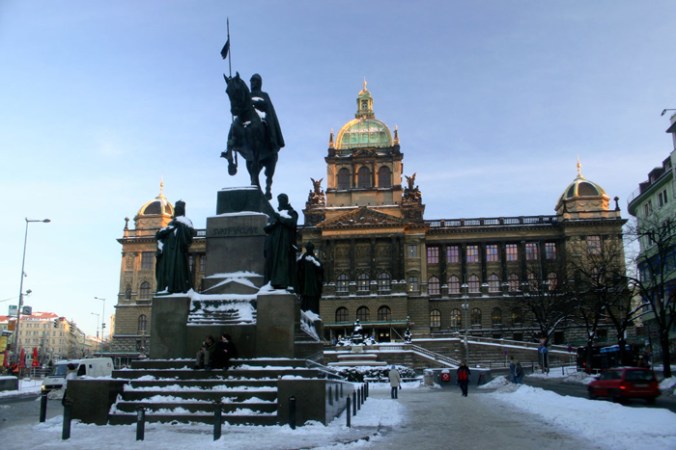
will come to life, raise a sleeping army of knights, and slay all the enemies of the Czechs, thus bringing peace and prosperity to the land.
Why the statue chose to sit out the Soviet invasion of Prague in 1968 has never been explained. I’d think the Czechs would be still a little peeved about it, though.
The carol itself has its puzzles. Why does the king think a poor man who lives by the forest needs wood? Is the main point of the story that he brings food to a poor man, or that he has the brilliant idea of letting his freezing page re-use his foot prints? And why would there be any warmth in the snow?
Nonetheless, the carol does extol kindness and charity. If only it didn’t spoil the ethical exhortation by promising a reward; ethical acts are their own reward. It isn’t altruistic conduct if you expect to benefit personally. As we know, Wenceslas’s rward was to be killed by his brother before he was 30.
Some blessing.
Take it, Bing..
 Ethics Alarms
Merry Christmas, Jack!
Ditto, and thanks so much for taking time out for lunch!
Way to guilt me. I had fully intended on doing an ethical analysis of several Christmas carols- from Deep Theological all the way to the Most Base Secular as a kind of addendum to Penn and my co-comment of the day from a few years ago.
Well done.
Thanks! Now I have to investigate “I saw three ships,” which has never made sense to me…
You’ll make *no sense* of that carol until you investigate the 15th and 16th century “carols” from which it is derived. It bears little semantic similarity to them but plenty of word and phrase matching. The earlier poems do seem to tell a story…
https://www.hymnsandcarolsofchristmas.com/Hymns_and_Carols/i_saw_three_ships.htm
…though one that varies wildly across the source carols.
I used to think the 3 ships were a symbolic reference to the Magi, but apparently not.
With the 3 from earlier poems being a reference either to the Trinity, or three groups of passengers on a single ship (Creation, Angels, Man), to three passengers such as the Archangel Michael, John the Baptist, and Mary, to other clusters of passengers…
Thanks so much for the leg work. That one has bothered me since the third grade.
The part that has bothered me is that the tune “I Saw Three Ships A-Sailing” and “Greensleeves” are essentially the EXACT same tunes…just set to vastly different meters.
And if you want to drive yourself crazy, try to go from one tune to the other deliberately.
How can baby Jesus and Mary be in all three ships?
It’s a miracle! And not to be questioned by mere mortals.
Not sure why we can’t question the writer of an obscure Kentish rendition of the earliest version of that carol when he uses an apparently vague symbol that doesn’t seem mathematically plausible.
By the by, your last two paragraphs aren’t puzzles when viewed poetically. I’ll have more later.
And the final line doesn’t promise material or even tangible reward. Just blessing. And if ethical acts are their own blessing the very last line of the song easily includes that meaning.
http://tvtropes.org/pmwiki/pmwiki.php/Main/NamesToRunAwayFromReallyFast
The carol itself has its puzzles.
“Why does the king think a poor man who lives by the forest needs wood?”
Medieval polity. The forests were ultimately the King’s property and thereby of-limits to any peasant that have not received express license from the King to gather any resources from the forest. However, the peasant was free to gather what he could from the commons and the village where we assume he is a member. King Wenceslaus then, assuming his good subject is loyally adhering to medieval “constitution”, recognizes he can alleviate the man’s misery on this bitterly cold night (we can forgive him his lack of foresight in realizing that Free Market Capitalism would have been a far better solution for both the King AND the peasant…it would be awhile yet)
“Is the main point of the story that he brings food to a poor man, or that he has the brilliant idea of letting his freezing page re-use his foot prints? And why would there be any warmth in the snow?”
Symbolism. There are 3 characters to this story…the page isn’t merely a foil or a prop. Someday, he’ll be a noble himself with vassals himself. Most pages were young children of the King’s vassals assigned to work the royal household and “learn the ropes” so-to-speak.
Not only does the King concern himself with the well-being of his peasant subject, he also must raise up a new generation leaders, who the page represents. In essence the poetry is the King imploring the Page to “follow in his footsteps” and be a benevolent noble someday as well.
Or this analysis could just be a load of straw grasping hogwash.
If I may be so bold as to add a tid-bit to your first paragraph, one of the best possibilities for our phrase “by hook or by crook” also derives from the same wood-gathering “by-laws” that you describe, and the act of another noble king (whose name I believe is lost to posterity). As part of the wood which the villagers and forest-dwellers were allowed to gather was included all the deadwood on the ground, and any dead branches that they could reach in the trees (without leaving the ground). The king I mentioned, in order to enlarge the available supply of fuel to his citizens during the harsh winters, extended the law to include any dead branches they could reach with the aid of their shepherd’s crooks, or reaper’s bill-hooks. The link below isn’t where I first heard this, but it does support the pertinent information. I just thought you might find it an interesting addition. Merry Christmas.
http://www.phrases.org.uk/meanings/by-hook-or-by-crook.html
Very interesting. And I lerv studying languages and etymologies. If you so enjoy geeking out as well, you might enjoy Kevin Stroud’s podcast: History of English.
I do very much. Thank-you for the lead, and have a Merry Christmas.
Kevin Stroud is a lawyer and, though he doesn’t actually explain his motivation for this, I suspect, based on other comments he’s made, that he became interested in this topic when he kept running into what are called “Legal Doublets”. Those are hold-over from England’s awkward bilingual days after the Norman Conquest and the new rulers spoke French while the common people spoke Middle English. To handle contracts, disputes, laws, and criminal charges, the legal system was compelled to use an Anglo-Saxon derived word and a French derived word to ensure any party involved understood exactly what was meant by a term.
From this we get doubles such as:
Aid and Abet
Goods and Chattels
Part and Parcel
Have and Hold
Cease and Desist
Terms and Conditions
Will and Testament
Breaking and Entering
All words that essentially mean (or meant) the same thing, though some over time have developed shades of different meaning.
Another very interesting lead. Thank-you. I’ve already started listening to “The History of English” from the beginning, and after the New Year I hope to be able to pick up my pace on it somewhat (things are just a little hectic at this time of the year). Thanks again, and best wishes for a great New Year.
You too!
And Merry Christmas to you too.
I see I forgot that.
!!!
Any thoughts on my answers to the “puzzles”?
Yes…I like them. Very helpful.
Interestingly enough you put the term “by-laws” in quotations. Yet it is a perfectly apt term to use there. Both components of the compound being given to the English by the Norse only a century or so before the topic of our discussion…
“By” being the ultimate descendent of a Viking word for “farmstead” or “village” which can still be seen in several town names, especially in the Danelaw, for example – Appleby, Witby, Wetherby, etc.
And the Viking word for law which is the direct ancestor of our word for law.
By-laws literally meant “laws of village” in its earliest sense.
Thank-you very much, even more proof that the English language has much more of interest for this 60-year old to discover before giving up on it. Merry Christmas to you.
I think my favorite was Tennessee Ernie Ford’s version, but I can’t find it online.
I heard Tennessee Ernie just yesterday! He and Pat Boone were especially great on Carols, singing them straight and with conviction.
Nice post, Jack. As always, the asides, digressions and historical context are among the best parts. I’m a little reluctant to get into politics and policy, but I guess not sufficiently reluctant.
I attended my friend and piano teacher’s annual Christmas/Winter Solstice concert a few weeks ago at a Church of Christ church. There were a number of felt banners hung around the church interior proclaiming various things. The largest and most prominently displayed, right in the center above the altar, read “Social Justice,” which I found even more remarkable because “Charity” was nowhere to be found.
This may be a curmudgeonly, anti-Dickensian, Scrooge-like thing to say during the holiday season, but I think this is something at the root of much of our current partisan divide in the country. Many people have gotten out of the habit of going to church. Certainly I have. Ironically, the people who look down on church goers have turned to government to do the things churches used to do. Giving to the poor was the main message in the Catholic Church in which I was marinated as a child. Now churches are (for the most part, unless they’re on the right side of history) evil and it is our obligation as taxpayers to give to the poor via taxation and redistribution of wealth to address income inequality. But enforced charity is not charity, nor does it do much for the soul. And simultaneously, churches (evidently at least places like the Church of Christ and the Unitarian Universalists) have gotten heavily into the policy business.
So, I guess, ironically, the government has become the modern American church and some churches seem to want to become helpful quasi-governments. Which I find very confusing. And I suspect I’m not alone. I wish we could go back to governments governing and churches saving souls. Which may explain the HRC defeat/Obama repudiation. When governments get into saving souls and changing people’s minds, we get into problems for non-believers in the wonders of politics and politicians. In any event, it’s a mess.
Cheers.
“But enforced charity is not charity, nor does it do much for the soul. And simultaneously, churches (evidently at least places like the Church of Christ and the Unitarian Universalists) have gotten heavily into the policy business. So, I guess, ironically, the government has become the modern American church and some churches seem to want to become helpful quasi-governments.”
As Dennis Prager characterizes it: Leftism is the fastest and most aggressively growing religion.
Though semi-hyperbolic to call Leftism a religion, it really doesn’t miss the mark in terms of describing Leftism’s trappings.
It’s a major, major goat rodeo, Tex.
Televangelists and Prosperity Gospel preachers now urge the poor to give to the Church, rather than the reverse.
Is this the cause or the effect?
That’s an entirely different topic. That’s churches being run as tax free scams to enrich the “pastors” and their families. Has nothing whatsoever to do with what I’m talking about.
Not sure what point you are trying to make?
Hasty generalization?
Beats me.
Either way, prosperity gospel preachers are a minority despised by the mainstream.
Although said with implied sarcasm tags, this is exactly true, yes.
That’s my point. I disagree with the assertion that prosperity gospel churches are outside the mainstream too. They make up the entirety of Trump’s Evangelical Advisory team, remember? 83% of white evangelicals voted for him.
Now I have to add a disclaimer or clarification, because every single one of the churches my Christian friends belong to genuinely do good works, and even allow unbelievers like myself to contribute to their warchest. We know they target genuine need, and are better able to judge that than we are. None of them would qualify as being “in the mainstream” like Hillsong Ministries though, whose budget is orders of magnitude greater than theirs, and who have representatives in cabinet. None have the faintest shred of political power, and the only influence they have is when getting arrested in protests against human rights abuses.
I face my own ethical dillemma here. A personal one. My son is friends with the son of the head if the Australian Christian Lobby, a virulently anti GLBTI group. I’ve had hearsay evidence regarding their US financial backers, which enabled me to verify links using other methods, and trace the money through the shelf companies offshore.
But that’s fruit of a poisoned tree. To use it would be wrong. Ok, not a dillemma, there’s no real choice is there? Just venting really.
“They make up the entirety of Trump’s Evangelical Advisory team, remember? 83% of white evangelicals voted for him.”
Who wants to play “name that fallacy”?
ZB, do you think it’s healthy to view everything with reference to a single issue?
“And why would there be any warmth in the snow?”
… because it’s a miracle.
AHA!
So the good king knew he was a saint? That’s some hubris. I interpreted the line thus: the trudging of the man through a deep snow would make things easier for the young page, otherwise the leader — that the footprints would be made warmer, more welcoming, as it were, by the man’s larger in”dint”ation. Another sign of Wenceslas’ simple generosity.
Wouldn’t it be hubris to assume he was greater than he was? If he knew he was a saint, then why wouldn’t he use whatever saintly “powers” he had for the benefit of others?
Humility isn’t necessarily saying “oh I’m not that great…” as much as it is “if I have any greatness, let me use it for others before myself”
I’m not sure what you’re objecting to, tex. The statement was made that he had done a miracle by “warming” the footprints. If so, then he knew what he had done and was thus aspiring to sainthood if not believing himself already elevated. Since that did not fit with the interpretation of the “good” king — known for doing good things for the needy, humbling himself, and being blessed (in the song) for so doing, none of which I gainsaid, by the way — I was expressing skepticism at the idea of a miracle being performed. It didn’t matter if the (miracle) statement had been made facetiously, either. It was my jumping off point. Okay? By the way, I can stand by my secular theory without rejecting yours or anyone else’s. In fact, I was set on that practical path by your “following in his footprints” and some of dbp49’s remarks; all fascinating and much appreciated. It is not my area of scholarship either linguistically or historically but, once upon a time, my reading comprehension in Greek was fairly good.
Excellent post … and long one of my favorite carols. It is in a minor key, which may be why it is so infrequently sung. But thanks for this!
I sang that song solo in my grade 3 Christmas concert, and strangely enough, one of the prouder moments of my life. Merry Christmas Mr. Marshall.
Merry Christmas!
Merry Christmas, Jack. Thank you for a post on one of my favorite Christmas songs.
There’s a lovely version on iTunes by the Regency College Choir. I was trying to find a video to post, but there don’t seem to be any.
Merry Christmas, Crella.
Should be a few more Good King Wenceslas’s around who spend their own money ((Not their foundations!!) to help the unfortunate. Maybe Trump will turn out that way let us hope. Btw, I like the Irish Rover’s a lot wild Irishmen that they are.
Speaking of generosity: http://downtrend.com/robertgehl/republicans-most-generous-people-in-the-world-democrats-not-so-much
I used to argue exactly that point – till I realised that “charitable donations,” were mostly tithes to churches. Not all of which was spent on real estate and business jets, or payouts in lawsuits, but at least a substantial proportion was.
I have been unable to determine the exact figures, but for example Focus on the Family, the anti gay group, gets $30 million in “charitable donations” every year, likewise the American Family Association.
Being fair, the LDS is a large proportion, and most of the money they take in really does benefit those in need. And as for the Democrat donations, much goes to the ACLU ($42m) and HRC ($37m) too.
In comparison, Mars Hill Church alone gets $30 million in tithes. Or did before it was wound up amidst court cases over its finances, diverting the $10 million per year it got for its “international fund” into Real Estate in the US.
Again in comparison, Houston Food Bank reticulates $150 million to 500 local organisations providing aid to about a million people. I don’t have any data about proportion of money from D vs R.
Yep. Latter Day Saints. Ten percent of AGI to the church. Explains why Utah is so high.
Nope. The disparity is still very large even in studies that don’t count giving to ANY religious charities (not even ones like Habitat for Humanity or the Salvation Army.) It also extends to time volunteered to secular charities. The fact that the religious tend to give to their churches and religious charities as well is just piling on.
For completeness sake, it’s not only the religious and conservative who give more than liberals; the poor also give more proportionately than the middle class, who in turn give more than the rich. It has often made me wonder if celebrated philanthropists’ giving adds up to the percentage of total wealth that the average joe gives.
Can you at least bust out the stats and sources to put zoebrain’s shibboleth to rest?
Interesting. Thanks Isaac.
I don’t know much about Focus on the Family and their anti-gay activities and how much they spend on these activities. Most of what I’ve read about them is from leftist organizations such as the SPLC which classifies as a “hate group”. Thinking about this in the USA today, the Evangelical Christians, Catholics and the Fundamentalists are still insisting that marriage is between a man and a woman. Ultimately, the states will decide this issue.
Another thing worth considering is the vast amount of money and assistance that conservative Christian groups provide for people in third world countries such as Habitat for Humanity.
” I don’t know much about Focus on the Family and their anti-gay activities and how much they spend on these activities”
84%. The rest on administration and fundraising, they don’t do anything else apart from propaganda radio, leaflets, and political donations. They’re actually financially honest and transparent. I also was using figures they reported to the IRS. Charitywatch puts their 2016 income as $79 million.
SPLC total revenue was $54 million.
Hmmm, Charity Navigator rates them a solid three stars. The highest amount for program expenses is listed as Parenting. The CEO is paid $250.000 which isn’t a lot for an organization that big. I have never heard of Charity Watch so I have no idea how reliable their information is.
“O Holy Night” was an abolitionist anthem in the U.S. I nominate it for “ethical Christmas carol” too. Also, Merry Christmas!
Somebody at the New York Times told the truth: http://mobile.nytimes.com/2008/12/21/opinion/21kristof.html
However, liberals take solace in the fact that the French are much stingier than you!
Merry Christmas, Jack and friends!
Other carols have ethical messages. The final stanza of “God Rest Ye Merry, Gentlemen” exhorts listeners “with true love and brotherhood/each other to embrace”. Fine advice.
My interpretation regarding the wood is the same as texagg04. The snow is warm because Good King Wenceslas’s feet have warmed it up to the very sod. The point is that Good King Wenceslas is good to all his vassals, peasant and page.
The Czechs did not get Václav the Good’s statue during the Prague Spring, but they did get Václav Havel. He helped out with radio narration during the events, and his experiences led to further dissident activities. In a way, he defeated the enemies of the Czechs.
Merry Christmas.
Jack posts about kindness and charity. The regular suspects use it as an excuse to make their usual attacks on their political opponents.
Ghu bless us, everyone.
So what?
I’ve always remembered that song because of a miserable afternoon in elementary school when the whole of Jersey City’s PS25 — its combined chorus — was kept in Assembly for an extra period because the music teacher was unable to identify who was singing the wrong lyrics and no one was willing to tattle on his or her classmate. She and her assistants went through the hundreds of students a singer at a time. One by one, as they uncovered the miscreants, a small row of children grew on stage.The only gaffe of several I recall now is one that was embedded in my brain that day, and the most excusable: “Good King Wences last looked out . . . . ” It was the largest audience of any of the most embarrassing experiences of my life.
Oh, and a very Merry Christmas to you, Jack.