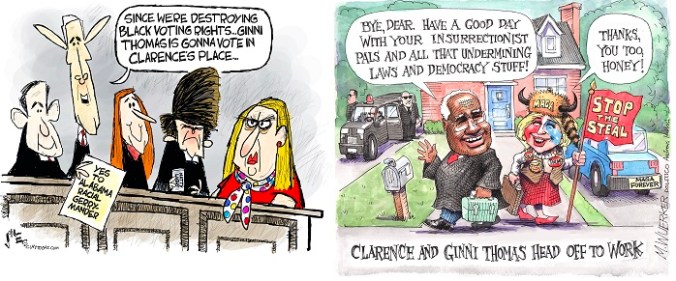
Under normal circumstances—but what is normal any more?—my conclusion regarding whether Clarence Thomas should or should not recuse himself in any cases involving the January 6 riot (which the Washington Post again calls “an insurrection” today)because of his conservative activist wife’s vocal support of vigorous responses by the Trump White House in response to what she felt was a fraudulent 2020 election would follow the same reasoning that my analysis of Justice Scalia’s recusal controversy trod almost exactly 18 years ago. The question then was whether Scalia’s participation in a duck hunt with Vice-president Cheney and his pals created a sufficient conflict of interest to trigger the “appearance of impropriety” standard that is supposed to govern judicial decisions whether to recuse, since Cheney was technically—but only technically—a party to lawsuit that had ended up in the Supreme Court.
Scalia adamantly insisted that there was no conflict and no impropriety, and authored an impressive memorandum to support his position. He indeed judged that case. I wrote in part,
Those who have criticized Scalia for his stance on this controversy have an obligation to read the Justice’s memorandum. They are sure to learn some things, such as why it is unwise to trust media accounts regarding anything more complicated than your typical Sponge Bob Square Pants episode; what constitutes a legally persuasive argument and why even Scalia’s ideological foes admire his sharp intellect and lively writing….
[I make] no pretense of being able to match Justice Scalia’s intellect or knowledge of the law. And he makes one especially chilling point: is appearance of impropriety sufficient to force recusal when that appearance is a false illusion created by inaccurate reporting, sloppy analysis, and misinformed reading of the law? It looked like an easy call based on what appeared in the papers; Scalia’s memorandum is a clarification that shows that his position is not just a product of stubbornness, but of careful scholarship. He wins the debate, hands down.
He should still recuse himself….
Scalia is right: there is the potential here for more than one bad precedent, and justices should not permit themselves to be run out of deliberating on politically sensitive cases by partisan misinformation campaigns. But the damage is done. To most of the public, the raw circumstances of the Scalia-Cheney outing will call Scalia’s impartiality into question, and because it is a high profile case, this will damage the public’s faith in the Supreme Court. It isn’t worth it. Americans, even Americans that don’t comprehend the legal requirements of recusal, need to believe in the integrity of the Supreme Court.
Next, the Court should recognize the new political realities of its role, and devise a review system that would make the whole court the arbiter of whether one of the brethren has a conflict, or an unacceptable appearance of one. Such a system would have made Scalia’s current dilemma less of a lightning rod for criticism.
For now, though, Justice Scalia needs to face facts: he may be right on the law, but he’s a dead man walking.
I like that post a great deal; I think I was right. (I also look wistfully back at the time when I could spend up to a week a week polishing a single post.) The parallels between Justice Thomas’s Left-and-news media contrived conflict is similar to Scalia’s. But if you think that means that I now must side with those who are pushing for Thomas’s recusal, you are wrong. Continue reading