Stephen Sondheim (1930-2021): Integrity Was Everything

Sondheim2

There’s not too much I can add to the many tributes and essays about Stephen Sondheim, who died yesterday at the age of 91, but I feel I owe him a special salute for his ethics. Ethics is not a common trait in theater, or in show business generally. Sondheim, one could argue (and I will) built his career on ethical values.

The Times has three excellent pieces: a front page obituary, a report on a final interview, and an appreciation by critic Jesse Green. I don’t disagree with any of them, nor do I dispute Sondheim’s importance to musical theater and the culture, which justifies his superstar send-off. None of them come right out and say what I believe to be obvious, if inconvenient: for all his influence, Sondheim represented a fascinating, elitist, dead-end for musical theater, which he was determined to elevate whether it was healthy for the genre or not.

Musical theater arose from humble, populist origins like the British music hall, and it was generally accepted to be a way for ordinary people to have a good time without having to think too much. That model served the genre, and the industry, well until Sondheim’s mentor, Oscar Hammerstein II took off from where only scattered experiments like “Lady in the Dark” and “Pal Joey” had previously ventured to bring serious topics and dilemmas into song while still sending the crowd home humming. Sondheim, once he had freed himself from writing words to established composers’ tunes in “West Side Story” and “Gypsy,” deliberately sought darker, more complex stories to musicalize than even Oscar would dare attempt.

Continue reading →

Ethics Leftovers, 11/26/21: “Truth Is Truth!”

Leftover

Oh, yum.

1. The Zenith Of The Great Stupid? At least for stupid apologies: the Women’s March—you know, the groups that gave us Pussy Hats?—-actually tweeted this:

Womens March

Deeply! I guess this means that Women’s March loyalists are expected to berate any merchant whose register come up with a charge that offends. We have offensive numbers now! Is there any point where recruits into Progressive Crazytown stop, listen to what their compatriots are saying (advocating, doing…) and realize, “Oh my God! These people I’ve been taking seriously are lunatics!”

2. In related news, a poll shows President Biden in negative territory in the approval polls of all but six states. I guessed four out of the five: I missed New Jersey, guessing New York instead. The rest, too easy for a quiz, are California, Massachusetts, Maryland, Vermont, and Hawaii. (D.C. is still not a state.) What can any state like about a Presidential performance as miserable as Biden’s so far? What is there to approve of? All I can think of is that they like the fact that he isn’t Donald Trump. Is that enough to approve of someone?

Continue reading →

“The Twelve Lies Of Rittenhouse”

Sadly, this is how my mind works and has always worked, if you can call it “working.” Once I wrote in the previous post that my mention of twelve lies in regard to the Kyle Rittenhouse case suggested a Christmas song parody, I couldn’t get the idea out of my head until I wrote it. Fortunately, there were more than twelve lies to play with, or the challenge would have been impossible.

Here it is; do with it as you choose. The video above is provided so you can sing along: Continue reading →

Take The Ethics Alarms Rittenhouse Case Pledge: “I Vow To Slap Down The False Narrative Whenever I Encounter It, Forever!”

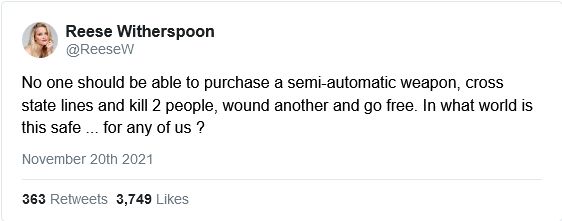
Witherspoon tweet

The five jagged prongs of the fantasy version of the Rittenhouse case are 1) He carried a semi-automatic weapon “across state lines” to cause trouble; 2) the teen is a white supremacist, hence a racist, and was “hunting” virtuous social justice crusaders justly and peacefully protesting ; 3) the three men he shot were innocent victims, and two of them were murdered, 4) the rioting Rittenhouse was opposing was a protest over a white police officer brutally killing an unarmed black man, and 5) the jury’s failure to convict resulted from the inherent racism of the justice system.

Within those prongs are at least (let’s see…) twelve lies that can no longer be excused by confusion over the facts. Nor is it an excuse that someone like Witherspoon has been reading and watching the wrong news reports (as well as getting her political views from within a progressive bubble), because every American knows or should knows that such sources cannot be believed or trusted.

Continue reading →

Post-Thanksgiving L-tryptophan Hangover Open Forum

food hangover puppy

There is absolutely no excuse, none, for readers to not engage in an epic ethics donnybrook in this week’s open forum. What else are you going to do? Watch young men begin their slow descent into premature dementia from successive concussions as thousands cheer? Watch the “Get Back” Beatles documentary? OK, that’s actually a good idea (I watched Part 1 last night), but that still won’t take up the whole day…

Ethics Quiz: Christmas Spirit Meets Hanlon’s Razor

Bad Santa

Your Ethics Alarms ‘Welcome to Pre-Christmas Madness!’ Ethics Quiz:

Was this design malicious or just stupid?

Remember Hanlon’s Razor, so essential to keep firmly in mind during The Great Stupid: “Never attribute to malice that which is adequately explained by stupidity.”

The Complete, Updated Ethics Companion To “Miracle On 34th Street”!

Introduction

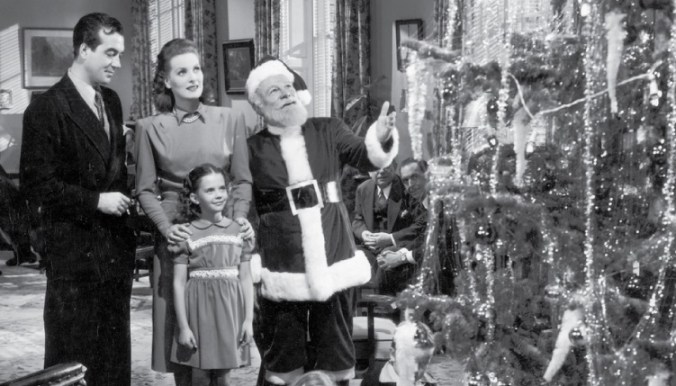
The holiday season traditionally kicks off with Macy’s Thanksgiving Day Parade, and so does this iconic holiday movie. As with most holiday movies, but perhaps more than most, the entire concept of digging into the ethics of the plot of “Miracle on 34th Street”  can be criticized as beside the point. Indeed, this ethics analysis of a classic Chritsmas movie received more flack than the previous two (“White Christmas” and “It’s a Wonderful Life” ) combined. The movie, at least the 1947 original, is a classic; I don’t dispute it. It works dramatically and emotionally, it makes people feel good, and it has held up over time. That’s all a Christmas movie is supposed to do, and if it does it without really making sense or avoiding ethics potholes along the way, so what?

I sympathize with this view. However, our ethical standards and ethics alarms are affected by what we see, hear, like and respond to. If popular holiday movies inject bad ethics habits and rationalizations into our character, especially at a young age, that is something we should at least be aware of by the tenth or eleventh time we watch one of them.

One ethical aspect of “Miracle on 34th Street” that must be flagged at the outset is competence. The film is so effortlessly engrossing and convincing that it is easy to forget how easily it could have failed miserably. Actually, it is also easy to remind oneself: just watch any of the attempts to remake the film. There have been four of these, starring, as Kris Kringle, Thomas Mitchell, Ed Wynn, Sebastian Cabot, and Richard Attenborough. That’s a distinguished crew, to be sure. Mitchell was one of the greatest character actors in Hollywood history. Wynn was nominated for an Academy Award (for “The Diary of Ann Frank”) and Attenborough won one, Best Supporting Actor Award in 1967 for “The Sand Pebbles.” Cabot wasn’t quite in their class, but he was a solid pro, and looked more like Santa Clause than Mitchell,  Wynn, or Richard Attenborough.

None of them, however, were as convincing as Edmund Gwenn. He made many movies—all without a white beard— and had a distinguished career in films and on stage, but even audience members who knew his work had a hard time reminding themselves that he wasn’t Kris Kringle while they watched the movie. I still have a hard time.

The rest of the cast is almost as perfect.  The film is one more example of the special, unappreciated talent of Maureen O’Hara, who never seemed like a movie star, as lovely and strong an on-screen presence as she was. Her ability to anchor great movies while never dominating them is the epitome of the “collaborative art” they always blather about during the Oscars, but which is seldom truly honored. There were Katherine Hepburn movies and Bette Davis movies; there are Meryl Streep movies. Nobody ever talked about Maureen O’Hara movies, just great movies that had Maureen O’Hara essential to making them great. O’Hara was the female lead in four genuine classics: “The Hunchback of Notre Dame,” “The Quite Man,” “How Green Was My Valley,” and “Miracle on 34th Street.” She never won any Academy Awards, nor is she ever named when the greatest Hollywood actresses are named, but how many actresses delivered four classics—not classic performances, but classic films?  Hepburn ties Maureen with four: The Philadelphia Story,” “Bringing Up Baby,” “Adams’s Rib” and “The African Queen.”  Streep maaay be credited with one, if you count “Sophie’s Choice”; personally, I wouldn’t.

“Miracle on 34th Street” is an ethics movie in part because its artists committed to telling a magical story and charming audiences by working as an ensemble selflessly and  efficiently. John Payne, as the idealistic lawyer in love with Maureen, is never flashy, just completely convincing. One reason may be that, as he told an interviewer once, the role of Fred Gaily perfectly matched his own ideals and beliefs. Payne never made another memorable movie in his long career; he was the classic bland, B movie leading man. He made Glenn Ford seem exciting. But he was the perfect choice for this story.  Similarly, there have been more impressive child actresses than young Natalie Wood—Margaret O’Brien, to name one; Dakota Fanning, to name another—but none who was better at simultaneously nailing her scenes while never taking a viewer out of the film by making him think, “Wow, she’s so precocious! I wonder if she’s a midget?”

This is the magic of performing talent: they make audiences suspend disbelief because they seem to believe in the story and characters too. The director,  George Seaton (who also directed “Airport”), not only wrote the script (that won him an Oscar, and deservedly so)  and cast his movie brilliantly, he also made the correct decision to stick with a matter-of-fact, realistic, unadorned style that keeps the story grounded. There are none of the features and gaffes in this film that make other holiday-themed movies inherently unbelievable, like the cheesy battlefield sets in “White Christmas” or the heavenly dialogues in “It’s a Wonderful Life.”

This is why the awful colorized version that Ted Turner inflicted on the world—this was one of the first movies to be subjected to Ted’s “improvement”—was such a disaster. The colored version looks fake, because it is. The original black and white version is set in a mundane, grey world like Doris’s—Maureen’s–view of life itself: no excitement, no romance, no fantasy, just cold, unadorned reality. No heaven, no magic, ghosts, nobody breaking into song and sounding like Bing Crosby. There’s no child’s point of view, like in “A Christmas Story.” No, all of us live in the world we are shown in “Miracle on 34th Street.” We would love the magic to be real, but we don’t believe in it any more.

We want it to be, though—and that’s why this movie works.

Chapter 1.

Meet Kris Kringle

The movie tells us right at the start that 1) the charming old man in the white beard can’t possibly be Santa Claus, and 2) that he’s nuts. That is, he tells adults who are paying attention this as soon as he starts complaining to a New York City storekeeper that his window display has the reindeer mixed up: “You’ve got Cupid where Blitzen should be. And Dasher should be on my right-hand side. And another thing…Donner’s antlers have got four points instead of three!”

Let’s see:

  • No Christmas display has ever distinguished between Santa’s reindeer (except for Rudolph), because the individual reindeer have never had any identifying characteristics in reality or myth. Are we to assume that there are name-tags on the models? If so, why wouldn’t Kris be complaining about the features of all of them, not just “Donner’s” antlers?
  • The names of the reindeer, even if there are flying reindeer, were 100% the invention of the poem “A Visit from St. Nicholas,” or “The Night Before Christmas,” originally published in 1823.  No one has ever claimed that the author had some kind of special info on the actual names of the reindeer when he wrote,

    More rapid than eagles his coursers they came,
    And he whistled, and shouted, and called them by name;

    “Now, DASHER! now, DANCER! now, PRANCER and VIXEN!
    On, COMET! on CUPID! on, DUNDER and BLIXEN!

    …and anyway, if he did, those were their names 120 years before the movie takes place. Nobody has ever claimed the reindeer were immortal, either. I suppose Santa Claus, in a nod to the poem’s popularity (it has been called the most famous poem of all time), could have adopted the practice of always having the reindeer named after the poem’s versions, and when one Vixen dropped of old age, the young reindeer that took her place became the new Vixen.

I suppose.

  • A bigger problem is that the movie’s alleged “St. Nicholas” calls the seventh reindeer “Donner.” It gets confusing here. The original St. Nicholas was Greek, the Christian bishop of Myra, now Demre, in Lycia.  Nicholas gave gifts to the poor, in particular presenting three impoverished daughters of a pious Christian with dowries so that they would not have to become prostitutes.  THAT would be neat poem! Saint Nicholas is buried in Italy. He was later claimed as a patron saint of children (also archers, sailors,  pawnbrokers, and the cities of Amsterdam and Moscow). The name “Santa Claus” is derived from the Netherlands version of St. Nick called Sinterklaas,  or “the Christmas man,” de Kerstman in Dutch. This explains “Dunder and Blixen,” meaning thunder and lightning in Dutch, and the movie later confirms Kris’s Dutch origins. (But why does he speak in a British accent?)

Never mind that: why would he call Dunder “Donner”? The “real” Santa wouldn’t. Though the original version of the poem got the names right (we know it’s Blixen and not “Blitzen” because it rhymes with Vixen), various editors, transcribers and  the author himself kept changing the names in subsequent printings. Dunder became “Donder” and eventually “Donner,” which is a meaningless Anglicizing of “Dunder.”

Santa Clause, aka Sinterklaas,wouldn’t be confused: he named the beasts. He’s correcting the shop-keeper while passing along a misnomer?

Baloney.

Well, enough of that. The next scene shows Kris encountering the Macy’s Thanksgiving Day Parade Santa pre-parade. He instructs him in the use of his whip on the reindeer! In the German Santa mythology, the jolly old elf used the whip on naughty children, but nowadays, using a whip on either kids or reindeer is pretty much excised from Santa’s methods, and should have been in 1947. It’s an unethical image…
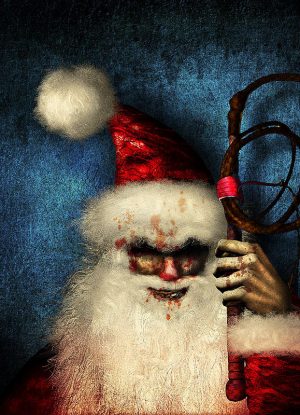
…even though artists have worked hard to confuse us….
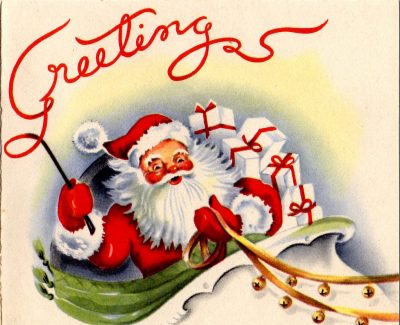
No, an ethical Santa Claus wouldn’t use a whip. He also wouldn’t put a poor old guy with a drinking problem out of work during the holidays, but that’s what Kris does next. He smells liquor on the costumed Santa, and shows no mercy:

“Don’t you realize there are thousands of children… lining the streets waiting to see you… children who have been dreaming of this moment for weeks? You’re a disgrace to the tradition of Christmas… and I refuse to have you malign me in this fashion. Disgusting!”

Then he tracks down Doris Walker, who is in charge of the parade, and gets the man fired. That’s just mean; there’s no way around it. I bet a lot of Macy Santas have had a few nips before and during the parade, and so what? How hard is it to say “Ho Ho Ho”?

Kris manages to get Drunk Santa’s job, having single-handedly gotten him sacked, no pun intended.

Why is Kris, if he’s the real Santa Claus, hanging around New York City and moonlighting in the Macy’s parade when the big night is just around the corner? This is no time for a vacation or boondoggles. If he’s really Santa, he’s goofing off, and he has the gall to tell a temporary parade Santa that he’s risking disappointing children!

Kris is not off to a good start. Continue reading →

Ethics Snacks Between Making The Stuffing And The Traditional Cranberry Salad, 11/24/2021: Trials, Pots, Pariahs And Cheapening Citizenship

stock-photo-cooking-food-vegetable-salad-potato-veggies-thanksgiving-food

Have a wonderful, ethical Thanksgiving tomorrow, everyone!

1. Trials and tribulations: All three of the men involved in the vigilante murder of Ahmaud Arbery were found guilty of murder. Given the facts of the case, I don’t see how, and never could see how, any other result was possible even without the ever-present threat of rioting if even one of the men was acquitted. I also don’t understand why the defense lawyers couldn’t talk the men into pleading guilty. Maybe they tried. It is unethical for a lawyer to pressure a client into pleading guilty, so the “You can plead guilty or find yourself another lawyer” tactic is sanctionable.

The Post story includes this passage:

For many, the trial took on even more weight after the acquittal last week of Kyle Rittenhouse. The White teenager successfully argued that he shot three people — killing two — in self-defense, after driving to Kenosha, Wis., to help protect businesses and property when protests over the police shooting of a Black man turned violent.

“Many” ignoramuses. perhaps? There is no legitimate comparison between the two cases, and anyone who claims there is has slapped a neon-bright “I don’t know what I’m talking about” sticker on his or her forehead.

2. More trials and tribulations. I don’t understand this one at all. Jurors found organizers of the “Unite the Right” rally in Charlottesville, Virginia in 2017 liable under state law for the injuries to counter protesters when the two groups clashed and a riot ensued The defendants were hit with more than $25 million in damages. The rally had a permit, the counter-protesters did not. The authorities did not adequately protect the “Unite the Right” marchers or do enough to keep the groups apart.

A rogue demonstrator, James Fields, used his car to kill counter-protestor Heather Heyer, 32, and is serving a life sentence for the crime. Yet the group, which was marching legally, is somehow liable for what he did. As far as I can see, the jury’s decision was based on the theory that the organizers’ rhetoric around the march was “hate speech” and that they should have known that it would incite violence.

The organizers’ rhetoric around the march was protected political speech, and this case is punishing ideas and words that the jury doesn’t like. It’s a dangerous, terrible precedent resulting from a political show trial, and should be overturned on appeal. (Read Simple Justice’s commentary here.) [Pointer: johnberger2013]

Continue reading →

The New York Times Has An Outbreak Of Integrity In The Midst Of Its Progressive Bias Fever!

books

The Times has compiled its list of the “best books of the last 125 years” as part of the celebration of the 125th anniversary of its Book Review Sunday supplement. Readers are invited to vote for their favorite on the list of twenty-five.

Here is the list:

Continue reading →

Thanks, Professor: We Needed That

Professor Ronald S. Sullivan, Jr. is criminal law specialist who trains Harvard Law students and practices law. He has just issued a superb explanation and analysis of the Kyle Rittenhouse verdict—fair, objective, and best of all, readable by those whose eyes usually glaze over at legal scholarship.

It should, in a just and sane society, permanently shut up—embarrass, even— the politicians, celebrities, and social media dolts who are still calling the jury’s verdict “racist” or an indictment of the legal system. Of course, it won’t. If there is a more annoying example of people loudly braying uninformed opinions about a technically complex matter that they know little or nothing about, I can’t think of it right now.

On “The View,” ABC’s depressingly popular “gullible idiots watching progressive idiots” news show, panel leader Whoopi Goldberg (because in the land of the blind…well, you know the metaphor), declared that Rittenhouse was a murderer. People will take that as authority, you know. She played a video of Anthony Huber’s father on CNN holding an urn containing his son’s ashes and emoting bitterly against Rittenhouse going free, as if the lament of a parent in such situations ever is anything but an irrelevant appeal to emotion. Then, armed with this irrefutable “evidence,” Whoopi gave her verdict on Rittenhouse, saying of Huber (who was shot while beating the teen with a skateboard), “He saw someone get shot. He thought he was doing the right thing. So … even all the excuses in the world does not change the fact that three people got shot. Two people were murdered. To me it’s murder. I’m sorry.”

I’m sorry too, Whoopi. I’m sorry you lack the sense of responsibility to keep your opinions on issues you don’t have the knowledge and background to understand to yourself, and instead wield them to make the public stupid. I’m sorry you believe “thinking you are doing the right thing” is ever a justification for doing the wrong thing (and you don’t believe that yourself: were the men who lynched Emmett Till blameless because they thought they were doing the right thing?). You have no way of knowing what Huber thought anyway. I’m sorry you are so ignorant that you can say something like “if he shot them and they died, then he’s a murderer,” which is redolent of your failure to take the initiative over the years to fill the gaps in your high school dropout education. Mostly I’m sorry that you’re not getting enough work as an actress and comic, both occupations you’re brilliantly qualified to do, so you’re stuck with being an incompetent pundit for a living.

Continue reading →