Sunday Ethics Shots, 7/11/2021: A Rescue, Larry Vaughn In Tokyo, Joe Trippi Trips, And “La Bamba” Meets Calvinball

Alexander Hamilton died on this date in 1804, in a bizarre episode in U.S. history with profound ethical and political implications. There Aaron Burr fatally shot dead the nation’s first Secretary of the Treasury and essential political thinker in an illegal duel at Weehawken, New Jersey. It was, of course, unethical to break the law, especially for these two men, who qualified as national leaders. Hamilton’s son had died defending his father’s honor in 1801 at the exact same spot (What was Alexander thinking?)

According to Hamilton’s “second,” Hamilton deliberately fired his weapon into the air rather than at Burr, a gentlemanly gesture and also a profoundly stupid one, if Hamilton believed half the things he had said and written about Burr’s character for years. This was why they were dueling, after all. Burr’s second claimed that Hamilton fired at Burr and missed, and the more I’ve thought abut this, the more I’ve come to believe that this is the more likely scenario. Hamilton was anything but naive, reckless or stupid. Yes, he was a crack shot, but anyone can miss. Even if the gesture of “throwing away his shot” as “Hamilton” puts it, would have impressed some adversaries and been seen as a display of mercy and an offer of reconciliation, it made no sense at all with this adversary. Moreover, Hamilton considered Burr a threat to the nation—he was right about that—why wouldn’t he shoot him? Whatever really happened, Burr, who had the second shot, killed Hamilton with a ball that went through his stomach into his spine. Hamilton died the next day.

This ended Burr’s political career: Would killing Burr have ended Hamilton’s? Probably, but Burr was the one who had issued the challenge. Maybe Hamilton would have been excused by the public. Maybe he would have ultimately become President; all the Founders of his magnitude except Ben Franklin did. For good or ill, Alexander Hamilton would have been a strong and probably transformative leader. But if he hadn’t died at Weehawken, it’s unlikely that we would have “Hamilton” the musical….

1. Baseball, hotdogs, and a bystander hero. Dr. Willie Ross, the father of Washington Nationals pitcher Joe Ross, saved the life of a choking fan midway through yesterday 10-4 Giants win over Washington at Oracle Park in San Francisco. Ross saw that a female spectator was choking, and when Ross came over to her seat to check on her, she couldn’t talk. Ross helped dislodge two pieces of a hot dog by using the Heimlich maneuver, then reached into her throat to take out the third and final piece. The woman, who is a nurse, could breath and speak at last. Ross received a standing ovation from nearby fans.

Continue reading →

Verdict: Feminists And Lesbians Need To Find Better Role Models And Heroes

Violette Morris

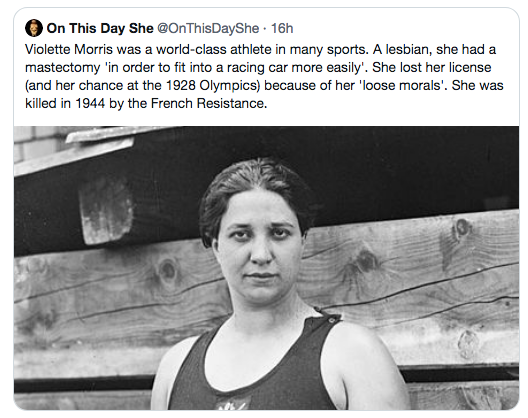
“On This Day She” is a book published this year dedicated to “the women whom [sic] time has forgotten; those who didn’t make it into the history books and those whom [sic] society failed to uphold as significant figures in their own right.” There is also a website following through on the premise of the book (and promoting it), from whence the misleading tweet above emanated. Though the book does admit to including women who engaged in “the bad” and who it deems unjustly ignored by history, the tweet above undercuts that admission. The hint is in the last sentence. Why was Morris killed by the French Resistance in 1944?

She was a Nazi, that’s why, and a traitor as well. Morris, a French citizen, sourced black-market petrol for the Nazis, ran a garage for the Luftwaffe, and drove for the Nazi and Vichy hierarchy. After Germany took over France, she worked to foil the operations of the Special Operations Executive, an English organization that aided the Resistance. Claims that she also engaged in spying activities and Nazi torture are disputed, but never mind: what she did do was sufficient to have her known as “The Hyena of the Gestapo” and sentenced to death in absentia. She was ultimately shot and killed—assassinated, to be technical— when her car was ambushed by the Resistance.

Good.

Continue reading →

And The July 5 Comment Of The Day Trifecta Concludes With Arthur In Maine’s Delicious Analysis of “Your 4th Of July Ethics Quiz: Food Racism?”

鮟肝

Finally, in the last of today’s opening trio of outstanding and varied Comments of the Day, Arthur in Maine, whom I did not know until this comment was a former chef, whips up a filling and pleasurable examination of of the issues raised in “Your 4th Of July Ethics Quiz: Food Racism?”...

There’s no longer any doubt in my mind: people are actively looking for ways to be offended. In the case of BLM, for example, the belief is clearly simple-minded rage at the rank-and-file level, but among those further up the chain it’s obviously about power and the grift. Calibrate your outrage correctly, and one can lead quite a handsome life.

Racism (and its first cousins misogyny and homophobia) is the perfect charge to level to achieve this (lucky souls like Lori Lightfoot can, and do, score the trifecta by claiming all three).

As a recovering professional chef (I haven’t lifted a pan for a paycheck in more than 30 years, and still miss it almost every day) I can tell you that serious pro cooks may be able to wow you with the complexity of their offerings. But the foods most of them prefer to eat generally trace back to poverty foods – those developed in poor cultures, where most people ate what the rich folk wouldn’t.

Most Americans, regardless of when or how their ancestors first showed up, simply don’t understand that in most other parts of the world NOTHING goes to waste. We give our scraps to cats and dogs. But very few other places do that. Thus, it’s little wonder that someone figured out a way to make duck feet in a way that actually tastes good. For the record, I would order those in a heartbeat, with full knowledge, just to try them! But in a place like China centuries ago, wasting protein like that was unthinkable, so you did what you could to make them tasty and that’s what’s for supper.

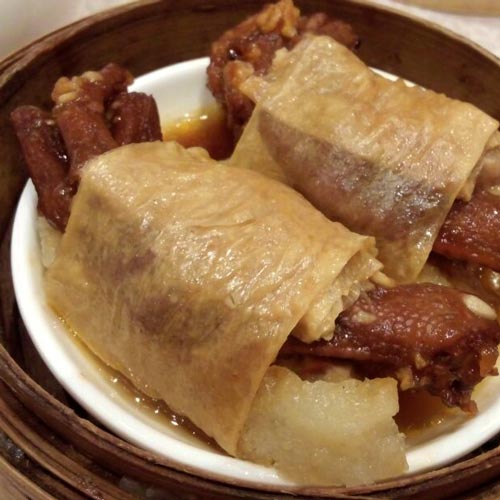
This doesn’t mean I like everything – not by a long shot. I find tripe revolting, and it’s extremely popular in first-world France. As a true afficionado of sushi, I’ll try anything – and just about the only thing I’ve ever been horribly disappointed in at a great sushi bar was ankimo – which is steamed monkfish liver. [Above] It was described to me as the “foie gras of Japan,” and I can see why. But it was still vile. I like foie gras, but not when it’s overlayed with the aroma of a cod-liver-oil-based ointment my mother used to use on us when we were small.

Some cultures happily eat grubs – no thank you. Others eat various insects; again, I’ll pass, but you’re welcome to my helping. The fact is that every culture has its culinary oddities and we’ve all got different tastes. This doesn’t mean our distaste for something is racist. It merely means that it’s so far outside of our culinary comfort zones that we just can’t get our heads around the idea. Many cultures find the American fondness for huge slabs of meat served up with starch baffling, for a variety of reasons.

This, by the way, extends beyond ingredients. There are those only too happy to make accusations of “cultural appropriation” when it comes to food. It is not. When I cook Chinese or Thai or Indian or Mexican food, I do so as a student, not as an appropriator. I do it because I’ve had the good fortune to taste these wonderful cuisines done properly. I want to understand how they’re done, partly because cooking professionally makes you fascinated by differing techniques and ingredients, and partly because I love to eat them and access to these foods locally, prepared by those from that region, is sharply limited. In the case of Chinese, especially, Chinese-American food has been so heavily adapted to North American tastes that it bears little resemblance to the real thing – and almost all of the adaptation has been done by Chinese cooks and restaurant owners. I really want to try the real thing.

Far as I’m concerned, when I make up a dinner of low-country shrimp and grits, the last thing on my mind is contempt for the poor Blacks for whom this was subsistence food. Rather, I’m thinking “this is absolutely ingenious. They took cheap stuff (grits) and free stuff (shrimp) and whatever else they had lying around and made it transcendent!” For me to cook it is not appropriation – it is the deepest possible respect.

I could make a similar argument with music, but I think you folks get my drift. This is “The Great Stupid” and “A Nation of Assholes,” to use Jack’s terms, colliding head-on to form a Great Nation of Stupid Assholes. We’d better come up with a way to pull out of this dive, and quickly.

Your 4th Of July Ethics Quiz: Food Racism?

duck_leg_wrap

Let’s play the ever more popular quiz show, ” Is It Racist?”!

Today’s topic: Late-night television host James Corden has long featured on his show a food-centered “Truth or Dare” variation called “Spill Your Guts or Fill Your Guts.” Celebrities choose to either answer personal questions or take a bite of a food that most viewers would deem nauseating or not properly food at all. Recently the cherubic British comic employed a table in the bit filled with Asian delicacies like chicken feet, pig’s blood and thousand-year eggs.

That was too much for the online outrage squad, apparently. An online petition condemning Corden’s use of Asian foods as disgusting has attracted than 46,000 signatories. The premise is that making fun of Asian food is racist.

Kim Saira, 24, a Los Angeles activist who organized the petition, told an interviewer, “James Corden is a white person and is actively using ingredients from Asian cultures and profiting from it and showing it in such a negative light. There’s a way to not like foods and still be respectful about it.”

The New York Times interviewed Lok Siu, an associate professor in the Department of Ethnic Studies at the University of California, Berkeley who agreed that Corden’s joke is indeed racist because it disrespects people’s cultures. The choice of Asian foods to highlight as disgusting to typical Americans makes Asian Americans feel more vulnerable or marginalized.

Really, Professor?

Oh yes indeed! “You use food as a metaphor to describe that distance, the kind of strangeness between a group of people that you don’t understand and their habits, the way they’re eating, the smell that comes with the spices,” she said. “There’s something around the way we discuss food, the way we think about food in our acceptance or rejection of it, it’s a rejection of a culture and the people that’s associated with it.” Siu regards the food as a metaphor for Asians not qualifying as “normal.”

Continue reading →

America Last: Good News And Bad News At The Same Time

Reuters-Survey-Trust-In-Media-June-2021

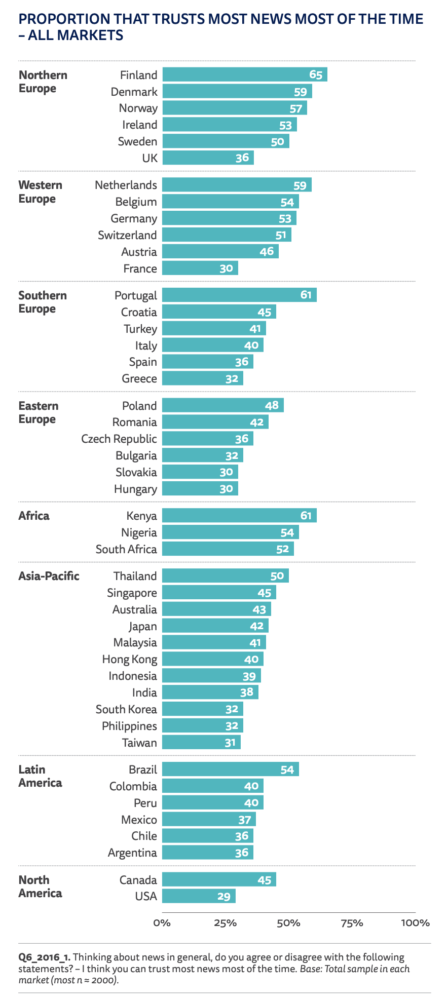
As you can see in the chart above, a report released by the Reuters Institute for the Study of Journalism at Oxford and the University of Oxford found that out of 46 nations surveyed the US public ranks last in its trust of the news media at 29%. The study surveyed 92,000 news consumers in those countries. Finland finished first with a trust rate of 65%.

I doubt that Finland’s journalists deserve that much more trust, which is one reason the report is good news for the United States. I think it is highly likely that the journalists everywhere else suffer from the same arrogance, relative lack of intellectual depth, and hive-mind leanings as U.S. journalists. I think that the U.S. public’s lack of trust shows growing and essential understanding of the true nature of what has become a corrupt and dangerous false profession that does not serve the interests of the people as it is pledged to according to journalistic ethics, but its own. Nor do I believe the U.S. has the worst and most unethical journalists in the world—far from it, I suspect. The U.S. has the journalists with the most freedom, making it especially easy to do their job as dishonestly as they do; yet unlike in many of those nations, their government isn’t forcing American journalists to substitute spin, distortion and propaganda for the truth.

The U.S. public has, finally, had its blinders ripped off, and is no longer under the delusion that they are being informed by altruistic and dedicated pros who only seek to reveal the facts necessary for us to live our lives as we choose to. Knowledge is power, and while our news media is wielding their control over knowledge to transfer power to their political allies, the public, at least most of it, has acquired crucial knowledge to neutralize it: the knowledge that that are not trustworthy.

Unfortunately, the bad news aspect of the study’s finding is arguably worse than the good news is encouraging. Democracy cannot function without a trustworthy news media, or as the Founders called it, “press.” Journalism rot is an existential threat.

Continue reading →

Satire Ethics: Carrying A Joke Too Far

Unethical!

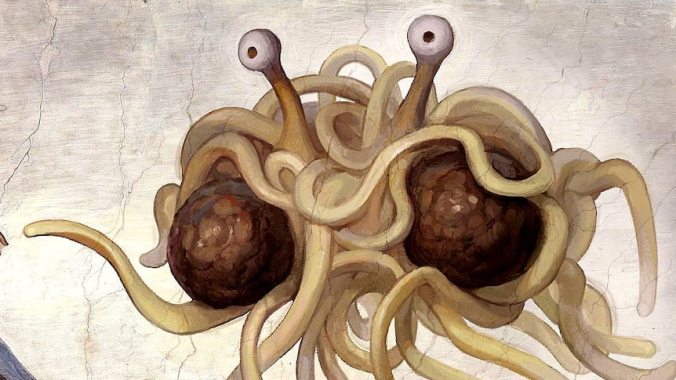
The Church of the Flying Spaghetti Monster’s Australian wing applied to be formally recognized as anon-profit charitable entity, but was rejected on the grounds that the purported religion is nothing more than a “hoax.” Ya think? This is the deliberately ridiculous parody religion devised to mock all organized religions and those who believe in them. Pastafarians, as “believers” call themselves, have extended a gag web post ridiculing the logic of every other religion to the point of diminishing returns. Its “heaven” has a Stripper Factory and a Beer Volcano; its argument for the existence of the deity with noodely appendages involves the world distribution of pirates. Very funny. Now stop wasting everyone’s time. Ethics Alarms discussed two abuses of process by Pastafarians here and here, but as with the career of Jimmy Kimmel and the persistence of tofu, I assumed that this joke would have run its course by now. Sadly, no.

Adelaide, Australia’s Tanya Watkins is a self-described “captain” of the church (like on a pirate ship, see) , has made repeated attempts to have the “church” be granted incorporated association status. After her latest attempt was scoffed at by the Corporate Affairs Commission, Watkins sought a review by the South Australian Civil and Administrative Tribunal (SACAT), claiming the movement was formed for a “religious, educational, charitable or benevolent purpose”, thereby meeting the criteria of South Australia’s Associations Incorporation Act.

Hilarious! She should be fined.

Continue reading →

Saturday Night Ethics Fever, 6/12/21: Cruel World Edition [Corrected]

John-Travolta-Saturday-Night-Fever

1. Cruel reality. You know, I’m starting to feel less and less sorry for Merrick Garland. The man who should have been confirmed as a member of the Supreme Court has revealed himself as an ultra-political and partisan Attorney General. His latest is to darkly hint of scrutinizing “post-election audits to ensure they abide by federal statutory requirements to protect election records and avoid the intimidation of voters.” He wrote in part,

“As part of its mission to protect the right to vote, the Justice Department will, of course, do everything in its power to prevent election fraud and, if found, to vigorously prosecute it. But many of the justifications proffered in support of these post-election audits and restrictions on voting have relied on assertions of material vote fraud in the 2020 election that have been refuted by law enforcement and intelligence agencies of both this Administration and the previous one, as well as by every court — federal and state — that has considered them.”

That’s simply a lie. The claims have not been “refuted,” nor has the Federal government shown sufficient curiosity about “election fraud” to investige any of the many suspicious events related to mail-in ballots counted in Democratic strongholds in closely contested states.

Republicans take this as a veiled threat to interfere with the limited audits taking place in Arizona and Georgia. Arizona state Senator Wendy Rogers (R) minced no words in her response to the almost-SCOTUS justice, saying in part,

“You will not touch Arizona ballots or machines unless you want to spend time in an Arizona prison….The free state of Arizona will not tolerate this federal meddling. If Attorney General Merrick Garland thinks he has a right to our ballots and machines he should go to court. If he uses force when multiple courts have already authorized this audit he will be in violation of the law.”

Translation: “Bite me.”

I approve.

Continue reading →

Comment Of The Day: “Casting Ethics: ‘Anne Boleyn’ And Discriminatory Double Standards”

Oh, I just love this Comment of the Day by Curmie, who was AWOL from the ethics comment wars for far too long, and whose return recently has made my heart soar like a hawk. I love it for many reasons, including, of course, the fact that it is well written and enlightening, far more so than my post that prompted it, which focused narrowly on the double standard of applauding the having a performer of one race portray another, but only when it’s the “right” races involved.

As with my posts about ethics issues in another lifetime passion, baseball, I know that many readers nod off when the framework is theater. But the conceit of Ethics Alarms is that the ethics issues and process of analysis are often universal regardless of where the dilemmas and conflicts pop up. As it happens, baseball and theater happen to be two realms that I know a lot about.

But not as much as Curmie, at least as far as theater is concerned. I had hoped that he would weigh in on the casting of a black actress as Anne Boleyn, and he did.

Here is Curmie’s Comment of the Day on the post, Casting Ethics: “Anne Boleyn” And Discriminatory Double Standards.

***

Literally two minutes after reading this post, I saw that Katori Hall had been awarded the Pulitzer Prize for Drama for her play The Hot Wing King. I don’t know the play—its Off-Broadway run was cut short by COVID, and as far as I can tell it hasn’t been published.

I do, however, recognize her name as the playwright of The Mountaintop, in which the two characters are Martin Luther King, Jr. and an employee of the Memphis hotel in which he is spending what he doesn’t know is his last night on earth. (Spoiler alert: she’s really an angel preparing him for what is to come.) It is a good, borderline great, play: by turns moving, humorous, and incisive. But what comes immediately to mind is the production by a student group at Kent State University, in which a white actor was cast as King. The director, of course, claimed the casting decision wasn’t a gimmick. (Newsflash: it was a gimmick.)

The original idea was to alternate the role between a white and a black actor to be, in the director’s words, “a true exploration of King’s wish that we all be judged by the content of our character and not the color of our skin.” The black actor had to drop out of the production, and the white one played the role throughout the run.

Continue reading →

Friday Ethics Dry-Off, 6/11/2021: Apple Pie, The Duke, “Lillibet,” The “Only If You’re The Right Kind Of Black Caucus” And Shut Up, Donald

It’s raining like crazy here, so…

1. And now for something completely stupid…Poe’s Law is getting a workout as The Great Stupid heads into its final stage, and I have to discipline myself not to write about too many episodes like this one, which once would have been regarded as parody because it would have been parody. Raj Patel, an apparent communist, explains in this unhinged piece by The Guardian about “food injustice,” that the apple pie is a symbol of American imperialism and white supremacy, like this…

“Not that apples are particularly American….Apples traveled to the western hemisphere with Spanish colonists in the 1500s in what.. is now better understood as a vast and ongoing genocide of Indigenous people….

Not that the recipe for apple pie is uniquely American….By the time the English colonized the new world, apple trees had become markers of civilization, which is to say property….John Chapman, better known as Johnny Appleseed, took these markers of colonized property to the frontiers of US expansion where his trees stood as symbols that Indigenous communities had been extirpated.…

Not that the gingham on which our apple pie rests is uniquely American….this war capitalism enslaved and committed acts of genocide against millions of Indigenous people in North America, and millions of Africans and their descendants through the transatlantic slave trade. In the process, cotton laid the basis of finance, police and government that made the United States.

Since this is quite a lot to acknowledge, it is easier to misremember. In the drama of nationalist culture, the bloody and international origins of the apple pie are subject to a collective amnesia.“

This, though extreme, is the weaponization of the cognitive dissonance scale that has become a prime part of the strategy to unmake the United States, cancel its freedoms, and turn its values inside out. Consistent with Critical Race Theory, literally everything in our culture, including the best and most innocent of it, must be traced to something evil.

Even apple pie. Conservative websites are having fun mocking this article. They are foolish. Patel is deadly serious, and our children will be taught this perspective unless there is relentless resistance.

2. John Wayne died on this date in 1979. “The Duke” had the biggest impact on American culture and ethics of any performer; there really isn’t anyone close. And it was a positive impact; John Wayne (really Marion Morrison) the man is an interesting subject, but what mattered was his art. He dedicated his career to portraying the independent American male individualist with all his virtues and flaws, aided by some of the greatest film-makers in Hollywood history, notably John Ford and Howard Hawks. Even before Hollywood took its disastrous turn to the hard Left, Wayne suffered because of the enmity liberals and the academic elite held (and hold) toward the core American values that Wayne’s characters, often incompletely, tried to embody. Pauline Kael, much idolized as a film critic (I detested her), refused to do anything but ridicule Wayne’s performances out of pure political bias. For me, especially as I became more experienced as a stage director, Wayne’s acting impressed me more the more I watched him, and I have watched him more than I have watched anyone.

There has been an effort of late to “cancel” the Duke, but they’ll have more luck with apple pie. The John Wayne character remains strong, inspiring, and complex. Over 40 years after his death, Wayne’s movies are still featured on TV regularly; no actor made more great ones, and the good ones are still entertaining. My favorites? “Stagecoach” (of course), “Red River,” “Rio Bravo”, “She Wore A Yellow Ribbon,” “The Searchers,” “Hondo,” “True Grit”, “The Quiet Man,” and “The Man Who Shot Liberty Valence,” with Hawks’ “Hatari!” as a special guilty pleasure.

I miss him. America misses him.

Continue reading →

Ethics Observations On The Naomi Osaka Affair [Corrected]

Osaka2

On Ethics Alarms yesterday, the controversy involving the current top female pro tennis star, Japan’s Naomi Osaka, was relegated to the morning warm-up rather than a stand-alone post. If you were not following EA yesterday, here’s a quick summary:

Citing her annoyance with repetitious questions from the news media that undermined her confidence, the 23-year old announced that she would violate the 2021 official Grand Slam rulebook, which requires players to participate in post-match news conferences. Violations result in fines of up to $20,000, but since Osaka made over 55 million dollars last year alone, more than all but the most elite U.S. professional athletes, this fine would be like a late fee at the library to normal people. I wrote in part,

“This is literally an example of a star announcing that rules are for lesser mortals. Verdict: Ethics Dunce. The reason Osaka makes so much money is that athletes are paid heroes and entertainers, and submitting to the idiocy of reporters is part of their job. Fines obviously aren’t enough: a tennis player who refuses to fulfill her obligations to the sport should be banned from competing until she does.“

Yesterday, after winning her first round match at the French Open, Osaka was fined (but only $15,000), and tennis officials proved that they read Ethics Alarms (I jest) and told Osaka that continuing her boycott of the media would result in her being suspended from the current tournament and others. Good. The organization had no other choice, unless it wanted to directly endorse the King’s Pass (Rationalization #11). If Osaka was allowed to snub the media with minimal consequences (for her), then no other player would feel obligated to cooperate either. Rennae Stubbs, a former player who is now a coach and ESPN analyst, stated the obvious while most of the players and former players were expressing sympathy for Osaka: “You cannot allow a player to have an unfair advantage by not doing post-match press. It’s time consuming, so if one player is not doing that and others are, that is not equal.”

Continue reading →