“White Christmas” Ethics

White-Christmas

I just completed my obligatory annual viewing of “White Christmas,” one of the stranger members of the Yuletide Movie Pantheon. Yes, I still get a lump in my throat when the old general, played by Dean Jagger, gets saluted by his reunited army unit, which has gathered at his struggling, snowless, Vermont inn on Christmas Eve to remind him that he is still remembered and loved. Nonetheless, it is by far the strangest of the Christmas movies, and also the most unethical. Though everything works out in the end, the characters in the rather sloppy plot spend the whole movie lying, extorting, betraying, manipulating and generally mistreating each other, always with no recriminations at all, and usually with no consequences either.

The movie starts out with guilt extortion, as army private Phil Davis (Danny Kaye) rescues his smooth-singing captain, Bob Wallace (Bing Crosby) from being crushed by a falling wall in a World War II bombing raid, and then uses Wallace’s debt of gratitude to coerce him into accepting the aspiring comic as a partner in Wallace’s already successful civilian act.  This is obviously unfair and coercive, but Bing accepts the ploy with good spirits, and the next thing we see is the new team of Wallace and Davis knocking ’em dead and rising in the ranks of stage stars. Now they have a show on Broadway, and as a favor to a mutual army buddy, they agree to watch the boonies nightclub act of “The Haynes Sisters” (Rosemary Clooney and Vera-Ellen, of wasp-waist fame). Bing is immediately smitten with older sister Rosemary, but there is a tiff over the fact that younger sister Judy fooled them into seeing their act: she, not her brother, had sent the letter asking for a “favor.” This is the first revealed of many lies woven into the script. Continue reading →

Ethics Dunce: Matt Lauer

It's lucky you're dead, Dave, because this would kill you...

It’s lucky you’re dead, Dave, because this would kill you…

Matt Lauer, as the primary host of the “Today” show, reigns where once distinguished journalists and professionals like Dave Garroway, Bryant Gumble, Tom Brokaw and Frank McGee made the show a morning oasis of news and pleasant banter. Yesterday Lauer, who has already revealed himself beyond any reasonable argument as a hack (yes, “Today” has had other hacks), showed himself to be an unmannerly creep as well. Continue reading →

Of Course Barry Bonds Doesn’t Belong In The Hall Of Fame

Buy a ticket, Barry.

Buy a ticket, Barry.

A full complement of baseball’s steroid class is among the 37 players on the 2013 Hall of Fame ballot, so it was predictable that a new round of arguments would surface claiming that it is unfair, illogical, inconsistent or otherwise unseemly to exclude Barry Bonds and others from enshrinement. Predictable but frustrating: the arguments in favor of Bonds are arguments against maintaining ethical values, in baseball, sports, and American society.  It is also an annoying debate to engage in, and I have been engaging in it in various forms for many years, because Bonds’ defenders typically represent themselves as modern, reasonable, and realistic, while anyone making the quaint argument that cheating on a grand scale should earn shame rather than honors is mocked as judgmental, sanctimonious and naïve.  As ever, I am a glutton for punishment, and since otherwise wise and perceptive commentators like NBC Sports’ Craig Calcaterra choose to ally themselves with Bonds, I really am obligated to point out what a corrupt, illogical and unethical position it is.  If I and people like me don’t persist in this, we’ll have cheating approved as a cultural norm before we know what hit us.

Calcaterra has been supporting Bonds as a Hall of Fame candidate for a while now, but the title of his latest essay, “It’s Lunacy To Keep Barry Bonds and Roger Clemens Out of the Hall of Fame” is a gauntlet that begs to be picked up.  “Bonds and Clemens,” Craig writes, “ are two players who, in a just world, would be unanimous selections for induction…”  I find this an indefensible, even shocking, statement, both before and after the writer attempts to defend it. In a just world, a member of a profession who achieved his prominence in part by breaking the law and the rules, as well as lying about it, should be accorded the highest honor that profession has!  What an astounding point of view.

For simplicity’s sake, I’m going to leave Clemens out of this, in part because I can see a Hall of Fame voter credibly deciding that there isn’t enough evidence to conclude that The Rocket really did use performance enhancing drugs on the way to forging one of the top five pitching careers of all time, and in part because I suspect Craig of pairing Bonds and Clemens to make his various rationalizations more pallatable than they would be in defense of Bonds alone.  Belief in Roger’s steroid cheating rests entirely on the testimony of a proven liar and slime-ball, his former trainer. MLB’s Mitchell Report sided with the trainer, and I’m inclined to as well, but Clemens’ unfitness for the Hall of Fame, unlike Bonds (and Mark McGwire, Rafael Palmeiro, and some others), is not an open-and-shut case.

I give credit to Craig for not raising my least favorite of the Bonds defenses, that he has to be regarded as innocent because he has not been “proven guilty.” Calcaterra is a lawyer, and he understands the over-use and misuse of that cliché, as well as how it only applies when “guilty” means “you’re going to jail.” Indeed, he begins by conceding the obvious, that the evidence that Barry Bonds used steroids is overwhelming, which it is.

His first argument, however, is terrible. Under the ironic heading “Baseball Bonafides,” Calcaterra begins by reciting Bonds’ (and Clemens’) impressive list of achievements, which taken at face value show Barry Bonds to be one the best of the best, not just a qualified Hall of Fame baseball player, but an epitome of a Hall of Fame player along with such legends as Babe Ruth, Walter Johnson , Ted Williams and Willie Mays. “Put simply,” Craig says in conclusion, Bonds is an “immortal.” But he’s not-–not if he cheated, not if he achieved his historic status by corrupting his sport and lying to team mates and fans. And, as Calcaterra admits at the outset, this he did. As a result, the fact that Bonds won a record seven Most Valuable Player Awards is irrelevant. He cheated to win some of those awards. He gets no credit for them.  In Bonds’s case, “baseball bonafides” are not bona fide at all. Continue reading →

I’ve Always Said, If You Want To Know The Values of America, You Have To Watch “Family Feud”

Somehow I missed this significant moment, from 2011.

The clip doesn’t show it, I but I’m guessing “STDs” scored higher in the survey than either answer given.

<sigh>

___________________________

Pointer: Jo Ursini (Thanks, Jo!)

Football Fashion, Ethics, and Our Wasteful Consumption

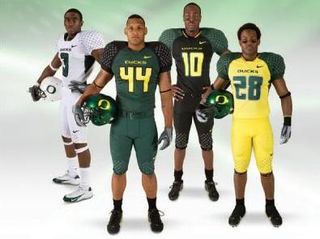
The many fashion choices of the Oregon Ducks...and children are starving in Appalachia.

The many fashion choices of the Oregon Ducks…and children are starving in Appalachia.

On his excellent ethics blog, the Ethics Sage, a.k.a. Dr. Steven Mintz, recently expressed dismay at the increasing trend in college and high school football teams that has them changing uniform designs for no discernible reason, but at significant expense. Focusing on the multiple uniforms used over a season by the Oregon Ducks, he wrote:

“The poverty line threshold in the U.S. ($23,050 for a family of four) is, on a daily basis, about $16 per person per day. If my estimates are close, the cost to outfit the Duck football players for a year is about $48,000, double the poverty level for a family of four and enough to sustain 3,000 people for one day or about 8 people for one year. When you think about the extravagant spending on uniforms by the Ducks, you begin to understand that it reflects a society where glitz and glamor are valued over feeding the hungry — not a pretty picture”

I am not sure what to make of this argument. Is Mintz arguing that the Ducks are ethically obligated to send the money they spend on extravagant uniform diversity to the poor? Isn’t this really just the old “How dare you waste those perfectly good peas when children are starving in Ethiopia?” argument? Realistically , there is no way the university’s football uniform budget is going to be able to help feed the poor. Why pick on the Ducks? He goes on to write, Continue reading →

The Shock Jocks and the Suicide: A Moral Luck Cautionary Tale

With every action we take, we're rolling the dice...

With every action we take, we’re rolling the dice…

Jacintha Saldanha, a nurse at the King Edward VII hospital in Great Britain, happened to be the staffer on duty when two Australian disc jockeys made a prank call to the hospital ward where the Duchess of Cambridge was staying for treatment of the symptoms of her recently disclosed pregnancy. The DJs, Mel Greig and Michael Christian,  pretended to be the Queen and Prince Charles, and the gullible nurse discussed the royal patient’s condition with them, violating protocol and security.  Three days later, Saldanha, the 46-year-old mother of two, was found dead of an apparent suicide.

Now the disc jockeys are off the air indefinitely, and being pilloried as virtual murderers in some local media as if Saldanha’s death was a predictable and reasonable outcome of their admittedly irresponsible gag. It wasn’t. Presumably the same people screaming for Gaig’s and Christian’s heads would also be doing so if the nurse had been asked, in the fashion of a gentler, dumber era of phone pranks, if she had Prince Albert (tobacco) in a can (“You do? Then for God’s sake, let him out!”) and killed herself in humiliation. This was not a natural outcome of their juvenile routine. This was an unhinged over-reaction that had to have underlying causes far deeper than a practical joke phone call. The shock jocks were the victims of moral luck, the same phenomenon that leaves a tipsy partier who drives home without incident a respected citizen, but turns a driver who is no more intoxicated and  attended the same party into a community pariah because a careless child ran in front of his car. The two drunk drivers were identical in their conduct. One was lucky. The other was not. Continue reading →

Ethics Quiz: Censoring a First Grader’s Poem

No-GodThis is a different kind of ethics quiz, because the question is where the blame for an unethical result lies. The result is clearly wrong, but I am uncertain who or what should be blamed for it.

A first-grade student in North Carolina wrote a Veterans Day poem honoring her grandfather, a Vietnam veteran. She had been selected to read the poem at a November 8 Veterans Day ceremony.   One of the lines was, “He prayed to God for peace, he prayed to God for strength.”

The Horror.

The school forced her to remove the line. Continue reading →

Where Is “Mr. C” When We Need Him?

"Sing to me, Mister C!"

Perry in 1993: “Sing to me, Mister C!”

The holiday music is upon us and unavoidable, and one of the recordings that it is annoyingly ubiquitous is Perry Como’s “Home for the Holidays,” though you often hear the Carpenters’ version too. Como was a big TV star in the Sixties— bigger, really, than Andy Williams, who died last month, but who managed to linger in the public consciousness longer. Perry, unlike Andy, never had his “Moon River”—he was just an easy-going, smooth-singing B-list Bing Crosby baritone without the movies,  the comedy, and all the iconic songs, but for a while tuning in to hear “Mr. C” sing the hit ballads of the day was a middle America tradition. As I heard Perry, smooth as ever, sing his one holiday standard, it occurred to me that without that recording, he would be forgotten completely today. Sic Transit Gloria.

Yet Perry Como would still have something to contribute. For example, his last hit record, “It’s Impossible,” could become a useful public anthem to croon to Republicans as we all head over the so-called fiscal cliff.  Here’s Perry:

And here’s what he could croon to the GOP Congress today, changing just a few words:

Irresponsible, take a pledge to never tax, it’s irresponsible!
Irresponsible, and forget about the facts, it’s irresponsible.

Can we pay back all the trillions, and not raise some extra billions?
Cut the budget and not bother with the debt? So irresponsible.

Will Obama make the cuts that must be made? He’s irresponsible.
Does his folly mean you still don’t have to trade? You’re irresponsible.
And tomorrow, when we’re belly-up like Greece, I’m sure you’ll tell us
That your pledge cannot be blamed for what befell us.
You’re a miserable disgrace—and irresponsible.

We miss you, Mr. C.

Comment of the Day: “The Asperger’s Child, the Company With A Heart, and the Cheapskate Parents: A Cynical Ethics Tale”

Death StarFrom new commenter Ron Bishop, a Comment of the Day on the post, The Asperger’s Child, the Company With A Heart, and the Cheapskate Parents: A Cynical Ethics Tale, It is self-explanatory. I would like to know, however, and have asked, what these parents would have done if, after all their son’s toil and planning, the Death Star had cost a hundred dollars or so more than he could raise. Would they have had him ask LEGO for help, or helped him out themselves?

“I believe it’s a real story, because my family has lived a very similar story. My 11 year old with Aspergers Disorder, also a Lego fan and in a social skills group, wanted the $400 Death Star set. Sensing a “learning moment”, I told him, if he saved up the money, he could purchase it. Continue reading →

“Liz and Dick,” The Ethics Train Wreck Movie

The real producer behind "Liz and Dick"?

The real producer behind “Liz and Dick”?

There was another movie I watched on TV when I was too sick to move, think, or, in this case, change channels: “Liz and Dick,” the infamous Lifetime Movie Network bio-pic starring Lindsay Lohan. Was it lousy? Sure it was lousy; there was no way such a film could have been anything but lousy. Lousy cable movies, however, are hardly news or uncommon, especially on LMN. Indeed, this one was probably in the upper 25% for the outfit that regular creates starring vehicles for the likes of Erika Eleniak and Kellie Martin. This one, however, was an ethics train wreck quite apart from its aesthetic flaws.

The whole project begins with a lie, albeit a popular and elaborately supported one, which is that Elizabeth Taylor was anything special as an actress. She was not. Taylor parlayed uncommon beauty, public sympathy, and later sexual notoriety into mega-celebrity status that drooling male movie critics disgracefully interpreted as genuine talent. She had a thin, unpleasant and brittle voice that made her already limited range even more so. She couldn’t play comedy, and didn’t have the chops for hard drama either. Continue reading →