Hundreds of newspapers have now stopped printing the popular workplace satire comic strip. The statements of the San Antonio Express-News, which is part of Hearst Newspapers, and the USA Today Network were typical. The Express-News said that it will drop the Dilbert comic strip “because of hateful and discriminatory public comments by its creator.” USA Today tweeted that it will stop publishing Dilbert “due to recent discriminatory comments by its creator.”
After a post and a Comment of the Day on San Diego Padres third baseman Manny Machado’s announcement that he would be opting out of his 10 year, 300 million dollar contract after next season to seek more money that he won’t even notice, it has been reported that Machado has agreed to a contract upgrade that will now pay him $35 million a year for eleven years.
Whew! Now he’ll finally be able to afford those custom-built, nuclear powered, gold-plated android models of the Major League Baseball Hall of Fame’s 342 members that he covets, and still have enough pin money to buy the Bolshoi Ballet.
So Manny’s announcement that he would opt out—he wasn’t ambiguous about it, he said that was a fact—was just a bargaining ploy. A lie. I said I detested this guy. I should have known.
When someone has tried such tactics on me, they learned that my response always is, “Fine, it’s settled then. Bye!” Eventually the word gets around, and nobody tries it any more. That’s what the Padres should have done. People keep using unethical tactics because their victims let them, and so they work.
Congratulations, Manny! You have your extra 5 million a year. May you choke on it.
Just as enough monkeys typing on enough typewriters will eventually produce “King Lear,” it was inevitable that “Judge John Hodgeman,” who shares “the Ethicist’s” page in the New York Times Magazine, would eventually hit on a topic worthy of Ethics Alarms. The existence of his sub-section is one more demonstration that the Times doesn’t take ethics seriously, and the real “Ethicist,” Kwame Anthony Appiah, should demand that it be banished. Calling Hodgeman “judge” is itself misleading and dishonest: he isn’t one. He’s an alleged humorist and actor. I almost never bother to read his junk, but someone sent me this for comment.
My wife and I had dinner with another couple. The other gentleman (we’ll call him Steve) and I split the bill. When our cards came back, Steve asked me how much I was tipping. I was dumbfounded. “So the tips match,” he said. I asked my wife, and she agreed the tips did need to match. Who’s right?
This actually has happened to me several times; I also confess to being curious about what some dining companions tipped, especially when the service was of questionable quality. But ethically, it’s not a tough question.
The tips don’t have to match: each is a matter of personal choice. I may have thought the meal was great and the wait-person was charming; my companion may have other standards. The question asked by the “judge’s” correspondent seems like either a fishing expedition for a justification to tip less, or one to embarrass a companion into tipping more. Either motive is obnoxious.
And what was Hodgeman’s answer? I didn’t read it. I don’t care.
“Nixon was pardoned, and the gut punch to our body politic turned into a festering cynicism about our leaders, which has only grown in the years since. Nixon should have been held accountable. And so should Donald Trump. Another gut punch may prove fatal.”
—-Esteemed actress Glenn Close, who was raised in a cult, whose only jobs have involved performing before and after college (where she majored in theater), and who has no more expertise or authority on these issues than anyone else, including my favorite Harris Teeter check-out clerk, in a letter to the editor that was given op-ed opinion status by the New York Times….because, you see, she’s a great actress, so of course her opinion is special.
Boy, am I sick of writing versions of this post.
Hollywood “resistance” culture and cant notwithstanding, there are no parallels between President Richard Nixon and President Donald Trump, other than the fact that most journalists hated both of them. Even in that respect, there are material differences: the journalists who hated Nixon at least made a pass at objective reporting, though they were thrilled when he provided them with an opportunity to attack. As has been documented here so often that even I’m bored with it, the tactics of the resistance/Democratic Party/ mainstream media regarding Trump was to assume he had committed heinous acts, and to see their task as removing him from office (or making sure he never again runs for office) by searching for some justification. This was the strategy that led to the two weak and unconstitutional impeachments and that produced the list of Big Lies fed to the public throughout Trump’s term in office (and after). It is an unethical and sinister strategy, and the approach of various prosecutors—“Let’s search for something we can get this guy on!” is a breach of legal and prosecutorial ethics as well.
Some misguided fool at the conservative polling operation Rasmussen Reports convinced the gang to ask 1,000 randomly chosen Americans two questions:
1. Do you agree or disagree with this statement: “It’s OK to be white”?
2. Do you agree or disagree with this statement: “Black people can be racist, too”?
Question #1 is unforgivable—incompetent, irresponsible, unethical. “It’s OK to be white” was designed as parallel “gotcha!” linguistic retort to “Black lives matter,” an equivalent to “When did you stop beating your wife?” What does it mean? Agreeing with “It’s OK to be white” might mean, “I reject the premise behind Black Lives Matter and Critical Race Theory!” It also could mean, “Of course it’s okay to be white; any other position is racist.”
Disagreeing with the statement might mean, “I see what you’re doing there: trying to weasel out of white society’s obligation to recognize the intrinsic injustices it inflicts on black citizens!” Or it might mean, “I hate those honky bastards! They’re all the same: evil.” Without defining terms, no poll is legitimate.
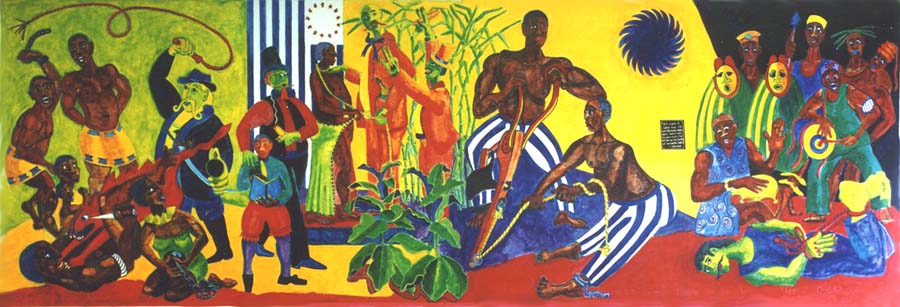
UPDATE: The Ethics Alarms post below ran in 2021. Now the revolting controversy is back in the news: the Vermont Law School in South Royalton, Vermont still seeks to remove the artwork above and below depicting the history of slavery in the U.S. As I wrote in 2021, the school simply capitulated to irrational, power-seeking student complaints alleging a racist message being conveyed by anti-racist art. To his credit, the artist has fought back, and the school has wasted resources intended for education to support the worst kind of mindless race-hucksterism.
At the end of the post, it noted that the case was headed to an appellate court, and it finally reached the U.S. Court of Appeals for the Second Circuit in New York, where the two sides presented arguments on January 27. For two years, the law school has covered the paintings with white panels suspended just above their surface so as not to damage them, pending the outcome of the court appeal.
I still think Kerson is likely to lose. I do not see how a Court can compel a school to display an artwork it doesn’t want to display. The federal law at issue says artists can prevent modification of their work if the change would harm their “honor or reputation.” The law school says that covering the murals, even permanently, is not a modification. An attorney representing the law school states simply, “If you own a painting, of course you have the right to decide whether or not to display it.”
The white artist, Sam Kerson argues that his reputation will be scarred if his work is falsely treated as “racist.” “He must suffer the indignity and humiliation of having a cover put over his art,” his lead attorney, argued to the Second Circuit.
Nothing much has changed since the 2021 post, but some of the quotes cited in the New York Times article this week are demonstrate how thoroughly race issues have become unmoored from rationality and fairness:
“If someone is saying to you, ‘How you’re depicting me is racist,’ for you to live in your own ignorance, and further aggravate the situation — now you’re showing us who you are,” said Yanni DeCastro, a second-year student. [In other words, if someone claims your art is racist, disagreeing with that assessment is racist.]
“We need to stop protecting white fragility,” said another student. [Another transparent tactic to ban disagreement with race hucksters! Kerson isn’t uncomfortable talking about race: his painting is an invitation to face racial history. It’s his black critics who are “fragile.”]
The same student told the Times: “The mural is covered, but what’s really changed? What is the plan to ensure that students of color feel safe and welcome?” [Yes, students are threatened by a covered painting. What kind of lawyer can someone like this become? My guess: a poor one.]
A second-year student told the Times: “What is real to me is a painting to you The artist was depicting history, but it’s not his history to depict.” [Only blacks can write about, make movies about, or paint pictures regarding black history. Why wouldn’t the converse also be true, then?]
I was going to post Steve-O-in NJ’s record-setting ( over 4700 words!) essay on the presidency of Jimmy Carter yesterday, and should have, but trips back and forth to the hospital (my Dad had his fatal heart attack in the midst of doing that, and now I know why) interfered with my best laid plans.
Then, last night, I read a head-exploding column by progressive Democratic historian, Kai Bird. His piece is an “it isn’t what it is” classic, as he tries to argue that Carter wasn’t the crummy President he unquestionably was. Bird can’t really do it, since the facts are so damning, the best he can muster being, “His presidency is remembered, simplistically, as a failure, yet it was more consequential than most recall.”
That evokes another terrible rationalization (“It isn’t what it is,” Yoo’s Rationalization, is #64on the list), #22, The Comparative Virtue Excuse, or “There are worse things,” of which “It could have been worse” and “It’s not as bad as you think” are sub-categories. This statement, however, demanded a “Popeye” (“It’s all I can stands, ‘cuz I can’t stands no more!”):
“Jimmy Carter was probably the most intelligent, hard-working and decent man to have occupied the Oval Office in the 20th century.”
No, I’m not ready for the epic job of defenestrating Seth Abramson for his ethics-anti-matter “justification” of re-witing Roald Dahl’s works. It’s not that its going to be difficult— most readers here could do it as well as I can—it’s just going to be tedious and infuriating, and I’m on edge already.
Right now I want to pose a related issue: the song you can hear above from Rodgers and Hammerstein’s Fifties Broadway hit “Flower Drum Song.” I hadn’t heard it myself for a very long time, and when it was played on the Sirius-XM Broadway channel, I almost drove off the road. It’s a famous song; Rodgers, as usual, provided a memorable melody to Oscar’s lyrics…but wow. Are there any demeaning female stereotypes that aren’t endorsed in this song? Here are the lyrics:
I’m a girl and by me that’s only great! I am proud that my silhouette is curvy, That I walk with a sweet and girlish gait, With my hips kind of swively and swervy.
I adore being dressed in something frilly When my date comes to get me at my place. Out I go with my Joe or John or Billy, Like a filly who is ready for the race!
When I have a brand-new hairdo, With my eyelashes all in curl, I float as the clouds on air do— I enjoy being a girl!
When men say I’m cute and funny, And my teeth aren’t teeth, but pearl, I just lap it up like honey— I enjoy being a girl!
I flip when a fellow sends me flowers, I drool over dresses made of lace, I talk on the telephone for hours With a pound and a half of cream upon my face!
I’m strictly a female female, And my future, I hope, will be In the home of a brave and free male Who’ll enjoy being a guy Having a girl like me!
I enjoy being a girl! I enjoy being a girl!
I flip when a fellow sends me flowers, I drool over dresses made of lace, I talk on the telephone for hours With a pound and a half of cream upon my face!
When I have a brand-new hairdo, With my eyelashes all in curl, I float as the clouds on air do— I enjoy being a girl!
When someone with eyes that smoulder, Says he loves every silken curl That falls on my ivory shoulder— I enjoy being a girl!
When I hear a complimentary whistle That greets my bikini by the sea, I turn and I glower and I bristle— But I’m happy to know the whistle’s meant for me!
Oh, baby, that whistle’s meant for me!
I’m strictly a female female, And my future, I hope, will be In the home of a brave and free male Who’ll enjoy being a guy Having a girl like…ME!
Clearly, by the criteria adopted by Puffin Books, that song would have to be re-written and censored, because they “regularly review the language to ensure that it can continue to be enjoyed by all today.” I know women whose teeth would be set on edge right from the title, in which a fully grown woman refers to herself as a girl. As the song proceeds, she checks all sorts of sexist other boxes too, including expressing secret approval of sexual harassment.
Readers here know that web lists of “bests” and “greatests” regularly drive me crazy, as they are almost invariably clickbait assembled according to no real standards, usually by self-appointed mavens who don’t know what they are talking about. But what drives me even more crazy are such lists created by actual authorities, whose assessments are taken to be gospel by readers who don’t know what they are talking about.
On March 1, I will be heading a 90 minute program for D.C.’s venerable Cosmos Club, whose members over the past 144 years have included men and (only relatively recently) women distinguished in science, literature, politics, scholarship and the arts. The title is “The Enduring Magic of Gilbert and Sullivan, and 12 numbers from eleven of the operettas will be performed with my narration and commentary. This is, I believe, my 14th such production over the years, but I may be missing a few. The works of Gilbert and Sullivan have had a greater influence on the path of my life and careers than even my obsession with the Presidents of the United States and the Boston Red Sox. I’ve been enjoying them, watching them, studying them, performing in them, directing them, producing them, forming organizations dedicated to them and writing parodies of them since I was ten-years-old.
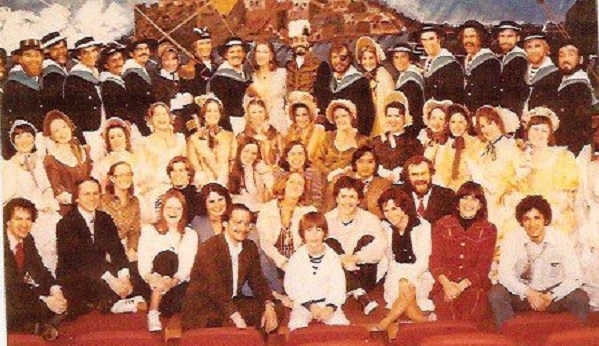
(That’s the cast of Georgetown Law Center’s Gilbert and Sullivan Society’s 1977 production of “H.M.S. Pinafore” above, which I directed. And that’s me, in the center, as Sir. Joseph Porter, KCB.)
In preparation for the presentation at the Cosmos Club, I decided to see how the old Victorian pair’s masterpieces were doing during The Great Stupid, as they have been subject to the predictable attacks that the shows are dated, sexist, racist, etc. (They aren’t any of these things.) In the process, I stumbled upon a post by Daniel Jaffé, a BBC music critic and classical music expert from a year ago titled, “The Top 10 Gilbert and Sullivan Operettas, Ranked And Rated.”
The piece turned out to be fascinating mess of many ethics problems such as, Continue reading →
This kind of conduct by an employee doesn’t require an investigation. Nobody needs to know why he did it. A responsible employer whose employee engages in this crime against any individual—yes. even a critic—has to fire him for cause, immediately and without hesitation.
The daily Frankfurter Allgemeine Zeitung reported that the Hannover state opera house’s ballet director Marco Goecke—that’s him above, looking like the son of the sinister Nazi whose head melts in “Raiders of the Lost Ark”— confronted its dance critic, Wiebke Huester, during the intermission of a premiere. Goecke, was furious over a nasty review she wrote of a production he staged at The Hague, and accused her of being responsible for people canceling their season tickets. Then he took dog excrement out of a paper bag he had brought for the occasion and smeared the woman’s face with the guck as she screamed. Huester has filed a criminal complaint.
On its website, the opera house said Huester’s “personal integrity” was violated “in an unspeakable way.” I wonder who came up with those weasel words. It added that the opera house had officially apologized to her. After all, the post said, Goecke’s “impulsive reaction” violated the ground rules of the theater and that “he caused massive damage to the Hannover State Opera and State Ballet.”
So…..?
So, it said, he is being suspended and banned from the opera house until further notice,though the lunatic will be given an opportunity to apologize “comprehensively” and explain himself to theater management “before further steps are announced.” Continue reading →





 Ethics Alarms