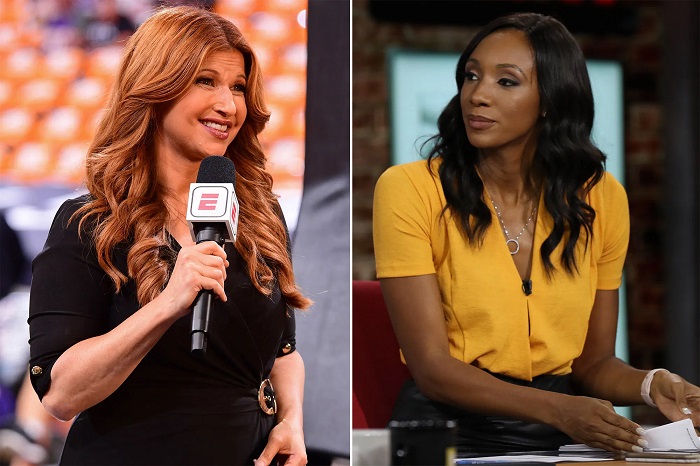
“I wish Maria Taylor all the success in the world — she covers football, she covers basketball. If you need to give her more things to do because you are feeling pressure about your crappy longtime record on diversity — which, by the way, I know personally from the female side of it — like, go for it. Just find it somewhere else. You are not going to find it from me or taking my thing away.”
—-ESPN sideline reporter Rachel Nichols in a phone conversation nearly a year ago after learning that she would not host coverage during the 2020 N.B.A. finals, as she had been expecting.
The phone call, unbeknownst to her, was being recorded, and someone leaked it to the ESPN brass and the public. The ethical issues raised by that conduct are clear and have been discussed here often: it is a dastardly thing to do, a breach of basic Golden Rule ethics, and indefensible because it creates harm to all involved. But that’s not the issue at hand.
After the video was leaked, many black ESPN employees told one another that it confirmed their suspicions that outwardly supportive white people talk differently behind closed doors. Nichols, seeing the ominous handwriting on the wall, tried to apologize to Taylor with texts and phone calls. Taylor did not respond. Meanwhile, ESPN employees turned against Nichols, whom they perceived as indulging in a “common criticism used by white workers in many workplaces to disparage nonwhite colleagues” when she suggested that “Taylor was offered the hosting job only because of her race, not because she was the best person for the job.”
I’m not a big Liza Minelli fan, and for over a decade now she has been rather pathetic (perishing early, like her mother, can be a smart career move for some artists), but still: I wonder if her film-ending performance of the title number in “Cabaret” is the most exhilarating solo by a female singer in any movie. It’s substantially the way the song is directed (by Bob Fosse), of course, that makes it so effective, but even so: the moment is a great legacy for Liza even if everything else in her career fades from memory. Just as Saroyan was right that if one human being sings your song, you haven’t lived in vain, creating one unique moment that inspires or uplifts others is a gift to the world.
And Liza’s moment also is a tonic I turn to to get me ready to face the day when the prospect of thinking and writing about ethics makes me want to go back to bed. Like right now.
1. Wait, I thought Joe Biden was supposed to be a nice guy! In an article about Andrew Cuomo’s final days in office, I learned that President Biden, who is a “close personal friend” of the now ex-governor of New York, has not spoken to him since Cuomo resigned two weeks ago. What kind of “close friend” is that? Whether Cuomo was treated justly or not (he was), his life has fallen apart in chunks this month (and began doing so months earlier). This is when friends, real friends, are most essential, and also when fake friends show their true character. Joe Biden’s entire political career has been built on the assertion that he is, whatever other flaws he might have (like being a lifetime chowderhead), a good, loyal and trustworthy person. Well, he’s not. This is hardly the first evidence we’ve seen of that, but it’s signature significance.
2. Is saying something should never happen again really “comparing it to the Holocaust”? This is Thursday, meaning that I get a lot of substack newsletters from pundits who want me to subscribe to theirs. Craig Calcaterra, the baseball writer whose product I will not pay for untilhe stops filling it with opinions on things he knows no more about than most people, filled today’s free offering with (let’s see) 740 words of baseball analysis (not counting brief accounts of last night’s games) and 2, 326 words about Republicans he hates, Billy Joel albums. and, most of all, a local school board member where he lives who wrote on his Twitter account,
“And if we are to truly learn from our mistakes these past 18 months Just as Jews after the horrors of the Holocaust We must declare, and implement laws to assure “Never Again” . . .Never again should we delegate policy authority to those qualified only to provide narrow advice Never again should we willingly sacrifice liberty without objective proof of imminent harm, and an objective restoration plan — in advance . . . Never again should emergency government authority extend beyond 7 days without legislative consent, reconfirmed every 7 days Never again should we blindly follow experts, regardless of the initials after their name, if they don’t provide proof, show their work & admit error . . . Never again should we EVER sacrifice the needs of children to the unfounded fears of adults.”
The writer is Jewish, by the way. Calcaterra uses the “offensive comparison” as a version of ad hominen attack to excuse him from the task of rebutting the writer’s substantive arguments and appeal to emotion, which is why I would never evoke the Holocaust in such a context simply as a matter of advocacy strategy. However, the school board member wasn’t comparing the genocide of 6 million Jews to pandemic totalitarianism, but stating that similarly absolutist policy prohibitions are appropriate after what we have learned from the past year and a half. There are a lot of things the U.S. has done that deserve a “Never again!” label—electing an obviously progressive dementia case as President, for example. Critics of the label are obligated, though, to deal with the reasons for making that claim, and should not be allowed to get away with “How dare you insult the victims of genocide by comparing what befell them to electing Joe Biden!”
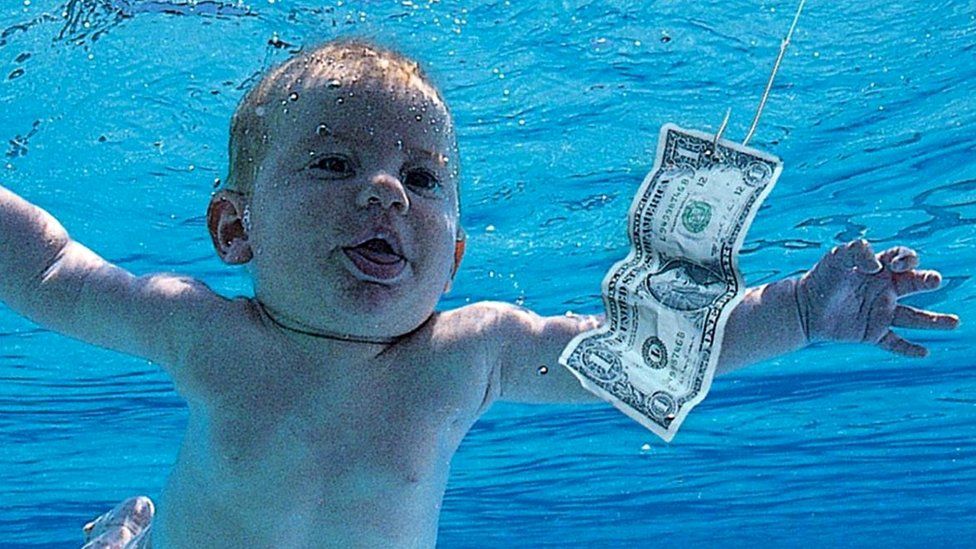
Thirty years ago, Spencer Elden, age four months, was photographed by a family friend naked and floating in a pool at the Rose Bowl Aquatics Center in Pasadena, California. The striking and cute photo was then sold by his parents to be the cover of “Nevermind,” the rock band Nirvana’s second album that shot the Seattle band to international fame. (Never could stand Nirvana myself.)
Through the years Elden pretty much exhausted the opportunities to exploit his accidental celebrity, recreating the wet, wild and adorable moment for the album’s 10th, 17th, 20th and 25th anniversaries (but not with his naughty bits exposed, of course) “It’s cool but weird to be part of something so important that I don’t even remember,” he said in an interview with The New York Post in 2016, in which he posed holding the album cover at 25. Eldon even reportedly has “Nevermind” tattooed on his chest.But this year he needs money, or has a change of heart, or met up with an unethical lawyer, or something. Now Elden is suing Nirvana for damages, claiming his parents never signed a release authorizing the use of his image on the album, and more provocatively, that his nude infant image constitutes child pornography.
“The images exposed Spencer’s intimate body part and lasciviously displayed Spencer’s genitals from the time he was an infant to the present day,” legal papers filed in California claim. Lasciviously? The album cover indeed showed Elden as a baby with his genitalia exposed. Maybe it also made tiny Spencer seem greedy, since the graphic artist added a digitally added dollar bill on a fishing line, leaving the impression that the tot was trying to grab the dollar.
“[N]ever assemble an all-white creative team on a production again, regardless of the subject matter of the show…”
——A provision in the “New Deal for Broadway,” an agreement signed by Broadway “power-brokers” pledging to strengthen the industry’s diversity practices as theaters reopen following the nearly 18-month pandemic shutdown.
“A New Deal for Broadway,” was developed by Black Theater United, one of several organizations established last year, the Times story tells us, “as an outgrowth of the anger Black theater artists felt over the police killings” of George Floyd in Minnesota and Breonna Taylor in Kentucky. “Black Theater United’s founding members include some of the most celebrated performers working in the American theater, including Audra McDonald, Brian Stokes Mitchell, Billy Porter, Wendell Pierce, Norm Lewis and LaChanze.”
The pledge was signed by the owners and operators of all 41 Broadway theaters as well as the Broadway League, the trade organization representing producers, and Actors’ Equity Association, which represents actors and stage managers.
Don Everly has died, and that’s the end of the Everly Brothers (Phil died years ago), one of the most influential and perhaps the most harmonious singing group of all time. The unique sympathetic vibrations that only sibling singers seem to be able to achieve is a marvelous metaphor for the ethical benefits of teamwork and trust.
This date also marks the demise of another famous duo: despite worldwide demonstrations in support of their alleged innocence, Italian-born anarchists Nicola Sacco and Bartolomeo Vanzetti were executed for murder in Massachusetts in 1921 .On April 15, 1920, a paymaster for a shoe company in South Braintree was shot and killed along with his guard. The murderers, who escaped with more than $15,000, were described by witnesses as two “swarthy Italian men.” Sacco and Vanzetti were arrested and charged with the crime. The men carried guns and lied to the police, but neither had a previous criminal record, and they definitely didn’t get a fair trial by modern standards. Prejudice against Italian-Americans was strong, and suspicion of anarchists was stronger. The pair was convicted on July 14, 1921, and sent to the electric chair on August 23.
A TV dramatization of their case, written by Reginald Rose (who authored “Twelve Angry Men”) made a huge impression on me as a child, and sparked the first stirrings of my interest in the law. In 1961, a test of Sacco’s gun using modern forensic techniques proved that it was his gun that killed the guard; he, at least, was guilty, but there was little evidence to implicate Vanzetti in the killing. To make this ethics train wreck complete, Massachusetts Governor Michael Dukakis ignored the evidence of Sacco’s guilt and issued a proclamation exonerating both Sacco and Vanzetti and proclaiming that no stigma should be associated with their names.
Typical of Dukakis.
1. Accountability? What accountability? “Sources”—and I stipulate that un-named “sources” are untrustworthy—tell various news outlets that “President Biden isn’t inclined to fire any senior national security officials over the chaos in Kabul unless the situation drastically deteriorates or there’s significant loss of American life.” That sounds as likely as it is depressing. The reluctance of American Presidents to fire subordinates for gross incompetence has become the norm rather than the exception, and the trend ensures that our government, whoever is the President and whatever party is power, will continue to decline in competence and trustworthiness. Consider President Bush’s refusal to fire any of those responsible for the botched intelligence regarding Iraq’s WMDs, and later Abu Ghraib, or my personal favorite, Barack Obama’s refusal to acknowledge the gross incompetence of Kathleen Sebelius, his Secretary of Health, after her inexcusable reliance on a flawed website to launch the Affordable Care Act.
Dumber still is the qualification “unless the situation drastically deteriorates or there’s significant loss of American life.” Morons. Morons! Whether the situation gets worse or not is pure moral luck; it doesn’t change the utter incompetence of the Afghanistan abandonment. Imagine a babysitter who gives a toddler knives to play with, and a parent whose reaction is, “Well, the kid wasn’t hurt, so there’s no reason to fire her.” That is literally what the reasoning at the White House is…if “sources” are accurate.
Baseball had a rare PR triumph earlier this month when it held a regular season game between the New York Yankees and the Chicago White Sox in the Iowa cornfield diamond that was the setting for the cult movie favorite “Field of Dreams.” The TV ratings were the best for any regular season broadcast in 16 years. That’s amazing, but maybe it shouldn’t be. Despite rumors of its demise, baseball still has a cultural bedrock of tradition, nostalgia and history unmatched by any other sport, professional or amateur. So many Americans would not tune in to a baseball game if they didn’t still have a flicker of affection for the sport, and if your argument is, “Yeah, but that’s just because of the movie,” the movie wouldn’t have become iconic if a lot of people didn’t care about baseball. As Terrence Mann said,
Now my confession: I’m not a wild fan of the film, nor that scene. The scene in particular is unforgivably stagey and artificial: it’s right out of the (much better) book, “Shoeless Joe,” and not even the great James Earl Jones could make it sound like anything but a recitation. I got annoyed, during the hype for the game broadcast, with “Field of Dreams” being repeatedly called “The greatest baseball movie.” I don’t regard it as that; I think it just barely makes the top five, and I could be talked out of ranking it that high.
For good reasons, many baseball writers, fans and bloggers have criticized the film over the years, and not just because it is shamelessly manipulative. But it is that. Baseball writer Craig Calcaterra, a vocal debunker of the film, writes,
“I will fully admit that a story about a father and son repairing a longstanding rift over a game of catch — with or without the magical realism elements — could form the basis of a MAJOR chills moment in an absolutely fantastic movie. The problem, as I’ve said in the past, is that “Field of Dreams” does not earn its chills moment. It is lazy in that it does not sketch out the dispute between Ray and his dad in anything approaching realistic terms — it’s dashed off in the rushed intro with almost no details — and it does nothing to explain why Ray’s moving the Earth and the Heavens to bring his dad back to that ball field is so important or why it serves as the “penance” Ray must pay for whatever reason. With no buildup or backstory, there’s no payoff.”
But worse, for me and others, is the slipshod handling of baseball history. “Shoeless Joe” Jackson was not innocent of taking a bribe to throw the 1919 World Series, he was guilty. He was not a thoughtful, wise-cracking Ray Liotta, he was just north of being a moron. He batted left-handed, and famously so, not right-handed like Liotta. When Frank Walley’s character, a magically reincarnated and youthened old ballplayer named Archie “Moonlight” Graham, whose single appearance in the major leagues was in 1905, is nearly beaned by a close pitch, he says “Hey ump, how about a warning?” Umpires didn’t warn pitchers for throwing at batters in 1905, and not for more than a half-century after that. Sloppy.
Ah, those heady days when the U.S. felt ethically justified in toppling governments it didn’t approve of, and “nation building” was still considered practical and virtuous. Today marks the anniversary of the U.S. overthrowing the government of Premier Mohammad Mosaddeq and reinstalling the Shah of Iran in 1953, The Shah was a torturing, oppressive autocrat, but he was our torturing, oppressive autocrat for 26 years, a dependable anti-Communist ally of the United States until a revolution ended his rule in 1979. You should know the rest. Wonder why Iranians aren’t crazy about the U.S.? Today is one big reason. Also on the ethics regrets list is the release of the West Memphis Three on this date in 2011. I wrote about that one here. An excerpt:
“In an ethical system, prosecutors would have made certain the wrongfully convicted men were freed, without any further adversary action. But this was not an ethical system. Instead, prosecutors insisted on a bizarre plea deal in which the Memphis Three agreed to take an Alford plea, a strange, dishonest and much criticized guilty plea in which a defendant essentially lies to avoid an otherwise unavoidable unjust punishment. With an Alford plea, the prisoner or defendant asserts he or she is innocent, but acknowledges that the prosecution has sufficient evidence to prove guilt beyond a reasonable doubt, and thus acknowledges legal, though not actual, guilt. Prosecutors insisted that all three men plead “guilty” in this fashion in order to agree to release them with time served. The judge accepted the deal. Now Echols, Baldwin and Misskelley are free, their lives all but ruined by 18 lost years, thanks to a rotten system. The news media for the most part didn’t bother to explain why the terms of their release was just one more gratuitous assault on their existence by Arkansas legal hacks.”
I’m sorry today reminded me of this case. It still upsets me to think about it.
1. Here’s evidence that the current complaints of antiracism propagandists is a crock: Denzel Washington. I’ve been watching a lot of his movies lately, and a comparison with Sidney Poitier is unavoidable. Poitier was the ground-breaker, the black man who became a genuine movie star in a majority white market, and more than that, did it by holding up the racism and discrimination in American culture for all to see. Nonetheless, he was limited by his race. Poitier always played character’s whose race was central to their roles in the plot. He never played a villain: like many stars, like John Wayne, Cary Grant and Clark Gable, he regarded his career as a continuous work exploring a particular archetype in all of its facets. For Poitier, it was that of the outstanding black man as an outsider in American society. In Poitier’s amazing year of 1967, he was in three hit movies: “In the Heat of the Night,” “Guess Who’s Coming to Dinner?,” and “To Sir, With Love.” All three featured Poitier as a black man thrust into a biased white environment, and gradually earning respect and some measure of equality. Today the #1 black star is Denzel, and he doesn’t have to play such sanctimonious roles. Race plays a part in many of his movies; he has even played black civil rights activists, like Malcolm X and Hurricane Carter. Washington, however, in part because of Poitier’s work, often plays parts that were written for white actors, and nobody cares. He isn’t afraid to play flawed characters and even brutal ones, like in “The Equalizer.” Washington’s success, and the versatility and range he is allowed to explore in his movies, would have been impossible in Poitier’s prime years. His body of work is proof of how far American attitudes toward race have advances and how unfair and dishonest the Black Lives Matter/ Critical Race Theory narrative is holding that the Jim Crow culture still rules America.
Denzel is also better than Poitier, although it is fair to say that Poitier never had the option of being as versatile as Washington. If Sidney Poitier is cinema’s Jackie Robinson, Denzel Washington is its Willie Mays.
1. Combine mental health with unaccountable female superstar athletes and you get.…another “How dare you expect me to answer questions like any other pro athlete, you sexists racist!” moment from Naomi Osaka. Ahead of the Western & Southern Open in Mason, Ohio, tennis’s reigning queen finally agreed to sit down for questions from the press on a Zoom call. You will recall that at the French Open in May, she said she would decline to do pretournament or post-match news conferences, even though they are required of all players. When Osaka was fined $15,000 for skipping her press commitments after her first-round victory, she withdrew before her second-round match in Paris, for the first time playing the mental health card., later used so effectively by Simone Biles at the Olympics. At the session in Mason, Paul Daugherty, a sports columnist for The Cincinnati Enquirer, asked ,“You are not crazy about dealing with us, especially in this format. Yet you have a lot of outside interests that are served by having a media platform. I guess my question is, How do you balance the two?” Osaka, after an attempt at an answer that wasn’t an answer, ran out of the room in tears. Her agent, Stuart Duguid, said via text message, “The bully at The Cincinnati Enquirer is the epitome of why player/media relations are so fraught right now. Everyone on that Zoom will agree that his tone was all wrong, and his sole purpose was to intimidate.”
Imagine that response from a male athlete to a legitimate if tough question. Imagine an agent for such a male athlete calling the questioner a “bully.” Female athletes cannot protest that they must be treated equally with male jocks and still reserve the right to revert to delicate flowers when it serves their purposes.
1. Giving credit where credit is due, at least some of the mainstream media isn’t avoiding calling attention to the Biden Administration’s epic debacle in Afghanistan. This is only a half IIPTDXTTNMIAFB: if Trump had done something even close to this incompetent, the news media would have been in full-fledged meltdown. In fact, there are enough harsh assessments coming from places that are not conservative mouthpieces that maybe Biden will face actual accountability for a change. (Nah, what am I saying?) CNN’s Jake Tapper, who occasionally has flashbacks to his pre-CNN days when he was a fairand trustworthy journalist, grilled Secretary of State Antony Blinken regarding Biden’s comments from last month, when he declared that it was “highly unlikely” the Taliban would overrun Afghanistan. That’s some intelligence work there, Joe! After some awkward huminahumina-ing, Blinken, kept trying to change the subject, defaulting to how everything was Trump’s fault. Amazingly, Tapper wouldn’t let him get away with it.
“You keep changing the subject to whether or not we should be there forever. And I’m not talking about that,” Tapper told Blinken. “I’m talking about whether or not this exit was done properly, taking out all the service members before those Americans and those Afghan translators could get out. That’s what I’m talking about. And then you have to send people back in. That’s the definition of, ‘Oh, we shouldn’t have taken those troops out, because now we have to send twice as many back in.'”
On Medium, political analyst John Ellis was on fire, writing in part,
“Handing over Afghanistan to the Taliban is President Biden’s idea, if that’s the right word, and his alone. It is terrible policy, on any number of levels. “Worse than a crime, a mistake” (Talleyrand’s phrase) describes it best. Axios reports that the Administration “derives comfort from the fact that the American public is behind them — an overwhelming majority support withdrawal from Afghanistan — and they bet they won’t be punished politically for executing a withdrawal.” Given events and the likely consequences, the fact that the Administration “derives comfort” from anything regarding its decision to hand over Afghanistan to the Taliban is nauseous. That they’re “betting” they will escape political punishment is perhaps more so….”
But that’s the routine, now. The Democrats count on the news media to minimize or hide their worst botches, so the public won’t know what’s going on and will keep on voting like good littel lambs. Other notes from Ellis:
“Abandoning the Kurds under Trump was bad enough. But this makes that look like home leave. This is an epic betrayal and strategically foolish to boot….
“…If you’re President Xi, you see Afghanistan, clearly, for what it is: a humiliating defeat for the United States. He might call it “flexible humiliation.” And what he knows from history is that defeated nations have little appetite for war in the immediate aftermath of losing one. Taiwan is there for the taking….
“When President Biden first announced that the US would be “leaving” Afghanistan, he set September 11, 2021 as the date when every last one of our people would be out. The announcement was greeted with astonished disbelief around the world. Could it really be possible that the US would officially hand over Afghanistan to the people who made it possible for Al Qaeda to attack it 20 years ago………on the very day of that attack? The answer was “yes,” although the Administration subsequently tried to walk it back without bringing attention to the fact that they were trying to walk it back.”
Ellis concludes, “Remarkably, the American press gave the president a pass on this, which seems to be its default setting when it comes to the Biden administration. “Trump was so much worse,” is the always-applicable rationale. Not in this case. Not by a long shot.”
It’s a sad truth, at least for me: the more you know about comedians and comics, the harder it is to laugh at them. There are notable exceptions of course (and as always): Martin Short, John Candy, Carol Burnett and a few more apparently are or were genuinely nice and relatively normal human beings. As a rule, however, extraordinary comedy talent is nourished by misery and emotional pain, and misery and emotional pain have a strong tendency to produce broken, sick, untrustworthy people.
For a lot of audience members, this isn’t a problem. For me, it is. I love great comedy, I’ve directed comedies, I’ve written comic scripts, revues, parodies and essays, and I’ve performed comedy. But once I learn that a comedy genius was or is a horrible human being, or acts like one sufficiently frequently not to be trusted, I just don’t enjoy watching and listening to that performer any more. The list of those who have landed on my “Can’t Make Me Laugh List” is too long to compile, and I really don’t care to encourage debates about whether it should matter that Charlie Chaplin was sexually attracted to little girls, or that Danny Kaye was a cruel misanthrope. It matters to me.
There are a few compensating advantages of this mindset, though. I haven’t watched a single minute of Saturday Night Live for so long I don’t even remember exactly when I started finding the show repugnant after years of never missing an episode. The reason I stopped watching was the show’s increasingly smug political bias that began to swallow the satire whole. I know it was somewhere around the George W. Bush presidency. (I had a similar experience then with David Letterman and The Daily Show.) SNL’s conversion into a full-time shill for progressives and Democrats became especially nauseating when it became addicted to using left-wing thug Alec Baldwin as a guest. There is no one on Earth I hate enough to find Alec Baldwin mocking him or her funny, and when it comes to Baldwin’s Trump impression, only the biases of Saturday Night Live directors and audiences can explain its popularity. As a director, I’d consider his amateurish routine unacceptable in a Cub Scout skit.
Fortunately, a recent emerging scandal looks like it will give me a new reason to detest the show that has nothing to do with politics.



 Ethics Alarms